The idea for a Wounds & Warriors workshop for writers after I became an EMT in New Mexico–because too often our characters get hurt and either recover ridiculously fast or have injuries that are just not plausible. What I realized was that most of us get our ideas from movies and TV–and boy do they get it wrong. Which means if a writer wants more accuracy it helps to know what are the common misconceptions and how do you go about better research.
In the Wounds & Warriors workshop I’m teaching in February for the Hearts Through History writers, we’re going to go over a lot of different information—and you’ll have a chance to ask about specific situations, including how your protagonist might care for himself or herself after something bad happens. But it’s good to know a few basics:
- A person can bleed out quickly. The average person has about five liters of blood—loosing even one liter (one large soda bottle) of blood is bad. Confusion and weakness sets in. That person the bleeding to stop and fluids to be put back in.
- Head traumas are dangerous—some of the most dangerous ones are those where the person feels fine but was unconscious. This can mean there is an internal bleed and that could kill within forty-eight hours.
- Almost everything causes nausea—hit on the head, you wake up throwing up or wanting to throw up. Getting shot—your body tries to dump the stomach so it can focus on other things. This is never pretty and so gets skipped over in most fiction.
- One issue can hide another—and people aren’t always honest about what is the real problem. As Dr. House said, “Everyone lies.” And not always intentionally. Sometimes folks just forget, and this is particularly true when stressed.
- Children are not small adults—their bodies can’t compensate as well, so when they use up their physical resources, they’re going to crash fast. A sick kid is often a critical kid.
- Extreme heat and extreme cold are deadly elements—and any injury makes them even more so. If you want to add more tension to a scene, use the weather.
- CPR can and does save lives. Even more importantly it can mean the difference between someone coming back fully functional or with permanent damage. But a lot of folks are afraid to dive in and help—it take training to make sure you just do what you’ve trained to do.
Ultimately, you want to know what’s plausible for your situation—even if you’re writing about vampires and werewolves, know the rules so you can know how you can break them. Research your injuries before you write them and never assume. You’ll be able to get away from the cliché of that flesh wound in the shoulder that the protagonist survives or the knife fight that somehow ends up with no one disfigured or with permanent damage.
The other thing to keep in mind is for your own safety. What should YOU know (just in case)?
1-Document your medications and history (and get your loved ones to do this). Paper, phone, whatever—just have it written down (VialofLife.com)
2-Keep your document/medications handy! It is so hard in an emergency to make sure these are not forgotten.
3-Do an DNR if you do NOT want CPR or extreme life-saving measures.
4 –Wear a medical ID bracelet and/or necklace for those REALLY important things (as in allergic to penicillin).+
5-Put “ICE” in your phone—“In Case of Emergency” contact, just in case you are in an accident and cannot talk.
6-Educate yourself! Take a CPR class! Know how to stop a bleed. Keep children’s aspirin around if you’re not allergic. (1 in 20 deaths from stroke, heart attacks are the no 1 cause of death in the US, what do you do for allergic shock?) The life you save may be your own.
7-If you—or a loved one—is allergic to something (anything), keep an EPI pen on hand.
8-Keep a “survival/emergency” kit around and fresh! (www.ready.gov/sites/default/files/documents/files/checklist_1.pdf and http://www.redcrossstore.org/item/321406)
9-Remember your pets! They have emergencies, too, and in a disaster they’ll need water and food, and possibly first aid.




 I’m doing a
  This is a huge issue in any book—it was one I faced in A Cardros Ruby. In an early draft, the heroine came off as too cranky and hard-edged. She was not likeable. Now, she had her reasons for being how she was, but she wasn’t someone you wanted to root for. That meant she needed major work to bring in some things to make her likeable. I had learned about this when I wrote the heroine of A Dangerous Compromise. She’s a spoilt girl who eventually redeems herself—or at least shows a good side—but that came too late in the story for many readers who just didn’t warm to her. And I can understand that.
 I’m teaching a
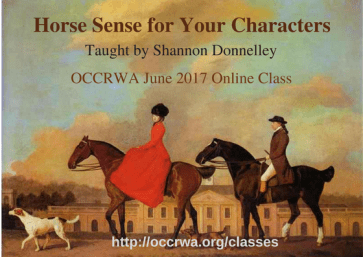
  All this means horses have always been part of my life. My aunt—also a horsewoman—taught me to ride side saddle. I went to England to get my riding instructor’s certificate and learned to drive carriage horses—and I got to hunt (meaning vast amounts of time standing about, then galloping to a new cover and more standing about, but it’s all on horseback, so not a bad time at all). I’ve shown hunters, jumpers, dressage, three-day, and did a year of western riding, and now only ride the trail for fun—my show days are behind me.
 I’ve also been bucked off, rubbed off on a tree, had a horse fall with me, dealt with barn sour, rearing horses, dirty stoppers, and a load of other problem horses. I’ve galloped race horses (and you really do have to get up all too early for that), and then I’ve had wonderful horses who would do anything for me–including the splendid Drake shown in the photo above (who hated to be left out and insisted on always having his stall door open so he could join in the fun), and the handsome Woody (the photo on the left) who was a perfect hunter, but never got the hang of fast turns in jumper classes.