From July on into September, this was the time in Regency England to get out of London and to the countryside if at all possible. However, the countryside was not always cooler. The 1808 July heatwave started up around July 13, and Fanny Chapman recorded in her diary that it was “One of the hottest days I ever felt.” Then, on July 15, she wrote, “A very fine day but hotter, if possible, than yesterday.” Temperatures in London were recorded at 38 Celsius (or 100.4 in Fahrenheit). Paris was also experiencing the heatwave.
The heat caused deaths, honeycomb to melt in bee-hives, food to spoil enroute to market, and was worse north of Bristol, and broke with a thunderstorm that brought damaging hail to Somerset, Dorset, and Gloucestershire, where lighting also destroyed one of the pinnacles of the Gloucester Cathedral. The only good news was the hot, dry weather allowed grain crops to be brought in early (harvest was typically in August). The print at right dates to 1800-1820 and is by an unknown artist.
That was not the only bad news to come. As Eli F. Heckscher notes in ‘The Continental System: An Economic Interpretation‘, July and August of 1810 brought an economic depression. “The purely commercial difficulties, with bankruptcies occurring to an extraordinary extent among merchants, formed the beginning of this; but they abated in some degree later on in the summer of 1811 and still more from February 1812.… the crisis broke out not solely in England, but quite as much in France, and not solely in those countries, but also in Amsterdam, the Hanse Towns, Prussia, and Switzerland, and above all in New York, shows how complicated the whole connection was.”
John Loudon’s 1822 book An Encylopaedia of Gardening lists the following tasks and foods, with an abundance of veg and fruits (if these had not been flattened by hail) for July:
Canning, Preserving, Wean Lambs, Mowing Grass, Fattening Oxen, Turnips drilled
Culinary Productions from the open Garden or Garden Stores. Cabbages and cauliflowers in perfection. Peas, beans, sugar-pea, and kidney-beans. New potatoes, turnips, carrots, radishes. Spinach, orache, sorrel, and white beet. Onions bulbed and ciboules, for salading. Artichokes, alisanders, rampion. Small salads, lettuce, radishes. Parsley, purslane, Indian-cress, marygold, borage, fennel, &c. Thyme, sage, mint, balm; and all the others from the open garden, and also from the herb-room. Angelica-stalks, gourds; the aromatic seeds from the seed-room, and the herbs either from the herb-room, or open garden. Caper, Indian-cress, radish-pods, kidney beans, and pickling cucumbers. The pot-herbs and salads as in June, the seeds of some sorts of vetches, as legumes; the cow-parsnip for its different uses, and butterwort; the roots of ficaria. Morels from their native habitats; garden mushrooms from covered ridges. Dulse, tangle, &c. as in June.
Hardy Fruits from the open Garden, Orchard, or Fruit-Room. Juneating, margaret, and codlin apples; James and other pears from the trees. Some peaches, nectarines, and apricots; also cherries. Gooseberries, currants, strawberries, raspberries. Almonds, wallnuts, chestnuts, filberts, from the fruit-cellar. Bird cherries, tree-currants.
Culinary Productions and Fruits from the forcing Department. Mushrooms, pines, grapes, peaches, nectarines, figs, cherries, apples, melons, cucumbers, &c. Lemons.
Foods that may be unfamiliar in this modern era include:
- Alisanders – also called black lovage, or horse parsley, with a taste similar to celery and parsley.Indian-cress – also called monk’s cress or nasturtiums, so edible flowers with a peppery taste.
- Cow parsnip – traditionally the root would be grated and put into poultices to apply as a pain reliever for aching joints, sore muscles, and swollen legs.
- Juneating – an early variety of apple.
- Bird cherries – native to England, with a small, tart and bitter fruit, which can be cooked into a jams or steeped in alcohol for a fruit brandy.
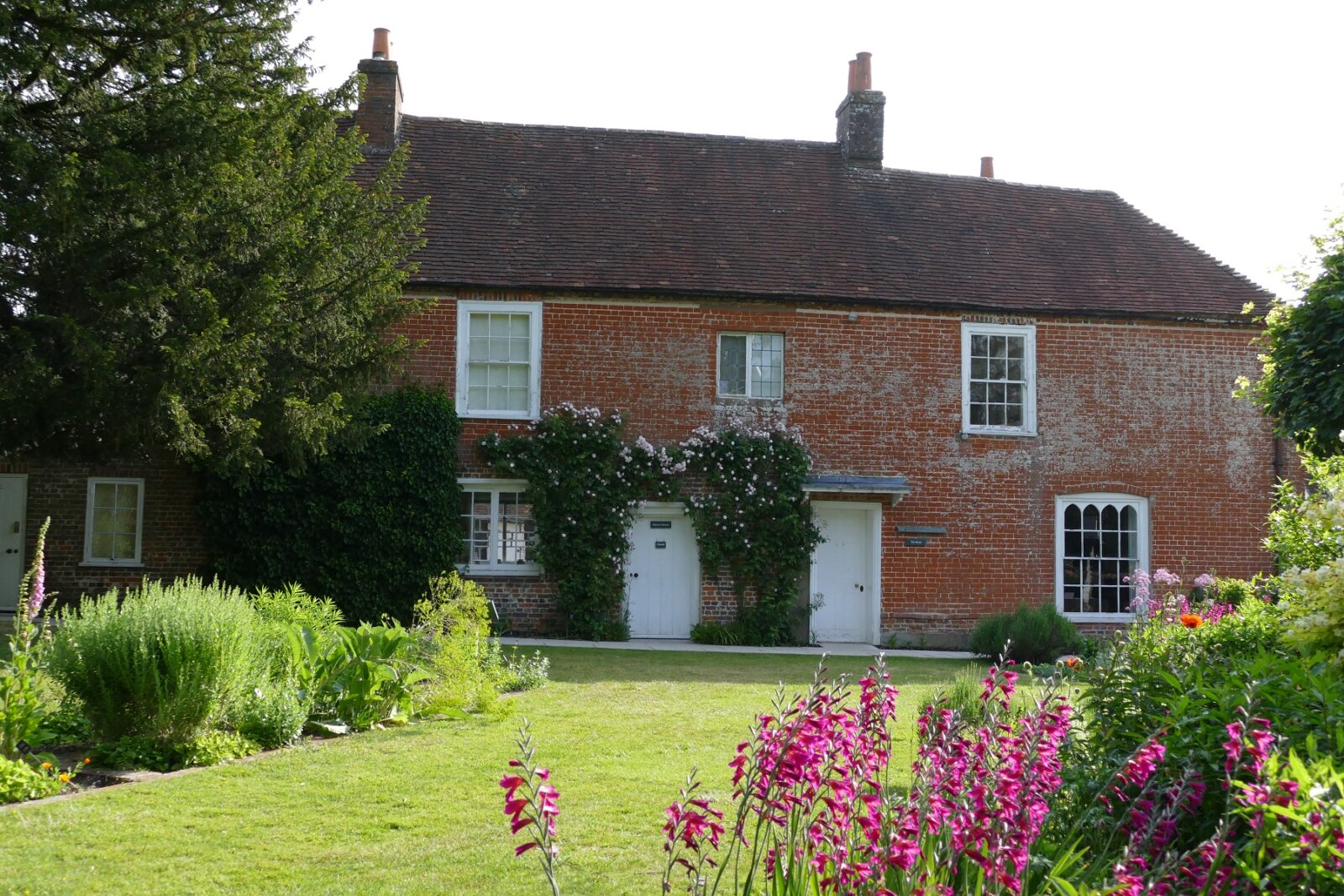
The picture below is of Chawton Cottage where Jane Austen lived, and JaneAusten.house notes it “boasted lawns, flower beds, an orchard, a shrubbery walk and also a large vegetable patch which Jane’s mother tended.” It currently has a perennial bed, rose beds with 30 old varieties, shrubbery with wildflowers, a garden wall, and dye plants, along with seasonal bulbs and summer annuals to create a cutting garden to go with the kitchen garden.