Tag Archive | foods

Merry Month of May

That phrase is probably much older than its use in a poem by Thomas Dekker in the Tudor era, but he writes:

“O the month of May, the merry month of May,
    So frolic, so gay, and so green, so green, so green!
O, and then did I unto my true love say:
    ‘Sweet Peg, thou shalt be my summer’s queen!”

The origins of celebrating May 1 go far back in time, with the date being Beltane and the official start of summer in the Celtic and Gaelic worlds. In Regency England, May festivals might be held in rural areas, particularly with a fair (Mayfair after all gets its name from a May Fair, held up until 1764). May brings with it flowers, and usually better weather (except for 1816, the year without a summer, which had wind and rain for much of England).

Ladies in Georgian dress dance around a servant with basically a table setting on his head while a fiddler plays
Francis Hayman’s The Milkmaid’s Garland (Humours of May Day) – Created for a supper box at Vauxhall

Venison came into season in May (though September), along with veal and grass-lamb. Eggs become abundant–hens don’t like to lay when it is cold–and so became cheaper, and a wide variety of fish is available including: trout, eels, tench, carp, smelts, turbots, soles, prawns, crabs, crawfish, and lobsters. River salmon also came into season.

John Loudon’s 1822’s An Encylopaedia of Gardening notes of the farming tasks that May is the month for sowing and planting, dairy work, breeding your mares, and bringing in hops. Beer and ale were ever popular, and generally a perk for anyone woking in the fields. The Female Economist even notes of table beer (also called small beer), “If brewed in October, it will be fit to drink in April or May, and is excellent for summer beer.” For the expanding list of produce Loudon writes of:

Culinary Vegetables from the open Garden, or Garden Stores.

Early cabbages, cauliflowers, brocolis, and coleworts. Haricot-beans, and soup-peas from the seed-room, and sometimes, though rarely, young peas, towards the end of the month, from a warm border. Potatoes and Jerusalem artichokes from pits, or cold cellars; turnip, carrot, and red-beet from cellars or the open ground, if not destroyed by the frost; young radishes. Spinach, orache, wild spinach, sorrel, and herb-patience in perfection. Housed onions, and winter leeks; young onions, ciboules, and chives, garlick and shallot from cold rooms. Asparagus and sea-kale in perfection. Lettuce, endive, celery, succory, young radishes, and all the salads in perfection; winter-radish, lamb-lettuce. Parsley, purslane, horse-radish, tarragon, and all this class, either fresh or from the herb-room. Thyme, sage, mint, tansey, costmary, &c. from the open garden; the others from the herb-room. Rhubarb-stalks, blanched, or otherwise, from earthed-up or uncovered plants, angelica-stalks, anise, and other seeds, and the dried herbs, as before, from the herb-room. Samphire, and buds of marsh-marigold. Charlick, fat-hen, chickweed, sea-orach, sea belt, &c. as greens; ladies’-smock and orpine, as salads; speedwell and vernal grass, as tea-plants. Morels from their native habitats; garden-mushrooms from covered ridges in the open garden. Dulse, tangle, and the other sorts of fuci, in a fresh state, and floating fucus for pickling.

Hardy Fruits from the open Garden, Orchard, or Fruit-Room. Apples, pears, from the fruitcellar. Dried grapes from the fruit-room. Almonds, walnuts, chestnuts, filberts, from the fruitcellar.

Culinary Productions and Fruits from the Forcing Department.

Kidney beans, peas, beans. Potatoes, carrots, radishes. Sea-kale, asparagus. Small salads. Chervil, purslane, & c. Mushroom. A pine occasionally; grapes, peaches, melons, cucumbers, cherries, figs, apples, pears, gooseberries, and strawberries. Lemons, shaddocks, oranges, pomegranates. Yams.

A boy sits on the back of a tired white horse and leads another horse that has stopped and doesn't look willing to move. A tree is behind them and the sky looks as if it is nearing sunset
James Burnet 1813 Landscape, Boy with Farm Horses; National Trust, Petworth House

Foods that are unfamiliar to most of us in this modern era are:

  • Angelica or Angelica-stalks – a herb sometimes called wild celery.
  • Borecoles –  comes from the Dutch word boerenkool and is another type of kale (also sometimes spelled cale).
  • Burnet – a herb with a cucumber-like taste.
  • Charlick – also called field mustard or wild mustard.
  • Chickweed – the leaves are used in salad and said to have a taste like spinach.
  • Ciboules – another name for a green onion.
  • Coleworts – a cabbage, one of the mainstays of the medieval diet.
  • Costmary – a herb often made into a tea, said to be good for digestion.
  • Dried lee chees – an older spelling for lychee, and this fruit would definitely need to be in a glasshouse, and this frist appears in England in the late 1700s. 
  • Elecampane – also called elfdock, and from the sunflower family, it can be candied or made into syrups due to its flavor that is similar to ginger.
  • Fat Hen – also called lamb’s quarter or wild spinach.
  • Fuci – this is the plural for Fucus a type of seaweed, and includes dulse, eulse, tangle and sea belt.
  • Haricot-beans – what is called string beans in the US.
  • Herb-patience – also called patience dock, and a plant from the buckwheat family, and useful in soups.
  • Ladies’-smock – a wildflower that is edible with a mustard-like taste.
  • Lamb-lettuce – the leaves can be used in salads, and said to have a nutty flavor.
  • Long-yens – another spelling for Longan fruit, also called “dragon’s eye,” which is related to lychees, which first shows up in England in the late 1700s.
  • Loquats – this fruit does best in a walled garden.
  • Marsh-marigold – the leaves are edible if boiled and have a texture similar to spinach.
  • Orache – sometimes called French spinach since it is similar.
  • Orpine – a wildflower with edible leaves best harvested in spring when tender, and these can be sauted in butter and eaten or used in salads.
  • Pishaminnuts – another name for pine nuts.
  • Purslane – a succulent with a lemony flavor and can be eaten raw or used in soups and stews.
  • Rocambole – another name for a shallot, which can still be found in many modern markets.
  • Salsify – a root vegetable, also called the “oyster plant” since it is said to taste like oysters.
  • Sea-orach – a coastal shrub with leaves that can be used in salad or cooked, with a salty, slightly bitter taste.
  • Scorzonera – another root vegetable that tastes a bit like an artichoke.
  • Skirret – a root plant which means hardy for winter, is said to taste like carrot.
  • Soup-peas – these would be dried peas, so for making pease soup.
  • Speedwell – a perenial herb with spinach-like leaves and a taste similar to watercress.
  • Succory – an alternate spelling of chicory, and the leaves have a bitter, peppery flavor.
  • Sauce-alone – also called garlic-mustard or hedge garlic.
  • Tansey – a herb with a yellow flower used to flavor puddings and omletes, but could also be placed on window sills to repel flies with its camphor-like aroma.
  • Vernal grass – a grass with a sweet, vanilla-like flavor, which is best in spring.

January Foods in 1822

John Loudon portrait

In the Regency era, the best gardeners were though to come from Scotland, and John Claudius Loudon certainly helped cement that idea. His portrait at left shows him looking both prosperous and rather Scottish. He is noted as being the first to use the word ‘arboretum’ in his writings, he was a botanist, garden designer, and author, and his wife, Jane Webb, was also a horticulturalist, and author. It was a talented family. An Encylopaedia of Gardening by Loudon speaks to the wide variety of produce available in England in 1822, and also how nuts were linked to fruit. Some reference are very odd to the modern reader:

  • Rocket, of course, is called arugula in the US.
  • Savoys means a type of cabbage, known for crinkled leaves.
  • When he says ‘kidney beans for harricots’ he means that kidney beans replace the French beans (or what is called green beans in the US).
  • Fuci is the plural for Fucus a type of seaweed (obviously, you’d have to be near the sea to get this along with other coastal plants).
  • Borecoles is a type of kale.
  • Jerusalem artichoke is a hardy, starchy root plant that has nothing to do with artichokes, but has more in common with potatoes and mashes up very well.
  • Skirret, also a root plant which means hardy for winter, is said to taste like carrot.
  • Scorzonera is another root vegetable that tastes a bit like an artichoke.
  • Rocambole is another name for a shallot, which can still be found in many modern markets.
  • Elecampane or ‘elf wort’ is one of those medicinal herbs from ancient times, said to be good for ‘lung issues’.
  • Samphire does still show up in English cooking, and grows in marshy areas. It is from the parsley family, looks like baby asparagus, and has a crisp, salty taste.
  • Wild services refers to a small, edible, pear-like fruits from a tree native to England that is now rare.
  • Haws are the red berries from the Hawthorn tree.
  • ‘Pine’ means a pineapple, which are touchy to grow in England (they do look a bit like a pinecone).
  • Filberts is another name for hazelnuts, and nuts in shells used to be a common thing in many stores, but now everything seems to come in a can or a jar.
  • Cloud-berries (or cloudberries) are bright, amber-colored fruits similar to cranberries in that they are tart and need water to thrive. They were once common in England, but not so much anymore.

Loudon speaks of the open garden, a fruit-room, and the forcing-room. The latter would be some sort of hot house or glass-house that allowed for heating to extend the growing season. His spellings and variations on capitalization are also left in place here—standardization of such things is a more modern idea. He does mention some plants if not ruined by rain or frost, which would be common problems, and use of frames (anything placed over a plant to protect it from frost—this could be a large glass jar or burlap or a large metal bell).

Pickling and storing in such places as a herb room, or in barrels in a cold place would be common, as in a ‘fruit-cellar’ or any cold room. As already noted, food storage—potting, pickling, and otherwise preserving—was a vital necessity, along with making certain you got the bugs (called vermine by period sources) off anything grown outside.

Loudon includes general notes, too, for agricultural tasks set out for the year, but let’s just look at the first of the year. I do have to say I would adore a garden large enough to have a ‘forcing department’.

JANUARY

Dealing with rot (in animal hooves and plants), Weaning pigs, Fence work, Fattening Beasts (oil cake and corn), Liming, Improvements, Pruning.

Vegetables from the open Garden or Garden Stores. Strasburg cabbage, savoys, borecoles, Brussels’ sprouts. Kidney beans for haricots, and Prussian and other peas. Potatoes, Jerusalem artichokes, turnip, carrot, parsnip, red beet, skirret, scorzonera, and salsify, from the seed-room. Spinach in mild seasons; also sorrel and white beet. Onions, leeks, garlick, shallot, and rocambole. Sea-kale from the covered beds. Lettuce, endive, celery, American and winter-cress. Parsley, if protected, horse-radish, and dried fennel, dill, chervil, &c. Thyme, sage, rosemary, lavender, from the open garden, and dried marjoram, savory, mint, basil, &c. from the herb-room. Rhubarb-stalks from covered roots; anise, coriander and carraway seeds, chamomile, elecampane, blessed thistle, &c. dried. Red cabbage and samphire. Wild rocket, wild spinach, sauce-alone, and sorrel, if a mild winter. Mushrooms from covered ridges. Sea-belt, or sweet fucus, dried.

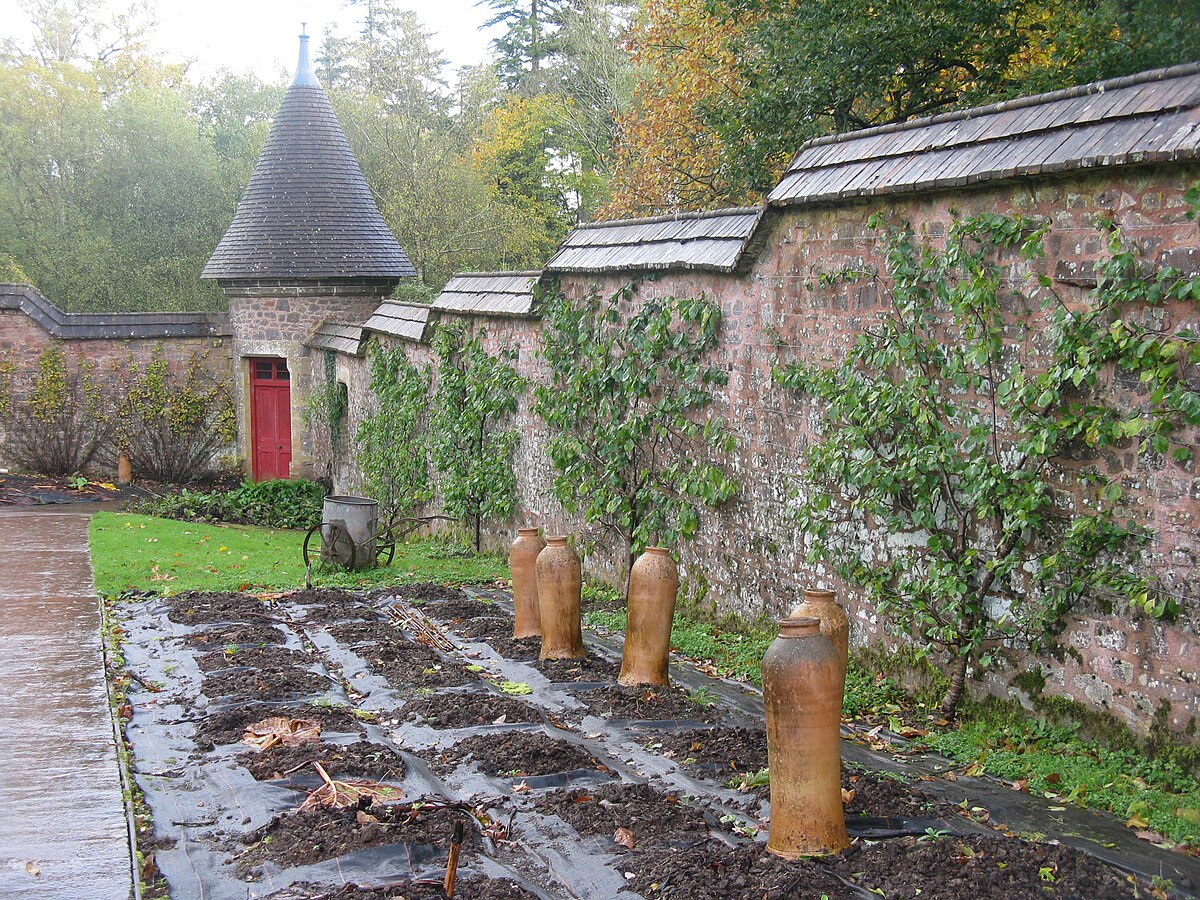
Four clay pots on dirt near a garden wall
Rhubarb forcing pots From geograph.org.uk

Hardy Fruits from the Open Garden, Orchard, or Fruit-Room. Apples, pears, quinces, medlars, services from the fruit-room. Some plums and morello cherries, carefully preserved on the trees. Some thick-skinned gooseberries, currants, and grapes, preserved on the trees. Some dried fruits of the same sorts on branches hung up in the fruit-room. Almonds, walnuts, chestnuts, filberts from the fruit-room. Sloes from the bushes, wild services, hips, haws, and sometimes a few cloud-berries.

A well occupied library opens into a glasshouse with plants. One child looks at a large book held by an adult. A lady holds large harp. A young couple sit by a table while older folks read. In the glasshouse several couples and a lady with a child tour the plants.
Glasshouse design by Humphry Repton, 1816 from Fragments on the Theory and Practice of Landscape Gardening

Culinary Vegetables and Fruits from the forcing Department. Kidney beans. Potatoes. Sea-kale. Small salads. Parsley, Fennel. Rhuharb. Mushrooms. Pines, winter melons, grapes, strawberries, cucumbers occasionally. Oranges, olives, and pomegranates. Malay apple, loquats, and lee-chees. Yams, and Spanish potatoes.

https://commons.wikimedia.org/wiki/File:John_and_Jane_Loudon_(4644568348).jpg
John and Jane Loudon blue plaque at 3 Porchester Terrace, Bayswater, London
London County Council
Here lived John and Jane Loudon
1783-1845 and 1807-1858
Their horticultural work gave new beauty to London squares