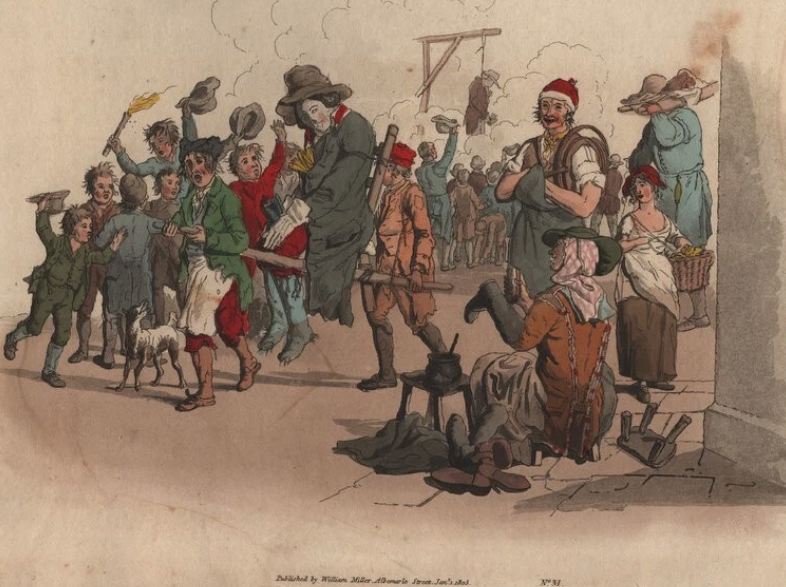
Guy Fawkes Night is, of course, November 5, and with the ground cold—and often snow covered—a bonfire was a very good idea. It was a night greatly celebrated in Regency England, as Kristen Kotter notes on her blog. Boys would go around villages and towns—even in London, where bonfires would go up in open spaces such as Lincoln Fields Inn—the cry would be ‘Penny for the Guy’ to make an effige to burn. Also to buy some penny sweets or roasted apples, gingerbread, or potatoes in jackets. Remembering the day that someone tried to blow up Parliament was secondary, and the evening and night was often celebrated with homemade fireworks and squibs (gunpowder was fairly easy to come by).
Traditional Guy Fawkes Day fare includes:
Parched Peas (also called dapple peas, carlin peas) or a black pea served with vinegar in Lancashire.
Mushy Peas served up in Norfolk.
Parkin served up in Yorkshire, which was type of ginger cake make with oatmeal and animal fat, so dense and filling.
Sausage and meat pies were popular almost everywhere, along with those hot roasted apples and potatoes that could help keep hands warm, and mulled cider would be on hand in most areas, particularly in the south where apples were easily grown.
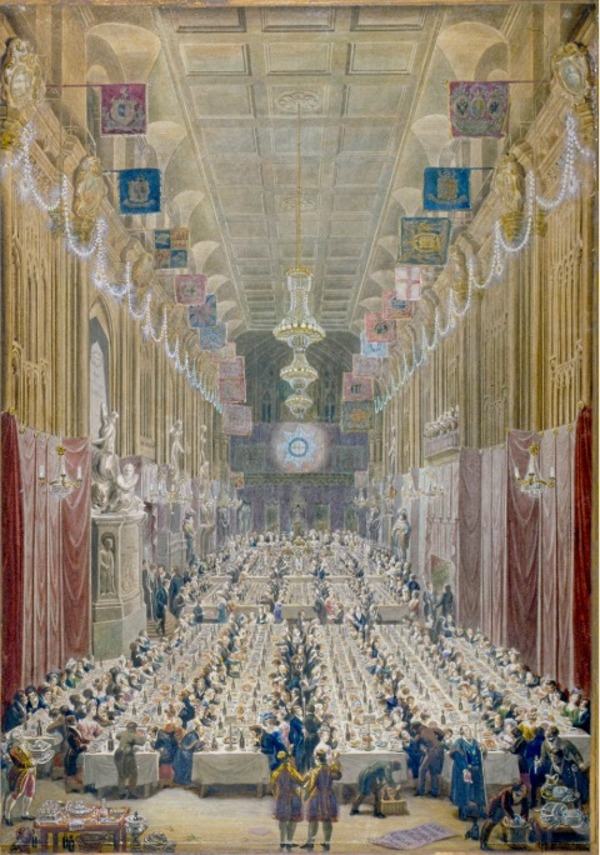
November 9 was when the Lord Mayor of London was sworn in and presented to the king. The ceremony included a procession from the City of London to Westminster with a water procession of barges, livery companies, bands, and members of the military. Along with the parade, a lavish banquet was held in the Guildhall instead of Mansion House, the mayor’s home.
The watercolor at left from the London Archives is by George Scharf and shows the Lord Mayor’s banquet in 1828 in the Guildhall. The mayor’s table is at the far end. In the foreground, waiters in livery attend, and some pull out wine from coolers and baskets. The food must have been cold by the time it was served, but the display is certainly fantastic. Leftover food was to be given to the poor.
November 30 is St. Andrew’s Day, and in Scotland that would mean haggis, Cullen stink (a smoked-haddock stew), neeps and tatties (meaning turnips and potatoes mashed together), black pudding, oat dumplings, cranachan which is a dessert of cream, oatmeal, and whisky, and other traditional food.
John Loudon’s An Encylopaedia of Gardening from 1822 includes the following rural tasks and foods readily available with cold setting in:
NOVEMBER
Threshing, Fence mending, Drainage, Frosts, Early Snow, Feed for Animals (hay, turnips), blanketing plants, rugs for horses, Animals to market.
Culinary Vegetables from the open Garden, or Garden Stores.
Cabbages, cauliflowers, protected by frames; brocolis, Brussels’ sprouts, savoys, borecoles. Dried kidney-beans and peas, from the seed-room. Potatoes, turnips, carrots, winter-radish, Jerusalem artichoke, red beet, skirret, salsify, scorzonera. Spinach, beet-chard, sorrel. Onions, leeks, garlick, shallot, rocambole. Cardoons, rampions, celery. Endive, lettuce, winter-cress, burnet. Parsley, horseradish, fennel, and dried chervil, &c. Thyme, sage, and rosemary, the others chiefly from the herb-room. Carraway, anise, and other aromatic seeds from the seed-room; the family herbs from the herb-room. Red cabbage. The edible roots, as in October. Sea-belt, badder-locks, and other species of fuci.
Hardy Fruits from the open Garden, Orchard, or Fruit-room.
Apples, pears, quinces, medlars. Some plums, and protected cherries from the trees. Grapes from the trees, and protected gooseberries, currants. Almonds from the fruit-room, and walnuts, chesnuts, filberts. Wild services, cloudberries, bilberries, cranberries, hips, and haws. Culinary mushrooms.
Productions and Fruits from the forcing Department.
Pines, grapes, melons, cucumbers, figs. Oranges, lemons, pomegranates, olives. Akees, guavas, granadillas, bananas, durions, mangos, and mangosteens. Yams, &c.
Hips, of course, refers to rose hips, and was often used as “hips and haws” since rose ripe could be harvested the same time as hawthorn berries or haws, and these could be used in making jam, fruit leather, and wine. Other less recognizable food names have been mentioned in past posts.
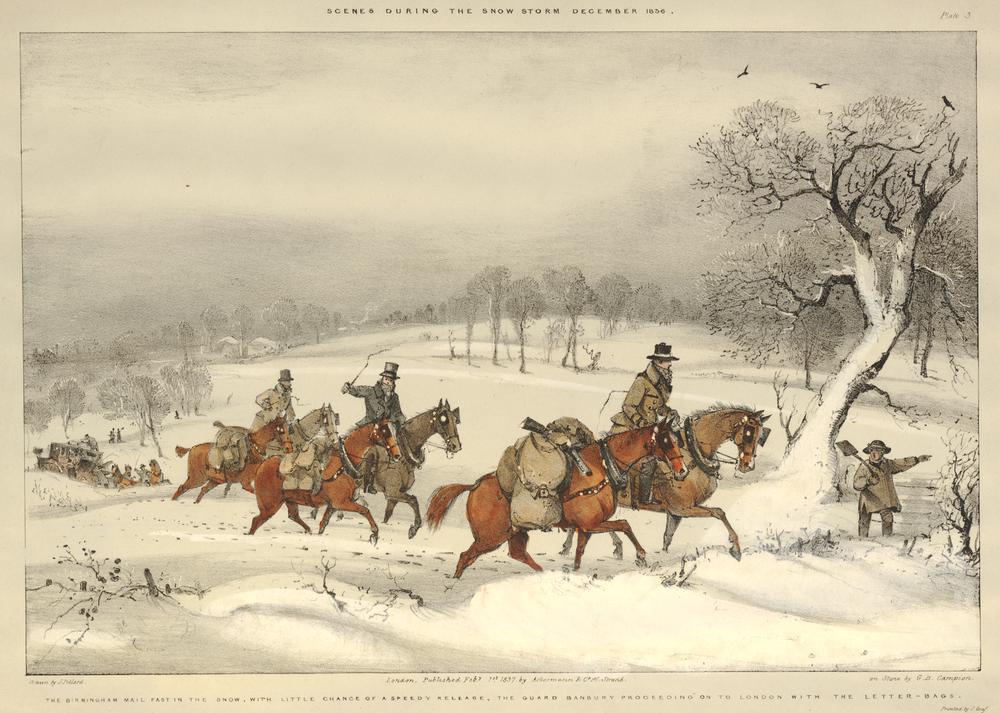
While November brought cold–and sometimes thick fogs to London–the worse weather was yet to hit in December through February. The 1837 print below by James Pollard shows the Birmingham mail coach stuck in snow at the bottom of a hill and the Royal Mail still having to get through with the post and guards going on horseback (the coach horses have been detached from the stuck coach). The caption reads “Scenes During the Snow Storm December 1836”. The man with the shovel–a local farmer–is pointing the way for the riders. The poor passengers are left to fend as best they may.