Hunter. Carriage horse. Race horse. Town hack. Horses were part of everyday life in Regency England. And the horse world of a few hundred years ago was quite different than its modern counterpart.
RACING
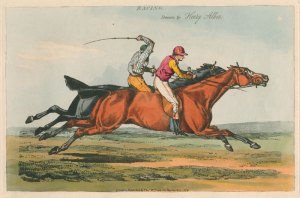 By the start of the 1800’s one of the biggest innovations in horses had already occurred—the Thoroughbred had arrived. Three founding stallions—the Darley Arabian “Manak,” the Godolphin Barb, and the Byerley Turk—had been brought to England in the early 1700’s. When the light, fast and sturdy Arabians were bred with the larger, cold-blooded English mares, the cross produced a horse with size, speed and stamina. It produced the Thoroughbred.
At the same time that the Thoroughbred was being established as a breed, horse racing was also becoming a regulated sport. In 1711, Queen Anne had established regular race meetings at her park at Ascot. Gentlemen organized races for themselves, often “matching” particular horses against each other, and by 1727 a Racing Almanac began to be printed.
Flat and jumping races were also held for women only. Mrs. Bateman wrote in 1723, “Last week, Mrs. Aslibie arranged a flat race for women, and nine of that sex, mounted astride and dressed in short pants, jackets and jockey caps participated. They were striking to see, and there was a great crowd to watch them. The race was a very lively one; but I hold it indecent entertainment.” Some women—such as the infamous Letty Lade, who apparently swore like a coachman—rode and drove to please themselves, but they were the exception in the Regency world.
Around 1750, the gentlemen who regularly met at the Red Lion Inn at Newmarket started the Jockey Club. And in May of 1779, the first Derby was held. By 1791, the Jockey Club had issued the “General Stud Book”, and by the early 1800’s Jockey Club stewards attended every racing meet.
Assize-week was the time for races, for that was when the gentry came into the chief town of the shire for trials and selling harvest. Meet sprang up, and still run, at Newmarket in April and October, York in May, Epsom, Ascot in June, Goodwood, Doncaster, Warwick, Manchester, Liverpool, Chester, Cheltenham, Bath, Worcester, and Newcastle.
Racing, however, was a sport for the rich. Before the Prince Regent quit the racing scene in 1807, his racing stud farm came to cost him 30,000 pounds a year.
FOX HUNTING
 For the less wealth, horses still served as sport, primarily for fox hunting. While Thoroughbreds might be seen in the field, one might also see farmers upon their heavier draft horses, such as the Suffolk Punch. Children might well be mounted upon the small but handy Welsh Cob or Welsh pony. And Irish Hunters, with their thick bones and size have always been prized for horses who can go all day and then some.
While fox hunting traces its roots back to the mid-1600’s, the sport did not take its present form of jumping and long runs until after the Enclosure Acts of the 1700’s. By the 1780’s, fox hunting had become the most popular of sports, replacing the more ancient sport of stag hunting.
November to March was, and remains, fox hunting season, starting after the fall of the leaf, when the fields lie fallow, and ending after the last frost, just before the first planting.
Hunt territories varied widely. The fifth Earl of Berkeley hunted an area from Berkeley Castle to Berkeley Square, stretching 120 miles.
By 1810, there were 24 subscription packs—a packs that one could pay to hunt with, as opposed to requiring an invitation from the Master. This would double, so that by the mid-1800s hunting had become more a matter of ‘subscribing’ in exchange for the right to hunt with the pack.
The golden age for hunting in Leicestershire is considered to be 1810 to 1830. During this time, there were as many as 300 hunters stabled in Melton Mowbray—with some gentlemen keeping up to 12 hunters. A gentleman could hunt six days a week with the Quorn, the Cottesmore, the Belvoir, and the Pytchley.
Ladies were also found in the field. Mrs. Tuner Farley hunted for 50 years. Lady Salisbury was master of the Hatfield Hunt from 1775 to 1819. She hunted old and blind, in her sky blue habit, with a groom leading her horse and yelling at her to, “Jump, damn you, my lady.” And from 1788 to 1840, Lord Darlington hunted his own hounds four days a week in Yorkshire and Durham, with his three daughters and his second wife, all in their scarlet habits.
However, between late 1700’s to about mid 1800s, when the jumping pommel was invented for the side saddle, ladies were more likely to be advised to “ride to the meet and home again to work up an appetite.”
While fox hunting was viewed as a sport for everyone, the reality was that it cost money to keep a pack of hounds and hunt them. However, anyone could take a horse and follow, if the master allowed it, and some followed the hunt in their carriages.
CARRIAGES
 For most families, a carriage was a necessity, and specific breeds of horses were used in harness. The ideal hunter had a long, low stride. But a carriage horse needed high-stepping action, which looks lovely in harness, but which is not always the most comfortable ride.
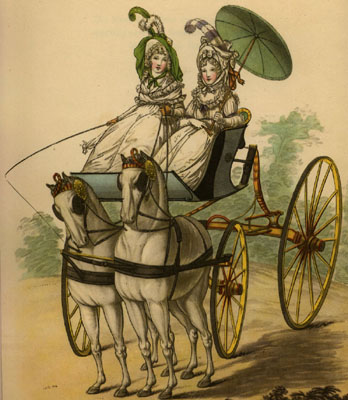
Carriage breeds of the era included the Yorkshire Trotter, the Norfolk Trotter, the Hackney Horse, the Hackney Pony, and the Cleveland Bay, which is still one of the most desired of carriage horses. Ponies were often used for smaller vehicles, and for ladies. Prints of the era often show ladies driving a matched team of cream ponies–which looks a lovely sight.
Owning and maintaining a horse could be expensive, but there were more affordable options.
John Tilbury of Mount Street in London offered a horse for rent at 12 guineas a month. For 40 guineas, one could hire two hunters and a servant.
Carriages were more expensive than horses, for they had to be custom built. Families with modest incomes would often purchase a carriage second hand, from an advertisement in The London Times. Those who could afford it would have a carriage built to their own specifications.
In Jane Austin’s Northanger Abbey, Mr. Thorpe enthuses over his new carriage, boasting: ‘Curricle-hung, you see; seat, trunk, sword-case, splashing-board, lamps, silver moulding, all you see complete; the iron work as good as new or better’ — and all for fifty guineas.
Chandros Leigh, a distant cousin of Jane Austen, obtained an estimate for a fashionable laundau in 1829. The price of the basic carriage was 250 pounds, which included: ‘plate glass and mahogany shutters to the lights, and plated or brass bead to the leather, lined with best second cloth, cloth squabs, and worsted lace….’ The ‘extras’ ordered including footman’s cushions, morocco sleeping cushions, steps, silk spring curtains, his crest on the door, embossed door handles and full plated lamps. These brought the cost to 417 pounds, 11 shillings and 6 pence, but he was given 60 pounds in exchange for his old carriage.
Carriages for country and for town were generally quite different in build, for they served different purposes. And since carriages were custom built, almost every carriage could be a unique design. Common types of carriages, however, included:
The Phaeton – a four-wheeled, owner-driven vehicle fitted with forward facing seats, usually an open carriage.
The Gig – a two-wheeled vehicles (Whiskey), built to hold two, usually an open carriage.
The Curricle – the “gig” of the quality, built to hold two, which could be two or four-wheels, and which sometimes had a top that could fold down.
A Town Coach – a closed coach that could be drawn by one horse or a pair.
Landau – a four-wheeled vehicle that held four, which was drawn by a pair and built with a removable or folding top.
Barouche – a four-wheeled vehicle drawn by a pair, or by four or even six horses, with an option for a driver, or for post boys to ride and control the horses. Sometimes built with a fold-down top.
(For images, visit –Georgian Times.)
A ‘Drag’ was a slang term for a gentleman’s private coach. It was built much like a mail coach, and often used for race meetings or other outdoor events as it height and roof seats created its own grandstand.
In 1805, smaller Hackney coaches came into use and in 1823 the first Hackney cabs came to London. It was not until 1830’s, however, that the famous Hansom Cabs appeared in London.
Both carriage and road constructions were being developed during the Regency and were not without problems.
Sylas Neville’s diary recorded a 1771 journey on the London to Newcastle stage. It took him two days, traveling day and night, to cover the 197 miles from Stilton to Newcastle.
By the 1780’s, private carriages could cover the distance from Bath to London in 16 to 18 hours. But the Royal Mail coaches were much slower until John Palmer produced a mail coach that left the Rummer Tavern in Bath on August 2, 1784 at four PM, and arrived at the Swan with Two Necks in London by eight AM the next morning. The stage had traveled 119 miles in less than 16 hours!
Up to 1820, most coach horses were changed every ten to eleven miles. Thereafter, to get better speeds, they opted for even less distances, changing about every six miles. But as Mr. Darcy says in Pride and Prejudice, “fifty miles of good road was ‘little more than half a day’s journey.’
With so many road problems, those who wished for speed would often ride.
RIDING: SIDE SADDLE AND ASTRIDE
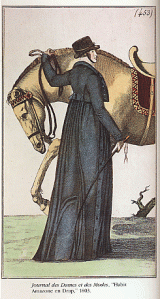 Riders of the 1800’s leaned back and rode with long stirrups that kept their seat in the saddle. Even jockeys rode sitting down square on a horse’s back. And English ‘tack’ or equipment is quite different from its ‘western’ counterpart.
An English saddle has a pommel up front, not a saddle horn. The back of the saddle is the cantle. The saddle is held in place with a girth–not a cinch–and uses stirrup leathers and stirrup irons.
Riders generally carry a hunting whip, which is designed with a crook on the end to open gates, and whip points on the opposite end that can be changed and used to control the hounds. This whip is not actually used to whip the horse.
A lady often used a whip to give a light tap to the horse on the ‘off’ or right side as a command, since her legs hang down on the ‘near’ or left side.
Prior to 1835, a side saddle had only one or two pommels. One turned up to support the right leg, and some had a second pommel which turned down over the left leg. The ‘jumping’ pommel did not exist in Regency times.
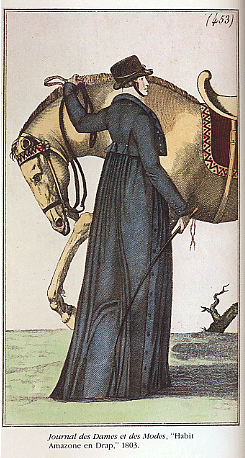
A lady’s riding habit had to be cut so that it draped down over the horse’s side, coving ankle and boot in a lovely flow. This drape required that a loop be attached to the hem, so that, when dismounted, a lady could gather up the extra length of skirt. The fabric for a habit was usually a heavy cotton, twill or wool. And due to its cut, a habit can provides any woman with a long stride as much freedom as breeches.
Riding habit styles often copied military fashion, with close cut coats, cravats, and military shakos. Ladies always wore gloves, both to preserve their hands, and to improve their grip upon the reins.
One print from the early 1800 shows a lady strapped into her saddle, but the danger from this would be that if the horse fell the rider would almost certainly be crushed or dragged.
Modern views make it seem as if riding side saddle must be awkward and uncomfortable. In fact, it is neither.
The important factor in riding side saddle is the horse. A comfortable stride and good manners are essential. This does not have to be a placid horse, but should not be a horse with a rough or bumpy stride.
The side saddle requires the rider to sit with a straight back and with hips and shoulders absolutely even. Slightly more weight should be carried on the right hip to compensate for the weight of both legs on the left. Any tilting to one side, leaning or twisting eventually results in a horse with a sore back.
Side saddles have a broad, flat and comfortably padded seat. The right leg goes over a padded leather branch which turns up (the top pommel). The left leg is in a stirrup that is short enough to bring it firmly up against a second pommel which turns down. If the horse plays up at all, the rider must clamp both legs together, gripping these pommels.
On a comfortable horse, riding side saddle soon begins to feel a bit like riding a padded rocking chair. It’s far less tiring than riding astride for the only effort is to sit straight and still.
While it is possible to rise to the trot in a “posting” motion, some claim that this is the real cause of giving a side saddle horse a sore back as it requires too much weight be put in the left stirrup.
Betty Skelton, author of Side Saddle Riding, found that….”As a teenager in the 1920’s, side saddle riding was second nature to me. I found it comfortable and I did not fall off as often as I had done from a cross saddle.” In teaching side saddle, Ms. Skelton has found that a beginner rider can often be comfortably cantering during her first lesson, which is far more progress than most can manage when riding astride.
It is possible for a lady to mound dismount on her own when riding side saddle.
To mount, she holds the reins and whip in the left hand and stands facing the horse, or even slightly towards the horse’s head. Taking the stirrup iron in her right hand to hold it steady, she places her left foot in the iron. With her foot in the iron, she can reach up to grip the saddle. As she hops up, her weight goes to the left foot in the iron and she leverages her weight up.
Instead of swinging her leg over the horse, she pulls her right leg up in front of her and seats herself sideways in the saddle. She then can settle herself with the right leg over the top pommel, the left under the left pommel and in the stirrup.
To dismount, a lady unhooks her right leg, takes her left foot out of the stirrup and simply slides off.
For a gentleman’s saddle, mounting also requires the reins and whip to be held in the left hand. A rider traditionally mounts from the left. The rider stands at the horse’s shoulder, facing the horse’s hind quarters.
With the right hand, the rider turns the stirrup iron sideways. The left foot goes into the stirrup, and the rider may grasp the cantle or back of the saddle with the right hand. He then pushes himself off the ground with the right foot, transfers his weight to the left, stirrup foot, and swings the right leg over the horse’s back to land lightly in the seat.
To dismount, the gentleman kicks his feet out of both stirrups and swings off to the left, the right leg coming over the horse’s back.
By natural inclination, a horse will move out of the way of any rider attempting to leap onto its back with a vault from the rear or a jump from a high point. However, horse may be trained to put up with this behavior.
A groom who leads a horse out for a gentleman or lady will stay and hold the horse’s head. If the gentleman is portly, the groom may also hold the stirrup on the opposite side from the rider to keep the saddle from ending up under the horse’s belly.
In giving a “leg up” to a lady, a groom would not dare to be so bold as to take a lady by the waist, as a rather forward gentleman might. Instead, the groom makes a stirrup from his hands. He then holds his hands low enough to allow the lady to easily step into them with her left foot. Then the groom boosts her lightly into the saddle.
When a groom is unavailable, a mounting block can help, and is particularly recommended to help keep a side saddle even on the horse’s back. This can be a block about two feet in height, or a fallen tree or river bank can serve the same purpose.
In general, horses prefer one horse, one rider. Being creatures of habit, carriage horses also prefer to be driven, not ridden, unless they have been trained for both.
However, with a man’s saddle, it is quite easy to manage two on a horse. The disadvantage is that the lady usually ends up sitting on the pommel, and galloping in this position can be painful on the posterior. For fast flight, it would be best to have the lady sit behind the gentleman and have him hold on to him.
FASHIONS
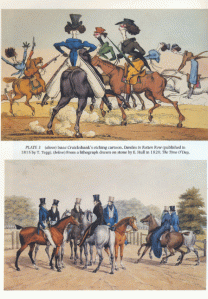 With all riding and driving, specific fashions evolved in the Regency to denote affiliations.
Each Hunt had its own hunting “colors,” which included a color of coat collar as well as a button insignia. The most fashionable gentlemen in the field might also wear white boot tops to their riding boots. Ladies, too, would wear hunt colors.
The exact origin of the bright red hunting coat—which is actually called a hunting pink—is a little vague, but one theory holds that it was army officers hunting in their scarlet regimentals that started that fashion. Another holds that the tailor Mr. Pink started the fashion, and that the coats took their name from him.
Driving clubs, such as the Four Horse Club or the Four-in-Hand Club, also had specific styles of dress that denoted membership. This included a blue coat with insignia buttons, a yellow and blue stripped waistcoat, a white muslin cravat spotted with black, and white corduroy breeches.
And in the stylish Regency, fashion extended to more than just clothing, for horses and carriages were ways to express ability, style and good Ton.
According to Captain Gronow in his Reminisces, Lord Barrymore drove, “…four splendid greys, unmatched in symmetry, action and power.” While Lord Petersham’s carriages, “…were entirely brown, with brown horses and harness.” Gronow accredits Petersham’s affectation as being due to his love for a widow named Mrs. Brown. Regardless, the color soon became his trademark signature.
Through it all, the horse endured as a symbol of style, as a sport, and as a source of pleasure and delight.
For further reading:
- Horses and Horsemanship though The Ages, Luigi Gianoli
- Royalty on Horseback, Judith Campbell
- Side Saddle Riding, Betty Skelton









 Shannon Donnelly's Fresh Ink