Pistols and Duels

Part of the allure of the English Regency is that it’s an era for swords, horses, and flintlocks. Everything to buckle the perfect swash. Dueling–and a lady’s muff pistol–became part of my novel, Barely Proper.  The dueling information came from research, but the lady’s muff pistol, complete with safety latch to prevent accidental shots, came courtesy of my uncle, Eric Ericson, who collects flintlocks.

Part of the allure of the English Regency is that it’s an era for swords, horses, and flintlocks. Everything to buckle the perfect swash. Dueling–and a lady’s muff pistol–became part of Barely Proper.  The dueling information came from research, but the lady’s muff pistol, complete with safety latch to prevent accidental shots, came courtesy of my uncle, Eric Ericson, who collects flintlocks.

Barely ProperActually, by the mid 1800’s, the duel had become extinct in England. Queen Victoria, and the British government, had taken steps to end duels in the army–it was, after all, difficult enough to lose officers to battle, let alone, losing them to each other’s bullets. However, in Regency England, gentlemen could settle any disagreement with pistols, and might well be acquitted by a jury of any murder charge.

The notion of a duel of honor first appeared in England in the early 1600’s. The duel between Sir George Wharton and Sir James Stewart was recorded in 1609.  Prior to that time, an Englishman could settle slights and quarrels by hiring a gang of assassins to avenge any slight. Through the 1700’s, duels tended to be fought with swords. This was due, in part, to technology.

Hand guns date back to the late 1300’s in Italy and appeared in England around 1375. These used gunpowder, a mixture of potassium nitrate, saltpeter, sulfur and charcoal.  It would take another half century, however, for a mechanical device to appear to actually fire a hand gun. The standard flintlock gun came then came about in the early 1600’s, and by 1690 flintlocks has become standard issue for the English army.

The flintlock had been developed in France as a more reliable improvement upon matchlocks and wheel locks. The principal was simple–a trigger released a lock that held a flint which would then strike a spark in the priming pan. This pan held a small amount of gunpowder. When ignited, it then would ignite the main gunpowder charge in the barrel, firing a lead ball.

In contrast, the older match lock had used a “matchcord,” a braided cord of hemp or flax soaked in a saltpeter and dried. The slow-burning matchcord would then be lit. Pulling the trigger caused the lit matchcord to be pressed onto the flashpan causing ignition. The wheel lock improved on the matchlock with a system that worked rather like a cigarette lighter. Pulling the trigger caused a rough-edged steel wheel to strike a piece of pyrite held in a metal arm called a dog head.

Misfires with matchlock and wheel locks had been common. And the effort to reload consumed time. While flintlocks still loaded the main gunpowder charge and ball from the front, the only addition work was to then pour a little gunpowder into the flash pan.

Around the 1750’s, the practice of carrying a small sword or dress sword also died out, and with the advances in gun making, pistols became the standard for duels. Dueling pistols developed into matched weapons with a nine or ten inch barrel. Most were smooth bore flintlocks.

However, pistols could be as individual as the maker, or the owner. Jean-Baptiste Gribeauval made a pistol for Napoleon Bonaparte around 1806 that had a twelve inch long barrel. And a set of dueling pistols made around 1815 by W. A Jones and given to Duke of Wellington by the East India Company boasted saw-handled butts, which made it easier to steady the pistols, as well as “figured half stocks, checkered grips, engraved silver and blued steel furnishings.”

By the mid-1700’s London was well-known for its excellent gunsmiths. George Washington patronized a London gunsmith named Hawkins (a family name in my lineage, as this was my grandmother’s maiden name). As with many of the pistols from this era it offers silver decoration.

Dueling PistolsIn the late 1700’s, and during the Regency, Joseph Manton became one of the best and most fashionable gunmakers. Manton’s shooting gallery on Davis Street was where a gentleman went to practice before he might use one of Manton’s pistols in a duel. And an apprentice of Manton’s left in 1814 to strike out on his own with a business in Oxford Street. James Purdey’s company is still renown for its shotguns. Part of Manton’s success came from his first patent, taken out in 1777.  Manton went on to open his shop in 1793 and was soon known for shotguns and pistols. His fame came from guns that “were light, trim, well balanced, fast handling, and impeccably fit and finished. Stocks were slender and of fine English walnut with a hand rubbed oil finish.”

In the early 1800’s, a new development came along when a Scotsman named Forsyth patented the percussion lock.  This did away with the flashpan and flint.  Instead, an explosive cap was used, so that when the cap was struck by the pistol’s hammer, the flames from the exploding fulminate of mercury in the cap move into the gun barrel and ignite the main charge of powder.

With the advent of the percussion cap, guns with revolving chambers became reliable weapons. The revolving principle for a gun had been around for as long as the invention itself. “…There were repeating matchlocks as early as 1550, some capable of firing as many as eight shots with multiple barrels, each fired by a separate flash pan and operated by a sliding trigger mechanism…Both French and Italian gun makers as early as 1650 had developed magazine-fed muskets.” The “pepperbox pistol” had between two to six barrels that revolved upon a central axis.

Examples of such pistols that still exist include a double-barreled turn-over flintlock pistol, a six-shot flintlock had been made in France in the late 1700’s, a three-shot Venetian pepperbox dates back to the mid 1500’s, and Twigg of London had even made a 7-barrel flintlock pepperbox in 1790. A three- barrel design made by Lorenzo some time in the 1680’s exists that carries the Medici Arms upon it. However, the pepperbox pistol was notorious for the mechanism jamming. Or worse, all the charges in the barrels might be ignited at once time by a flint strike, resulting in the entire pistol discharging at once–or blowing up in your hand. The first accurate chambered weapons date from the latter part of the Regency, around 1810 to 1820. Multiple shot pistols, however, were not allowed in any duel.

The elegant matched sets of pistols manufactured for a gentleman might boast silver filigree or gold inlay. Their balance was paramount, for a pistol that could not be easily held up at arm’s length might mean an inaccurate aim and shot. Also, the “hair trigger” or a trigger that responded to the slightest touch could mean the difference in being the first to get off a shot.

In the early 1800’s duels might be fought for honor, as in the case of a duel fought in Hyde Park in March 1803 between two officers, and reported to have been held to avenge a sister’s dishonor. Or it might be an absurd affair, as in the duel fought in London on April 6 that same year. This second affair involved Lieutenant-Colonel Montgomery of the 9th Regiment of Foot and Captain Macnamara of the Royal Navy, and was reported to have started when the two men, both riding in the park and each followed by a Newfoundland dog, had their dogs start to fight. This led Montgomery to exclaim, “Whose dog is that? I will knock him down.”  That set off an argument that resulted in a meeting at seven that evening near Primrose Hill. Even the Duke of Wellington fought a duel.
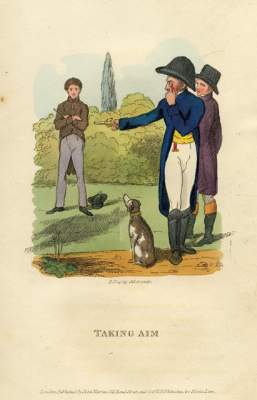
Taking AimDuring the Peninsular War, Wellington had been known to frown on dueling among his officers.  However, in 1829, Wellington’s support of the Catholic Relief Bill angered the Earl of Winchilsea, who then made public a letter that disparaged the duke accusing him of having, “…insidious designs for the infringement of our liberties, and the introduction of Popery into every department of the state.”  Wellington pushed for reparations, and would be satisfied with nothing less than a meeting over pistols at Battersea Fields. “At the word ‘fire,’ the Duke raised his pistol, but hesitated a moment, as he saw that Lord Winchilsea had kept his pistol pointed to the ground.”  Wellington then fired at random, as did the earl. The press did not approve and reported, “…all this wickedness was to be perpetrated–merely because a noble lord, in a fit of anger, wrote a pettish letter…Truly it is no wonder that the multitude should break the law when we thus see the law-makers themselves, the great, the powerful, and the renowned, setting them at open defiance.”

Illegal as they were, duels were numerous, and were often not prosecuted unless proven fatal.

In the duel between Macnamara and Montgomery fought over their dogs, both were wounded, Montgomery fatally so. Macnamara recovered and was tried for murder, and his arguments for his motives being that of “proper feelings of a gentleman” carried enough weight that the jury returned a not-guilty verdict, even though the judge asked them to find Macnamara guilty of manslaughter.

Times and sentiment changed, however and in 1838 when a Mr. Eliot shot and killed a Mr. Mirfin in a duel, the jury returned a verdict of willful murder. The trial smacked of class prejudice, for in 1841 when Lord Cardigan was tried in the by his peers in the House of Lords for dueling, he was found not guilty.

By 1843, an Anti-Dueling Association had been formed and by 1844, Queen Victoria was discussing with Sir Robert Peel how to restrict duels in the army by “repealing an article of the Mutiny Act, which cashiered officers for not redeeming their honor by duel.” The Regency by then had long passed, and so had the era of pistols for two at dawn to settle affairs of honor, and so had the art of the elegant and deadly dueling pistol.

To read more on dueling pistols, try:

Antique Guns by Hank Bowman, Arco Publishing Co, Inc.

The Illustrated Encyclopedia of Firearms by Ian V. Hogg, New Burlington Books

Gunmakers of London 1350-1850 by Howard L. Blackmore, George Shumway Pub

The Duel: A History by Robert Baldick, Barnes & Nobel

Christmas Stories

It’s Dicken’s fault–he started the trend. Now, maybe there were Christmas stories around before A Christmas Carol (favorite film version being the one with Alistair Sim), but Dicken’s became the one trotted out every year with the trees and holly and mistletoe. And why fight success. But I actually never set out to write a Christmas story.

Under the Kissing BoughUnder the Kissing Bough started life as a short story. It was supposed to be about 100 pages, and I actually didn’t start out with a time of year, but I did want to see if I could do a novella. I’d been writing a lot of novels and hadn’t done any shorter fiction in a long time, and I actually really, really like the shorter format. It’s a challenge to work in, but can be rewarding. I forgot one thing–you cannot do a short story with lots of characters. Not and do all the characters any kind of justice.

You see, I love to give every character a ‘star turn.’ I think of them all as actors, and every actor–even ones with bit parts–loves to have that great screen moment with wonderful dialogue that moves the story (and the audience). All this mean that with large families (heroine has two sisters, and her parents; hero has father, two brothers, and a former love interest who is now married), I knew that by page seventy, no way was this story ever going to fit into 100 pages. So I put it aside.

And then my then editor at Kensington asked if I’d like to do a holiday book–a Christmas story. “Sure” is always the immediate answer I provide in such situations. And then I had to figure out what I could do for Christmas. Because I can’t just stick on some holy and call it holiday. To me, if an element is not important in the story–and to the characters–it’s got no business being stuck in.

This mean research–as in I needed to dig into English Christmas customs (not difficult since I had a grandmother from Yorkshire and a lot of handed-down family traditions). And I dug out my short story to take another look.

The December setting suited my characters very well–I’d already set up a ‘marriage of convenience’ story (always a wonderful plot to use for historical fiction). Now I could weave in the holiday customs, make them part of the plot and the story (because, in England, you really, really need a very good reason to get married in the cold of winter). There were a few things I couldn’t quite fit into the story due to the limitations of page counts (from the days when that mattered so very much in print)–as in it would have been fun to do more with Twelfth Night celebrations. But I did get other things in there that I loved adding.

And I ended up with a Christmas story.

I’m toying this year with rereading it. I don’t often reread my own work. When you’ve spent a long time writing and revising, another read seems more of a burden than a treat. But it would be fun to do another holiday story. Mmmm…maybe Guy Fawkes day.

Rules of the Written Road

Kurt Vonnegut came up with eight rules for writing fiction, nicely referenced in an interview with Andrew O’Hagan, and noted there by O’Hagan as: “His rules for good writing are entirely bogus – he knew it, too – but they are not un-useful. Rules are just a bunch of things someone adorned into precepts while they were on the way to getting it wrong, but Vonnegut got it right now and then so we’d do well to listen.”

Vonnegut’s work, like his work, is more than “not un-useful” and it got me to thinking if I have rules. But then my love/hate relationship with rules kicks in–there is much to be said for wandering off any well-troden path. Something Vonnegut agreed as well with when he said, “The greatest American short story writer of my generation was Flannery O’Connor….She broke practically every one of my rules but the first. Great writers tend to do that.”

Now I do hold that extraordinary talent can get away with almost anything–and everything.  However, I’m pretty damn sure most folks over-estimate their talent by a huge factor.  Talent also, like a charming relative, can wear out its welcome way too fast if that’s all there is–auditions for any reality show prove this over and over again.

So…rules, or no rules? Or do you try a compromise and call them guidelines? But then I’m always suspicious of compromise in art–it tends to lead to a mush that no one can love.  Or, to put it another way, mix all your colors and you get bland gray mud. So how about  we say that it’s not bad to know the rules, use them, and ignoring either at your peril or only because they don’t work. But this brings us back to folks abusing the rules, ignoring them, and not necessarily coming up with a good story.

Also, writers being writers, the temptation to be clever crops up, as when Vonnegut’s advises to “Start as close to the end as possible.”   That’s about as much use as telling someone, “Start in the right place.”  Well, duh.  If one knew that, a whole host of other writing problems would be solved in an instant.  But the rest of his rules are good ones to lean on.

It’s also useful to have things boiled down by a pro like Vonnegut to what’s really important.

Personally, I find the last one the most useful:  Give your readers as much information as possible as soon as possible.

Seems to me that most folks mistake ‘tension or suspense’ as coming from a reader not knowing something. In truth, suspense comes from the reader knowing a lot and a character missing out on some key info, or just a plain old fashioned ticking clock going.  But there’s a caution here, too–too much information is as dangerous as too little.  You can overload a reader.  So the trick is:

Give your readers as much IMPORTANT information as possible as soon as possible–and make sure it’s interesting.

This automatically helps with not wasting anyone’s time.  Also, it cuts down on repetition. Saying something once is interesting. More than that and your now wearing on the nerves.

Two, three and four are all solid.  But ‘how ‘ to do all this becomes the question, so we have to expand this one…

Give the reader at least one character he or she can root for–as in you need to show that character early on doing things that earns a reader’s sympathy. We all admire talent, grace, good deeds. You can have a character get away with a lot if you set up a few traits the reader will fall for right off the bat.  Sympathy (by understanding someone) is an awesome hook.

Good to remember, too, that what you tell a reader often doesn’t stick. What you show, stays forever.  (i.e.–only bad guys kick the dog.)

Every character should want something, even if it is only a glass of water. This goes for every character and every scene. And again, is best shown by showing the character doing stuff to get what he or she wants.  The other shoe that needs to fall here is that something or someone should stand between the character and his or her goal. Conflict is what keeps any story popping.  Doesn’t have to be world-ending stuff, but does need to be there, or you’re back to wasting someone’s time. So could add here…

Every character should want something, even if it is only a glass of water–and something or someone should come between the character getting that want satisfied.

This also actually then ties into the advice that, Every sentence must do one of two things: reveal character or advance the action. If you’ve written a character who wants something, then what you’re writing is more likely to reveal something about that character (the want does that) and advance the action. Keep in mind that this does not mean ‘no description.’  Used right, descriptions can reveal everything.

And all of this then fits into, Be a sadist. Give a character a ‘want’–then you find ways to keep the candy from reach. Or give the character the candy, and have it blow up. Take joy in your work–in making life more complicated, making goals harder to reach, and raising stakes for failure to unbearable.  It’s not so much sadism as tough love–put your characters though the worst things possible so they can come out the other side knowing themselves better.

Now for the tricky bit–Write to please just one person.  There is a danger in getting too many opinions, particularly if the input comes too early.  It’s like opening the oven to see if the souffle is done–the thing usually falls flat on you.  Alternately, you’re going to have to show your work at some point unless it is just for you.  So, really, this to me is…

Write to please just one person–but learn to edit and take advice once the writing is done.

If one other person sees a mistake, maybe they’re wrong. Two people, same flaw–time to look at the pages. Closely. Three folks…ignore that at the peril of either appearing stupid in print or not even getting to that point. In this world, keeping the writing close is not a bad thing. But if your goal is to publish and be accessible, then eventually you not only have to open the window, but you have to throw your work there.

So those are my rules, I guess. My guidelines. I reserve the right to throw them out, but only if the story really, really, really needs something different.

The Balancing Act

Adobe Walls Going UpWe’re building a house–it’s a passive solar adobe straw bale hybrid, meaning we’re inventing some things as we go and learning a lot. And we’re working damn hard. As in laying actual adobe bricks. Which also means my life’s out of balance. Again. This happens with obsessive-compulsive types, but I can’t moan too much about being that type since it also helps with the writing. But…a little more balance is needed. As in I need to carve out my writing time again.

I was doing great with this. Up an hour or so early. Get my coffee, sit down and write. Even a few pages is great, and I could often do five or ten before the day got cooking. Then it got cold. And dark. A warm bed is now too much of an invitation to lounge. It’s not going to get warm again for more than a few months–meaning I need to adjust my schedule, or I’m going to have to bite the bullet and get out of bed. Since the latter is not too likely, I’m going to try other things. Such as making sure I have my priorities sorted out. And pulling out the pages to mess with them every day, even if it’s only for a few minutes here and there.

It’s all part of the balancing act–one I have to go through every few months (or sometimes every few weeks). Get enough sleep, enough food, enough solitude–too much company and my brain gets too busy.  A little bit of “bored” time is a good thing. So is a little bit of daydreaming time. But there always seems to be other things making demands on my time. Which is when I have to remember what’s important. And, yes, house done before winter would be a very, very good thing — warm place to write…mmmmmm. But I’ve got a book that’s begging to be finished. For a writer, you’ve got to write.

Cat’s Cradle – Behind the Story

Cat's Cradle There’s a story behind every story–this one is about Cat’s Cradle, which is now available at Amazon for Kindle, BN.com for Nook, and at Smashwords. And I have to start this off by saying I’m partial to this story–ridiculously so, for a couple of reasons.

The first reason is this is the first Regency novella that I wrote. That’s not to say this is the first short fiction I’d written. I’d actually cut my writing teeth on shorter works before I went after novels–in fact, I wasn’t sure I could write anything longer than fifty pages or so until I’d written a longer work. But I’m a believer that structure is structure. Meaning if you can structure a story, you can structure a story. The nice thing about starting off working in shorter form is that there’s no room for wandering. In a novel, you can put in side bits, you can mess around a bit, you can basically add fluff. You can get lost. In a novella or short story, every word counts, so they all have to be right. You have to keep your focus. And I love working within the restrictions that applied.

The second reason this story holds a special place in my heart is that when I was asked if I’d like to do a kitten story, I knew I wanted the cats/kittens to be integral to the plot–they could not be stuck in there for window dressing (I hate that kind of story). With that in mind, I applied my theory of idea hunting–I went mining my past.

Now, I’ve heard it said that some writer write about their own lives and some steal other people’s lives for their source. I’m not sure which group I fit into–I’ve done both. But I do find that mining my own past tends to make for stronger stories. And I’d had this cat.

Stripey showed up one summer day when my brother and I were eating lunch on the back patio. She was–as she was named–a grey-striped cat with white patches. She was also hungry. And I was not about to eat the baloney in my sandwich. (I have never liked baloney and still do not eat the stuff.) Stripey was happy to help out with the sandwich, and since she hung around for more handouts, she became my cat. (I seem to recall there was also shameless begging on my part, but the end result is that Stripey stayed long enough to give us three litters of kittens.)

Most of time Stripey was the most timid of cats. She was the cat other cats chased–the weakling into whose face all felines kicked metaphorical sand. Until she had kittens. Then she became Stripey the Tiger, capital GRR. No one messed with her kittens–or her when she had kittens to look after. She also had one other habit. Her idea of the proper place to raise the kittens was in the garage.

We had an old dresser in the garage and my dad stored his tools and bits and pieces there. Stripey also insisted on having her kittens in the bottom drawer, which wouldn’t close. No matter what kind of beautiful kitten basket we made her, the kittens came into the world in that dresser. We’d try putting the kittens into the basket for her. Soon, she’d be trotting back to the garage, one kitten at a time dangling from the hold she had on the scruff of their necks. Eventually, we gave way to her demand that the kittens spend their first few weeks in the garage–as I said, she was more than decisive with kittens in her charge.

Stripey’s story became the story of “Bea” who insists on having her kittens in one place, even if that place proves inconvenient for her owner. And that became the catalyst (sorry about the pun) for the romance in the story.

Of course, a cat alone a romance does not make. Meaning I needed a hero and heroine to go with the cat. Obviously, such a protective mother as Stripey needed an owner with the same inclination–like cat, like owner. And so the hero would have to pose a threat to my heroine’s offspring (but the husband would have to be out of the scene). Thankfully, my muse presented me with two very good candidates–Ash and Evelyn. This also gave me a chance to do a fresh take on the “proper spinster” (the heroine’s not actually a spinster), and the bad boy (Ash isn’t that bad, either, but he does have a past that’s not all that savory).

One thing I’ve found with short stories or novellas–you have to limit the characters. Too many characters and you either cannot do justice to everyone or the story expands into a novel (that’s a tale for another day about Under the Kissing Bough and how that came to be written). But Evelyn needed boys–two youngsters, because it raised the stakes for her to have kids to look after. And Ash needed someone, too, because it’s no fun having the hero talk to himself or spend all his time brooding and thinking–besides, long-time servants are as good as family and families always cause the best additions of conflicts for characters. So that rounded out the cast to about six (including Bea, the cat–the kittens are a little too young to be more than “spear carrying” kittens). And there’s a couple of walk-ons, but a novella could handle that.

And so Cat’s Cradle was written. It’s one of those blessing stories–it flowed from start to finish, and I loved writing every bit of it. I got to have fun, and to put in those little bits I love in a story. I don’t know that it’s one of my best works, but it’ll always be a special story for me. I’m more than delighted that it’s available again, now as an e-book.

Is Your Scene Working Hard Enough?

Every now and then, a scene won’t work and my guiding principle here is that if a scene is boring to write, it’s going to be deadly dull to read. Which means time to rethink and revise. Over the years I’ve found–and have learned from others–that scenes need to have more than one thing going on in order to have that spark that keeps a reader’s attention. So here’s my checklist for all the heavy lifting that needs to happen in a scene:

1-Increase conflict.

If there’s no conflict in a scene, you might as well be writing down a recipe. Conflict can be as simple as she wants a glass of wine and he thinks she should have a beer. Or it can be deep and major. But it all boils down to making sure that every character wants something, and not everyone’s going to get what they want out of that scene.

2-Heighten tension.

This one is a little different than “conflict” — tension comes from the reader not quite being sure what will happen next. The reader may have an idea, but if it’s obvious how things will work out, there’s no tension. Sometimes you have to leave room for the characters to surprise you, meaning they’ll also surprise the reader and set up that tension. But you also have to stay away from cliches–there is nothing more predictable than a cliche. And this means do not push your characters into acting a set way to make a plot go a set way (as in the heroine who sees the hero with another woman and immediately assumes he’s cheating on her, which allows her to storm off and do something stupid, allowing the bad guy to kidnap her, so the hero can save her — just don’t do it).

3-Add complications.

Things have to get worse. Particularly, the relationship issues between a hero and heroine in a romance. And more obstacles have to crop up for the main character who is trying to reach  a goal.

This can also be called “plot twists” or “turning points” or there are a lot of other terms, but the guidelines I like to follow is that you cannot resolve one conflict or issue for the main character without introducing two new ones. So this is where its time to look at the scene and ask: How is this making it harder for the main character to get to his main goal? This can be with little things that add up, or a big old nasty complication, but it’s got to get worse.

4-Develop characters.

This can be posed as a question: What new side of the main character does this scene show to the reader? In other words, a song doesn’t play the same note over and over. You want your main character to stay fresh and keep developing. New conflicts means your character needs to be faced with having to make new choices. And new people in the story means you’re able to reveal new sides to your character since we all act differently with different folks. So each scene needs to show fresh angles on your main characters.

5-Show the world.

Scenes always need to take place somewhere. Ideally, the setting is as much a character as anyone walking or talking. The setting provides mood, it can be a contrast, can help heighten tension, can add in more conflict, it can enrich the reader’s feeling of being in another world. Too often I see setting skipped over, when it should be made into a vital part of the scene.

One big note here–I can write dialogue or I can write description. Meaning I can focus on the characters or the setting. Doing both at once–not an option with my brain. So I’ll do a draft that is only dialogue, and then go back and layer in the setting. Or I’ll get the setting right and then go back and lay in the scene. I have to do both, but they have to be done in different drafts.

6. Layer Subtext.

This one takes some work, but it’s one of my favorite things to do in a scene. I always want a scene to be about more than what’s obvious–there’s the surface text, and under that is the sub-text. This is where what characters want in the scene becomes very important–so does how a character goes about getting that desire. This is where you have characters talking at cross-purpose–one person talking about topic A while the other person thinks they are talking about topic B. This is where, as the writer, you can have a lot of fun, both with the characters and readers.

7. Raise the stakes.

This one seems a lot like conflict or tension, but it’s really about how a character comes out of a scene. This relates more to consequences. Every goal needs to come with consequences–what happens if you succeed and what happens if you fail? If the character’s life does not change, there are no consequences. Obviously, the worse the consequences, the greater the tension and conflict. But it’s even better if scenes can keep raising the stakes. It’s like a poker game–you want to keep making the pot bigger. Meaning, the main character has more to win–and more to lose. So how can the scene raise those stakes by offering the main character more, or by leaving the main character with a need to “ante up” to stay in the game?

8. Hit emotions.

This comes last on the list, but it’s perhaps the most important element. Readers need to feel something in a scene–if I’m crying when I write, that’s a good thing. If I’m starting to laugh, that’s great. If I don’t feel anything, that scene needs to be taken apart, scrapped, or totally rewritten. I’d rather come out of a draft with rough scene that has emotion, than perfect writing that’s flat. And if the emotion is there, I’m very, very careful with the editing — you can revise the emotion right out of a scene.

There’s also an obvious note is that scenes have to have something to do with the plot or subplots–don’t laugh, I’ve written great scenes and realized afterwards they didn’t have a damn thing to do with this book. (However, save these–they’ve found their way sometimes into other stories.)

And the final note is that scenes should be about forcing the main character to make a choice–and these should become tougher and tougher choices. The choices that someone makes reveal that person’s character. So scenes need to set up bad and worse choices–tough and tougher choices.

Now all of this is hard to get right in every single scene, so my goal is to get as many of these things right as possible. It’s my checklist. If a scene is only doing one or two of these things, that’s a scene that could be cut and the book won’t suffer for it. Or that scene needs to be revised and rewritten so that it’s doing more work.

If a scene is doing five or six of these things, cutting that scene is going to damage the story–that scene HAS to stay (and now I have good arguments if any editor even thinks of cutting it). It’s all about making sure every scene is working hard to help create a strong story.

A Sexy Synopsis

The synopsis–we all hate writing them, and yet, it’s one of the most valuable tools a writer has. And it’s not just about condensing the story–for me, it’s really more about if I have an idea for where the story is going and  a clear handle on the conflict. It’s a place where flaws shine big and bright, which means I need to fix them in the book, too. But, oh, have I written some very, very bad synopses.

What set me on the course to learn how to do a better job of this was my first synopsis. Like many writers, I just wrote. And then I heard about RWA’s Golden Heart contest. Ah, ha–a way to get to an editor faster than through a slush pile. But I needed a synopsis to enter. So I wrote one–twenty pages of details about the book. Thank heavens, this was a time when you still got feedback from this contest, and some kind soul pointed out I really needed to condense my synopsis and do a better job of just telling the story.

With that in mind–and now as a member of RWA–I set about to learn how to do a better job.

One of the best tools came to me through Dwight Swain’s book Techniques of the Selling Writer.

I still reference his book when it comes to writing a new synopsis. His advice is to boil your story down to some immediate, big picture information.

  • Who is the main character, and what is the situation this character is coming out of?
  • What does this person want?
  • What’s keeping this person from his or her goal?
  • What are the consequences–the bad outcome–from this character not getting his or her goal?

This was great. This allowed me to write an opening paragraph for each of my characters in the romance. The next year I went on to final in the Golden Heart–but I still wasn’t satisfied. Yes, it was progress, but it wasn’t a win and it wasn’t a sale (my ultimate goal). So I kept at it. And I kept learning. I’d go listen to anyone talk about writing a synopsis, and gradually I learned I not only needed a good synopsis, but I could use that to show me if I had weaknesses in my book (if the middle of a synopsis is vague, the real problem is probably not enough conflict to keep the story going).

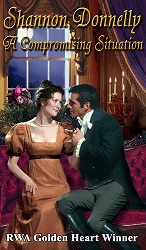
I was happy with the book, and the synopsis I wrote for A Compromising Situation–and the book won the Golden Heart and sold. That was a huge win.

A Compromising Situation

The synopsis then turned into a sales tool for me. From it, I was able to pick out possible cover scenes–because I knew by then that you needed a couple of key scenes in the synopsis to show the relationship developing. I was able to help focus cover copy, and also to write promotional copy that I could use on my website.

Now I realized just how powerful–although still painful–a synopsis could be.

Here’s the opening for that synopsis for A Compromising Situation.

After breaking her heart once years ago, MAEVE MIDDEN now only longs to find a position as a governess in a house full of young girls, where she might have a permanent position and a place to belong.  But can she settled for that after she falls in love with COLONEL ANDREW RICHARD DERHURST, now LORD ROTHE, a man far above her in station, a man who is supposed to be her employer, a man who may not be able to return her love?

And here’s how it fits into Dwight Swain’s advice:

Who is the main character, and what is the situation this character is coming out of:

  • After breaking her heart once years ago, MAEVE MIDDEN

What are the consequences–the bad outcome–from this character not getting his or her goal?

  • …now only longs to find a position as a governess in a house full of young girls, where she might have a permanent position and a place to belong.

What’s keeping this person from his or her goal?

  • …far above her in station, a man who is supposed to be her employer

What are the consequences–the bad outcome–from this character not getting his or her goal?

  • …who may not be able to return her love?

Notice the consequences are not world-ending. This was (and is) a story about people and so the consequences are deeply personal–and, for Maeve, a woman who has experienced rejection before, this type of rejection is deeply wounding. This would be a loss that would scar her.

By this point I’d learned how to stick to the main plot points in the synopsis, to focus on the conflict and the relationship since this was a romance, and I’d learned how to be very picky about each word used in the synopsis so that it was crafted to convey a tone and feel for the story (there’s no sense writing an action-packed synopsis if your story is a character study).

And I’m still learning.

Which is also why I’m still giving the synopsis workshop. Except these days a synopsis has to be even shorter, and even more able to catch someone’s interest. Which is why I call this a “sexy synopsis“. It’s got to be like a little black dress. It’s got to be something you can wear anywhere, and that’s useful as well as sexy–but it has to cover all the vital parts.

Just like the perfect little black dress,  a synopsis can take a lot of work to find all the right parts–the parts that flatter as well as fit. So if you, too struggle with your synopsis, head on over to the workshop at ORIW to pick up more tips and help for learning to get a synopsis that’s more than just something you need for writing contests and queries.

Showing More, or Lessons from Your Favorite Actors

The old adage given to most young (and I mean young in writing years, not in age) is: “show don’t tell.” Good advice, and while there’s a place for story telling in any story, showing is important enough to get top billing. You can see this in action in any decent film with good actors at work.

Actors have to show more–telling in a movie gets you boring exposition or, even worse, the deadly monologue from the bad guy as he explains evSilent Film Becky Sharperything. When you’re working in a visual media, telling ends up being talking heads. So movies have to show more–and actors have to put their characters into action. But novelists get to cheat.

In a novel or short story, the writer can just put down the words: “He was angrier than he’d ever been in his life.” Not great prose, but the reader gets the idea. Give that to any actor, and you’d end up with an actor struggling how to show that on the screen. So that’s one way a novelist can switch over from telling too much to showing more–imagine your favorite actor in the role.

What would an actor do to show this character’s anger on the screen? Would his jaw tense, his fists bunch? Would he hit something? Or would he smile, pull out a gun and shoot someone. Would he turn away, and turn back with a punch? Or would he offer up a cutting remark? It’s those little bits of business that an actor uses to better show their character in action–to put the characterization on screen. And it’s just those bits of business that a novelist needs to create to make a character come to life on the page.

Years ago, I took some improve classes. They were fun, and I was going out with an actor–and it was a great way to meet other cute guys, too. It was also great to get my head wrapped around thinking like a character, instead of myself. I had to start thinking about “how do I get this emotion across” or “how do I show this better?”  And that’s a great exercise for a writer, too–to act out your scenes.

Silent Film Star Theda BaraAnd this is where I study my favorite actors, too. How is he underplaying this scene–getting everything across with just a twitch, or a tilt of the head, or a slump of the shoulders? How is she making me see and feel the sorrow her character is dealing with–and not just with tears? I look for the honest performances–the ones that seem effortless, but which have had all the hard word done before the actors show up in front of the camera. I look for the actors who may know how to overplay a scene for farce, but who also know how to pull back and let their characters listen and react in ways that help me start to understand their characters.

All of this has gone into the Show and Tell workshop I teach–and which I’m giving for OCC RWA chapter this September (starting Sept 11). And it does seem to be the show part that most folks are working on, and which gives them the most trouble.

But narrative is a part of any story or novel–the narrative is often the stitching that holds all those great “showing” scenes together (which is why the workshop is called Show AND Tell).

Regency Actor GarrickHowever, next time you’re watching a favorite TV show or movie, or at the next play you go to, start to watch like a writer (or another actor, or the director). Look for those little bits of business that put a twist on the dialogue, or which reveal a ton about what the character is thinking or feeling. Would you have done something differently in that scene? Chosen to play it another way? Study the pros–and then write a scene that would earn the undying love of your favorite actor if you were to give them such a juicy, emotional scene with so much character hidden in the actions that show us the real person.

The 99 Cent Lesson

It’s almost a year ago since the last NINC conference, which inspired me to get my books back into print. I’d gotten the rights back, but I’d done nothing with the books, other than to let them sit on the ‘out of print’ shelf. Last November I brought the first out into the digital age. Getting all eight Regency romances into print took longer than I anticipated–I wanted all done by the first of 2011, but it was more like July of 2011 when the last rolled into the digital world. Covers took longer to have done–I paid for professional covers, all of which I love. I also had edits and some revisions to do to update the books. And I move to New Mexico during that time, so that was a distraction.

I also went from just using a clean (very clean) formatted Word document to using MobiCreator to convert a Word document that’s been saved as “Web Filtered” and add my covers and metadata there to produce better formatted ebooks.

And I learned about pricing.

Initially, I priced all my books at 2.99. That seemed reasonable. They’d been priced at 4.95 in print editions, but the electronic copies didn’t have paper, ink, or warehouse costs to defray. Sales were good, but not great, so I started experimenting.

I also noticed my own Kindle-buying habits. With the move and everything, books at .99 on Amazon started catching my eye. They were easy buys–more like the old days when you could pick up a paperback for just a couple of bucks, and so there was no worry about an investment of money (and time). For .99 I could take reading risks. And so I started pricing some of my books at .99.

They sold well. Very well.

A Proper MistressSo I put all of my Regency romances up at .99. And now I have one book (A Proper Mistress) that’s in the Amazon Top 100 (top 50 actually, and #1 Regency). All eight are in the top 50 Regency romance best sellers.

Now, maybe they would have made it to best sellers without the .99 price. On the other hand, I have to figure that in this economy lots of other folks are being careful with money. And why not sell for .99? Publishing houses may have overhead–and maybe they’re worried that if ebooks are so affordable folks will stop buying the print editions, where a publishing house can make a better profit margin. They’re right to worry. Particularly since mid-list authors can now actually make better money with ebooks than with print editions (I haven’t yet out-earned what I made with print editions, but I’m on my way there).

And, finally, the bottom line is that if I’m looking for those .99 bargains, why not participate and offer them up as well. I believe in walking the talk–and the talk is that digital is not just the future, it’s a reasonable one where good books can again find their way into reader’s hands.

I’m going again to the NINC conference this year — what’s not to love about white beaches, blue ocean, other writers, and tons of great ideas.

And NINC has adjusted its membership requirements–if you’re earning money (good money) with a book you’ve brought out online, you can be a NINC member. This not only seems wise to be for the organization, but it’s supportive of authors–it’s about supporting money into the author’s hands so that you can both write and eat (and not have to eat canned soup).

Will book prices ever go up? Maybe. I can see bringing out a new book at 2.99, or 1.99 — or maybe even free. But I love the flexibility–and the ability as the author to have more input into my own books.

It’s funny since I write about the Regency era–an era when authors often participated financially in their own book production costs, an era when an author had a great deal of say about publishing. Technology is taking us back again to those days.

Reading Like a Writer

Another writer posted a question the other day to a loop I follow about chapter lengths.  It got me to thinking about how I’d learned where to break chapters from Elizabeth Daly, a fabulous mystery writer, who wrote back in the 40’s (you really have to love stories where everyone stops for civilized cocktails at five).  And that started me thinking about other writers I’ve learned from.

From Georgette Heyer and Catherine Coulter, they taught me about writing dialogue that has the same sharp sparkle as champagne (we’re talking the good stuff, not Cold Duck).

Jayne Ann Krentz and Nora Roberts taught me the importance of likeable main characters. Nora also taught me how to handle viewpoint transitions, and a dozen other things.

Dick Frances gave me great lessons in fast openings with strong hooks that pull you into empathy with the main character and a story that never lets up.

Dan Brown taught me about pacing–and that you really can make all that research into facinating stuff.

Loretta Chase taught me how great narrative can be, that if you work at your writing, you can hold the reader’s attention for anything.

From Susan Elizabeth Phillips I have great lessons on making even unlikeable characters into sympathetic characters–a very hard trick to pull off. And Jane Austen taught me that character flaws can make the entire story.

Connie Brockway taught me that funny is good, a lesson I keep forgetting until I go back to re-read her books.

From CJ Barry I learned about how good SF and Romance are when you mix them with a skilled hand and keep the tension going in both.

There’s lessons from Tate Hallaway and Libby Bray and Melissa Marr and Mary Stewart in how to mix magic and story and make it wonderful and not too complicated (or so crazy it makes no sense). And Jessica Davis Stein taught me in Coyote Dream how all the work to make a good book great is worth it (she wrote and rewrote that book six times from scratch and it shows in all the beautiful craft).

Fantasy writers Ray Bradbury taught me about lyrical prose, and Edgar Rice Burroughs taught how to keep a reader turning the page no matter what–and that writers improve as they write. While western writer Ernest Haycox taught me about strong characters and even stronger, clean, lean prose.

The list goes on and on and on–so does the bookshelves. I’ve learned from the books I don’t like as well–taking them apart has taught me to edit my own work, and it’s shown me mistakes I want to avoid.

Which all goes to show you need to be a reader to be a writer. And it all goes into the pot to influence your work.

All this means, too, that once you start writing, you start reading differently. You stop at great prose and take it apart. You find a passage and you ask, “How did she do that?” and so you study it and figure it out so you can use that trick, too. You become a critical reader, but the very best still make you stop reading and become part of the story so that you have to go back later and figure it out.

So who are you reading today who is giving you new lessons and ideas?