Tag Archive | food

Things We No Longer Ask For

I love old cookbooks–they are a glimpse into a past era. They also often have great recipes. Reading Dorothy Hartley’s wonderful Food in England got me thinking about how there are certain foods and drinks we no longer ask for when dining out, such as:

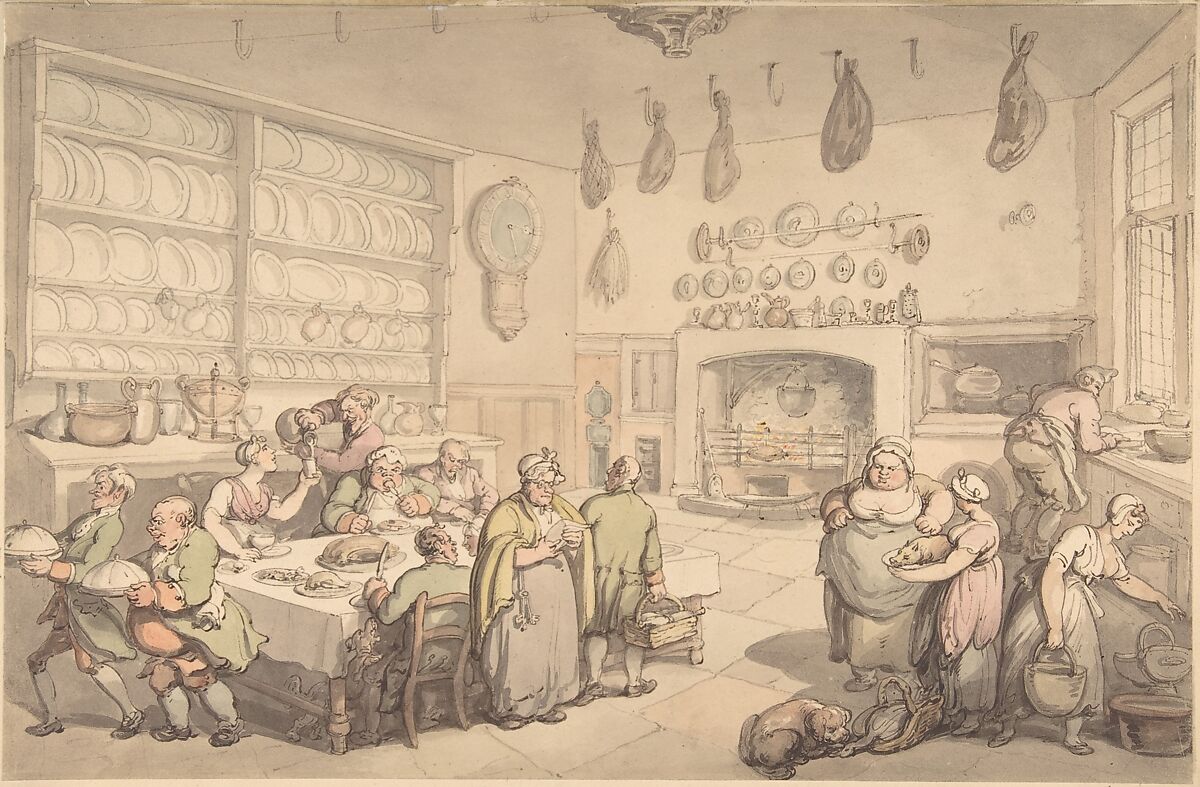
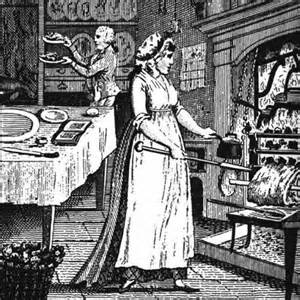
Meat and fish hanging, bread, cooked eggs, glassware, parsnips, lemon, platters on a side table all in  a larder or kitchen

A joint of beef — we have all sorts of fancy cuts these days.

Johnnycakes — these are actually delicious…they are basically a cornmeal fried bread, meaning like a pancake but with more crunch. Easy to make, too.

Mutton — it is still possible to find lamb in some supermarkets, but mutton has gone completely out of fashion (no old sheep for a low cost meal).

Pig cheeks — still available in some parts of the world, and by all accounts, the best part of the pig. Also called pork cheeks, and this goes along with calf cheeks or beef cheeks, a specialty of the Café Procope, one of the oldest cafes in Paris.

cucumber or parmesan ice cream — it is difficult enough these days to find real parmesan cheese.

watercress and egg sandwiches — these can be found in some tea shops still (thankfully), but watercress can be difficult to come by in many modern supermarkets (at least in the US).

gruel — this is an unlovely name and the food has a bad rep from the Victorian era, but some recipes call for butter, brandy, and enough spices to make this a very tasty mean (it’s basically think oatmeal).

A pot of ale — while ale is still around, it usually comes in cans, bottles, or a pint or half pint. The pint pot has long ago been replaced with glass.

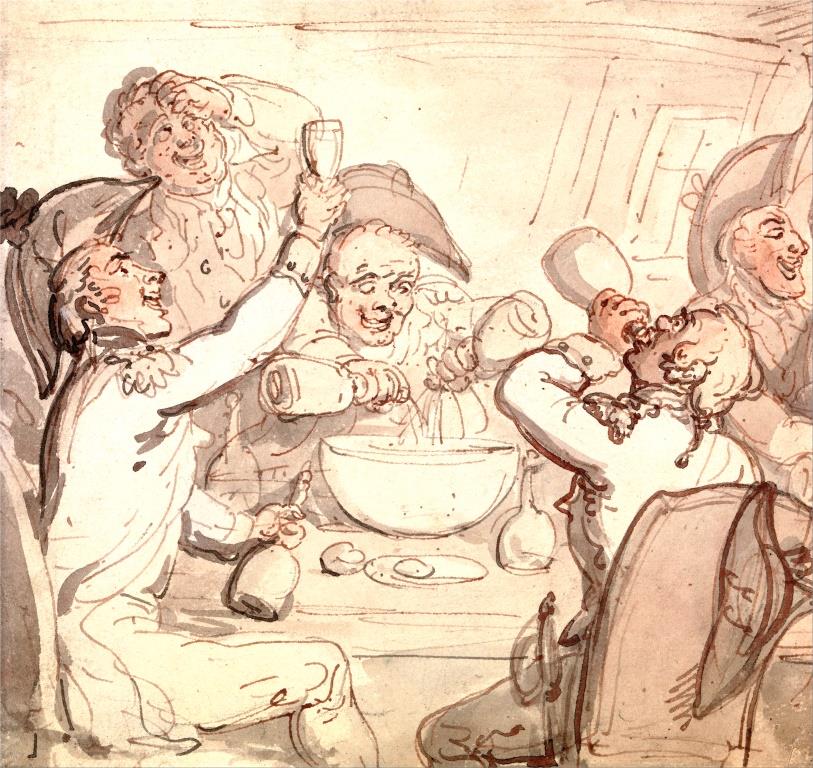
A bowl of punch — this used to be a highly alcoholic drink, but these days folks are more likely to think of punch being a fruity drink without brandy, champagne, rum, and other spirts all mixed together. The bowl is no longer with us either for dipping into with a mug or cup.

A posset — this was a hot drink made from curdled milk and sack or a sweet sherry.

A flip — another drink (more alcohol) usually made with beer, rum, eggs, and heated with a poker (not the one used to stir the fire, but a special poker used just to heat drinks).

A purl — another hot drink made with beer, gin, nutmeg, and sugar.

That is just a few things we generally must make ourselves if we want to sample something from the past (unless we find a place that also likes to keep going with what were once old favorites).

Thomas Rowlandson Naval Officers and a bowl of Punch

Coffee – As Important as Tea

I’ve just finished up the Regency Food and Seasons workshop for Regency Fiction Writers, and there’s always some ephemera that doesn’t quite make it into the workshop. This one is a poster from 1840 showing coffee being grown, what the leaf and bean looked like, roasting, grinding, and serving it up.

We tend to associate tea drinking with England–thanks to the high tea that came along in the late 1800s. But coffee was just as important a beverage–perhaps even more so–in the late 1700s and early 1800s. Coffee houses became all the rage in the 1600s, and continued to be so into the Regency era in England.

Not everyone was a fan of the coffee house (they also would serve drinking chocolate, tea, and punch, and provided newspapers to read). As reported on The Gazette UK website, “On 29 December 1675, a proclamation by the king was published that forbade coffee houses to operate after 10 January 1676 (Gazette issue 1055), because ‘the Idle and Disaffected persons’ who frequent these establishment have led to ‘very evil and dangerous Effects’ and ‘malicious and scandalous reports to the defamation of His Majesties Government’.” Meaning, of course that folks were talking politics. The notice gave warning that, “after the 10th day of January ensuing, to keep any publick Coffeehouse, or to utter or sell .… any Coffee, Chocolet, Sherbett or Tea, or they will answer the contrary at their utmost Perils’. Licences were to be made void, and if continued to trade, given a forfeiture of £5 per month and then ‘the severest Punishments that may by Law be inflicted’.” Naturally, the whole thing went bust, along with a “Women’s Petition Against Coffee” which reported it made men talk too much–it was, of course, yet another political maneuver that lacked popular support.

Folks kept drinking coffee, grocers added the beans to their stock (along with tea leaves), and porcelain manufacture created lovely tea and coffee sets, some as large as 40 pieces including cups, saucers, pots and everything else needed. Silversmiths also did a good trade, such as for this coffee pot, tea pot, creamer and sugar holder from 1800 made by John Emes, with gilt interiors.

Jane Austen wrote in a letter, commenting on her brother’s habits, that, “It is rather impertinent to suggest any household care to a housekeeper, but I just venture to say that the coffee-mill will be wanted every day while Edward is at Steventon, as he always drinks coffee for breakfast.” Coffee would also be brought into the drawing room with tea after dinner, so that guests could have a choice of beverage.

All these thoughts about coffee come–not just due to my being a coffee drinker, for I also love my morning and afternoon tea–but due to a headline that, ‘Your coffee habit could be linked to healthier aging, study finds‘. Good news for those of us who love that morning coffee…and who are getting up in years.

So drink up and enjoy your coffee…and you can still fit in that afternoon tea as well–green tea, after all, is so good for you as well.

What’s the Recipe?

There’s always a big question with any writing—what do you put in and what do you leave out? This is not just confined to scenes and characters, but also to information, particularly to research to make a story come to life.

This may be why I’m also drawn to cooking—it is still the same idea of what do you put in and what is better left out. Food in general is just a terrific topic. When it comes to history, it is fascinating both how tastes change and how much stays the same. For example, the English classic ‘Toad in the Hole’ (such an odd name, since it has no toads and not much in the way of holes) goes back at least to the 1700s. That was a time when cookbooks really started to flourish.

Rolandson Bird Eye View Covent Garden 1811

Cookbooks are both an insight into a period and also something of an insight into a way of thinking. I love that earlier cookbooks use measurement such as “a good handful”. Is that my hand? A small hand? A man’s big hand? And then there’s ingredients such as “blade of mace” (I had to look that one up). Then there’s the spellings to deal with, and how sometimes the instructions leave out some steps, assuming that everyone knows the obvious.

Assumptions—that brings me back to thinking about recipes and the idea of leaving in or out. We sometimes assume someone will know something, but what if the reader doesn’t get it? What if the assumption is wrong? The opposite can be just as bad. We assume the reader doesn’t know so now we slip into overexplaining. Too much detail can be as bad as too little.

One of the keys I find is to make certain the details are always interesting. I find this is true when I did into those old cookbooks.

Two different authors will have the same recipe, but one manage to infuse energy and interest into the writing. This can be done with a point of view put onto the writing. It can also be done with a just a little finesse. There’s a difference between “put the chicken in the pot and boil until done” and “put a fine chicken into a gentle simmer of water and cook until plumped”.

In May I’m doing a workshop for Regency Fiction Writers on Regency Food and Seasons—always good to put those two together (sometimes I think very few people these days know what a truly ripe summer peach tastes like). It’s a workshop I’ve done before, but with history you can always learn more. That means dusting off the writing for the lectures, and more dives down research rabbit holes…and having to make that call as to what should be put in and what is better taken out.

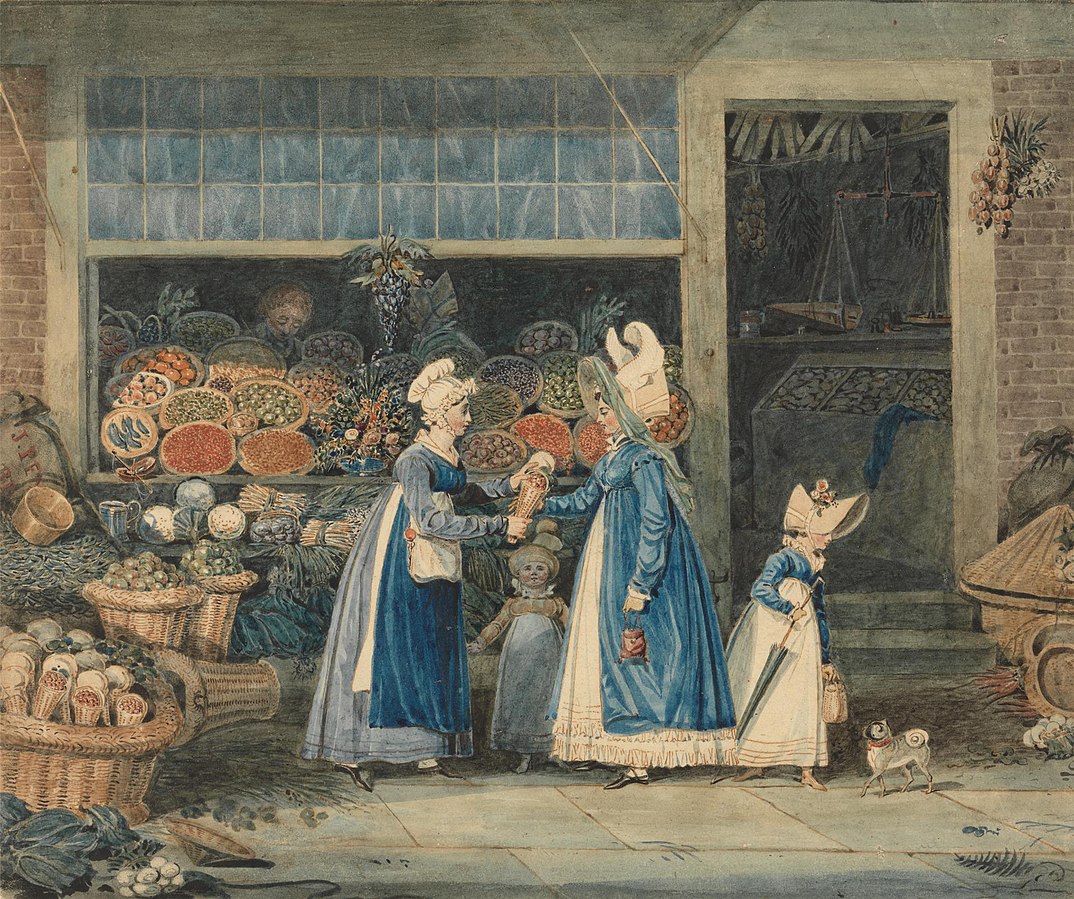
The workshop covers far more than seasons, with a look at kitchens of the era, markets (particularly those in London), a jaunt across the seasons of the year and holiday fare, shops for food in London such as the Italian Warehouses, the eating houses available in places such as London. It’s a broad look at an even broader topic, covering cookbooks of the era which offer up some great recipes, and just some things I couldn’t leave out just because sometimes it’s the cool details that add that spark of insight into a time and place.

Squire's Kitchen Rowlandson

For more about the workshop head to Regency Fiction Writers.

Food in Paris in 1815

Cooking is one of my favorite pastimes—eating and learning about good food is a pleasure. This means it was not difficult to dive into the research needed for a restaurant in Paris of 1815 for the setting of Lady Lost (which comes out in March).

Lady Lost

France gets the credit for inventing the more modern idea of a restaurants, and they certainly came up with the name. The word comes about in 1806 for “an eating-house, establishment where meals may be bought and eaten,” but comes from a “food that restores” from the Old Frence restorer.

The original idea was to serve up a healthful bouillon—basically a bone broth or consommé as a restorative. This was also to get around the strict guilds that made selling bread, meat, fruit, and vegetables separate affairs. In 1765, a gentelman named A. Boulanger opened a restaurant on what was then rue des Poulies (now rue du Louvre). It was his idea to serve a wide rage of food—and Boulanger offered up menus, waiters, and small, round marble-top tables. A new business was born.

The term “Gastronomie” comes about in 1801, in a French poem by Joseph Berchoux, and was translated into English in 1810 as: “Gastronomy or a Bon-vivant’s Guide: A Poem”.

The phrase établissement de restaurateur was shortened, and there were soon enough restaurants that the guide L’Almanach des Gourmands was published annually from 1803 to 1812 by Grimod de La Reynière.

In 1782, Antoine Beauvillier opened Grande Taverne de Londres on rue de Richelieu, and went on to write L’Art du Cuisinie, published in 1814. He had to close that restaurant when things got a bit too hot in Paris during the Revolution, but he then opened Beauvillier’s. Jean-Anthelme Brillat-Savarin said, it was “the first to combine the four essentials of an elegant room, smart waiters, a choice cellar, and superior cooking.”

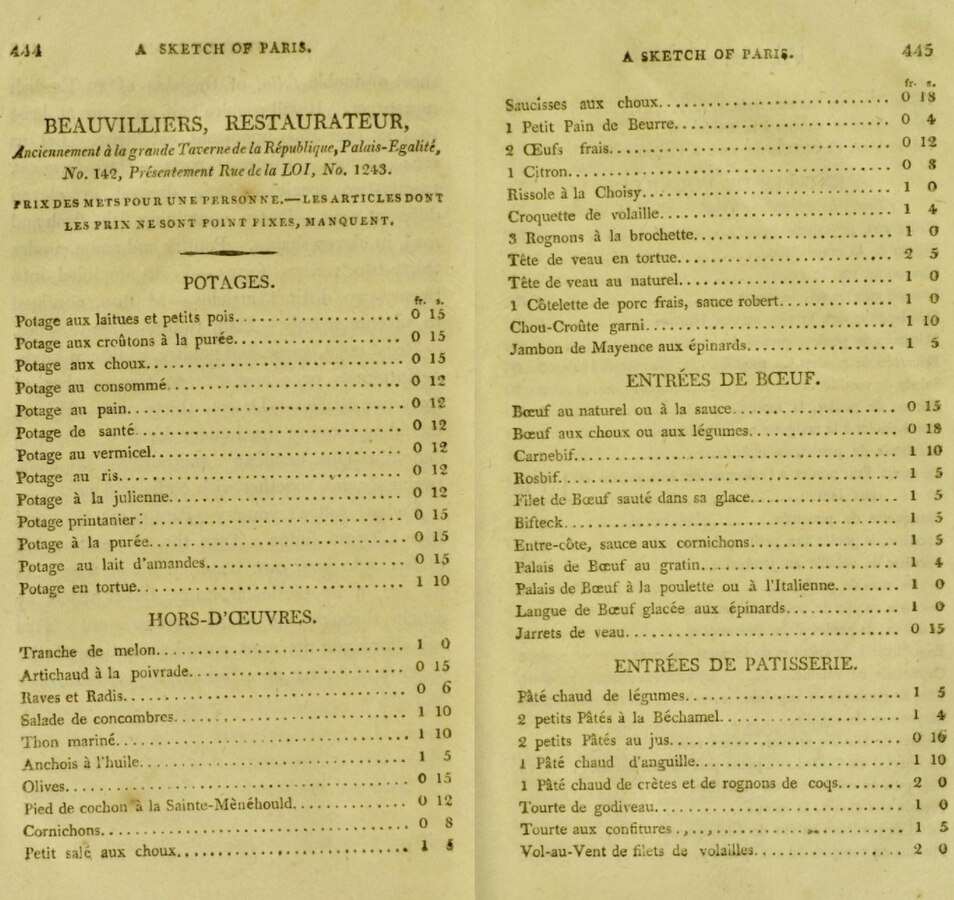
Francis Blagdon, Englishman, wrote of Beauvillier’s in 1803, “The bill of fare is a printed sheet of double folio, of the size of an English newspaper. It will require half an hour at least to con over this important catalogue. Let us see; Soups, thirteen sorts. — Hors-d’oeuvres, twenty-two species. — Beef, dressed in eleven different ways. — Pastry, containing fish, flesh and fowl, in eleven shapes. Poultry and game, under thirty-two various forms. — Veal, amplified into twenty-two distinct articles. — Mutton, confined to seventeen only. — Fish, twenty-three varieties. — Roast meat, game, and poultry, of fifteen kinds. — Entremets, or side-dishes, to the number of forty-one articles. — Desert, thirty-nine. — Wines, including those of the liqueur kind, of fifty-two denominations, besides ale and porter. — Liqueurs, twelve species, together with coffee and ices.” Below is just part of the menu sheets showing prices.

London continued on with taverns, coffee houses, chop houses, confectioners that served tea, sweets, ices and pastries, and a few gentlemen’s clubs. The Epicure’s Almanack by Ralph Rylance came out in 1815, listing more than 650 eating houses, inns and taverns in London, but was a financial failure. The English just were not that interested.

By 1815, the Palais Royal alone had fifteen restaurants, twenty cafes, and eighteen gambling halls—not to mention the brothels. This included Café de Chartres. Other restaurants included Le Grand Véfour next door to the Palais Royal gardens, Le Procope in Saint-Germain-des-Pré and said to be Bonaparte’s favorite restaurant, Véry which moved to the Palais Royal in 1808, Frères Provençaux in the Palais Royal, and the Café des Aveugles was one of those in the basement of the Paris Royal that offered cheaper prices. In 1815, the Café Anglais opened on the corner of rue Gramont and the Boulevard des Italien, and that boulevard would become extremely popular over the next few decades for restaurants and cafes.

There’s the saying about many sauces in France and one religion, but the opposite in England, and often attributed to Voltaire, but which comes from Louis Eustache Ude’s 1829 book, The French Cook; A System of Fashionable and Economical Cookery, Adapted to the use of English Families. The quote is, “It is very remarkable, that in France, where there is but one religion, the sauces are infinitely varied, whilst in England, where the different sects are innumerable, there is, we may say, but one single sauce.” He was speaking of the English penchant for a white sauce of butter, with a little flour and then perhaps some anchovies or capers, put over most everything.

Back to Paris of 1815—and there were at least a couple hundred of restaurants, some out to attract the wealthy but others serving up food for the average man and woman. The café’s had figured out the idea of putting tables outside to attract customers to sit with a coffee. The Parisians drank lots of coffee, offered along with the inevitable wine, and sometimes chess as well. Pastries, of course, came out along with cakes and bread and cheese. Soups were always a popular meal—despite what the song says about ‘April in Paris’ springtime is lots of wet and March of 1815 served up more than a little bad weather.

A meal might be had for a few sous, or the francs piled on with an array of dishes served up—the wine was generally the most expensive item on any menu.

All of this kept making me remember a trip to Paris—the street food was amazing, as was almost any café serving up crepes or fondue (interestingly Homer’s Iliad describes a mixture of goat cheese, flour, and wine that is basically fondue, but the Swiss came up with their version to use up leftover bread and cheese—a cheap and easy meal.) It is said that the version with meat was created in the Middle Ages in the Burgundy region of France, and the word fondre means to melt in French. Like most foods, everyone seems to have come up with their version. And…oh, the patisseries!

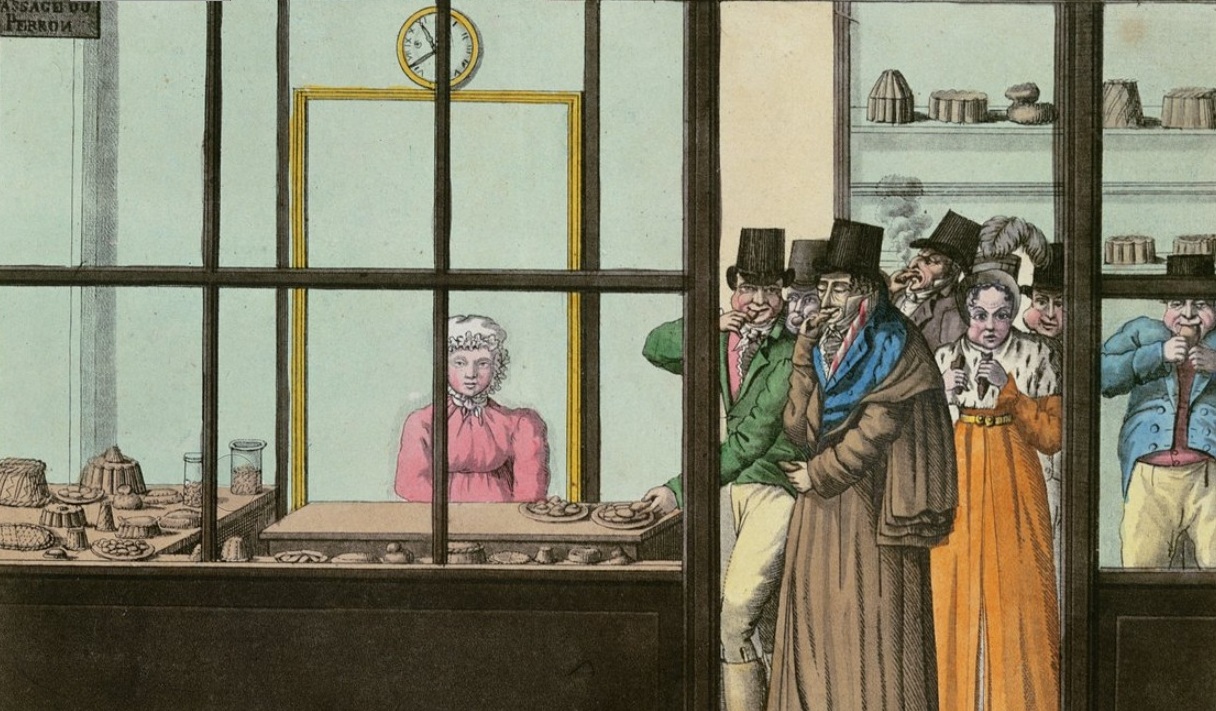
Which are nothing new to Paris, as shown in the print below, entitled, “The English Revenge or, The Patisserie at the Palais Royal” by John Sharp, from 1815, no doubt after Waterloo, with the English eating up all the sweets in the shop. The poor shop girl doesn’t look happy about it, even if she is selling out of everything. Which seems a very Parisian attitude.

Patisserie. A girl in a pink dress and white cap sits at the counter, while six gentleman and one lady eat up all the cookies and cakes.

All of this made for a fun bit of research for the book when I had to weave in a meal, or put a conversation into a café, which were all considered suitable places for women as well as men, and isn’t it nice to know the cafés and restaurants of Paris still seek to serve up some of the best food that can be had.

Historical Drinks

Tom and Jerry Taking Blue Ruin (Gin)

Every now and then I find a word that sends me off on a research hunt, and this led me to drink names. While we think of “cocktails” as a modern invention, the word dates back to at least 1798. Etymology.com has cocktail as a “drink made from water, sugar, spirits and bitters” first attested 1798.” So the idea of a drink mixed with all sorts of things is nothing new (Ancient Greeks and Romans mixed all sorts of things into their wines). However, my stumbling across a ‘purl’ being drunk by a man about to get onto a coach on a cold day led me to these other wonderfully named drinks that were often to be found in an inn or even sometimes sold on the street to the common folk in the late 1700s and into the 1800s.

Buttered Beer – this was a great way to add calories to ale or beer to make it into almost a meal. It obviously has butter in it, but might also have eggs and spices and was served hot (must have been lovely on a cold, wet day – an old recipe is here).

Dog’s Nose – so called for it was black and cold and one of my favorite names. It was porter, sugar, gin and nutmeg. However, some recipes call for it being warm, and modern recipes generally use brown sugar (a recipe is here).

Flip – this would be any mixture of beer or ale, mixed with rum or brandy, sugar, spices, and usually eggs. Every inn would have their own version, and the name comes from “flipping” or heating it with a “flip dog” also called a toddy iron (it was like a hot poker) (a recipe can be found in William Kitchner’s 1822 The Cook’s Oracle).

Gin-Twist – gin was usually the hard drink of the lower class, and was often watered down (and given to children for toothache) The twist is gin, lemon, and simple syrup. The word ‘gin’ comes from the Dutch genever and Old French génevrier for juniper (and a recipe is here).

Half-and-Half – this was a way to have the good, expensive beer mixed with something cheaper (as in half ale and half two-penny). In the late 1800s, it became a ‘black and tan’ (no recipes since you just mix two beers or ales or porters, but more information is here).

Lambswool – a cider with a baked spiced apple included, a traditional wassail drink in parts of England (a recipe is here).

Perry – cider made from pears (links here to where you might buy some and it sounds lovely).

Purl – Beer or ale with a shot of gin, often with wormwood or served hot as a means to keep warm (several recipe variations here).

Rum and Milk – gin and milk also shows up, which sounds even worse to me, but rum and milk are at the core of eggnog, so it must work, and milk punches also go far back in time (more on gin and milk is here and on milk punches).

Saffron Bitters – Bitters were sometimes used as a hangover cure (recipes here, and the saffron bitters and tonic water sounds rather good), but on a side note “tonic water” wasn’t around as a phrase until around 1850s, but as of 1789 Schweppe was advertising soda water and seltzer, along with sea water as a purgative. Quinine was also known about and sometimes added to “fizzy water” (fizz in a drink dates to 1812, but fizzy dates to 1885).

Saloop – Richard Valpy French in Nineteen Centuries of Drink in England notes it as “…a greasy-looking beverage, sold much on stalls in the early morning. It was prepared from a powder made of the root of the Orchis mascula, and from the green-winged meadow orchis….like porter, to be a favourite drink of porters, coal-heavers, &c. It is said to contain more nutritious matter in proportion to its bulk than any other known root…” (French’s book can be found here).

Shrub – like punches, all sorts of variations exist but this is a drink typically made with rum or brandy, sugar, and the juice and/or rinds of fruits, particularly citrus (recipes here, along with punch recipes).

Spruce Beer – this is beer obviously flavored with spruce needles, which can be purchased in a dried form today (a Jane Austen recipe is here)

Tewahdiddle – and isn’t that a great word! William Kitchner writes this is “a pint of table beer (or ale, if you intend it for a supplement to your “night cap”), a table-spoonful of brandy, and a tea-spoonful of brown sugar, or clarified syrup; a little grated nutmeg or ginger may be added, and a roll of very thin-cut lemon-peel.” (see Flip for a link to Kitchner’s The Cook’s Oracle.)

St Giles - Tom and Jerry Masquerading it among the Cadgers in the Back Slums in the Holy Land (slang for Irish slums)

Regency Triva

mealI’m going to be teaching a workshop in June on Regency Food and Seasons because when you write historical romances you tend to end up knowing a lot of odd things. And I love this kind of trivia.

For example, sugar used to come in cones–you’d scrape off what you needed. And recipes usually did not have measures–a goodly handful is often give as amount to use.

Or did you know tea used to be locked up in lovely tea boxes for the tea leaves were far too valuable to leave lying about.Enameled tea box

Or that in the early 1800’s Nicholas Appert won 12,000 francs when he invented a method to preserve food in glass–Napoleon had wanted this for as a means to better preserve food for the French Army. However, this method was not widely used, and canning would not come about until well after the Regency.

Food preservation, however, is ancient, with the more common techniques being salting and smoking, or the use of vinegar to pickle food.

It amazes me, too, how modern folks often don’t think about an era when food was not always available. I garden so I’m always looking forward to my seasonal produce–but what you can grow in England during its seasons is a different world from California or New Mexico where I now live.

Food tastes, too, are quite different.

Captain Gronow remarked on how London Inns always served “‘the eternal joints, or beef-steaks, the boiled fowl with oyster sauce, and an apple tart.'” Hmmm…maybe that’s not too different from modern London pub grub. The English at one point used to eat a lot of lamb (and mutton), too.

For Leg of Mutton, Mrs. Rundell’s recommendation is, “If roasted, serve with onion or currant-jelly sauce; if boiled, with caper-sauce and vegetables.” Personally, I would swap in lamb for the mutton and opt for roasting it. My grandmother who came from Yorkshire insisted on boiling all meat, and nearly made vegetarians out of all of her sons.

hannahGBut I also love digging out bits and pieces such as a “recipt against the plague” given by Hanna Glasse in The Art of Cookery made Plain and Easy. She also offers not one, but two certain cures for the “bite of a mad dog, one of which is both given to the “man or beast” bitten as well as recommending to be bound into the wound. Makes you wonder how big of a problem were mad dogs? Perhaps a large one given that there were no rabies shots.

Back in the 1800’s the day had a different pace to it–lunch was not a common meal, and you have servants for almost all classes except the poor. This makes for a lot of advice coming out in the mid 1800’s for how to deal with servants–one of those lovely problems we all wish we had. Oh, to have to supervise the house maid and oversee the cook instead of having to do for oneself.

All of this makes for a lovely bit of trivia to share.


The Regency Meal, or Food, Glorious Food

Hanna GlassThere is something wonderful about food. Why else would we watch shows about cooking, buy cook books, and even enjoy reading (and writing) about food. Regency England was also an era that enjoyed its food.

There was interest enough in food skills that by 1765 Hanna Glasse’s The Art of Cookery, Made Plain and Easy had gone into nine editions, selling for five shillings if bound. (Back then, one could buy unbound books and have them custom bound to match the rest of the books in one’s library.) Hanna’s book remained popular for over a hundred years. However, her recipes can be difficult to translate into modern terms–the quantities often seem aimed to feed an army, as in this recipe for ‘An Oxford Pudding’:

“A quarter of a pound of biscuit grated, a quarter of a pound of currants clean washed and picked, a quarter of a pound of suet shred small, half a large spoonful of powder-sugar, a very little salt, and some grated nutmeg; mix all well together, then take two yolks of eggs, and make it up in balls as big as a turkey’s egg. Fry them in fresh butter of a fine light brown; for sauce have melted butter and sugar, with a little sack or white wine. You must mind to keep the pan shaking about, that they may be all of a light brown.”

I’ve yet to try this recipe, and when I do I’ll probably substitute vegetable oil for suet, but it does sound tasty.

Amounts in older cookbooks are also often confusing to the modern reader, often listing ingredients to be added as handfuls, as in the rue, sage, mint, rosemary, wormwood and lavender for a “recipt against the plague” given by Hanna Glasse in The Art of Cookery made Plain and Easy.

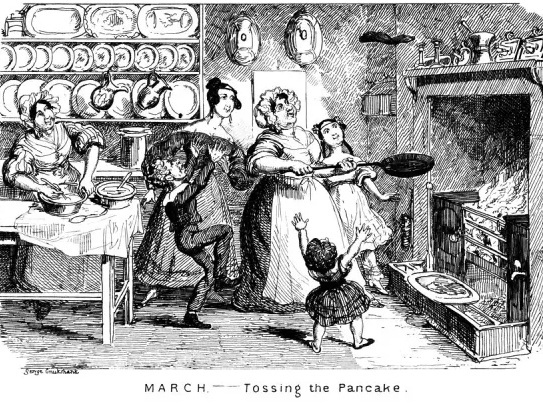
Brighton KitchenThe time spent on making these recipes could also be considerable. This was an era when labor was cheap, and if one could afford servants, they could provide that labor.  The Prince Regent’s kitchen in Brighton was fit for a king of a chef, and large enough to allow an army of cooks, pastry chefs, under cooks, and scullery maids. It also sported windows for natural light as well as large lamps, and pillars in the shape of palm trees to carry on the exotic decor of the rest of the Brighton Pavilion. Elaborate dishes could be concocted both for the well and the sick.

Shank Jelly for an invalid requires lamb to be left salted for four hours, brushed with herbs, and simmered for five hours. There are few today who have time for such a recipe, unless they, too, are dedicated cooks.

Sick cookery is an item of importance as well for this era. Most households looked after their own, creating recipes for heart burn or making “Dr. Ratcliff’s restorative Pork Jelly.” Coffee milk is recommended for invalids as is asses’ milk, milk porridge, saloop (water, wine, lemon-peel and sugar), chocolate, barley water, and baked soup. (Interestingly, my grandmother swore by an old family recipe of hot water, whisky, lemon and sugar as a cough syrup, and that’s one recipe I still use.)

As interest expanded, and a market was created by the rise of the middle class, other books came out. Elizabeth Raffald had a bestseller with The Experienced English Housekeeper. The first edition came out in 1769, with thirteen subsequent authorized edition and twenty-three unauthorized versions.

Dinner_FromMrsHurstDancingIn 1808, Maria Rundell, wife of the famous jeweler (and a correction is needed here–I started reading how there was confusing about her being wife of the jeweler or a surgeon. It seems she married Thomas Rundell, brother of Philip Rundell, who was the jeweler. So she was the sister-in-law, not wife, but she did some out with her book, published by John Murray) came out with her book A New System of Domestic Cookery for Private Families. This book expanded on recipes to also offer full menu suggestions, as well as recipes for the care of the sick, household hints, and directions for servants. This shows how the influence of the industrial revolution had created a new class of gentry, who needed instructions on running a household, instructions that previously had been handed down through the generations with an oral tradition. The rise of the “mushrooms” and the “cit”, merchants who’d made fortunes from new inventions and industry, created a need for their wives and daughters to learn how to deal with staff and households.

Any good wife had much to supervise within a household, even if the servants performed much of the actual work.

A household would make its own bread, wafers, and biscuits, brew its own ale, distill spirits, and make cheese. In the city, some of these would be available for purchase. Fortnum and Masons specialized in starting to produce such ‘luxury’ goods (jams and biscuits, or what we Americans would call cookies).

In London, wines would be purchased from such places as Berry Brothers, a business still in existence as Berry Bros & Rudd. Establish in the late 1600’s at No. 3 St. James’s St., the store initially supplied coffee houses with coffee and supplies. They expanded into wines when John Berry came into the business due to marriages and inheritance. Berrys went on to serve individuals and London clubs such as Boodles and Whites with coffee, wines, and other goods. They put up their ‘sign of the coffee mill’ in the mid 1700’s, and Brummell as well as others used their giant coffee scale to keep an eye on his weight and keep his fashionable figure.

Laura Wallace offers more information on wines and spirits of the Regency (http://laura.chinet.com/html/recipes.html. She notes Regency wines: port, the very popular Madeira, sherry, orgeat, ratafia, and Negus, a mulled wine. Other wines you might find on a Regency dinner table include: burgundy, hock (pretty much any white wine), claret, and champagne (smuggled in from France).

For stronger spirits, Brandy was smuggled in from France. Whiskey, cider, and gin were also drunk, but were considered more fitting for the lower class. (Whiskey would acquire a better cachet in the mid to late 1800’s, due to the establishment of large distilleries and after it again became legal. The Act of Union between Scotland and England in the early 1700’s and taxation drove distillers into illegal operation. After much bloodshed, and much smuggling, the Excise Act of 1823 set a license fee that allowed the distillery business to boom.)

For weaker fare, ale, porter, and beer were to be found in almost any tavern, and would be brewed by any great house for the gentlemen. Water as a beverage, was often viewed with deep suspicion, wisely so in this era, but lemonade was served.

As Laura Wallace notes on her site, “port, Madeira and sherry are heavy, ‘fortified’ wines, that is to say, bolstered with brandy (or some other heavy liquor). Port derives its name from the port city of Oporto in Portugal. Madeira is named for an island of Portugal…

“Madeira is particularly noted as a dessert wine, but is often used as an aperitif or after dinner drink, while port is only for after dinner, and historically only for men. ‘Orgeat’ is… ‘a sweet flavoring syrup of orange and almond used in cocktails and food.’ Ratafia is…a sweet cordial flavored with fruit kernels or almonds.”

In the country, a household functioned as a self-sufficient entity, buying nothing other than the milled flour from the miller (although many great houses might also grown their own wheat and mill it), and perhaps a few luxuries that could not be produced in England, such as sugar, tea, coffee, chocolate, and wines that could not be locally produced. Fish could be caught locally; sheep, beef, and pigs were raised for meat as well as hides and fat for tallow candles; chickens, ducks, and other tame birds were raised for eggs and for their feathers (useful things in pillows); wild birds, deer and other game could be hunted on great estates; bees were raised for honey and wax candles of a high quality; breweries and dairies were found on every estate, and every house would have its kitchen garden with vegetables and herbs. Berry wines could be made in the still room, along with perfumes, soaps, polishes, candles and other household needs. Many of the great houses also built greenhouses or orangery to produce year round, forcing early fruits, vegetables, and flowers, and providing warmth for the production of exotics such as oranges and pineapples. (The concept of heating with local hot springs had been introduced to England by the Romans, and was still around in Regency Era, and many new innovations were also being introduced for better heating and water flow into homes.)

For a gentlemen who lived in the city without a wife or a housekeeper, cheap food could be purchased from street vendors in London, but most meals would be taken at an inn, a tavern, or if he could afford it, his club. Many accommodations provided a room, and not much more, with the renter using a chamber pot that would be emptied into the London gutters, and getting water from a local public well (and this shared water source accounted several times for the spread of cholera in London). Cheaply let rooms had no access to kitchens. Hence the need for a good local tavern, or to belong to a club.

According to Captain Gronow, remembering Sir Thomas Stepney’s remarks, most clubs served the same fare, and this would be, “‘the eternal joints, or beef-steaks, the boiled fowl with oyster sauce, and an apple tart.'” From this remark about the poor quality of food to be had, the Prince Regent is said to have asked his cook, Jean Baptiste Watier to found a dining club where a gentleman could have a decent meal. Headed by Labourie, the cook named by Waiter to run the club, it served very expensive, but excellent meals. It was no wonder that a single gentleman might well prefer to perfect his entertaining discourse so he might be invited to any number of dinners at private houses.

As with all eras, in the Regency, meals provided a social structure for life.

a simple mealTo start the day in London, a fashionable breakfast would be served around ten o’clock, well after most of the working class had risen and started their day. The Regency morning went on through the afternoon, when morning calls were paid. In London, five o’clock was the ‘morning’ hour to parade in Hyde Park. A Regency breakfast party might occur sometime between one and five o’clock in the afternoon.

During morning calls, light refreshments might be served.  Ladies might have a ‘nuncheon’ but the notion of lunch did not exist. Also, the lush high tea now served at most swank London hotels actually originated as a working class dinner, and was perfected by the Edwardians into an art form, but was not a Regency meal.

In London, the fashionable dined between five and eight, before going out for the evening. This left room for a supper to be served as either a supper-tray that might be brought into a country drawing room, or as a buffet that would be served at a ball. Such a supper would be served around eleven but, in London, this supper could be served as late as nearly dawn.

Country hours were different than city hours. In the country, gentlemen would rise early for the hunt or to go shooting. Breakfast would be served after the hunt, with only light refreshments offered before hunting. These hunt breakfasts might be lavish affairs, and if the weather was good, servants might haul out tables, silverware, china, chairs and everything to provide an elegant meal. Again, tea might be taken when visitors arrived in the country, and this would include cakes being served, along with other light sweets.

Dinner then came along in the Regency countryside at the early hour of three or four o’clock. This again left time in the latter evening for a tea to be brought round, with light fare, around ten or eleven. A country ball might also serve a buffet or a meal during the ball, or a dinner beforehand.

From the Georgian era to the Regency the method for serving dinner changed. “…as soon as they walked into the dining-room they saw before them a table already covered with separate dishes of every kind of food…,” states The Jane Austen Cookbook.
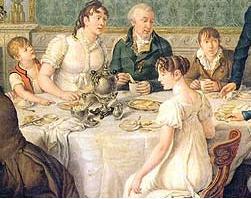
Family MealThe idea was that with all courses laid on the table, those dining would choose which dishes to eat, taking from the dishes nearest. It was polite to offer a dish around. Food in History notes, “It was a custom that was more than troublesome; it also required a degree of self-assertion. The shy or ignorant guest limited not only his own menu but also that of everyone else at the table. Indeed, one young divinity student ruined his future prospects when, invited to dine by an archbishop who was due to examine him in the scriptures, he found before him a dish of ruffs and reeves, wild birds that (although he was too inexperienced to know it) were a rare delicacy. Out of sheer modesty the clerical tyro confined himself exclusively to the dish before him….”

This style of serving dinner was known as service à la française. During the Regency this was replaced by service à la russe in which the dishes were set on a sideboard and handed around by servants.
Food Glorious Food

The wonderful thing about food is that it’s as much fun to read about it and write about it as to actually indulge–well, almost as much fun.  And the joy of writing a historical novel is the meals–breakfast, nuncheon, tea (but not High Tea unless you’ve a Victorian setting or a lower class who must make do with this for their dinner), dinner and supper were and still are the main eating occasions in England.

Meals often provide a social structure for life. However, as noted in The Jane Austen Cookbook, “In the late eighteenth century, at the time of Jane Austen’s birth, it was necessary to make the best possible use of the hours of daylight….candles, wood and coal were quite as expensive comparatively speaking as gas, oil and electricity and far more liable to be in short supply or to run out altogether during hard winters.”

What this meant was a different structure to meals.

To start the day, breakfast came around ten o’clock–well after most had risen and started their day.  The Regency morning then went on through the afternoon, with morning calls being paid.  In London, five o’clock was the fashionable ‘morning’ hour to parade.  And so serving a breakfast party might well occur sometime between one and five o’clock in the afternoon.

During morning calls, light refreshments might be taken.  Ladies might have a ‘nuncheon’ but the notion of lunch did not exist.  Also, the lush high tea now served at most swank London hotels actually originated as a working class dinner, and was perfected by the Edwardians into an art form, but was not a Regency meal.

Dinner in the Regency came at three or four o’clock in the country.  In London, the fashionable dined between five and eight, before going out for the evening.

This left room for a supper to be served–as either a supper-tray that might be brought into a country drawing room, or as a buffet that would be served at a ball.  Such a supper would be served around eleven.  Again, in London, this supper could be served as late as nearly dawn.

From the Georgian era to the Regency the method for serving dinner changed.  “…as soon as they walked into the dining-room they saw before them a table already covered with separate dishes of every kind of food…” states The Jane Austen Cookbook.  The idea was that with all courses laid on the table, those dining would choose which dishes to eat, taking from the dishes nearest.  It was polite to offer a dish around.  Food in History notes, “It was a custom that was more than troublesome; it also required a degree of self-assertion.  The shy or ignorant guest limited not only his own menu but also that of everyone else at the table.  Indeed, one young divinity student ruined his future prospects when, invited to dine by an archbishop who was due to examine him in the scriptures, he found before him a dish of ruffs and reeves, wild birds that (although he was too inexperienced to know it) were a rare delicacy.  Out of sheer modesty the clerical tyro confined himself exclusively to the dish before him….”

This style of serving dinner was known as service à la française.  During the Regency this was replaced by service à la russe in which the dishes were set on a sideboard and then handed around by servants.

Maggie Black and Deirdre Le Faye in The Jane Austen Cookbook provide this menu for a meal recorded in Mrs. Philip Lybbe Powys’ diary of some of the dishes she served, as hostess for her brother-in-law the Dean of Canterbury, for Prince William of Gloucester.  Fourteen sat down to a meal in August, 1798, that included:

Salmon
Trout
Soles

Fricandó of Veal
Raised Giblet Pie

Vegetable Pudding

Chickens
Ham

Muffin Pudding

Curry of Rabbits
Preserve of Olives

Soup
Haunch of Venison

Open Tart Syllabub
Raised Jelly

Three Sweetbreads, Larded

Maccaroni
Buttered Lobster

Peas
Potatoes

Basket of Pastry
Custards

Goose

Society meals were also being influenced at this time by the French chefs who had fled the revolution in their own country, and who had become a fashionable necessity in London.

Food in History gives this account of the dinner held by the Prince Regency at the Bright Pavilion, with his chef Carême in command on January 15, 1817:

“It began with four soups:

Le potage à la Monglas – creamy brown soup made with foie gras, truffles, mushrooms and Madeira

La garbure aux choux – country-style vegetable broth with shredded cabbage

Le potage d’orge perlé à la Cracy – a delicate pink puree of pearl barley and carrots

Le potage de poissons à la russe – ‘Russian-style’ fish soup, probably made from sturgeon

The soups were ‘removed’ with four fish dishes:

La matelote au vin de Bordeaux – a light stew of freshwater fish cooked in wine from Bordeaux

Les truites au blue à la provençal – lightly-cooked trout with a tomato and garlic sauce

Le turbot à l’anglaise aux homards, poached turbot with lobster sauce

La grosse anguille à la régence – a large fat eel, richly sauced, garnished with quenelles, truffles and cocks’ combs

The fish dishes were followed (the trout and turbot remaining on the table, the matelote and eels being taken away) by four grosses pieces or pieces de resistance:

Le jambon à la broche au Madére – spit-roasted ham with Maderia sauce

L’oie braiése aux racines glacées – braised goose with glazed root vegetables

Les poulards à la Perigueux – truffled roast chicken

Le rond de veau à la royale – round of veal, enrobed in a creamy sauce, finished with truffle purée and various garnishes

These grosses pieces (and the turbot and the trout) were flanked by no less than thirty-six entrée…”

Reay Tannahil, author of Food in History, gives a sampling of the various entrée, which includes macaroni and grated cheese, pheasant, rabbit, and other dishes, all with lush descriptions of rich sauces.  He adds that this was considered only the first course.

He also describes the set pieces brought in made of sugar icing and molded into such things as ‘The ruin of the Turkish mosque’, as well as the other entremets (between serving items) and the assiettes volantes, such as the five chocolate soufflé.

As stated earlier, while no one was expected to sample every dish on the table, the description makes it instantly understandable why the Prince Regent had run to fat.

The menus also reflect dishes familiar to any modern table–macaroni and cheese, trout with a tomato and garlic sauce, spit-roasted ham.

For a more simple family meal, Maria Rundell’s Domestic Cookery of 1814 gives this menu:

Crimp Cod

Salad
Gooseberry Pudding
Jerusalem Artichokes

Leg of Mutton

Crimp Cod is the simplest of recipes.  The directions are to take a cod and, “Boil, broil, or fry.”

For a salad, this is not what might be found in any modern American restaurant.  Instead, for Mrs. Rundell’s French Salad, “Chop three anchovies, a shalot, and some parsley, small; put into a bowl with two table-spoons-full of vinegar, one of oil, a little mustard, and salt.  When mixed well, add by degrees some cold roast or boiled meat in very thin slices; put in a few at a time; not exceeding two or three inches long.  Shake them in the seasoning, and then put more; cover the bowl close, and let the salad be prepared three hours before it is to be eaten.  Garnish with parsley and a few slices of the fat.”

Gooseberry pudding is a baked dish.  “Stew gooseberries in a jar over a hot hearth, or in a sauce pan of water till the will pulp.  Take a pint of the juice pressed through a coarse sieve, and beat it with three yolks and whites of eggs beaten and strained, one ounce and half of butter; sweeten it well, and put a crust around the dish.  A few crumbs of roll should be mixed with the above to give a little consistence, or four ounces of Naples biscuits.

(If you actually wish to try making this dish, you may want to start with gooseberry jelly, if you can find it.  For a ‘few crumbs of roll, think of this as something like a bath bun–a sweet roll.  Or for biscuit, think English cookie–something sweet to crumble into this.)

Jerusalem Artichokes offer another simple recipe in that they, “Must be taken up the moment they are done, or they will be too soft.  They may be boiled plain, or served with white fricassee sauce.”  Otherwise, prepare them as you would any artichoke, taking off a few outside leaves and cutting off the stalk (I also like to cut off the tips, but that’s optional).

For Leg of Mutton, Mrs. Rundell’s recommendation is, “If roasted, serve with onion or currant-jelly sauce; if boiled, with caper-sauce and vegetables.”  (Personally, I would swap in lamb for the mutton and opt for roasting it.  My grandmother who came from Yorkshire insisted on boiling all meat, and nearly made vegetarians out of all of her sons.)

And now I think I’ll go off and get something to eat.