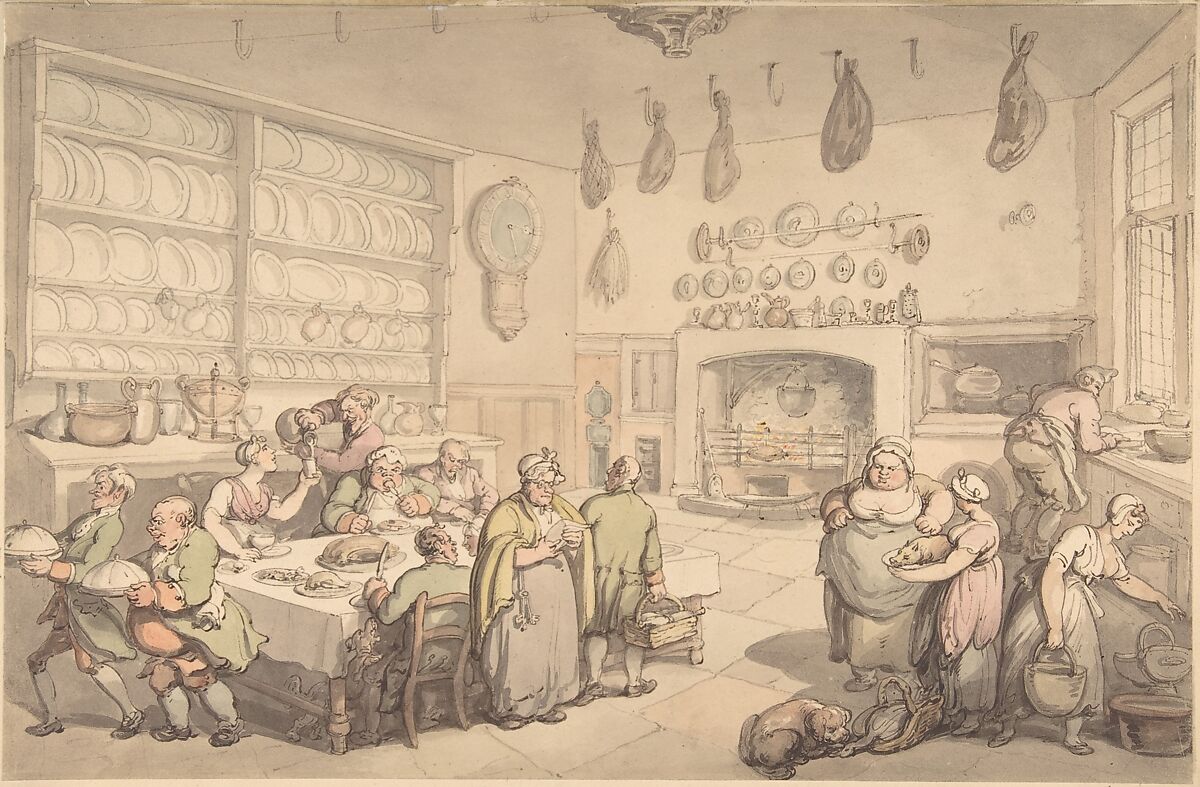
June was the time in Regency England when there would be fruits of all sorts ripening, vegetables aplenty, fish and meats of all types, and problems would only show up in the bad-weather years (such as in 1816).
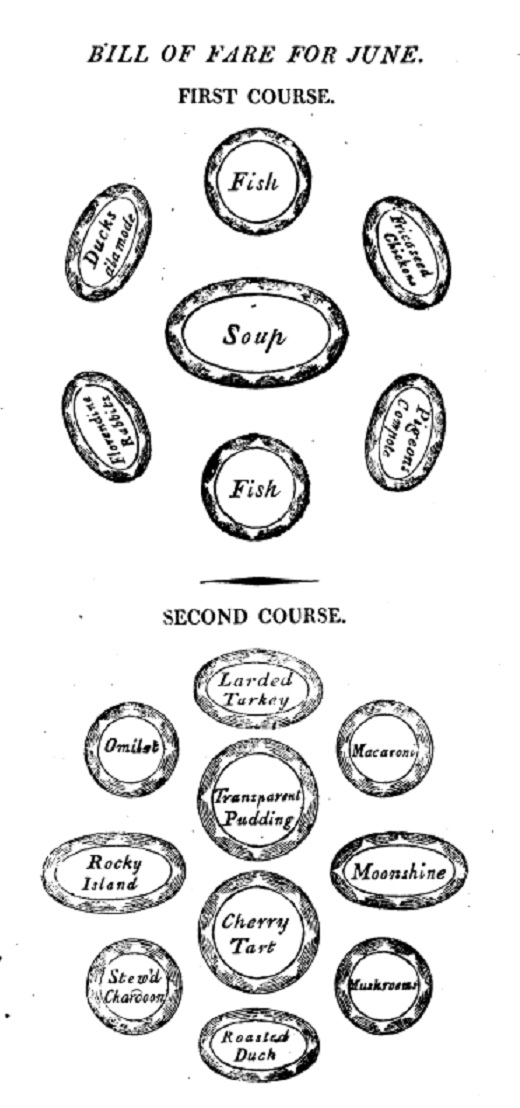
The Bill of Fare at left from The London Art of Cookery by John Farley, who had been principal cook at The London Tavern (chef was not in common usage until the late 1820s in England) . This shows a sample layout of two courses for a meal in June. The dishes are meant to be all on the table with each course, and you might help someone sitting next to you to a dish. Some items are obvious, such as fish, and soup in the first course, along wit pigeon, duck, and even fricassee chicken and rabbit (that simply means a type of stew).
The soup might be a white soup–very popular at the time–a pease soup, or even an expensive turtle soup. Turtle became available in late May or early June, having been shipped live from the West Indies, and was considered a wonderful dish. Turtles weighed in at anywhere from 30 to 600 pounds, and the cooking of turtle was held to be a special skill. A turtle might cost as much as 5s per pound, making it an expensive dish, and that is in addition to someone who knows how to open and clean the turtle.
Many opted for a less expensive ‘Mock Turtle Soup’, which could be a complex recipe. One recipe calls for the meat from a scalded calf’s head, ham, onion, carrots, turnip, celery, cloves, pepper, sweet herbs, lemon, truffles, marjoram, savory, thyme, parsley, chopped mushrooms, Madeira, the yolks of two eggs, the juice of half a lemon and half an orange, and then you throw in some “broiled forcemeat balls”. Those are basically ground meat made into balls and broiled.
The second course offers less familiar dishes.
Larded turkey simply means wrapping the bird in fat. The omelet might be cut into squares, and macaroni was a very popular dish. Mushrooms and a cherry tart are still something that might show up on a dinner table today.
The ‘Transparent Pudding’ in the second course is basically an egg custard in a puff pastry, while ‘Moonshine’ is an ornamental jelly and the ‘Rocky Island’ was a dessert with a custard base and ornamental paste meant to look like rocks. ‘Stew’d Chardoon’ refers to an older name for the artichoke thistle, a celery-like edible plant (the stem is eaten).
John Loudon’s 1822 book An Encylopaedia of Gardening offers up these outdoor tasks for June, along with vegetables and fruits available for the month, with some still needing to be found in a forcing department or hot house in the northern parts of England (citrus was always in hot houses):
JUNE
Fishing, Feeding and Mowing, Hire Harvest Men, Sheep Shearing, Burn dry weeds
Culinary Vegetables from the open Garden, or Garden Stores. Cabbages and cauliflowers in perfection. Kidney beans, peas, and common beans. Old potatoes from watered pits; new potatoes, turnips, carrots and radishes. Spinach, orache, and sorrel, in perfection. Young onions and chives; rocambole and garlic from the root-room. Asparagus and sea-kale in perfection till the middle of the month. Small salads, lettuce, lamb-lettuce, radishes. Parsley, purslane, tarragon, horse-radish, fennel, dill, marygold, &c. Thyme, sage, mint, savory, basil, &c. from the garden, and the others from the herb-room. Rhubarb-stalks, angelica. Samphire, three sorts Charlick, chickweed, fat-hen, orache, and willow-herb, as pot-herbs; orpine, ladies’-smock, &c. as salads; sweet cicily, as a garnish; sea-bindweed, as a pickle, and butterwort as rennet; ficaria roots as saloop. Morels from their native habitats; and the garden mushroom from covered ridges. Dulse, tangle, and the other sorts of edible fuci. Apples, pears, from Gooseberries, Almonds, walnuts.
Hardy Fruits from the open Garden, Orchard, or Fruit-Room. the fruit-cellar. Some cherries towards the middle of the month. Currants, strawberries, and raspberries, towards the end of the month. Chestnuts, filberts from the fruit-cellar. Some snowberries and tree-currants.
Culinary Vegetables and Fruits from the forcing Department. Mushrooms. grapes, peaches, nectarines, figs, cherries, &c. melons, cucumbers. Shaddocks, oranges, lemons.
Adding to the list of less familiar plants that have been covered in past months are:
- Sweet Cicily – a fern-like plant with leaves that have a sweet licorice-like flavor, sometimes used to sweeten dishes or can be made into tea.
- Sea-bindweed – which grows near the seaside, with a pretty white flower and can be boiled or pickled and used in place of samphire, but which has to be used with caution since it has a purgative effect.
- Butterwort – a vegetable substitute for rennet, which comes from the stomach lining of young ruminant mamals, used for curdling milk to make cheese.
- Ficaria roots as saloop – saloop was typically a creamy, hot beverage made from wild orchid roots ground up, but ficaria–also called fig buttercup–which had similar tubers in the roots could be used instead.
- Snowberries – these are noted to have a minty favor with a bitter aftertaste, and were sometimes used to reduce fevers or rashes, but are a purgative and so could be toxic in large quantities.
June also brings the celebration of Midsummer Eve (St. John’s Eve fell on June 23 and St. Peter’s Eve fell on June 28). Tradition was to light bonfires, feast and drink, and pretty much have a good old time. The celebration has ancient pagan roots, and celebrations often sat uneasily with the Church, even with the additions of saints to help sanctify the date. This probably also had to do with the fact that things often got out of hand.
Traditional bonfires are still lit on some hills Cornwall, such as Carn Brea and Castle an Dinas. Bonfires in Cornwall were also once common as part of Golowan, the Feast of St. John (Gol-Jowan). Midsummer festivals are also celebrated throughout Scotland, notably in the Borders (the hilly rural area between England and Scotland). The custom of dining with new neighbors was an ancient one that carried through to the Regency in villages with the idea of breaking bread being one way to cement friendships.
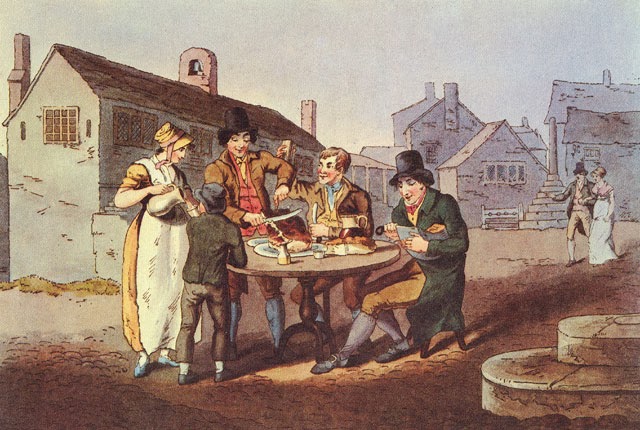
The print below is from George Walker’s The Costume of Yorkshire (1814), and in it he writes, “Every custom which tends to promote social intercourse and hospitality should be zealously encouraged. Of this class is the one here represented, which is still observed in some parts of Craven, and other districts of Yorkshire. New settlers in a town or village, on the Midsummer Eve immediately succeeding their arrival, set out a plentiful repast before their doors, of cold beef, bread, cheese, and ale. Those of their neighbors who feel inclined to cultivate their acquaintance sit down and partake of their hospitable fare, and thus eat and drink themselves into intimacy.”