Regency Coin — What Did it Cost?

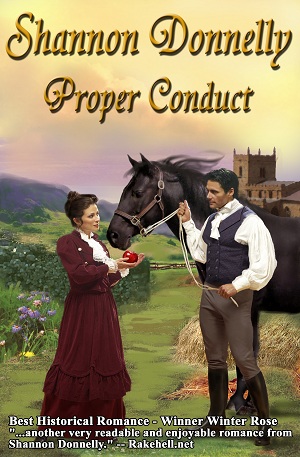
Proper ConductIn Proper Conduct, the heroine spends a good deal of time worrying about money that is not there, particular after her father spends nearly 1,000 pounds on a horse.  Not an excessive sum to someone such as the Prince Regent, whose racing stud farm cost him 30,000 pounds a year.  But all these numbers seemed to need a bit perspective.

We also have to remember that back in the 1800’s England was not on a decimal system–you had to know your farthings, pennies, and shillings. And coins were far more common for use than any paper money. Banknotes–slips of paper that promised payment for a set amount–were initially issued by individual banks. In the late 1600’s the Bank of England was established and by the late 1700’s their notes were viewed as being as good as gold (or silver). But Scottish banks issue their own notes until the mid 1800’s, and other private banks o issue their own notes until the mid 1800’s, and the last English private banknote was issued in the early 1900’s.

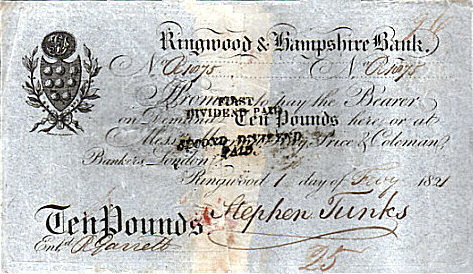
Banknotes began to be standardized in the mid 1700’s, with ten and five pound notes appearing. These were all hand-lettered and signed–and 1821 banknotewere viewed by many with deep suspicion. A coin, after all, was to hold the value of itself within it’s metal. And for many, a bit of gold or silver in hand was better than any promise given in a bit of paper. Banknotes were much easier to forge than any coin–another good reason for anyone to prefer payment in solid coin.
So we look to coinage as the most common form of currency.

In the Regency, we have as the main coins denominations:

  • Farthing – four farthing made a penny
  • Penny or Pence – twelve pennies (or twelvepence) made a shilling
  • Shilling – five shillings made a crown
  • Crown
  • Pound – twenty shillings made a pound
  • Guinea – twenty-one shillings made a guinea

In ledgers, a pound is often written with the pound mark–£. Shilling is written as an “s” or a slash mark, as in 6/ is six shillings. And a penny is written up as “d” for denarius, a Roman silver coin that had the same value as the English penny. So 4d is four pence.

Coinage in use in the Regency included:

  • Gold for one, two, five and half-guinea coins
  • Silver for one, two, three, four, and six penny (or pence), shilling, and crown coins
  • Copper for half-pence and farthing coins

Two-penny coins were called tuppence. And there were all sorts of slang names for coins including a quid (pound), a bob (shilling), and a goldfinch (guinea).

Due to a shortage of copper and silver coins in the late 1700’s, firms began to use tokens to pay wages.  There was also a growth in payments by foreign coins at this time.

The annual expenses of a great house could run between 5,000 and 6,000 pounds a year including housekeeping, repairs, stables, parklands, gardens, home farm costs, servants, and taxes.

Mrs. Whitney’s  Boarding School for Young Ladies at Buckingham cost twelve guineas a year, and one guinea extra if tea and sugar were required to be served.

In Bath, one paid two guineas were paid for subscription balls, five shillings for concert tickets, and ten shillings sixpence for a subscription to the booksellers.

With an income of 400 pounds a year, one could employ two maids, one groom and keep one horse in London.  On 700 hundred a year, one could have one manservant, three maids and two horses.  With an income of 1,000 pounds a year, one could have three female servants, a coachman, a footman, two carriages and a pair of horses in London.

There were three to four hundred families whose income was over 10,000 pounds a year, due to vast land holdings (hence, these were called “The four hundred” — it was a small world at the top).

During the London season, the lease on house in the West End could cost as much as 1,000 pounds.

Anyone with a debt of twenty pounds or more could be sent to debtor’s prison.  However, a member of Parliament could not be imprisoned while Parliament was sitting.

The capital to secure an estate was approximately thirty times the desired income–so, if you want to make 1,000 pounds a year, you need 30,000 to secure the amount of good land that could produce such an income.

The Earl of Egremont saw a rise in income due to land rentals from 12,976 pounds in 1791 to 34,000 pounds in 1824.

In Somerset (where Proper Conduct is set) 30 acres for let went for 35 pounds per annum, with the tenant paying all taxes except land tax.

In 1801, a 100-acre estate in Sussex sold for 3,500 pounds.

In 1804, due to the silver shortage, the Bank of England issued light-weight token silver coins for one shilling, three shilling and six pence coins.

From 1811 to 1812, an estimated 250,000 people lived comfortably on more than seven hundred pounds a year each.  A half million shopkeepers made a hundred and fifty pounds a year each, two million artisans lived on the edge of poverty at 55 pounds per annum, and one and one half million laborers earned only 30 pounds a year each.

In 1813, a cow fetched about 15 pounds at the market, while a ewe went for 55 to 72 shillings.

In 1816, a new British one pound coin made of gold, the sovereign, began to be produced.

In 1820, 1,100 years after the first English silver pennies were minted, the last British silver pennies were minted.

New Cover, New Book – Paths of Desire

Paths of DesirePaths of Desire comes out as an eBook this week—my first venture both into self-publishing and my first Regency Historical romance. I’ve been bringing out my backlist of Regency romances, and that’s encouraged me to take this next step.

There are several reasons to take “Paths” on this path, the main one being I really want the book out in print and in reader’s hands. It’s a book about courage and stepping out onto risky paths, so it seems to be one that really fits into new ventures.

It’s a book I wrote a few years back—my step into writing a longer Regency Historical. But it ended up being smack in the middle between being a Historical romance and a Historical novel—there are elements of both, and therefore it’s a hard book to market to publishers. Traditional publishers don’t know what to do with it. It covers ten years, a long time for a romance, and the hero is a married man—unhappily so. That’s a really hard sell to any romance publisher. But that’s something I wanted to deal with in this story. Fiction is a place to look at life, and romances can tackle issues of infidelity and what does it mean to love someone when you have ties to others. Yes, I could have pulled that out, changed the character to better fit the market, but this one stuck with me—this story needed to be told.

It’s a story about paths crossing—about how sometimes the timing for a relationship isn’t right, and then it is. The heroine struggles with her own issues—her need for security after having grown up on the streets of London and seen her younger brother die due to not having the money for a doctor. And also her realization that her acting talents are never going to get her to the top of her craft—limitations are a hard thing for anyone to come to terms with. The hero has both a loveless marriage with a wife who doesn’t really like sex, and a wanderlust that keeps taking him from home—he’s an adventurer, and the wrong man to love if you’re looking for that illusion of security. As with all my books, I wanted to give all the characters a “star moment” in the book—that was fun. It was great fun to research London theaters of the early 1800’s and to also be able to use Lady Hester Stanhope in a story—she’s the larger than life type of character that you could never hope to create and have believable because she defies all the conventions of the time.

So “Paths” is about to take its own path—and it’s actually been hard to let it go (compulsive editing and checking and I know I’ve still left typos in there or formatting stuff where Word is not playing nice with eBook formatting). But it’s been an adventure to get this ready to go out in the world—it’ll be another one to see if readers like something that’s a little different. But that’s the point of the book—we all have to find our own paths, and the courage to follow them if we’re to be worthy of our desires.

Look for Paths of Desire as Amazon Kindle eBook, exclusive to Amazon until April 2012.

Traveling in the Past – Cary’s New Itinerary

Cary's New ItineraryWhen writing about characters who live in the Regency, we often need t o get into those character’s heads. We need to see how they lived. We need first-hand experience. I’ve been known to read by candlelight–truly an eye-straining experience–brandish a sword, and even try a pen and ink to see what it’s really like (that’s pen as in a sharpened quill, and boy does it make you take time when you write).

But there are some books that offer a first-hand experience. And one of my favorites is Cary’s New Itinerary.

At the end of the eighteenth century, John Cary was commissioned by the Postmaster-General to survey all the principal roads in England. He did this by walking these roads, pushing a wheel connected to a counter, which kept a tally of the number of rotations and then produced an accurate mileage.

Between 1787 and 1831, Cary put his knowledge to use and published, among other books, the New English Atlas, The Travellers’ Companion, the Universal Atlas of 1808, and Cary’s New Itinerary. The maps and surveys have some of the most accurate and valuable data about the structure of the Regency world. They also provide an insight into how people traveled in the Regency.

Published in 1815, the fifth edition of Cary’s  goes on to explain that it is, “an Accurate Delineation of the Great Roads, both direct and cross throughout, England and Whales, with many of the Principal Roads in Scotland, from an actual admeasurement by John Cary, made by command of his Majesty’s Postmaster General.

There’s more detail provided at the front of the book in an “advertisement” that’s more of a preface.

The information alone on roads and distances, with fold-out maps provided, has helped me sort out the practical problems that face any Regency writer–such as, how far is it really between London and Bath?  And what roads might one take?  However, Cary’s offers much more.

Cary’s divides into neat, organized sections. The man was obviously methodical. The first section lists the direct roads to London– as in all roads lead to this metropolis. The next section gives a list of principal places–i.e., larger towns, that occur along the cross-roads.  A cross-road is a road that crosses one of the direct roads into London.  At this point, you begin to see how London-centric this world really was. As someone living outside of London, it would be your goal to get to a major town, and then you could get to London. Cary, living in London, wrote his book for outward-bound Londoners, and that is how the book is organized.

The next section is as important to a Regency writer as it would have been to someone traveling in the Regency–it is a list of coach and mail departures. This includes the name of the London inn from which the coaches departed, the towns each coach passed through, the mileage, the departure time, and the arrival time. It’s an utter godsend if you have to get your heroine to Bath at a certain hour on the coach. I can also picture Regency Londoners pouring over this information, planning short trips to the seaside, or to watering towns.

The next section lists all direct roads, as measured from key departure points in London, but this is not just a dry list of mileage. Descriptive notes are tucked into various columns to describe houses of note and distinctive sights.  For example, if you’re going to Wells from London, then, “Between Bugley and Whitbourn, at about 2 m(iles) on l(eft) Longleat, Marquis of Bath; the house is a Picture of Grandure, and the Park and Pleasure Grounds are very beautiful.”  This was an era in which slower travel meant taking the time to look at surroundings.

The next section provides a similar treatment for cross-roads, and not to be overlooked, Packet Boat sailing days are listed for England’s various sea ports, just in case an intrepid traveler whishes to travel abroad.

Finally, Cary’s provides an index to Country Seats, or as Cary’s notes, “In this Index the Name of every resident Possessor of a Seat is given, as well as the Name of the Seat itself, wherever it has a distinctive Appellation.”  This is actually a list from the 1811 returns to Parliament, as noted in the book. In the Regency, this actually would have been a much used feature, for it would allow a traveler to look up and visit various great houses and country seats. It was a time, after all, when visitors expected the great houses to always be open for show, and to be gracious in their hospitality.

Overall, Cary’s is not a book that will give you insight into the politics of the Regency, nor into the social structure of that world. However, between its worn covers lays the description of the Regency world that can put you back into that era, just as if you were traveling the roads of England in times long past.

The Desert Island Test

It’s contest judging season, and I have to say most of the manuscripts I’ve seen lately have been failing my “desert island” test. It’s a test I put my own plot ideas through—and it sorts out if all you have going is external conflict.

The question to ask is: If I dropped the hero and heroine in my romance onto a desert island, would there still be any conflict? If the answer is no, you know you’ve put all the conflict into external circumstances. There’s a problem with this.

Stories need conflict—the more the better. When you short-change your characters by having them only focus on external issues, you’re short-changing the romance and the reader. We all have issues. And the hero and heroine in a romance need to have personal issues that relate to the external ones you create to the plot—but these should be core issues. Issues so deep that dropping these two people onto a desert island would result in more than a few arguments—it might even result in separate living quarters on opposite sides of the island.

A good demonstration of this actually showed up in the second Pirates of the Caribbean movie. Captain Jack and Elizabeth are stuck on a desert island. Now these two are not the hero and heroine of a romance—the movie’s action/adventure—but you get instant conflict. She has ideas about how he should be acting, and he has ideas about getting drunk on rum, and since she’s here maybe he’ll have sex with her. The rum goes into an alert fire, thanks to Elizabeth. And now he’s ready to feed her to the sharks. She’s proper—he’s not. She’s focused on being active, facing their situation, taking charge—he’s focused on trying to avoid most everything, particularly the situation. You have personality conflicts showing up in action. That’s what makes a good romance into a great one.

Here’s the trick with this—it’s no good just giving a character arbitrary personal issues. These issues have to rub against the other person’s issues—if she likes cats, he has to be  dog guy, and vice versa. They have to be motivated in the character’s past—that makes the character more believable as a real person. And they work best if they have something to do with the external issues as well. As in, if these are cat and dog people, animals should probably come into the external problems (which is why you see stories about shape shifters and he’s a wolfman and she’s a cat-person quite literally—that’s amplified personal conflict since cat and dogs don’t even speak the same language).

For example, if you have a heroine who has been brought up a tom-boy, she’s going to have a pretty blunt way of taking action. She’s going to be insecure about having much skill with feminine grace, and she may end up pushy and take-charge. This is going to rub against a guy who is also take-charge and who has a pretty blunt way of taking actions. This is where being too much alike creates as much friction as does two opposites. I used this in Barely Proper for part of the conflict between here and heroine. I also did something similar in Under the Kissing Bough—the hero and heroine are two people with deep insecurities. They have different ways of hiding that they don’t feel adequate, but their insecurities keep cropping up and coming between them. For A Proper Mistress I went for the opposites. The heroine is level-headed and practical—she’s had to be due to her past. The hero is a bit of a wild cannon. They both learn from each other—she learns to enjoy spontaneity, and he learns a bit about responsibilities. So their issues become strengths to the other person—that makes for a very satisfying relationship, and a satisfying read.

So take a look at your characters—what would happen if you dropped them onto a desert island? Would they get along fine? Would one take charge and the other would allow it and all is good? Or would they fight and argue best plans for rescue? Would one be all about accepting the situation while the other is fighting it? Would one be exploring the island while the other hugs the beach, refusing to go into the dark jungle? How would their personalities clash—and how would their personalities complement each other?

Free Books at Amazon — What’s All the Fuss?

Amazon’s launched their “Select” program — meaning that Amazon Prime members can read enrolled books for free. These books have to be exclusive to Amazon for now. Authors decided if they want to opt in or not, and are compensated from a pool of funds that all participating authors share in based on total number of books read through the program. And you would think from all the fuss that the sky is falling yet again. (It used to be falling about every couple of years, but technology has accelerated this so that it’s falling at least once a month now.)

Personally, I think it’s an author’s decision what to do with his or her own writing. Give it away, sell it to the highest bidder, sign a contract with a publisher (a good one, or a even one that’s going to make your life hell)…it’s a personal choice and we all get to make ’em.

For Amazon’s program, I did sign up. I’ve two books enrolled, and I’m about to bring out a new book and put it in the program. It’s an experiment, but isn’t everything right now in this ever shifting market. However, what really got me excited about the program is that fact that it works like a digital library.

As a kid, I got my reading start in the local library. I still remember the pleasure of getting my very own first library card so I could check out my own books (instead of checking them out under my mum’s card). Free books at the library made me into a life-long reader. So free books online–a way for folks to access books and read more. That’s fantastic.

I don’t expect to get rich or famous from the program — I’m one of many authors. I do hope I’ll get additional exposure and perhaps sales of other books will go up — I know if I like a book, I don’t just want a copy from a library, I want a copy at hand. I don’t really think of this as “losing sales” — a sale isn’t a sale until money has exchanged hands, so I think folks looking for free books are folks looking for free books.

As to what anyone thinks of the program, I recommend taking a deep breath and going and reading the actual terms. There’s a lot of not quite true facts being batted around, and a whole lot more about how this is going to put other folks out of business, and given the number of books that are out there I think this is more than unlikely. There are tons of books out there, and exclusive distributions have been around for a long time in a lot of different outlets.The sky is not falling, publishing is not dead, books are still going to be around, and that means we’ll have booksellers, too.

It’s up to each author to decide for yourself if it’s right for you or not. Make the call that you can live with. If you don’t like the terms, don’t opt in. If you do, try it out. It’s that simple. No one is an idiot or a fool for making a choice here. And that’s the real joy of being an author right now–there are choices. Lots of them. And if you just want to post your books for free on your site, go for it. We all write for different reasons, and it’s about time we started to celebrate that diversity of choice.

Pistols and Duels

Part of the allure of the English Regency is that it’s an era for swords, horses, and flintlocks. Everything to buckle the perfect swash. Dueling–and a lady’s muff pistol–became part of my novel, Barely Proper.  The dueling information came from research, but the lady’s muff pistol, complete with safety latch to prevent accidental shots, came courtesy of my uncle, Eric Ericson, who collects flintlocks.

Part of the allure of the English Regency is that it’s an era for swords, horses, and flintlocks. Everything to buckle the perfect swash. Dueling–and a lady’s muff pistol–became part of Barely Proper.  The dueling information came from research, but the lady’s muff pistol, complete with safety latch to prevent accidental shots, came courtesy of my uncle, Eric Ericson, who collects flintlocks.

Barely ProperActually, by the mid 1800’s, the duel had become extinct in England. Queen Victoria, and the British government, had taken steps to end duels in the army–it was, after all, difficult enough to lose officers to battle, let alone, losing them to each other’s bullets. However, in Regency England, gentlemen could settle any disagreement with pistols, and might well be acquitted by a jury of any murder charge.

The notion of a duel of honor first appeared in England in the early 1600’s. The duel between Sir George Wharton and Sir James Stewart was recorded in 1609.  Prior to that time, an Englishman could settle slights and quarrels by hiring a gang of assassins to avenge any slight. Through the 1700’s, duels tended to be fought with swords. This was due, in part, to technology.

Hand guns date back to the late 1300’s in Italy and appeared in England around 1375. These used gunpowder, a mixture of potassium nitrate, saltpeter, sulfur and charcoal.  It would take another half century, however, for a mechanical device to appear to actually fire a hand gun. The standard flintlock gun came then came about in the early 1600’s, and by 1690 flintlocks has become standard issue for the English army.

The flintlock had been developed in France as a more reliable improvement upon matchlocks and wheel locks. The principal was simple–a trigger released a lock that held a flint which would then strike a spark in the priming pan. This pan held a small amount of gunpowder. When ignited, it then would ignite the main gunpowder charge in the barrel, firing a lead ball.

In contrast, the older match lock had used a “matchcord,” a braided cord of hemp or flax soaked in a saltpeter and dried. The slow-burning matchcord would then be lit. Pulling the trigger caused the lit matchcord to be pressed onto the flashpan causing ignition. The wheel lock improved on the matchlock with a system that worked rather like a cigarette lighter. Pulling the trigger caused a rough-edged steel wheel to strike a piece of pyrite held in a metal arm called a dog head.

Misfires with matchlock and wheel locks had been common. And the effort to reload consumed time. While flintlocks still loaded the main gunpowder charge and ball from the front, the only addition work was to then pour a little gunpowder into the flash pan.

Around the 1750’s, the practice of carrying a small sword or dress sword also died out, and with the advances in gun making, pistols became the standard for duels. Dueling pistols developed into matched weapons with a nine or ten inch barrel. Most were smooth bore flintlocks.

However, pistols could be as individual as the maker, or the owner. Jean-Baptiste Gribeauval made a pistol for Napoleon Bonaparte around 1806 that had a twelve inch long barrel. And a set of dueling pistols made around 1815 by W. A Jones and given to Duke of Wellington by the East India Company boasted saw-handled butts, which made it easier to steady the pistols, as well as “figured half stocks, checkered grips, engraved silver and blued steel furnishings.”

By the mid-1700’s London was well-known for its excellent gunsmiths. George Washington patronized a London gunsmith named Hawkins (a family name in my lineage, as this was my grandmother’s maiden name). As with many of the pistols from this era it offers silver decoration.

Dueling PistolsIn the late 1700’s, and during the Regency, Joseph Manton became one of the best and most fashionable gunmakers. Manton’s shooting gallery on Davis Street was where a gentleman went to practice before he might use one of Manton’s pistols in a duel. And an apprentice of Manton’s left in 1814 to strike out on his own with a business in Oxford Street. James Purdey’s company is still renown for its shotguns. Part of Manton’s success came from his first patent, taken out in 1777.  Manton went on to open his shop in 1793 and was soon known for shotguns and pistols. His fame came from guns that “were light, trim, well balanced, fast handling, and impeccably fit and finished. Stocks were slender and of fine English walnut with a hand rubbed oil finish.”

In the early 1800’s, a new development came along when a Scotsman named Forsyth patented the percussion lock.  This did away with the flashpan and flint.  Instead, an explosive cap was used, so that when the cap was struck by the pistol’s hammer, the flames from the exploding fulminate of mercury in the cap move into the gun barrel and ignite the main charge of powder.

With the advent of the percussion cap, guns with revolving chambers became reliable weapons. The revolving principle for a gun had been around for as long as the invention itself. “…There were repeating matchlocks as early as 1550, some capable of firing as many as eight shots with multiple barrels, each fired by a separate flash pan and operated by a sliding trigger mechanism…Both French and Italian gun makers as early as 1650 had developed magazine-fed muskets.” The “pepperbox pistol” had between two to six barrels that revolved upon a central axis.

Examples of such pistols that still exist include a double-barreled turn-over flintlock pistol, a six-shot flintlock had been made in France in the late 1700’s, a three-shot Venetian pepperbox dates back to the mid 1500’s, and Twigg of London had even made a 7-barrel flintlock pepperbox in 1790. A three- barrel design made by Lorenzo some time in the 1680’s exists that carries the Medici Arms upon it. However, the pepperbox pistol was notorious for the mechanism jamming. Or worse, all the charges in the barrels might be ignited at once time by a flint strike, resulting in the entire pistol discharging at once–or blowing up in your hand. The first accurate chambered weapons date from the latter part of the Regency, around 1810 to 1820. Multiple shot pistols, however, were not allowed in any duel.

The elegant matched sets of pistols manufactured for a gentleman might boast silver filigree or gold inlay. Their balance was paramount, for a pistol that could not be easily held up at arm’s length might mean an inaccurate aim and shot. Also, the “hair trigger” or a trigger that responded to the slightest touch could mean the difference in being the first to get off a shot.

In the early 1800’s duels might be fought for honor, as in the case of a duel fought in Hyde Park in March 1803 between two officers, and reported to have been held to avenge a sister’s dishonor. Or it might be an absurd affair, as in the duel fought in London on April 6 that same year. This second affair involved Lieutenant-Colonel Montgomery of the 9th Regiment of Foot and Captain Macnamara of the Royal Navy, and was reported to have started when the two men, both riding in the park and each followed by a Newfoundland dog, had their dogs start to fight. This led Montgomery to exclaim, “Whose dog is that? I will knock him down.”  That set off an argument that resulted in a meeting at seven that evening near Primrose Hill. Even the Duke of Wellington fought a duel.

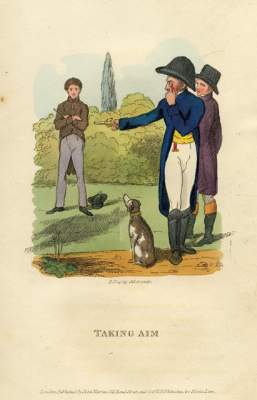
Taking AimDuring the Peninsular War, Wellington had been known to frown on dueling among his officers.  However, in 1829, Wellington’s support of the Catholic Relief Bill angered the Earl of Winchilsea, who then made public a letter that disparaged the duke accusing him of having, “…insidious designs for the infringement of our liberties, and the introduction of Popery into every department of the state.”  Wellington pushed for reparations, and would be satisfied with nothing less than a meeting over pistols at Battersea Fields. “At the word ‘fire,’ the Duke raised his pistol, but hesitated a moment, as he saw that Lord Winchilsea had kept his pistol pointed to the ground.”  Wellington then fired at random, as did the earl. The press did not approve and reported, “…all this wickedness was to be perpetrated–merely because a noble lord, in a fit of anger, wrote a pettish letter…Truly it is no wonder that the multitude should break the law when we thus see the law-makers themselves, the great, the powerful, and the renowned, setting them at open defiance.”

Illegal as they were, duels were numerous, and were often not prosecuted unless proven fatal.

In the duel between Macnamara and Montgomery fought over their dogs, both were wounded, Montgomery fatally so. Macnamara recovered and was tried for murder, and his arguments for his motives being that of “proper feelings of a gentleman” carried enough weight that the jury returned a not-guilty verdict, even though the judge asked them to find Macnamara guilty of manslaughter.

Times and sentiment changed, however and in 1838 when a Mr. Eliot shot and killed a Mr. Mirfin in a duel, the jury returned a verdict of willful murder. The trial smacked of class prejudice, for in 1841 when Lord Cardigan was tried in the by his peers in the House of Lords for dueling, he was found not guilty.

By 1843, an Anti-Dueling Association had been formed and by 1844, Queen Victoria was discussing with Sir Robert Peel how to restrict duels in the army by “repealing an article of the Mutiny Act, which cashiered officers for not redeeming their honor by duel.” The Regency by then had long passed, and so had the era of pistols for two at dawn to settle affairs of honor, and so had the art of the elegant and deadly dueling pistol.

To read more on dueling pistols, try:

Antique Guns by Hank Bowman, Arco Publishing Co, Inc.

The Illustrated Encyclopedia of Firearms by Ian V. Hogg, New Burlington Books

Gunmakers of London 1350-1850 by Howard L. Blackmore, George Shumway Pub

The Duel: A History by Robert Baldick, Barnes & Nobel

Christmas Stories

It’s Dicken’s fault–he started the trend. Now, maybe there were Christmas stories around before A Christmas Carol (favorite film version being the one with Alistair Sim), but Dicken’s became the one trotted out every year with the trees and holly and mistletoe. And why fight success. But I actually never set out to write a Christmas story.

Under the Kissing BoughUnder the Kissing Bough started life as a short story. It was supposed to be about 100 pages, and I actually didn’t start out with a time of year, but I did want to see if I could do a novella. I’d been writing a lot of novels and hadn’t done any shorter fiction in a long time, and I actually really, really like the shorter format. It’s a challenge to work in, but can be rewarding. I forgot one thing–you cannot do a short story with lots of characters. Not and do all the characters any kind of justice.

You see, I love to give every character a ‘star turn.’ I think of them all as actors, and every actor–even ones with bit parts–loves to have that great screen moment with wonderful dialogue that moves the story (and the audience). All this mean that with large families (heroine has two sisters, and her parents; hero has father, two brothers, and a former love interest who is now married), I knew that by page seventy, no way was this story ever going to fit into 100 pages. So I put it aside.

And then my then editor at Kensington asked if I’d like to do a holiday book–a Christmas story. “Sure” is always the immediate answer I provide in such situations. And then I had to figure out what I could do for Christmas. Because I can’t just stick on some holy and call it holiday. To me, if an element is not important in the story–and to the characters–it’s got no business being stuck in.

This mean research–as in I needed to dig into English Christmas customs (not difficult since I had a grandmother from Yorkshire and a lot of handed-down family traditions). And I dug out my short story to take another look.

The December setting suited my characters very well–I’d already set up a ‘marriage of convenience’ story (always a wonderful plot to use for historical fiction). Now I could weave in the holiday customs, make them part of the plot and the story (because, in England, you really, really need a very good reason to get married in the cold of winter). There were a few things I couldn’t quite fit into the story due to the limitations of page counts (from the days when that mattered so very much in print)–as in it would have been fun to do more with Twelfth Night celebrations. But I did get other things in there that I loved adding.

And I ended up with a Christmas story.

I’m toying this year with rereading it. I don’t often reread my own work. When you’ve spent a long time writing and revising, another read seems more of a burden than a treat. But it would be fun to do another holiday story. Mmmm…maybe Guy Fawkes day.

Rules of the Written Road

Kurt Vonnegut came up with eight rules for writing fiction, nicely referenced in an interview with Andrew O’Hagan, and noted there by O’Hagan as: “His rules for good writing are entirely bogus – he knew it, too – but they are not un-useful. Rules are just a bunch of things someone adorned into precepts while they were on the way to getting it wrong, but Vonnegut got it right now and then so we’d do well to listen.”

Vonnegut’s work, like his work, is more than “not un-useful” and it got me to thinking if I have rules. But then my love/hate relationship with rules kicks in–there is much to be said for wandering off any well-troden path. Something Vonnegut agreed as well with when he said, “The greatest American short story writer of my generation was Flannery O’Connor….She broke practically every one of my rules but the first. Great writers tend to do that.”

Now I do hold that extraordinary talent can get away with almost anything–and everything.  However, I’m pretty damn sure most folks over-estimate their talent by a huge factor.  Talent also, like a charming relative, can wear out its welcome way too fast if that’s all there is–auditions for any reality show prove this over and over again.

So…rules, or no rules? Or do you try a compromise and call them guidelines? But then I’m always suspicious of compromise in art–it tends to lead to a mush that no one can love.  Or, to put it another way, mix all your colors and you get bland gray mud. So how about  we say that it’s not bad to know the rules, use them, and ignoring either at your peril or only because they don’t work. But this brings us back to folks abusing the rules, ignoring them, and not necessarily coming up with a good story.

Also, writers being writers, the temptation to be clever crops up, as when Vonnegut’s advises to “Start as close to the end as possible.”   That’s about as much use as telling someone, “Start in the right place.”  Well, duh.  If one knew that, a whole host of other writing problems would be solved in an instant.  But the rest of his rules are good ones to lean on.

It’s also useful to have things boiled down by a pro like Vonnegut to what’s really important.

Personally, I find the last one the most useful:  Give your readers as much information as possible as soon as possible.

Seems to me that most folks mistake ‘tension or suspense’ as coming from a reader not knowing something. In truth, suspense comes from the reader knowing a lot and a character missing out on some key info, or just a plain old fashioned ticking clock going.  But there’s a caution here, too–too much information is as dangerous as too little.  You can overload a reader.  So the trick is:

Give your readers as much IMPORTANT information as possible as soon as possible–and make sure it’s interesting.

This automatically helps with not wasting anyone’s time.  Also, it cuts down on repetition. Saying something once is interesting. More than that and your now wearing on the nerves.

Two, three and four are all solid.  But ‘how ‘ to do all this becomes the question, so we have to expand this one…

Give the reader at least one character he or she can root for–as in you need to show that character early on doing things that earns a reader’s sympathy. We all admire talent, grace, good deeds. You can have a character get away with a lot if you set up a few traits the reader will fall for right off the bat.  Sympathy (by understanding someone) is an awesome hook.

Good to remember, too, that what you tell a reader often doesn’t stick. What you show, stays forever.  (i.e.–only bad guys kick the dog.)

Every character should want something, even if it is only a glass of water. This goes for every character and every scene. And again, is best shown by showing the character doing stuff to get what he or she wants.  The other shoe that needs to fall here is that something or someone should stand between the character and his or her goal. Conflict is what keeps any story popping.  Doesn’t have to be world-ending stuff, but does need to be there, or you’re back to wasting someone’s time. So could add here…

Every character should want something, even if it is only a glass of water–and something or someone should come between the character getting that want satisfied.

This also actually then ties into the advice that, Every sentence must do one of two things: reveal character or advance the action. If you’ve written a character who wants something, then what you’re writing is more likely to reveal something about that character (the want does that) and advance the action. Keep in mind that this does not mean ‘no description.’  Used right, descriptions can reveal everything.

And all of this then fits into, Be a sadist. Give a character a ‘want’–then you find ways to keep the candy from reach. Or give the character the candy, and have it blow up. Take joy in your work–in making life more complicated, making goals harder to reach, and raising stakes for failure to unbearable.  It’s not so much sadism as tough love–put your characters though the worst things possible so they can come out the other side knowing themselves better.

Now for the tricky bit–Write to please just one person.  There is a danger in getting too many opinions, particularly if the input comes too early.  It’s like opening the oven to see if the souffle is done–the thing usually falls flat on you.  Alternately, you’re going to have to show your work at some point unless it is just for you.  So, really, this to me is…

Write to please just one person–but learn to edit and take advice once the writing is done.

If one other person sees a mistake, maybe they’re wrong. Two people, same flaw–time to look at the pages. Closely. Three folks…ignore that at the peril of either appearing stupid in print or not even getting to that point. In this world, keeping the writing close is not a bad thing. But if your goal is to publish and be accessible, then eventually you not only have to open the window, but you have to throw your work there.

So those are my rules, I guess. My guidelines. I reserve the right to throw them out, but only if the story really, really, really needs something different.

The Balancing Act

Adobe Walls Going UpWe’re building a house–it’s a passive solar adobe straw bale hybrid, meaning we’re inventing some things as we go and learning a lot. And we’re working damn hard. As in laying actual adobe bricks. Which also means my life’s out of balance. Again. This happens with obsessive-compulsive types, but I can’t moan too much about being that type since it also helps with the writing. But…a little more balance is needed. As in I need to carve out my writing time again.

I was doing great with this. Up an hour or so early. Get my coffee, sit down and write. Even a few pages is great, and I could often do five or ten before the day got cooking. Then it got cold. And dark. A warm bed is now too much of an invitation to lounge. It’s not going to get warm again for more than a few months–meaning I need to adjust my schedule, or I’m going to have to bite the bullet and get out of bed. Since the latter is not too likely, I’m going to try other things. Such as making sure I have my priorities sorted out. And pulling out the pages to mess with them every day, even if it’s only for a few minutes here and there.

It’s all part of the balancing act–one I have to go through every few months (or sometimes every few weeks). Get enough sleep, enough food, enough solitude–too much company and my brain gets too busy.  A little bit of “bored” time is a good thing. So is a little bit of daydreaming time. But there always seems to be other things making demands on my time. Which is when I have to remember what’s important. And, yes, house done before winter would be a very, very good thing — warm place to write…mmmmmm. But I’ve got a book that’s begging to be finished. For a writer, you’ve got to write.

Cat’s Cradle – Behind the Story

Cat's Cradle There’s a story behind every story–this one is about Cat’s Cradle, which is now available at Amazon for Kindle, BN.com for Nook, and at Smashwords. And I have to start this off by saying I’m partial to this story–ridiculously so, for a couple of reasons.

The first reason is this is the first Regency novella that I wrote. That’s not to say this is the first short fiction I’d written. I’d actually cut my writing teeth on shorter works before I went after novels–in fact, I wasn’t sure I could write anything longer than fifty pages or so until I’d written a longer work. But I’m a believer that structure is structure. Meaning if you can structure a story, you can structure a story. The nice thing about starting off working in shorter form is that there’s no room for wandering. In a novel, you can put in side bits, you can mess around a bit, you can basically add fluff. You can get lost. In a novella or short story, every word counts, so they all have to be right. You have to keep your focus. And I love working within the restrictions that applied.

The second reason this story holds a special place in my heart is that when I was asked if I’d like to do a kitten story, I knew I wanted the cats/kittens to be integral to the plot–they could not be stuck in there for window dressing (I hate that kind of story). With that in mind, I applied my theory of idea hunting–I went mining my past.

Now, I’ve heard it said that some writer write about their own lives and some steal other people’s lives for their source. I’m not sure which group I fit into–I’ve done both. But I do find that mining my own past tends to make for stronger stories. And I’d had this cat.

Stripey showed up one summer day when my brother and I were eating lunch on the back patio. She was–as she was named–a grey-striped cat with white patches. She was also hungry. And I was not about to eat the baloney in my sandwich. (I have never liked baloney and still do not eat the stuff.) Stripey was happy to help out with the sandwich, and since she hung around for more handouts, she became my cat. (I seem to recall there was also shameless begging on my part, but the end result is that Stripey stayed long enough to give us three litters of kittens.)

Most of time Stripey was the most timid of cats. She was the cat other cats chased–the weakling into whose face all felines kicked metaphorical sand. Until she had kittens. Then she became Stripey the Tiger, capital GRR. No one messed with her kittens–or her when she had kittens to look after. She also had one other habit. Her idea of the proper place to raise the kittens was in the garage.

We had an old dresser in the garage and my dad stored his tools and bits and pieces there. Stripey also insisted on having her kittens in the bottom drawer, which wouldn’t close. No matter what kind of beautiful kitten basket we made her, the kittens came into the world in that dresser. We’d try putting the kittens into the basket for her. Soon, she’d be trotting back to the garage, one kitten at a time dangling from the hold she had on the scruff of their necks. Eventually, we gave way to her demand that the kittens spend their first few weeks in the garage–as I said, she was more than decisive with kittens in her charge.

Stripey’s story became the story of “Bea” who insists on having her kittens in one place, even if that place proves inconvenient for her owner. And that became the catalyst (sorry about the pun) for the romance in the story.

Of course, a cat alone a romance does not make. Meaning I needed a hero and heroine to go with the cat. Obviously, such a protective mother as Stripey needed an owner with the same inclination–like cat, like owner. And so the hero would have to pose a threat to my heroine’s offspring (but the husband would have to be out of the scene). Thankfully, my muse presented me with two very good candidates–Ash and Evelyn. This also gave me a chance to do a fresh take on the “proper spinster” (the heroine’s not actually a spinster), and the bad boy (Ash isn’t that bad, either, but he does have a past that’s not all that savory).

One thing I’ve found with short stories or novellas–you have to limit the characters. Too many characters and you either cannot do justice to everyone or the story expands into a novel (that’s a tale for another day about Under the Kissing Bough and how that came to be written). But Evelyn needed boys–two youngsters, because it raised the stakes for her to have kids to look after. And Ash needed someone, too, because it’s no fun having the hero talk to himself or spend all his time brooding and thinking–besides, long-time servants are as good as family and families always cause the best additions of conflicts for characters. So that rounded out the cast to about six (including Bea, the cat–the kittens are a little too young to be more than “spear carrying” kittens). And there’s a couple of walk-ons, but a novella could handle that.

And so Cat’s Cradle was written. It’s one of those blessing stories–it flowed from start to finish, and I loved writing every bit of it. I got to have fun, and to put in those little bits I love in a story. I don’t know that it’s one of my best works, but it’ll always be a special story for me. I’m more than delighted that it’s available again, now as an e-book.