Susan Squires Guest Blog: Set the Stage – Part II

Do You Believe in Magic?Today Susan Squires Guest Blog Part II on Settings, with examples from her own work….

Susan Squires is New York Times bestselling author known for breaking the rules of romance writing. She has won multiple contests for published novels and reviewer’s choice awards. Publisher’s Weekly named Body Electric one of the most influential mass market books of 2003 and One with the Shadows, the fifth in her vampire Companion Series, a Best book of 2007. Her latest book is Do You Believe in Magic? which is available in print or as an ebook.

Susan has a Masters in English literature from UCLA and once toiled as an executive for a Fortune 500 company. Now she lives at the beach in Southern California with her husband, Harry, a writer of supernatural thrillers, and three very active Belgian Sheepdogs, who like to help by putting their chins on the keyboarddddddddddddddddd.

And now let’s hear from Susan:

SET THE STAGE PART II

As an exercise, look at your current work in progress to be sure that every setting has at least some description. Then ask yourself, “Have I used the most telling details, ones that not only describe my setting, but my theme or my character?” Then continue with the question, “Do I need all this description for my reader to get the idea I’m trying to convey?” That’s a good place to start.

Now, I still struggle with this every day. Here are a couple of examples from my latest book, Do You Believe In Magic?, the first in my Children of Merlin series about the big and very successful Tremaine family who are descended from the wizard of Camelot. Each sibling will come into a magic power when they meet and fall in love with another who carries the Merlin gene. This first book is about Tris, the bad boy brother who doesn’t believe in his destiny. He certainly never suspects that he’s met his future in the middle of Nevada in the person of one Maggie O’Brian, a spitfire little rodeo rider.

First, a light description that introduces Maggie and Tris, in Maggie’s point of view, in the second scene of the book. We won’t be back to the diner, but her truck and Tris’s bike tell us a lot about them.

It was a hundred miles into Fallon. She’d been so anxious to get away, she hadn’t eaten breakfast. Since she was flush, at least for a minute, she decided to stoke up on some of Jake’s steak and eggs. Maggie O’Brian’s rig clattered into the dirt parking lot next to the diner. The four-horse trailer was one of those old iron slat jobs where the horses were tied in at an angle. It made a God-awful racket when it was empty. Truck wasn’t exactly new either. Ford F250, vintage 1970. But the big 390 diesel did the job. You couldn’t see much of the faded red paint under all the dust anyway, so the dings and dents didn’t matter.

She climbed out of the cab. A kick-ass black Harley with minimum chrome and scarred leather saddlebags leaned on its stand in front of the diner windows, no doubt so the owner could keep an eye on it. Covered with road grit and sporting a couple of dings itself, it wasn’t a Sunday afternoon ride for some rich Hell’s Angel wannabe. That bike had seen action. Maggie pulled open the ancient screen door, the smell of grease and fried pork product wafting over her.

The only people in the diner at this hour were usually locals. It was too early for tourists in the “living ghost town,” of Austin, Nevada. The counter was filled with single old guys, leaving only one empty seat next to a really broad-shouldered man. He was the youngest guy in the diner by probably forty years. She didn’t recognize him. He must be the owner of the cycle. His black leather jacket was slung over the low back of the barstool, leaving a faded blue work shirt, longish black hair, and some three-day stubble the only things she could see.

This, on the other hand, is a major description of the Maggie’s house as the Tris sees it for the first time. The house will be the setting for a climactic scene later in the book and it says something about Maggie, so I took some time with the description. The old rusted truck, the propane tank and the windmill will all be important to the story. Could I have cut it? As I read over it, I think maybe so. We all just keep trying to find the right balance.

A motel actually seemed like a safe haven. Tris couldn’t imagine spending the night under the same roof with Maggie and her father. Or rather he could. He could imagine what she’d wear to bed. Probably a tee shirt. And nothing else. He could imagine hearing her undressing in another room. He could see her slim, muscled rider’s legs and imagine them wrapped around his hips…. Shit. Apparently he’d gone from not giving a damn about women at all, straight to what probably amounted to addiction. Do not pass go. Do not collect two hundred dollars.

Her father would kill him if he saw the hungry look in Tris’s eyes.

He chewed the inside of his lip as she turned the truck down an unpaved road, really just two tire tracks in the sandy dirt where the mountains flattened out into desert. The tracks wound through a dry streambed that would have to be forded in the rain. In the distance a clump of feathery gray-green Palo Verde trees clustered around a weathered house with a corrugated iron roof and a sagging front porch. The whole shack seemed about to disappear into the gray and brown colors around it. The roof barely supported a TV satellite dish. A white propane tank that looked like a Tylenol pill settled out a ways from the house and a windmill towered behind it, blades spinning lazily in the desert wind. That well must be their source of water way out here. A pickup, circa ’48, more rust than metal, sat on blocks next to a late ’70s station wagon with peeling white paint. No yard. But he could see a lean-to full of hay bales out back and some pipe corrals with horses milling around in them, peering over the rail toward the approaching truck. He recognized the mustangs he’d watched her gentle but there were others too, less rough looking. As they got closer, he realized the horses were much tidier than when he’d last seen them. The lean-to was freshly whitewashed and the water barrels in the corrals were painted a bright blue-green in contrast to their desert surroundings.

Someone took care of the horse part of the property—the house, not so much.

He caught himself wondering what his family would think of a girl who came from a house like this. Sere and hard. That’s what her life must be like.

Her mouth was set in a grim line as she pulled up behind the station wagon. She cut the engine. Staring straight ahead, she said, “Don’t pay attention to Elroy. You’re my guest here.”

“Okay.” He hoped that word wasn’t loaded with the dread he felt. He tried not to let in an ounce of judgment either. He had no right. But he saw why she wanted to be on the road.

To read more about Tris and Maggie, and learn about Susan, visit www.susansquires.com.

Susan Squires Guest Blog: Set the Stage, Part 1

Bestselling author Susan Squires is guest blogging today on settings.

Susan SquiresIn addition to being a New York Times bestseller, Susan is known for breaking the rules of romance writing. She has won multiple contests for published novels and reviewer’s choice awards. Publisher’s Weekly named Body Electric one of the most influential mass market books of 2003 and One with the Shadows, the fifth in her vampire Companion Series, a Best book of 2007.

Susan has a Masters in English literature from UCLA and once toiled as an executive for a Fortune 500 company. Now she lives at the beach in Southern California with her husband, Harry, a writer of supernatural thrillers, and three very active Belgian Sheepdogs, who like to help by putting their chins on the keyboarddddddddddddddddd.

And now over to Susan (and the Belgians)….

SET THE STAGE – PART I

Learning to write good settings for your stories can serve two purposes. Setting the scene of the novel helps draw the reader into the book immediately, giving them time and motivation to connect to the characters. Setting makes them feel as if they’ve “gone to another place.” Readers love to be carried away. And if you can connect the setting to the characters, you deepen the reader’s understanding of them, also increasing reader satisfaction. So–setting the scene well is a good thing, no matter what kind of books you write.

First, I admit that description is scary. How much do you describe? How do you know you have described your setting in a manner that will engage the reader? In the end, there are no single right answers to these questions. But I can share a few tricks of the trade I’ve learned along the way.

The concept of using “telling detail” has helped me immensely. First decide what the milieu of the scene will be. Is this midnight in a circle of standing stones? A sumptuous Italian palace in the early nineteenth century? The cubicle farm of a giant technology company? I’ve used all of those. Put yourself there in your imagination. Look around. Listen. Take a whiff. Feel the effect the setting has on your body. Take a moment to really understand what it would be like to stand there.

Okay, got it? Now comes the hard part. If you really described all that, the reader would be snoozing. So pick the important details. What’s important? Well, it’s what tells your reader most about the setting itself, the characters, and about what you want them to get from the story. Do you want the jungle in the Caribbean to be dangerous? Then make it night. The air is so heavy with heat and humidity that your characters can hardly breathe. A reptile of some kind always represents danger for me, or describe noises your protagonist can’t identify. What if you’re describing a small town main street in a contemporary setting? Well, what role will the town play? Is the town poor and your character is aching to get out? Is your town a symbol of the simpler times the characters never want to leave? Those decisions will tell you what details to include.

It goes without saying that you try to involve as many senses as you can. That draws your reader into the milieu whether they want to come or not! You don’t have to mechanically tick off inserting every sense into every description. Pick the senses that will most evoke your story and use them.

Now let’s talk about how settings are related to your characters. The description is either from a character’s point of view, or if you don’t specify, by default it’s from the author’s point of view. The author talking, (omniscient POV) makes the reader feel like she’s watching the scene, not living it. While this was common in novels of the nineteenth and early twentieth century, it’s no longer enough to keep readers reading. Hook your description to a particular character’s POV.

How do you do that? Well, you’ve experienced your setting in your own imagination. Now think about how your character would think about those details, based on who he is, his background and his most recent experiences. How does that change the description? Is the person in your Caribbean jungle a fearful young girl who knows nothing about nature? Is he an ex-military man trained in survival? These two characters would experience the setting differently, and HOW they experience it will tell us something about them. This can be an exciting way to introduce hints at a character’s background and personal characteristics, too.

New writers often make the mistake of piling on the descriptors, thinking it makes their settings more evocative. Nouns are not carefully chosen, every noun has an adjective (or two or three) and multiple clauses say basically the same thing in different ways. This just makes the prose heavy going for the reader. It’s much more effective to choose the right noun and add adjectives sparingly, so they stand out in the reader’s mind. Don’t worry about this in the first draft–just write. But when you go back and revise, cut out the excess. You’ll never believe what a difference it makes in your prose.

Not every setting needs the same detail either. A setting that’s important to your character, or one where much of the action occurs, should have a fair bit of description devoted to it. But if the setting is used only in a single scene and it’s not important to any of the characters, an evocative word or phrase will do.

Do you have to do the description of setting all at once in a big paragraph? Absolutely not. It’s better, in fact, to layer it in. But be sure to start with a little bit of description to ground the reader. I’ve read many contest entries that do a wonderful job with setting, but only get to it three-quarters of the way through the scene. Meanwhile the reader has been wondering, where are these people? Annoying, even if the annoyance is subconscious. You never want to produce a subconsciously annoyed reader.

In conclusion, descriptions don’t have to slow your story down. They can be satisfying in themselves. Choose only a few telling details. Describe the setting through a character’s eyes. And take the time to find the right nouns and a few right adjectives.


Check back Wednesday for Part II with some exercises and examples on better settings. To find more out about Susan, visit www.susansquires.com.

What You Feel

There’s a lot of books about writing techniques–and this stuff is important. If craft stuff gets in your way, it ends up bending the story in ways that are not good. Tangled sentences and awkward paragraphs can kick a reader right out of the fiction. However, it’s not just about the craft. You have to have something that matters–to you.

This is where I think so many writers go wrong. A writer heads into vampire territory since vampires sell, or writes a historical without really having a deep passion for that era and a longing to dip a toe into living in that time, or gets caught up in what should be a cool idea. But the passion is missing. This is where you get the good book–the writing may work, but there’s just something off. It’s like eating a pizza where all the ingredients are there, but someone didn’t add the fire needed to take okay into amazing.

You can fake almost anything, but you cannot fake passion.

You also need this because at the end of a couple hundred pages even the hottest need to write has cooled so if you start out anything less than desperate to write a story odds are not good for getting the thing finished.

For me, this passion, the feeling that works to keep working comes from loving the work (and hating it sometimes, too), from needing to write the story, from not being able to stay out of that fictional world. It’s got to be there or you end up with words on a page. Which is not a bad place to start. But at some point you have to put more into it.

And that the scary part–you don’t always know when you’ve got that more.

Sometimes writing is worse than ditch digging (I’ve done both, and the digging breaks your back, but writing can break your soul by inches). Sometimes it feels bad but it’s actually really good stuff. You just don’t know. You lose perspective on it, and that’s what you want. You want to be so deep into it you have no idea. You have to throw everything to the winds and dive in and you just have to be willing to make a fool of yourself.

You have to be willing to write god awful stuff and write stuff that may just be tripe and you have to be willing to write stuff that others may hate, because that also may be your best stuff. To me, this is only fun if you’re taking chances. And what’s the worst of it? Someone slams the work (and, yes, that does irritate, but so what–the work is done and has that person ever written a book?), or someone slams you (not the work, which is even more irritating and these folks need to learn the artist is not the art–there are only glimpses of the artists at that moment in time in the art). But this is also where a cool thing happens.

If you’ve written something you really put yourself into, you don’t care as much about what folks say. Because you have the work in your hands. You’ve done your job and if you’ve given it your best there’s a satisfaction in that. You have something that matters to you–and that’s what you hang onto.

The other good news is that the more you do this, the more this becomes a habit. It never gets easier. But it becomes the default way to write.

Regency Travel: Cary’s New Itinerary

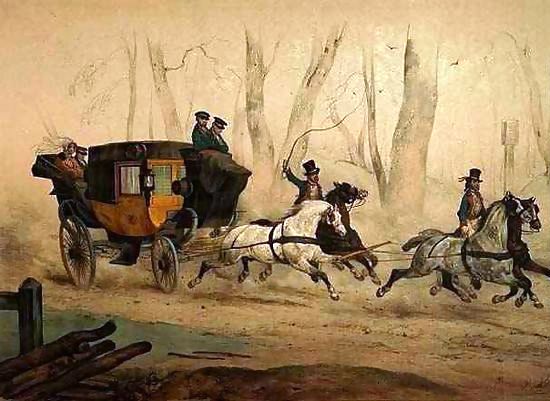
The Post ChaiseWhen you’re writing about the past, too often our references come second, third, or even fourth-hand. We read diaries and letters that are often edited by children and grandchildren. We scan biographies–some brilliant and some shabby beyond belief. And we read books written about the Regency. But sometimes a novelist needs more.

When writing about characters who live in the Regency, we often need t o get into those character’s heads. We need to see how they lived. We need first-hand experience. I’ve been known to read by candlelight–truly an eye-straining experience–brandish a sword, and even try a quill and ink to see what it’s really like.

But there are some books that offer a first-hand experience. And one of my favorites is Cary’s New Itinerary.

At the end of the eighteenth century, John Cary was commissioned by the Postmaster-General to survey all the principal roads in England. He did this by walking these roads, pushing a wheel connected to a counter, which kept a tally of the number of rotations and then produced an accurate mileage.

Between 1787 and 1831, Cary put his knowledge to use and published, among other books, the New English Atlas, The Travellers’ Companion, the Universal Atlas of 1808, and Cary’s New Itinerary. The maps and surveys have some of the most accurate and valuable data about the structure of the Regency world. They also provide an insight into how people traveled in the Regency.

Published in 1815, the fifth edition of Cary’s  goes on to explain that it is, “an Accurate Delineation of the Great Roads, both direct and cross throughout, England and Whales, with many of the Principal Roads in Scotland, from an actual admeasurement by John Cary, made by command of his Majesty’s Postmaster General.”

There’s more detail provided at the front of the book in an “advertisement” that’s more of a preface.

The information alone on roads and distances, with fold-out maps provided, has helped me sort out the practical problems that face any Regency writer–such as, how far is it really between London and Bath? And what roads might one take? However, Cary’s offers much more.

Cary’s divides into neat, organized sections. The man was obviously methodical. The first section lists the direct roads to London–as in all roads lead to this metropolis. The next section gives a list of principal places–i.e., larger towns, that occur along the cross-roads. A cross-road is a road that crosses one of the direct roads into London. At this point, you begin to see how London-centric this world really was. As someone living outside of London, it would be your goal to get to a major town, and then you could get to London. Cary, living in London, wrote his book for outward-bound Londoners, and that is how the book is organized.

The next section is as important to a Regency writer as it would have been to someone traveling in the Regency–it is a list of coach and mail departures. This includes the name of the London inn from which the coaches departed, the towns each coach passed through, the mileage, the departure time, and the arrival time. It’s an utter godsend if you have to get your heroine to Bath at a certain hour on the coach. I can also picture Regency Londoners pouring over this information, planning short trips to the seaside, or to watering towns.

The next section lists all direct roads, as measured from key departure points in London, but this is not just a dry list of mileage. Descriptive notes are tucked into various columns to describe houses of note and distinctive sights. For example, if you’re going to Wells from London, then, “Between Bugley and Whitbourn, at about 2 m(iles) on l(eft) Longleat, Marquis of Bath; the house is a Picture of Grandure, and the Park and Pleasure Grounds are very beautiful.”  This was an era in which slower travel meant taking the time to look at surroundings.

The next section provides a similar treatment for cross-roads, and not to be overlooked, Packet Boat sailing days are listed for England’s various sea ports, just in case an intrepid traveler whishes to travel abroad.

Finally, Cary’s provides an index to Country Seats, or as Cary’s notes, “In this Index the Name of every resident Possessor of a Seat is given, as well as the Name of the Seat itself, wherever it has a distinctive Appellation.”  This is actually a list from the 1811 returns to Parliament, as noted in the book. In the Regency, this actually would have been a much used feature, for it would allow a traveler to look up and visit various great houses and country seats. It was a time, after all, when visitors expected the great houses to always be open for show, and to be gracious in their hospitality.

Overall, Cary’s is not a book that will give you insight into the politics of the Regency, nor into the social structure of that world.  However, between its worn covers lays the description of the Regency world that can put you back into that era, just as if you were traveling the roads of England.

POV — What Readers Don’t Notice (Unless it’s Wrong)

Point of View is a phrase that writers use to death. It’s one of those things that a reader doesn’t notice until it’s done badly. But it’s also one of the most critical skills because it affects everything else in the story.

You don’t really think about until you have to figure out whose point of view gives you the best story.

Now, the “duh” moment here seems to be that well, of course any story uses the point of view of the main character. But sometimes that doesn’t work so well. Dr. Watson is the point of view character in Sherlock Holmes stories so Sherlock can seem smarter. (Watson’s no slouch, but by making him the POV character, the writer can hide clues that Sherlock will eventually use to make amazing deduction.)

My rule of thumb is to use the character with the most at risk in a scene–this gives the scene better conflict and drama. That risk also works better, too, if it’s emotional risk–a character who doesn’t care that a gun is pointed at him is not going to give you great drama if that character doesn’t care about dying. But this is a guideline, not a rule. Also, this doesn’t help with the whole story.

Should you write in third person, first person, multiple viewpoints, single?

This goes back to being a reader first.

What do you read? What do you like to read the most?

I’ll read just about anything, cereal boxes included. But while I like first person stories–when they’re good, they’re brilliant–I tend to read more third person. I’ve written first person stories, but I lean towards third person. But I’ve also learned over the years to control this so it’s a limited third person–I’m not dragging the reader into everybody’s heads.

There are also a few tricks to smooth viewpoint transition.

1 – Use proper names, not pronouns. He/she (or even worse, he/he) tends to put the reader deeper into his/her point of view. By moving out to a proper name, you’re moving the viewpoint out (like a camera would move out), which helps smooth the transition.

2 – Use action to hand off the POV switch. As in: Helen dropped the book. John caught it and handed it back. Notice how the action again moves the reader out of thought and into “seeing” a scene, so the action allows a change of POV by also helping move the POV out a little, into the room before dipping back into someone’s thoughts.

3 – Use clean sentence and paragraph structure to keep the transition cleaning. You can do anything, even change the point of view in the middle of a sentence. But why risk losing your reader by doing this? Instead, make your transitions clean and clear.

If you use POV right, no one will ever notice it. But oh, if you do it wrong, everyone knows.

Writing the Regency Novel

I’m giving a workshop at the RWA National Conference this July (just got the times and it’s Friday at 4:30 – 5:30, so early enough to enjoy dinner Friday). And part of what I’ll cover is why set your fiction in the Regency era?

For all that it covers an amazingly short time span (1811 to 1820) the English Regency has a remarkable allure.  Mystery writers, including the great John Dixon Carr, have chosen this era for a setting, and the Napoleonic wars offer the setting for the popular Sharp series by Bernard Cornwell and the Aubrey/Maturin Series by Patrick O’Brian’s. In Romance writing, the Regency is perhaps the most popular historical time period, and has launched many now best selling authors. But why should such a short time span–nine years really, although the Regency influence extends over perhaps thirty years–prove so magnetic?

Answering that question could be the target of a scholarly book, but space is limited–and time fleeting–so perhaps the best course is to emulate the Regency in brevity, as well as in style, and carry things off with a high hand. Of all time periods, the allure of the Regency might well be that it was a time when style triumphed. The era sparkles with wit, gallantry and elegance in fashion, furnishings and frivolity. It was an era in which a man with no background–Beau Brummell–could become the leader of male society just because of his style and wit. At the same time, Turner was painting and shocking the world with his art, while Byron was writing and shocking society with his life. Charles Fox was being brilliant in politics, and shocking just about anyone who met him. And Sheridan was writing plays that still amuse with their wit.

It was a brilliant era. And an era of the extremes of rich and poor, and yet it was an era in which if you were good at something, you could gain fame and fortune. The prizefighter John Jackson (1769-1845) won fame with his fists, but went on make his real fortune by teaching boxing lessons to the cream of society. For a gentleman to say he got the chance to spare with Jackson was considered a social coup. The status given Jackson makes him perhaps a forerunner of the modern sports superstars. In fact, the Regency could be said to be a time when much of our modern sensibility of admiring skill–rather than inherited status–seemed to take hold.

A full answer to the appeal of the Regency era, however, must look at not just the actual time period itself, it must take into account the fiction and films which have so greatly shaped our impressions.

All this and some details of the history that you have to get right (and what can you fuss with or make up) will be covered in the workshop. But it’s worth noting that the Regency’s reflections to our era cannot be overlooked: change, uncertainty, but still the need for daily routine, and the relief of pleasure. The royal scandals filled newspapers with sympathy for the Princess of Wales, and this left the Prince unhappy about this. There were opportunities for those with vision, and at the same time great risk for those so unwise as to invest in the wrong future.  All of these qualities resonate with us. However, the Regency is blessedly in the past.  It is a world slipped into the past and therefore one with a safely known future.  Somehow these people who lived then found a way to happiness, to prosperity, to joy, to survival.  And what more comforting message can a reader find?

The Pitch, The Blurb, The Writer’s Headache

It’s not enough to write a book–you have to figure out the pitch…the blurb…the exciting sentence that’ll make someone want to read a book. So you have to switch from a writing mind to a marketing mind, which is not always easy. But at the Desert Dreams conference this past weekend, I had a “duh” moment–this blurb is the external conflict for the main character.

This is a “duh” moment since it seems obvious, but I’d be struggling with fitting external/internal/more than I need into a short, catchy sentence. I know some folks like high concept–I’m more about interesting conflict.

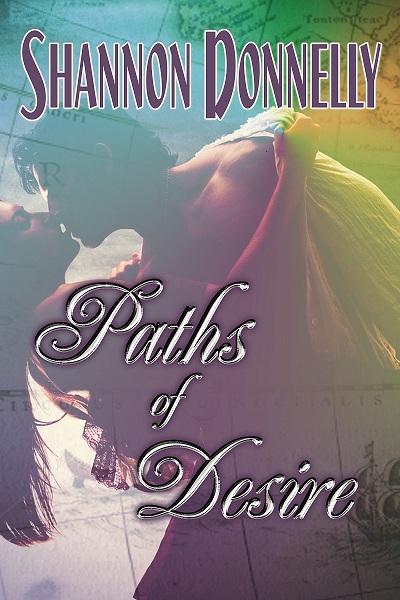
Paths of DesireSo I’ve been applying this insight to the books, and came up with this for Paths of Desire:

NO MAN’S MISTRESS…

She wants a rich lord for a husband—she won’t end like her mother, abandoned and broken.

NO WOMAN’S FOOL…

He wants to prove to his friend she’s the wrong woman—he knows too well the pain of a bad marriage.

WHEN AN ACTRESS CROSSES PATHS WITH AN ADVENTURER IN 1813 LONDON…

The last thing either wants is to fall in love, but when desire leads to a passion that won’t be denied, how can the heart do anything but follow?

This is way shorter than what I had and I actually think (hope) it’s far more catchier. Can you match these others to my books? (Click on the phrase to see the book.)

Reformed rakes make the best husbands–or do they?

Will it take a Gypsy thief to steal the heart of a rake?

A girl who can tame any wild creature….

A Gypsy lord out to redeem his name…

Some of the lines came out as questions, some as core situations.  The situation ones obviously needed a bit more, but they are at the heart of the book.

So…better maybe? We’ll see in the sales.

Clichés: Easy as Pie

1: a trite phrase or expression; also : the idea expressed by it
2: a hackneyed theme, characterization, or situation
3: something (as a menu item) that has become overly familiar or commonplace
Easy as Pie ClichesThat’s how Merriam-Webster’s defines a cliché — unfortunately, there are still far too many of them around. As writers, we owe it to our work, our characters, and our readers to change these hack phrases and situations around for something fresh. They are, to use a cliché phrase, easy as pie to come up with. And that’s the problem.
The first step, as with an addictive problem, is to recognize that it is a problem. And, yes, clichés are addictive. They pop out easy as easy as that pie from a greased tin, and they slide on by–which it’s why it’s a good idea to read your work aloud. You’ll catch these more easily when you read your own work.
They’ll show up in phrases–those are the easier ones to grab and shake out. The “stalking like a panther” phrases. Or easy as pie, or you’ll find many more over at Laura Hayden’s handout on Suspense.net. These just need a fresh phrase–an image that has not become used up in its overuse.
The harder ones to catch are the clichés situations that come from getting a little too lazy with the plotting. The ones I keep seeing crop up (in unpublished manuscripts) are:
1-Kidnapped heroine. Heroine stupidly ends up on her own and bad guy kidnaps her. Bad guy never seems to have a particularly good reason for this, menaces heroine without doing anything to her really, and ties up heroine for convenient rescue by hero. This is so old it creaks. Come on folks–if you need a confrontation with heroine and bad guy, come up with a better situation. How about bad guy throws a party and heroine is invited? Or what about kidnapping is really a plot to get to bad guy? Or how about a smarter bad guy who is just going to shoot the woman on sight and get her out of his way. This is easily solved with characters who are better motivated and who make sense.
2-Hero and heroine argue after making love. He pulls away, she pulls away, and all for no particular reason. How about letting your characters talk, hash it out, and make everything worse by blurting out the wrong thing at the wrong time? If you find yourself having to contrive the conflict, go back and give your characters deep, good reasons for not being in a relationship. If your characters are not acting in unique fresh ways, time to look at how do you motivate them to be unique, fresh folks.
3-Bad guy is infatuated with heroine. In such cases, heroine is usually hateful, mean, and bad mouths the guy, but somehow he still “wants” her. Another moldy oldy. This often comes along with bad guy wants heroine’s money–and while money is a good reason for a lot of things, it’s also been done way too many times. This is where you need to find better, deeper reasons for actions. Orson Scott Card gives wonderful advice in his book, Characters & Viewpoint, that the first four or so ideas you come up with for character motivation are almost always clichés–that’s why they pop up so fast.
4-Bad guy is just insane, which becomes explanation for everything. This shows up in almost every weak romantic suspense out there–and in more than a few Westerns, too. Bad guys need to make sense–they need motives and in some ways the word “sociopath” has led too many writers to think this is a bucket into which the bad guy can be dumped without any more effort applied. Go watch Dexter to see how a complex character can be created instead of just another crazy killer on the loose.
5-Hero/Heroine experience unexplainable attraction–beauty blinds sense and leads to lasting love, they are just “meant to be” soul mates. This often comes along after characters have been rude and horrible to each other for about 100 pages, but the truth dawns and true love (and sex) wins out. This situation is older than Cinderella, and is overdue for retirement. Give all your characters good reasons for their actions, and look for fresh reasons. Maybe your hero is a sucker for a great pair of legs, and that’s the initial draw–but it’s the fact she has a Cub’s t-shirt in her closet and wears it on game day, and eats hot dogs just the way he likes them (dripping with mustard, relish and sliced red onion), and won’t go outside without smearing every nose in sight with SPF 50 that does him in. Maybe her eye is caught by the broad shoulders, but he is a guy who cooks, loves pasta as much as she does, and he has a southern drawl that does her in, and he’ll do a deal to watch chick flicks with her (in exchange for a movie with stuff that blows up in between).  Its the details that make your characters–don’t get lazy here.
6-Hero’s ex wants him back, and so causes trouble. Usually this means ex lies (and heroine believes her–and, really, you would believe whatever you guy’s ex said over what he says?). This also usually has the ex being so nasty that you wonder how the hero ever hooked up with her in the first place–it really does put him in a very bad light. There’s an easy fix for this one–just remember we are all the hero of our own story. Even the ex has a story that makes her sympathetic and a good guy–make sure you know this story about her (and that you like you as much as you like all your other characters). And keep telling yourself–characters who are one-sided are cliche.
7-The big “MISUNDERSTANDING”. Hero/heroine assume the worst about each other after glimpsing something. This is usually heroine sees ex leaving hero’s bedroom (and or an intimate moment) and heroine assumes he’s back with her (and why she doesn’t go pounding on doors for answers is a mystery), or this is heroine is seen with someone from her past and hero assumes the worst–oh, my god, she hasn’t changed. This is a case where you wonder what are these two doing together. Then you wonder why doesn’t anyone talk. Make it easy on yourselves, folks–when in doubt, put your characters together and get them talking. The talking should make things worse, not clear up misunderstandings. And always remember conflict based on misunderstanding is a cliché.
8-Bad guy has to explain all his reasons for his actions. The Incredibles gave us this present tense verb of monologuing. If you have to stop the story to explain a bunch of stuff, consider the possibility that either the plot is too complicated or that you need smarter characters who can figure out things without having to have stuff explained. The other way around this is to make the information so interesting that folks will sit though this cliché without complaint. But that’s a risky bet.
9-The hero/heroine suddenly has a skill that’s unexplained and doesn’t fit their past. This happens with careless writing (the writer forgot to foreshadow a skill), or when a writer has backed herself into a corner and needs to get out–that’s not usually done gracefully. Just remember to ask if you’ve set up a character who can pull off the skills needed to make the plot work. Also remember that readers are not very forgiving of “luck” factoring into a story unless it’s bad luck (or unless the character has had so much bad luck that the readers are rooting for the universe to give the characters a break).
10-The parents who want to force the heroine into a bad marriage. This one shows up mainly in historical romance, and sometimes in some contemporary romances. And, yes, while there are bad parents out there, this ignores the basic core of most folks, which is that we regard friends and family as attachments of ourselves–we want the best for them because they are a part of us. To go against anything that is core to most people, you have to use strong motivations–this is usually overlooked for the quick form of just having them be greedy folks. That’s a cliché because it’s going for a quick answer instead of really figuring out your characters.
Now you’re going to find all of these clichés in various best sellers. Which goes to show there are no rules. But you’ll find them carried off with either a twist that gives them a little fresh tread on an otherwise worn tire, or you’ll find them stuffed in with so much other good stuff that most folks will turn a bad eye. But how much better to be aware of the clichés and to be ready to make the effort to find characters who’ll take you through a story with a lot more interesting things going on, all because the characters themselves are fresh and new and worth spending your time in their company.

Novelist’s Inc’s Cast of Characters

Cast of Characters CoverNovelists Inc. is the only writers organization devoted exclusively to the needs of multi-published novelists. They’re also doing a lot to innovate these days, and help authors publish–this includes starting to do some publishing too.

Today, April 3, NINC is bringing out  a fiction anthology, Cast of Characters, with twenty-eight original stories, eleven of which are from New York Times bestselling authors that reads like a who’s who.

Contributors include:

CATHERINE ANDERSON
VICTORIA ALEXANDER
JO BEVERLEY
BARBARA BRETTON
JULIE COMPTON
TANYA ANNE CROSBY
CAROLE NELSON DOUGLAS
ROSEMARY EDGHILL
ANGIE FOX
HEATHER GRAHAM
VICKI HINZE
CJ LYONS
KATIE MACALISTER
ASHLEY MCCONNEL
JULIE ORTOLON
LAURA RESNICK
PATRICIA RICE
DEB STOVER
VICTORIA STRAUSS

And, as they say, more. It’s not quite a cast of thousands, but as NINC puts it, you do get “a collection of unforgettable personalities.”

Stories range over all genres–so there’s lots to enjoy, including:

  •   #1 New York Times bestselling author Victoria Alexander delivers her first short story with a contemporary setting – as does New York Times bestselling author Tanya Anne Crosby.
  • New York Times bestselling author Jo Beverley brings back the hero of her novel Forbidden Magic.
  • New York Times bestselling author Angie Fox creates a new Biker Witches story.
  • New York Times bestselling author Katie MacAlister tells the story of one of her most beloved teen characters as an adult.
  • National bestselling author Julie Ortolon tells the beloved Pearl Island story her fans have been clamoring for.
  • National bestselling author Diana Peterfreund offers the origin story for one of the most important magical items in her “killer unicorn” series.

You can buy Cast of Characters from from Amazon, Barnes and Noble, Apple and all other online booksellers. And Novelists Inc. is offering a free e-book of “set pieces” from upcoming member novels. You can get this volume free at the Novelists Inc. website, www.ninc.com.

To read more, head on over to Fiction Studio (Lou’s site — he edited the anthology and is the current NINC president). Or just go buy the book–short stories are a great way to find new authors to love.

The Story Tellling Instinct

Don't Fence me InThere’s a school of thought that there are somethings about writing that cannot be taught. In other words, you can teach grammar and plot structure and the technical stuff, but there’s something about story telling that you have or you don’t have. I’m not sure I buy into this.

Yes, we all have different levels of talent, but if you start fencing some folks out, you’re also fencing yourself in, and that’s never good. To me, this is like saying, “Well some dogs don’t chase chickens.”  If you hit a dog for doing something, that will stop that dog’s instinct to do what it loves to do–but that doesn’t mean that dog was not born to chase and hunt. And folks just like to tell stories–we all love stories.

I’ve taught story telling before–I’m about to teach an online class for Lowcountry Romance Writers on this (because there are classes on so many things, but most folks don’t talk about how to put it all together). And I think if you have a strong desire to do something because you love that thing, you’ll find a way to improve. You don’t get the desire to do something without some level of talent to go with.

Now, American Idol auditions may point to this not always being the case. But I’m willing to bet a lot of those really awful singers are there not because they love music and singing, but because of a desire for fame. This means their desire and talent don’t match: a love of fame is not going to make you a singer. (Or a writer.) You have to love your art enough to sweat for it, and be willing to do it for pennies, for free sometimes, and just because you cannot not do it. You tell stories because you have a story telling instinct. This, like any other instinct, can be developed and improved–or it can be beaten into oblivion. It’s that small, still voice inside that tells you when a story is on track, and it’s the thing that stops you from writing when the story is going wrong. It’s something you have to come to believe in and the more you use it, the better it will get.

And here’s ten ways to know if you have this instinct.

1-You cannot tell anyone about what happened today without embellishing, just to add some interest.

2-If someone’s giving you gossip about others, you always end up asking: “And then what happened?” And it’s really irritating if that person doesn’t know.

3-When you walk a city at twilight, you not only look into the open windows, but start inventing things about the people who live there.

4-If folks start telling you real life stories you want them to put a good ending on it even if there wasn’t one.

5-For any news story you don’t just wonder why someone acted as they did, you can come up with all sorts of plausible reasons.

6-When something bad happens to you, yes you cry–but there’s always some small part of you taking notes.

7-When a friend starts telling you about terrible things that have happened to them, you think about how this would be great in a story.

8-It’s almost impossible for you to walk out of a movie or put down a book–even the really terrible ones–because you always have a hope the story will get better, and you have to see how it ends (even if its obvious, because its cliche, how its going to end).

9-Your pets always have back stories–and you’ll tell them to anyone who will sit still.

10-You’re willing to do stupid things at times just because you’ve never done them and you have a character (or might someday have a story with a character) who is going to do them.

If you start nodding at five or more of these, you’ve got the story telling instinct, but it needs work. If you’re only nodding at a couple, your story telling instincts have been beaten out of you by past teachers who have also killed their own instincts–time for lots of meditation and getting back in touch with your subconscious. If you nod at eight or more of these, congrats–you’re instincts are going to serve you well.