The Regency Meal, or Food, Glorious Food

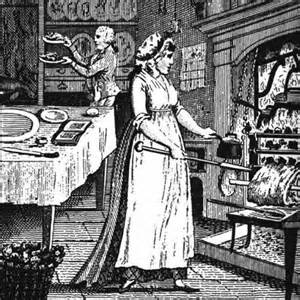
Hanna GlassThere is something wonderful about food. Why else would we watch shows about cooking, buy cook books, and even enjoy reading (and writing) about food. Regency England was also an era that enjoyed its food.

There was interest enough in food skills that by 1765 Hanna Glasse’s The Art of Cookery, Made Plain and Easy had gone into nine editions, selling for five shillings if bound. (Back then, one could buy unbound books and have them custom bound to match the rest of the books in one’s library.) Hanna’s book remained popular for over a hundred years. However, her recipes can be difficult to translate into modern terms–the quantities often seem aimed to feed an army, as in this recipe for ‘An Oxford Pudding’:

“A quarter of a pound of biscuit grated, a quarter of a pound of currants clean washed and picked, a quarter of a pound of suet shred small, half a large spoonful of powder-sugar, a very little salt, and some grated nutmeg; mix all well together, then take two yolks of eggs, and make it up in balls as big as a turkey’s egg. Fry them in fresh butter of a fine light brown; for sauce have melted butter and sugar, with a little sack or white wine. You must mind to keep the pan shaking about, that they may be all of a light brown.”

I’ve yet to try this recipe, and when I do I’ll probably substitute vegetable oil for suet, but it does sound tasty.

Amounts in older cookbooks are also often confusing to the modern reader, often listing ingredients to be added as handfuls, as in the rue, sage, mint, rosemary, wormwood and lavender for a “recipt against the plague” given by Hanna Glasse in The Art of Cookery made Plain and Easy.
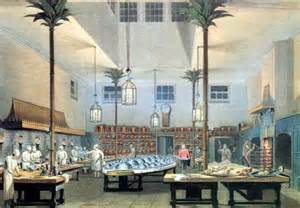
Brighton KitchenThe time spent on making these recipes could also be considerable. This was an era when labor was cheap, and if one could afford servants, they could provide that labor.  The Prince Regent’s kitchen in Brighton was fit for a king of a chef, and large enough to allow an army of cooks, pastry chefs, under cooks, and scullery maids. It also sported windows for natural light as well as large lamps, and pillars in the shape of palm trees to carry on the exotic decor of the rest of the Brighton Pavilion. Elaborate dishes could be concocted both for the well and the sick.

Shank Jelly for an invalid requires lamb to be left salted for four hours, brushed with herbs, and simmered for five hours. There are few today who have time for such a recipe, unless they, too, are dedicated cooks.

Sick cookery is an item of importance as well for this era. Most households looked after their own, creating recipes for heart burn or making “Dr. Ratcliff’s restorative Pork Jelly.” Coffee milk is recommended for invalids as is asses’ milk, milk porridge, saloop (water, wine, lemon-peel and sugar), chocolate, barley water, and baked soup. (Interestingly, my grandmother swore by an old family recipe of hot water, whisky, lemon and sugar as a cough syrup, and that’s one recipe I still use.)

As interest expanded, and a market was created by the rise of the middle class, other books came out. Elizabeth Raffald had a bestseller with The Experienced English Housekeeper. The first edition came out in 1769, with thirteen subsequent authorized edition and twenty-three unauthorized versions.

Dinner_FromMrsHurstDancingIn 1808, Maria Rundell, wife of the famous jeweler (and a correction is needed here–I started reading how there was confusing about her being wife of the jeweler or a surgeon. It seems she married Thomas Rundell, brother of Philip Rundell, who was the jeweler. So she was the sister-in-law, not wife, but she did some out with her book, published by John Murray) came out with her book A New System of Domestic Cookery for Private Families. This book expanded on recipes to also offer full menu suggestions, as well as recipes for the care of the sick, household hints, and directions for servants. This shows how the influence of the industrial revolution had created a new class of gentry, who needed instructions on running a household, instructions that previously had been handed down through the generations with an oral tradition. The rise of the “mushrooms” and the “cit”, merchants who’d made fortunes from new inventions and industry, created a need for their wives and daughters to learn how to deal with staff and households.

Any good wife had much to supervise within a household, even if the servants performed much of the actual work.

A household would make its own bread, wafers, and biscuits, brew its own ale, distill spirits, and make cheese. In the city, some of these would be available for purchase. Fortnum and Masons specialized in starting to produce such ‘luxury’ goods (jams and biscuits, or what we Americans would call cookies).

In London, wines would be purchased from such places as Berry Brothers, a business still in existence as Berry Bros & Rudd. Establish in the late 1600’s at No. 3 St. James’s St., the store initially supplied coffee houses with coffee and supplies. They expanded into wines when John Berry came into the business due to marriages and inheritance. Berrys went on to serve individuals and London clubs such as Boodles and Whites with coffee, wines, and other goods. They put up their ‘sign of the coffee mill’ in the mid 1700’s, and Brummell as well as others used their giant coffee scale to keep an eye on his weight and keep his fashionable figure.

Laura Wallace offers more information on wines and spirits of the Regency (http://laura.chinet.com/html/recipes.html. She notes Regency wines: port, the very popular Madeira, sherry, orgeat, ratafia, and Negus, a mulled wine. Other wines you might find on a Regency dinner table include: burgundy, hock (pretty much any white wine), claret, and champagne (smuggled in from France).

For stronger spirits, Brandy was smuggled in from France. Whiskey, cider, and gin were also drunk, but were considered more fitting for the lower class. (Whiskey would acquire a better cachet in the mid to late 1800’s, due to the establishment of large distilleries and after it again became legal. The Act of Union between Scotland and England in the early 1700’s and taxation drove distillers into illegal operation. After much bloodshed, and much smuggling, the Excise Act of 1823 set a license fee that allowed the distillery business to boom.)

For weaker fare, ale, porter, and beer were to be found in almost any tavern, and would be brewed by any great house for the gentlemen. Water as a beverage, was often viewed with deep suspicion, wisely so in this era, but lemonade was served.

As Laura Wallace notes on her site, “port, Madeira and sherry are heavy, ‘fortified’ wines, that is to say, bolstered with brandy (or some other heavy liquor). Port derives its name from the port city of Oporto in Portugal. Madeira is named for an island of Portugal…

“Madeira is particularly noted as a dessert wine, but is often used as an aperitif or after dinner drink, while port is only for after dinner, and historically only for men. ‘Orgeat’ is… ‘a sweet flavoring syrup of orange and almond used in cocktails and food.’ Ratafia is…a sweet cordial flavored with fruit kernels or almonds.”

In the country, a household functioned as a self-sufficient entity, buying nothing other than the milled flour from the miller (although many great houses might also grown their own wheat and mill it), and perhaps a few luxuries that could not be produced in England, such as sugar, tea, coffee, chocolate, and wines that could not be locally produced. Fish could be caught locally; sheep, beef, and pigs were raised for meat as well as hides and fat for tallow candles; chickens, ducks, and other tame birds were raised for eggs and for their feathers (useful things in pillows); wild birds, deer and other game could be hunted on great estates; bees were raised for honey and wax candles of a high quality; breweries and dairies were found on every estate, and every house would have its kitchen garden with vegetables and herbs. Berry wines could be made in the still room, along with perfumes, soaps, polishes, candles and other household needs. Many of the great houses also built greenhouses or orangery to produce year round, forcing early fruits, vegetables, and flowers, and providing warmth for the production of exotics such as oranges and pineapples. (The concept of heating with local hot springs had been introduced to England by the Romans, and was still around in Regency Era, and many new innovations were also being introduced for better heating and water flow into homes.)

For a gentlemen who lived in the city without a wife or a housekeeper, cheap food could be purchased from street vendors in London, but most meals would be taken at an inn, a tavern, or if he could afford it, his club. Many accommodations provided a room, and not much more, with the renter using a chamber pot that would be emptied into the London gutters, and getting water from a local public well (and this shared water source accounted several times for the spread of cholera in London). Cheaply let rooms had no access to kitchens. Hence the need for a good local tavern, or to belong to a club.

According to Captain Gronow, remembering Sir Thomas Stepney’s remarks, most clubs served the same fare, and this would be, “‘the eternal joints, or beef-steaks, the boiled fowl with oyster sauce, and an apple tart.'” From this remark about the poor quality of food to be had, the Prince Regent is said to have asked his cook, Jean Baptiste Watier to found a dining club where a gentleman could have a decent meal. Headed by Labourie, the cook named by Waiter to run the club, it served very expensive, but excellent meals. It was no wonder that a single gentleman might well prefer to perfect his entertaining discourse so he might be invited to any number of dinners at private houses.

As with all eras, in the Regency, meals provided a social structure for life.

a simple mealTo start the day in London, a fashionable breakfast would be served around ten o’clock, well after most of the working class had risen and started their day. The Regency morning went on through the afternoon, when morning calls were paid. In London, five o’clock was the ‘morning’ hour to parade in Hyde Park. A Regency breakfast party might occur sometime between one and five o’clock in the afternoon.

During morning calls, light refreshments might be served.  Ladies might have a ‘nuncheon’ but the notion of lunch did not exist. Also, the lush high tea now served at most swank London hotels actually originated as a working class dinner, and was perfected by the Edwardians into an art form, but was not a Regency meal.

In London, the fashionable dined between five and eight, before going out for the evening. This left room for a supper to be served as either a supper-tray that might be brought into a country drawing room, or as a buffet that would be served at a ball. Such a supper would be served around eleven but, in London, this supper could be served as late as nearly dawn.

Country hours were different than city hours. In the country, gentlemen would rise early for the hunt or to go shooting. Breakfast would be served after the hunt, with only light refreshments offered before hunting. These hunt breakfasts might be lavish affairs, and if the weather was good, servants might haul out tables, silverware, china, chairs and everything to provide an elegant meal. Again, tea might be taken when visitors arrived in the country, and this would include cakes being served, along with other light sweets.

Dinner then came along in the Regency countryside at the early hour of three or four o’clock. This again left time in the latter evening for a tea to be brought round, with light fare, around ten or eleven. A country ball might also serve a buffet or a meal during the ball, or a dinner beforehand.

From the Georgian era to the Regency the method for serving dinner changed. “…as soon as they walked into the dining-room they saw before them a table already covered with separate dishes of every kind of food…,” states The Jane Austen Cookbook.
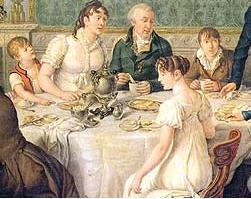
Family MealThe idea was that with all courses laid on the table, those dining would choose which dishes to eat, taking from the dishes nearest. It was polite to offer a dish around. Food in History notes, “It was a custom that was more than troublesome; it also required a degree of self-assertion. The shy or ignorant guest limited not only his own menu but also that of everyone else at the table. Indeed, one young divinity student ruined his future prospects when, invited to dine by an archbishop who was due to examine him in the scriptures, he found before him a dish of ruffs and reeves, wild birds that (although he was too inexperienced to know it) were a rare delicacy. Out of sheer modesty the clerical tyro confined himself exclusively to the dish before him….”

This style of serving dinner was known as service à la française. During the Regency this was replaced by service à la russe in which the dishes were set on a sideboard and handed around by servants.

Introductions

introductionsReader meet character–character, meet reader.

Character introductions are a bit tricky. Too much information and you risk boring your reader. Too little information and your reader doesn’t know enough about your character to really care what happens. So how do you get this right?

First off, you want to recognize that characters need to be introduced–dump a character on a reader and you risk confusing and that lack of caring. For example, a woman is running through the woods. Okay…so what. Why does this matter, why should I ( as a reader) care? Notice how the lack of information leaves an emotional void. Every character who has a name should be introduced–take a few sentences and sketch in some description or background or details that will make the reader interested in this person. The more important the character, the more important is that introduction.

Next, you want to use information that makes that character unique. A woman running through the woods is not unique–so what matters. What if she’s pregnant? Notice how that detail changes everything–therefore, that detail matters. Does it matter if she’s a red head or brunette? Not really. But it may matter if she’s a long-distance runner, or a housewife. So use the most important information up front in your introduction–you want relevant information.

After that, you want information that is geared to making the reader emotional invested in that character. A pregnant woman running through the woods–and running for her life–automatically generates reader emotion just because most people will care about such a vulnerable person (we’re wired that way). Same goes for a child who is in danger–we’re geared to start caring more for that child. So if you have a warrior swinging a sword, you might not get as much emotion–the reader figures, hey, he can look after himself. So you have to look at what else matters.

What is your character good at?

How is your character vulnerable?

Can you show your character doing something–taking some action–right off that will incline the reader to sympathy or admiration?

A great example is from Dick Francis, the mystery writer who was a  master of character introduction. He would often show his main character in the very first scene doing something that makes a reader “buy into” that character. For example, in one of his books, the hero saves a baby in a pram (or baby carriage) from a horse trailer that’s broken loose and is headed for the kid. That right there is going to make you inclined to like that guy–he is shown being a hero.

And that’s the next big point–be aware that what you SHOW your character doing is more important than what you tell the reader.

If you introduce a character and say she’s a wiz at magic, but you show her flubbing a spell, or show her picking flowers, the reader is included not to believe you telling and instead will believe this girl is a disaster.

The strongest introduction show the character’s core. Think of the opening of Indiana Jones–the first movie–where Indy is shown recovering a golden idol. We get right off that Indy is an amazing guy–he gets through traps that would kill anyone else. We also get his enemy set up (the man who takes the idol from him), and we get that he hates snakes. All useful information for anyone, and notice that we get both how Indy is admirable with his courage and vulnerable with his dislike of snakes. He’s not a perfect guy and that helps us to like him even more.

So step back and look at how are you introducing your characters. Are you taking enough time to handle a smooth introduction, are you getting in the important information, or just details that don’t really matter? Are you making sure you engage the reader emotionally before you dump the character (and the reader) into too much action?

Action without emotional investment will lead to a bored reader–so look to hook your readers into your characters with a strong introduction.

Are you a writer or a story teller?

readerI’m doing a workshop on Storytelling this August — the idea for it came out of reading a lot of manuscripts where the writing was really good, but the story just didn’t work. Either the characters didn’t really make sense, or the story itself went off the rails about midway through and became a bunch of actions instead of a story arc that worked to really explore the characters and their relationships. This is something we all have to work on (constantly it seems). So what makes a good story compared with good writing?

1- Good writing can make you stop in awe. This is actually a problem in a story. A good story keeps you turning the pages, not stopping to admire the scenery. I find if the writing stops the reader for any reason, it’s a place the author needs to look at to see if the writing is just getting too “writerly” and getting in the way. Truman Capote said you want to be that voice by the fireside telling the story–invisible but compelling.

2- A good story sweeps you away. This means the reader doesn’t stumble over complicated sentences, or even more complicated plots–instead the reader is pulled into a fully developed world where the characters all make sense as people who work in that world. And the world all makes sense (things don’t just happen because the author thinks it would be cool or a great twist, but they happen within the rules of that world–and that takes a lot of development).

3- Good writing can be intellectually pleasing, but a good story catches your emotions. This is something I see a lot–the author has gotten carried away with a story that is just too much about the author being clever and not really enough about the author digging deep into both their own emotions and their characters’ emotions. This is where the story is just flat. You can overthink stories–and you can overwrite them, too.

4- Good writing is perfect; a good story may have flaws, but you just don’t care because it’s great as it is. This is where someone has edited out the emotion from the page–we all do this at times. We get so caught up in dotting every period and worrying over every comma that we forget that it’s the flawed characters and it’s the story that a reader wants. Ever come out of a movie and suddenly you realize there were a lot of plot holes, but you never noticed them during the movie? That’s a story that did it’s job–it engaged you on an emotional level. That’s a story teller’s job.

5- A good story needs great characters, and good enough writing that the writing comes second. This again is a place where I see less experienced writers struggling–their technical skills are weak enough that they have to focus too much attention on untangling sentences. The more I write, the more I tend to love simple, clean prose. The reason for this is that if I don’t have to fuss with craft, I can focus more on the characters and getting them on the page.

6- A good story has an arc–it goes somewhere. Good writing can wander–you can have beautiful prose that doesn’t really go anywhere. Story telling goes way, way back in the human psyche, and if when you break those rules we all love in stories (even without knowing what it is that makes a story work), the risk is that you’re creating a story that readers will put down.

7- A great story is one that must be told, but it’s rare that a writer really must produce great writing just for the sake of the writing. A great story is the one that burns in you, the one you can’t ignore, the one that you have to get on the page because the characters won’t leave you alone and you know that you’ll write this one even if only your mother reads it. You want to look for these stories.

You can be a good story teller and sell well–Edgar Rice Burroughs, to me, is a perfect example of this. Not a great writer, but it’s really hard to put down one of his books once you start reading. You just keep turning the page. There are other writers who are both great story tellers and really good writers–Stephen King is a good example of this (boy, can he write!). However, there really aren’t any great writers who are not great story tellers on any fiction best seller lists–and even the best non-fiction writers know how to spin a yarn.

So are you a great story teller–what stories are the ones you must tell?

Writing Regencies

writingdeskThe Regency romance is one of the most popular types of romance published–but what makes for a good Regency? What do you need to know to write one.

I’m teaching a workshop on Writing the Regency this July (22-Aug 18), but here are a few basics:

1-Voice. First things first, and the first thing any Regency novel needs is the right voice. Now the Regency voice can be funny or dramatic, but the feel has to be something that invites the reader into a world that doesn’t exist–yes, it’s the past, but it’s a past that no one’s been to, so it’s up to the writer to come up a “tone” or voice that feels right. It’s the sort of thing that readers know, and the writer has to find.

2-Research. This is the one that stops most folks. The odd thing is that contemporary novels can need research, too, particularly when you dip into fields that aren’t your own (medical, legal, cowboys, fire, etc. etc.). The trick to research is to know the right questions to ask–what do you need to know. And where do you go to find it? Too much time spent in research means too little time spent writing.

3-Plausibility. Readers have to buy into the world. You can actually have accurate details–but will readers believe them? The same goes for the characters. Do you have people who make sense within this world you’re creating? The reader has to believe not just in your characters, but that your characters could have existed within the Regency world.

4-Glamour. The Regency is an era of style–of wit. And clothes. And, also, titles. Lords and ladies, and getting this wrong can throw a reader right out of the story. Setting matters, as does the furniture, and the outfits. We all want to be swept away–that’s part of the attraction of the past.

5-History. Technically, you don’t need too much of this in a Regency (you can go for costume drama). But you do need some basics, otherwise why bother setting a book in this era. And if you’re writing a Regency mystery, or historical fiction, you need more than the basics. But part of this is why you pick the Regency to start with–it helps a lot if you’re more than a little in love with the era.

6-Details. The right details can make or break a story, and this is where you want to find fresh details (and not just repeat what other authors may have done in their stories). The search for these details can be like a treasure hunt–the one trick here is not to stuff every little detail you find into one story.

7-Adventure. We read about the past because it is past–nicely, safely so. But it’s also a time with a touch of adventure, with swords and duels, war and spies, candlelight and balls. It’s a place for the reader to move into and have a short adventure into that past. The adventure may be as simple as an elopement or as complex as an unsolved murder, but a touch of this always helps any Regency.


Plotting from Character

rosesI’m going to be teaching a workshop soon on this because it’s something I see in a lot of contest manuscripts–there’s a good start and then the synopsis slips into cliches or takes a left into what comes across as a contrived plot. This comes from forcing a set plot onto the characters instead of developing characters that bring their own conflicts and issues to the party.

Robert McKee who teaches one of the best classes there is on story structure states: story is character and character is story—if you change the story you must change your characters and if you change your characters your story will change.

What this means is that if you approach the plot (the things that happen) from the aspect of forcing certain actions to happen, you’re going to end up with a contrived story—the reader won’t believe the events because they are forced onto the characters. This is where you end up with the heroine kidnapped because she does something stupid, or the hero believes his girl is cheating on him just because he sees her with another guy, or some other external events forces the characters to do stupid things that really don’t match the character’s character.

To avoid this, you look for the story to come from the characters—you set up your characters to generate the plot (the things that happen) because the characters make choices. Those choices have consequences that generate new problems and the need for new choices.

So, how, exactly, do you go about doing this?

1. Start at the deepest point: for every character, find that person’s core need. (And, yes, you need to do this for all your characters, good guys and bad, and secondary characters, too.) Know what every character wants most in this life.

2. Find out why that character needs that one thing. When looking for these motivations for a character’s core need, discard the first two or three ideas. And look for motivations that happen early in life—we’re all shaped most strongly by those things that happen in our formative years.

3. In a romance, set up a potential mate who can’t provide that need for your main character (and know who really is the main character in the story).

4. Decide if your characters recognize their needs and motivations.

5. Go beyond he’s hot and she’s sexy for characters to click emotionally, mentally, and on levels beyond physical.

6. Layer.  Add traits that are strengths and ones that are weaknesses, make them compliment and contrast.

7. Give every character a secret.  Maybe even one that stays hidden in that story.

8. Focus the story on one character’s specific growth—that is your protagonist, and that person’s growth is at the heart of the book. Yes, in a romance you have a hero and a heroine, but one of them needs to be the main focus.

9. Put in clear, specific goals for each character. Avoid negative goals (she wants to avoid being killed)—the reader won’t know if the character archives this goal since it’s an avoidance goal. And make it tangible—a goal to be rich doesn’t mean much since one person’s rich might be a thousand dollars while another’s is a hundred million. In every scene, every character needs a goal. And your characters need a specific, tangible goal that sets the story into action.

10. Make sure every choice (and every failure) has consequences. It’s no good having a character whose goal is a “so what” goal. The character’s life, or at least their image of themselves, should be on the line. If the hero doesn’t get that promotion, he’s got to lose his wife, his home, and never be able to work in that profession again. If the heroine doesn’t find the three hundred dollars to keep her car, she should lose her child because she can’t keep a job and keep food on the table. There have to be costs for failure, otherwise why should the reader care.

Finally, if you get stuck for what happens next, go back to your characters and play the “what if” game with them. Look at throwing more obstacles at your character—how will that person react to this new problem? For example, if your heroine has to get a contract signed to get that promotion to VP to be able to afford the medical bills for her mother’s cancer, what if she finds out the contract is with a mobster? Is she still going to go for it? Or what if the guy does sign—and then shows up dead the next day? What does she do now? Or what if in the middle of the business meeting, she has an asthma attack? How will she handle that?

Look for how to make things worse for your characters—but always look at the story evolving from your characters reactions to those obstacles. Instead of thinking, “Oh, and then this will happen in the story and my character will do that.” Go for thinking, “What if this happens—how would I react to that if I were this person?” And let your story evolve from your characters so that your story is really about your characters, and your characters are your story.

And if you need to know more (or put this into practice), come and take the workshop–we’ll do some hands-on work with this.

Getting More From Online Workshops

writingdeskI’ve been teaching (and taking) online workshops for a number of years now, and they’re always tricky beasts. The instructor can’t see the students’ eyes, so there’s no using glazed stares to realize the students aren’t getting it, and no seeing the spark of understanding. There’s also a slow down in communication–questions have to be written out and answers written out, and back-and-forth becomes a bit harder. And witting comments can sometimes come across as snide insults (from the instructor or the student). So how do you deal with this and still do an online workshop and get something out of it?

Here’s my recommendations. (And since I’m doing three back-to-back workshops this summer–Plotting from Character July 8 – Aug 4, Writing the Regency Set Novel July 22 –  Aug 18, and a Storytelling Workshop Aug 5 – Sept 1–I hope folks will take notes of what can improve your workshop experience.)

1-Interact–a lot! The more you put into the workshop, the more you’ll get out of it. I’ve “lurked” in some online workshops and I never found them as useful as when I participated. This can be with questions or assignments.

2-Offer feedback. This can be praise or suggestions for what might work for you better. Be polite, but do offer feedback (this is so helpful to me when someone suggests a new idea).

3-Ask your questions. Even if it seems dumb or basic, ask anyway. You might also help someone who is just too shy to ask.

4-Make mistakes. Forget the idea of “doing it right.” Every workshop someone will post the phrase, “I hope I did this right.” It drives me nuts. First because there is no “right” in writing–there’s what works, or doesn’t work. And second because if you were pro and slick at everything why would you need (or take) this workshop? Go in with the mind-set that you’re there to screw up and make mistakes–you’ll learn more from mistakes.

5-Use emoticons. Semi-colon, close parenthesis are great to add a smiley face 🙂 to let folks know you intend to be funny here. For a long time I didn’t use them and I think I ended up with a lot of folks not understanding my humor to try and make a point.

6-Relax and have fun. Workshops should be a safe place. You don’t have to impress anyone there. It’s a place to take risks and try new things and see what works and what doesn’t work.

7-Remember you are getting one person’s point of view. Every writer has a different process. It’s great to find out what works for someone else–and often those tips can help your own process. But not everything that works for someone else will work for you. That doesn’t mean you’re a failure–or that you are not a writer. It means your process is different. Try new things out. But discard what doesn’t work for you. Run everything past the filter of your own writing process and style.

Above all, use the workshop as a reason to get yourself writing! Remind yourself you paid money for that class, so use that as your reason (excuse) to get up early or stay up late to read the lessons and do the writing assignments. Make your writing your first priority, at least for the duration of the workshop!

Edge Walkers – Play List

Edge Walkers_200x300Edge Walkers is one of those books with a soundtrack — I spent hours listening to Sarah Mclachlan, Nine Inch Nails, Adam Lambert, Evanescence, Coldplay and K.D. Lang (yeah, quite the mix). My trick with writing and songs is to play the song so often that it becomes white-noise. Somehow this shuts off the editor so you can get to a different place with the story.

Here’s the play list for the book:

Building a Mystery, Sarah Mclachlan
Answer, Sarah Mclachlan
Hallelujah, K.D. Lang
Breath No More, Evanescence
Whisper, Evanescence
Mad World, Adam Lambert
The Day the World Went Away, Nine Inch Nails
The Persistence of Loss, Nine Inch Nails
Fix You, Coldplay

Now I need to go build a play list for a historical romance–that’s a whole lot harder to find.

FROM REVIEWS:

There was no insta love in this story. Instead it was slow and was built up over the course of the story. It was nice to see them get to understand each other better and come to trust one another as they slowly fell in love. — The Romance Reviews

EXCERPT

He was barefoot, his feet grubby and dusted.
The face seemed younger than the muscle on a body that looked honed as if he’d been working on sharpening it. But the eyes could pass for as old as these stones and held something that looked about as ruined. With his face half in shadows he almost could be one of the angels who should have been on stained glass here, and maybe he’d stepped out from the shattering.
Or could be he was one of the ones who’d fallen because of great sin.
He stepped closer and went down to one knee, genuflecting, she thought for the absurd fragment of a second, but his head didn’t bow. And now his eyes were at the same level as her.
He put his hand out, palm up. “It’s okay. You’ll feel disoriented and confused for a time. That’s normal.”
“Normal?” The question sputtered out. “What does this place have to do with anything normal?”
God, it felt good to get a coherent sentence out. It surged some strength into her arms and legs, make her stop shaking like an EM needle over graphite-laden shears. She uncurled her fists and her body, pushed up against the pillar and back to her feet. He rose as well, his eyes tracking her as she stood, his hand falling back to his side again. He was only a few inches taller than she was. Most guys weren’t.
“Just where am I? Who are you? How’d I get here? Where’s the rest of my staff?” Ah, good–coherent questions. Or they would be if her teeth weren’t chattering. She could hear the lack of control in herself, and she dragged down another breath that left her entire body aching. Putting back her shoulders, she thought of how the Old Man would have been yelling at her at this point to ‘buck up.’ Thank god he wasn’t here to see her, but on the other hand she could have used him–and a few more military types.
She’d have to make do with what she had.
Now if she could remember what had happened goddammit.
“What happened to me?” she asked. “What happened to my team?”
The guy turned away, angled his body from her last question as if he wanted to walk from it but couldn’t. She stared at the profile of a straight nose and strong chin, at angles made sharp by what looked like existence living. And she knew with insight so sharp it jolted whose blood covered her hands, splattered her clothes.
“Oh God,” she said, dragging the words from hiding. Eyes stinging, she gulped a breath through her mouth–no, no, no! She repeated the word in her head, but she knew the truth. Knew it bone deep.
Oh, God! Not Thompson. He had a baby due in three weeks. And Chand–had he been spared because he was out sneaking a cigarette? She couldn’t remember, but Chand didn’t think anyone knew about his habit, even though he took breaks every two hours and came back with tobacco acrid on his clothes. And what about Zeigler, or the new tech whose name she couldn’t remember? Eyes stinging, she swallowed hard, gulped down another aching breath.
Well, she’d just mapped something new–grief and terror could fracture in you like a vibrant sunset with the edges of darkness falling fast.
Some part of her catalogued the adrenal burst pouring through her–elevated pulse and quickened breath to oxygenate the blood, trembling to loosen muscles. She thought about the Tai-Bo she’d taken up last year to try and fight off the pounds that came from working too hard and not eating right. The fad was already past, but she’d always been off any normal trend–and it fit well with the self-defense her father had taught her as if he’d intended her for a military career.
Straightening, she made her next question very clear, dropping each word like a stone into water six times. “What did you do to them?”

Every Book Has Two Stories

TheCardrosRubyThere are two stories for every book–the story in the pages, and the story behind the pages. For The Cardros Ruby, it’s story is a long one, but I’ll shorten it up.

Back in the day I’d written a story–this one–and it was good enough to final in RWA’s Golden Heart for Best Regency. That delighted me, and I went to Hawaii (and I doubt RWA will ever have a conference there again, since most of us really wanted to be on the beach and not in conference rooms). The book didn’t win, but a good friend (made at the conference), won and went on to sell–this book didn’t sell.

Now there are always many reasons why a book might not sell, even a very good book. Back then the choices were traditional Regency publishing with strict word counts of under 70K, and Historical Regency romance, but those were going hot, and have since even gone hotter. This book didn’t fit either marketing category–it’s a long traditional Regency (with a bit of a mystery in it, but not enough to make it a mystery). So it was a book without a marketing category–that used to be death for any book.  It was doomed to a shoebox life.

These days, thank heavens, it’s a different world. So…an edit later, a read through by others, and a cover, and it’s now finally out in the world.

The Cardros Ruby is–I hope–a bit of a throwback to the days when novels could be novels–when a romance could have some action, some history, some mystery, and just be a great read. Hopefully, it’s all that.

A Man with a Dark Past…

After leaving home years ago amid scandal, Captain Desford Cardros has returned home to mend his wounds, and settle an old score with his brother. But he is drawn to a beautiful woman whose brother is the target of mysterious accidents. Now Cardros must choose between repayment for past wrongs, or a love that could be his salvation.

A Lady Whose Future is Uncertain…

Helena Seaford is ready to do anything to protect her only brother, even trust a scoundrel. But will she hold to her an upbringing that intends her to be a lord’s wife, or will passion lead her into scandal?

 A Deadly Secret to Hide…

As a killing frost holds everyone prisoner in the Yorkshire country, a fragile alliance will be tested by old secrets and lies. Ultimately, the truth may be found in the story of what did happen to the Cardros Ruby five years ago?

EXCERPT

Cardros had a dislike for being of use. Army life had taught him that always meant doing something stupid and generally dangerous. Over the years, he had learned to salute and say, “Yes, sir,” and do as he thought best given the circumstances. He had not, however, learned to master his dammed curiosity. It tugged on him now, pulled like a cat with yarn to unravel. He knew he would do better to ignore it. “My dear girl, my reputation precedes me, as your aunt has said, so you must know I’m no gentleman.”

Her eyebrow quirked high again, and her mouth twitched as if she might have something to say, but she bit back the words. She had a light dusting of freckles across her nose—very unfashionable—and they no longer stood out on too-pale skin. She stared at him for a moment, her gaze direct, leaving him uneasy, feeling as if she could see through to his thoughts, to the old hurts that he took care to hide from the world. But that was only a fancy, for she pokered up again with proper manners.

“I presume too much on your time. Of course, despite aiding Havelock, you have no real interest in our troubles.”

He let out a breath. If she had pressed, he would have resisted, but this sudden capitulation—this retreat—left him with the ingrained desire to pursue. A withdrawal needed to be followed. However, he kept his tone flippant—he wanted his options left open.

“Will it help if I say I do find my interest in you growing by the minute? Probably not such a good thing for you, but shall we take that drink and see what develops?”

Crossing the room to the decanters, his stride stiff and shortened, he wondered what she thought of his limp. Damaged goods, no doubt. Less than a full man. She said nothing, however, of his injury and asked instead, “Did you happen to see my brother’s accident?”

“I didn’t, but I should think his horse slipped in the mud. Now, you owe me an answer—why on earth did my mother drag you here? I assume she must be in residence and did so, for I can’t imagine why else you’d be visiting. It’s a dull place in the best of weather.”

He poured brandy for himself, almost poured her wine, but thought better of it, so a splash of brandy to steady her nerves as well. He brought the glasses back, put them on a side table where the sharp aroma wove into the room along with the comfort of wood smoke. He settled himself on the couch next to her, and thought she looked to be carrying on an internal debate.

She sat with her hands tightly intertwined, her eyes downcast, and a frown tugging her brows flat on her forehead.

He almost reached out to smooth the lines forming, but he wasn’t quite certain of his ground yet. Always best to scout the area before choosing to engage in a skirmish. Stretching out his bad leg, he took up his brandy and sipped. Ah, good to see Ian hadn’t drunk the cellars dry of the good French cognac. The golden liquid warmed his insides like a Guy Fawkes bonfire. He couldn’t let such drink go to waste.

Picking up the second glass, he nudged her arm with it. She glanced at it as if he was offering poison.

“You may trust me on one thing—this will help,” he said.

She took the glass with a challenge in her eyes, and tossed it back as if it were water. “My grandmother raised my brother and I, and she’s Scottish. We know how to drink.”

“Well, in that case…” he rose, refilled both glasses and came back. Clinking glasses with her, he offered a toast, “To mending old wounds, and making new ones.”


Tea Time

TeaServiceToday we have a guest post from author Ella Quinn on tea — so curl up with a cuppa and enjoy!

Ah, tea. Once could wax eloquently on the subject of tea, and one has. The small leaves have been the topic of erudite, and sometime heated conversation, especially when talk turns to how tea was drunk over 200 years ago. And why, you ask, would one want to discuss that particular matter? Well… because I am a Regency author, and, therefore, I tend to have conversations with other Regency authors on seemingly innocuous matter.

The actual origins of the drink are said to date back to Sichuan province’s Emperor Shen Nung 2737 BC. In China, tea had the reputation of being helpful in treating everything from tumors to making on happy.

teaboxTea was first brought to England from China in the mid-17th Century. It made its debut around the same time as Turkish coffee and hot chocolate. Tea had been drunk on the Continent prior to its arrival in England as Ladies Arlington and Offory developed a taste for it in Holland and brought some home with them. At the time, tea was hideously expensive, one report in 1666 had it as costing 40s a pound when brandy cost 3. Considering the average lawyer earned the equivalent of £20 per year, it is not surprising that only the wealthy could afford to buy it. It was during this century that tea began appearing in coffee houses as well.

While the men were out drinking coffee, tea and chocolate at coffee houses which were morphing into clubs such as White’s, the ladies followed Queen Catherine’s example (she brought her own tea from Portugal) and remained home to drink tea a chocolate. There appear to be several reasons that coffee did not become popular at home, one was the smell, which many found objectionable.

Tea PartyThe earliest painting I found of ladies getting together to drink tea is A Tea Party by Verkolje. Since 17th Century it was customary for the lady or gentleman of the house to actually brew and serve the tea.

By the late 17th Century, green tea in both leaf and powered form, and black tea called Bohea from the Bohea mountain region were being imported. If tea wasn’t expensive enough, the government decided to tax it, and smugglers opted to take advantage of that decision and a trade smuggled tea began. By the 18th Century the beverage had become so popular that no less than at least fourteen different types of tea were available, as were adulterated teas. Smouch making, the mixing of tea with dried ash tree leaves had begun. Because it was easier to hid smouch in green tea, black tea became more popular. At the end of the century, tea was enjoyed by all social classes.

By the 19th Century, tea was also being imported from India and Ceylon. The beverage was drunk at breakfast, in the afternoon (Jane Austen makes mention of it in1804), evening and in times of distress. A while ago, I ran across a quote from a lady stating that one invited friends to “drink tea” and that the term to “take tea” was vulgar. Unfortunately, I can no longer find the reference.

teatableThe popularity of tea also spurred new serving wear, furniture and later in the century rooms in houses were set aside for the purpose of drinking tea.

Now back to the original debate. According to Jane Pettigrew’s A Social History of Tea, which I highly recommend and from whence much of this information has been derived, Tea was drunk with sugar and either sweet milk or cream. It appears that more men preferred cream than did women. Or at least they wrote about it more. When Jane Austen wrote about drinking tea, it was with milk.

Tea plays a large part in my debut novel The Seduction of Lady Phoebe. The hero, Lord Marcus is devoted to tea. Unfortunately, his father will only allow coffee to be served at breakfast. Lady Phoebe, as did most ladies of the time, had her own blend.

Excerpt from The Seduction of Lady Poebe

A low growl from her stomach caught her attention. “I’m famished.”

Marcus nodded. “As am I. When I have a household of my own again, I’ll order breakfast to be served early.”

She turned Lilly toward the gate. “I’ll wager if we go back to St. Eth House now, François, my uncle’s chef, will find something to feed us.”

“Lead on.”

After they entered St. Eth House, Phoebe motioned to Marcus to follow her through the baize door leading to the kitchen.

With a brilliant smile on her face, she approached François, the St. Eth chef de cuisine. “François, we have been riding and are so very hungry. Will you feed us?”

He glanced from her to Marcus. “Oui, milady. Naturellement.”

François gave them each a warm bun with honey before shooing them up the stairs to await their breakfast.

Phoebe took a place at the table and Marcus sat next to her. Ferguson brought tea and she poured them each a cup. The buns were wonderful, tasting of honey and butter. She wondered what François would send up for the rest of their breakfast.

Marcus gave a satisfied sigh. “Phoebe, I can’t thank you enough for the tea. I almost always have to have coffee at home.”

That was very strange. Puzzled, she asked, “Why do you not ask for tea to be served if you don’t like coffee?” It was the first time she’d ever seen him disgruntled.

“I asked for tea once, years ago, and my father gave me coffee. He was so adamant, I never asked again. I still feel like a guest at Dunwood House, as if I’ll be returning to Jamaica. . . .”

THE SEDUCTION OF LADY PHOEBE ~ ON SALE: September, 19, 2013LADY PHOEBE STANHOPE, famous for her quick wits, fast horses, and punishing right hook, is afraid of nothing but falling in love. Fleeing a matchmaking attempt with the only man she despises, Phoebe meets a handsome blue-eyed stranger who sends her senses skittering. By the time Phoebe discovers the seductive stranger is the same arrogant troll she sent packing eight years ago, she is halfway to falling in love with him.

LORD MARCUS FINLEY last saw Phoebe striding regally away, as he lay on the floor with a bruised jaw and a rapidly swelling eye. Recently returned from the West Indies, Marcus is determined to earn Phoebe’s love, preferably before she discovers who he is. Determined to have Phoebe for his own, Marcus begins his campaign to gain her forgiveness and seduce her into marriage.

Can Phoebe learn to trust her own heart and Marcus? Or is she destined to remain alone?

“Lady Phoebe is a heroine Georgette Heyer would adore–plucky, pretty, and well worth the devotion of the dashing Lord Marcus. A marvelous find for Regency romance readers.” — NYT Bestseller Grace Burrowes 

“Ella Quinn’s The Seduction of Lady Phoebe is a passionate tale full of humor, romance, and poignancy. Quinn writes classic Regency romance at its best!” — Shana Galen

Preorder or Buy at:

Amazon US

Amazon UK

B&N

Author Ella Quinn has lived all over the United States, the Pacific, Canada, England and Europe before finally discovering the Caribbean. She lives in St. Thomas, Virgin Islands with her wonderful husband, three bossy cats and a loveable great dane. Ella loves when friends connect with her. Visit her at www.ellaquinnauthor.com, or connect on Facebook, Twitter, or at her blog. 


Emotion

emotionI’ve been thinking about emotion on the page, probably just because I’ve been working on the emotional edit for Diana’s story (Lady Chance). It’s a tough thing to do, and probably the most important–if you can’t feel with the characters, how can you feel for them?

I suspect this is also something that cannot be taught to other writers–lord knows, folks have tried. But you either get into the characters and connect with them or you don’t–that goes for readers and writers. And it’s so easy to get caught up in all the technical stuff–the sentence structure, the words, the punctuation, the descriptions, making the setting work, and covering up plot holes. That’s when you forget the story has to have a heart. The story has to get your blood pumping, it has to pull you in, and it has to connect you to the characters.

It’s why I think every writer falls in love (a little at least) with their fictional creations–we bleed with them, cry with them, laugh with them. And then we want to know what happens after the last page too–which is where sequels are so much fun.

This also makes me wonder if we don’t all read for specific emotions. A mystery when we want tension and danger and excitement, and a cozy mystery when we want that cup of hot tea and scones and to curl up with something comfortable. A romance for…well, duh, romance. A paranormal when we want the world on the page to be weirder than it is in reality (getting harder to get that all the time). Maybe that’s why books have developed those marketing tags–they tell us what we’re going to be reading so we can settle down with the emotion of choice.

And maybe that’s really the heart of our craft–learning to write with that heart that appeals, with that emotion that connects not just strongest to us, but to readers as well. That’s not only a hard thing to learn, but even harder to carry off.