Archives

Are you a writer or a story teller?

readerI’m doing a workshop on Storytelling this August — the idea for it came out of reading a lot of manuscripts where the writing was really good, but the story just didn’t work. Either the characters didn’t really make sense, or the story itself went off the rails about midway through and became a bunch of actions instead of a story arc that worked to really explore the characters and their relationships. This is something we all have to work on (constantly it seems). So what makes a good story compared with good writing?

1- Good writing can make you stop in awe. This is actually a problem in a story. A good story keeps you turning the pages, not stopping to admire the scenery. I find if the writing stops the reader for any reason, it’s a place the author needs to look at to see if the writing is just getting too “writerly” and getting in the way. Truman Capote said you want to be that voice by the fireside telling the story–invisible but compelling.

2- A good story sweeps you away. This means the reader doesn’t stumble over complicated sentences, or even more complicated plots–instead the reader is pulled into a fully developed world where the characters all make sense as people who work in that world. And the world all makes sense (things don’t just happen because the author thinks it would be cool or a great twist, but they happen within the rules of that world–and that takes a lot of development).

3- Good writing can be intellectually pleasing, but a good story catches your emotions. This is something I see a lot–the author has gotten carried away with a story that is just too much about the author being clever and not really enough about the author digging deep into both their own emotions and their characters’ emotions. This is where the story is just flat. You can overthink stories–and you can overwrite them, too.

4- Good writing is perfect; a good story may have flaws, but you just don’t care because it’s great as it is. This is where someone has edited out the emotion from the page–we all do this at times. We get so caught up in dotting every period and worrying over every comma that we forget that it’s the flawed characters and it’s the story that a reader wants. Ever come out of a movie and suddenly you realize there were a lot of plot holes, but you never noticed them during the movie? That’s a story that did it’s job–it engaged you on an emotional level. That’s a story teller’s job.

5- A good story needs great characters, and good enough writing that the writing comes second. This again is a place where I see less experienced writers struggling–their technical skills are weak enough that they have to focus too much attention on untangling sentences. The more I write, the more I tend to love simple, clean prose. The reason for this is that if I don’t have to fuss with craft, I can focus more on the characters and getting them on the page.

6- A good story has an arc–it goes somewhere. Good writing can wander–you can have beautiful prose that doesn’t really go anywhere. Story telling goes way, way back in the human psyche, and if when you break those rules we all love in stories (even without knowing what it is that makes a story work), the risk is that you’re creating a story that readers will put down.

7- A great story is one that must be told, but it’s rare that a writer really must produce great writing just for the sake of the writing. A great story is the one that burns in you, the one you can’t ignore, the one that you have to get on the page because the characters won’t leave you alone and you know that you’ll write this one even if only your mother reads it. You want to look for these stories.

You can be a good story teller and sell well–Edgar Rice Burroughs, to me, is a perfect example of this. Not a great writer, but it’s really hard to put down one of his books once you start reading. You just keep turning the page. There are other writers who are both great story tellers and really good writers–Stephen King is a good example of this (boy, can he write!). However, there really aren’t any great writers who are not great story tellers on any fiction best seller lists–and even the best non-fiction writers know how to spin a yarn.

So are you a great story teller–what stories are the ones you must tell?

Writing Regencies

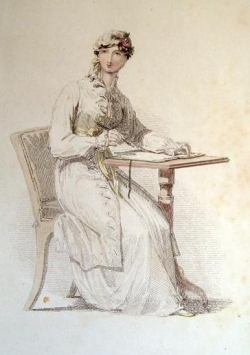
writingdeskThe Regency romance is one of the most popular types of romance published–but what makes for a good Regency? What do you need to know to write one.

I’m teaching a workshop on Writing the Regency this July (22-Aug 18), but here are a few basics:

1-Voice. First things first, and the first thing any Regency novel needs is the right voice. Now the Regency voice can be funny or dramatic, but the feel has to be something that invites the reader into a world that doesn’t exist–yes, it’s the past, but it’s a past that no one’s been to, so it’s up to the writer to come up a “tone” or voice that feels right. It’s the sort of thing that readers know, and the writer has to find.

2-Research. This is the one that stops most folks. The odd thing is that contemporary novels can need research, too, particularly when you dip into fields that aren’t your own (medical, legal, cowboys, fire, etc. etc.). The trick to research is to know the right questions to ask–what do you need to know. And where do you go to find it? Too much time spent in research means too little time spent writing.

3-Plausibility. Readers have to buy into the world. You can actually have accurate details–but will readers believe them? The same goes for the characters. Do you have people who make sense within this world you’re creating? The reader has to believe not just in your characters, but that your characters could have existed within the Regency world.

4-Glamour. The Regency is an era of style–of wit. And clothes. And, also, titles. Lords and ladies, and getting this wrong can throw a reader right out of the story. Setting matters, as does the furniture, and the outfits. We all want to be swept away–that’s part of the attraction of the past.

5-History. Technically, you don’t need too much of this in a Regency (you can go for costume drama). But you do need some basics, otherwise why bother setting a book in this era. And if you’re writing a Regency mystery, or historical fiction, you need more than the basics. But part of this is why you pick the Regency to start with–it helps a lot if you’re more than a little in love with the era.

6-Details. The right details can make or break a story, and this is where you want to find fresh details (and not just repeat what other authors may have done in their stories). The search for these details can be like a treasure hunt–the one trick here is not to stuff every little detail you find into one story.

7-Adventure. We read about the past because it is past–nicely, safely so. But it’s also a time with a touch of adventure, with swords and duels, war and spies, candlelight and balls. It’s a place for the reader to move into and have a short adventure into that past. The adventure may be as simple as an elopement or as complex as an unsolved murder, but a touch of this always helps any Regency.


Plotting from Character

rosesI’m going to be teaching a workshop soon on this because it’s something I see in a lot of contest manuscripts–there’s a good start and then the synopsis slips into cliches or takes a left into what comes across as a contrived plot. This comes from forcing a set plot onto the characters instead of developing characters that bring their own conflicts and issues to the party.

Robert McKee who teaches one of the best classes there is on story structure states: story is character and character is story—if you change the story you must change your characters and if you change your characters your story will change.

What this means is that if you approach the plot (the things that happen) from the aspect of forcing certain actions to happen, you’re going to end up with a contrived story—the reader won’t believe the events because they are forced onto the characters. This is where you end up with the heroine kidnapped because she does something stupid, or the hero believes his girl is cheating on him just because he sees her with another guy, or some other external events forces the characters to do stupid things that really don’t match the character’s character.

To avoid this, you look for the story to come from the characters—you set up your characters to generate the plot (the things that happen) because the characters make choices. Those choices have consequences that generate new problems and the need for new choices.

So, how, exactly, do you go about doing this?

1. Start at the deepest point: for every character, find that person’s core need. (And, yes, you need to do this for all your characters, good guys and bad, and secondary characters, too.) Know what every character wants most in this life.

2. Find out why that character needs that one thing. When looking for these motivations for a character’s core need, discard the first two or three ideas. And look for motivations that happen early in life—we’re all shaped most strongly by those things that happen in our formative years.

3. In a romance, set up a potential mate who can’t provide that need for your main character (and know who really is the main character in the story).

4. Decide if your characters recognize their needs and motivations.

5. Go beyond he’s hot and she’s sexy for characters to click emotionally, mentally, and on levels beyond physical.

6. Layer.  Add traits that are strengths and ones that are weaknesses, make them compliment and contrast.

7. Give every character a secret.  Maybe even one that stays hidden in that story.

8. Focus the story on one character’s specific growth—that is your protagonist, and that person’s growth is at the heart of the book. Yes, in a romance you have a hero and a heroine, but one of them needs to be the main focus.

9. Put in clear, specific goals for each character. Avoid negative goals (she wants to avoid being killed)—the reader won’t know if the character archives this goal since it’s an avoidance goal. And make it tangible—a goal to be rich doesn’t mean much since one person’s rich might be a thousand dollars while another’s is a hundred million. In every scene, every character needs a goal. And your characters need a specific, tangible goal that sets the story into action.

10. Make sure every choice (and every failure) has consequences. It’s no good having a character whose goal is a “so what” goal. The character’s life, or at least their image of themselves, should be on the line. If the hero doesn’t get that promotion, he’s got to lose his wife, his home, and never be able to work in that profession again. If the heroine doesn’t find the three hundred dollars to keep her car, she should lose her child because she can’t keep a job and keep food on the table. There have to be costs for failure, otherwise why should the reader care.

Finally, if you get stuck for what happens next, go back to your characters and play the “what if” game with them. Look at throwing more obstacles at your character—how will that person react to this new problem? For example, if your heroine has to get a contract signed to get that promotion to VP to be able to afford the medical bills for her mother’s cancer, what if she finds out the contract is with a mobster? Is she still going to go for it? Or what if the guy does sign—and then shows up dead the next day? What does she do now? Or what if in the middle of the business meeting, she has an asthma attack? How will she handle that?

Look for how to make things worse for your characters—but always look at the story evolving from your characters reactions to those obstacles. Instead of thinking, “Oh, and then this will happen in the story and my character will do that.” Go for thinking, “What if this happens—how would I react to that if I were this person?” And let your story evolve from your characters so that your story is really about your characters, and your characters are your story.

And if you need to know more (or put this into practice), come and take the workshop–we’ll do some hands-on work with this.

Getting More From Online Workshops

writingdeskI’ve been teaching (and taking) online workshops for a number of years now, and they’re always tricky beasts. The instructor can’t see the students’ eyes, so there’s no using glazed stares to realize the students aren’t getting it, and no seeing the spark of understanding. There’s also a slow down in communication–questions have to be written out and answers written out, and back-and-forth becomes a bit harder. And witting comments can sometimes come across as snide insults (from the instructor or the student). So how do you deal with this and still do an online workshop and get something out of it?

Here’s my recommendations. (And since I’m doing three back-to-back workshops this summer–Plotting from Character July 8 – Aug 4, Writing the Regency Set Novel July 22 –  Aug 18, and a Storytelling Workshop Aug 5 – Sept 1–I hope folks will take notes of what can improve your workshop experience.)

1-Interact–a lot! The more you put into the workshop, the more you’ll get out of it. I’ve “lurked” in some online workshops and I never found them as useful as when I participated. This can be with questions or assignments.

2-Offer feedback. This can be praise or suggestions for what might work for you better. Be polite, but do offer feedback (this is so helpful to me when someone suggests a new idea).

3-Ask your questions. Even if it seems dumb or basic, ask anyway. You might also help someone who is just too shy to ask.

4-Make mistakes. Forget the idea of “doing it right.” Every workshop someone will post the phrase, “I hope I did this right.” It drives me nuts. First because there is no “right” in writing–there’s what works, or doesn’t work. And second because if you were pro and slick at everything why would you need (or take) this workshop? Go in with the mind-set that you’re there to screw up and make mistakes–you’ll learn more from mistakes.

5-Use emoticons. Semi-colon, close parenthesis are great to add a smiley face 🙂 to let folks know you intend to be funny here. For a long time I didn’t use them and I think I ended up with a lot of folks not understanding my humor to try and make a point.

6-Relax and have fun. Workshops should be a safe place. You don’t have to impress anyone there. It’s a place to take risks and try new things and see what works and what doesn’t work.

7-Remember you are getting one person’s point of view. Every writer has a different process. It’s great to find out what works for someone else–and often those tips can help your own process. But not everything that works for someone else will work for you. That doesn’t mean you’re a failure–or that you are not a writer. It means your process is different. Try new things out. But discard what doesn’t work for you. Run everything past the filter of your own writing process and style.

Above all, use the workshop as a reason to get yourself writing! Remind yourself you paid money for that class, so use that as your reason (excuse) to get up early or stay up late to read the lessons and do the writing assignments. Make your writing your first priority, at least for the duration of the workshop!

Tea Time

TeaServiceToday we have a guest post from author Ella Quinn on tea — so curl up with a cuppa and enjoy!

Ah, tea. Once could wax eloquently on the subject of tea, and one has. The small leaves have been the topic of erudite, and sometime heated conversation, especially when talk turns to how tea was drunk over 200 years ago. And why, you ask, would one want to discuss that particular matter? Well… because I am a Regency author, and, therefore, I tend to have conversations with other Regency authors on seemingly innocuous matter.

The actual origins of the drink are said to date back to Sichuan province’s Emperor Shen Nung 2737 BC. In China, tea had the reputation of being helpful in treating everything from tumors to making on happy.

teaboxTea was first brought to England from China in the mid-17th Century. It made its debut around the same time as Turkish coffee and hot chocolate. Tea had been drunk on the Continent prior to its arrival in England as Ladies Arlington and Offory developed a taste for it in Holland and brought some home with them. At the time, tea was hideously expensive, one report in 1666 had it as costing 40s a pound when brandy cost 3. Considering the average lawyer earned the equivalent of £20 per year, it is not surprising that only the wealthy could afford to buy it. It was during this century that tea began appearing in coffee houses as well.

While the men were out drinking coffee, tea and chocolate at coffee houses which were morphing into clubs such as White’s, the ladies followed Queen Catherine’s example (she brought her own tea from Portugal) and remained home to drink tea a chocolate. There appear to be several reasons that coffee did not become popular at home, one was the smell, which many found objectionable.

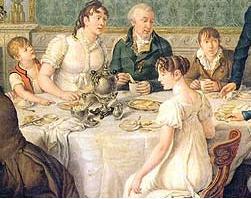
Tea PartyThe earliest painting I found of ladies getting together to drink tea is A Tea Party by Verkolje. Since 17th Century it was customary for the lady or gentleman of the house to actually brew and serve the tea.

By the late 17th Century, green tea in both leaf and powered form, and black tea called Bohea from the Bohea mountain region were being imported. If tea wasn’t expensive enough, the government decided to tax it, and smugglers opted to take advantage of that decision and a trade smuggled tea began. By the 18th Century the beverage had become so popular that no less than at least fourteen different types of tea were available, as were adulterated teas. Smouch making, the mixing of tea with dried ash tree leaves had begun. Because it was easier to hid smouch in green tea, black tea became more popular. At the end of the century, tea was enjoyed by all social classes.

By the 19th Century, tea was also being imported from India and Ceylon. The beverage was drunk at breakfast, in the afternoon (Jane Austen makes mention of it in1804), evening and in times of distress. A while ago, I ran across a quote from a lady stating that one invited friends to “drink tea” and that the term to “take tea” was vulgar. Unfortunately, I can no longer find the reference.

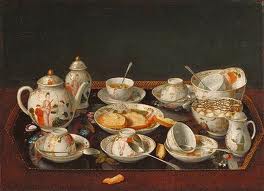
teatableThe popularity of tea also spurred new serving wear, furniture and later in the century rooms in houses were set aside for the purpose of drinking tea.

Now back to the original debate. According to Jane Pettigrew’s A Social History of Tea, which I highly recommend and from whence much of this information has been derived, Tea was drunk with sugar and either sweet milk or cream. It appears that more men preferred cream than did women. Or at least they wrote about it more. When Jane Austen wrote about drinking tea, it was with milk.

Tea plays a large part in my debut novel The Seduction of Lady Phoebe. The hero, Lord Marcus is devoted to tea. Unfortunately, his father will only allow coffee to be served at breakfast. Lady Phoebe, as did most ladies of the time, had her own blend.

Excerpt from The Seduction of Lady Poebe

A low growl from her stomach caught her attention. “I’m famished.”

Marcus nodded. “As am I. When I have a household of my own again, I’ll order breakfast to be served early.”

She turned Lilly toward the gate. “I’ll wager if we go back to St. Eth House now, François, my uncle’s chef, will find something to feed us.”

“Lead on.”

After they entered St. Eth House, Phoebe motioned to Marcus to follow her through the baize door leading to the kitchen.

With a brilliant smile on her face, she approached François, the St. Eth chef de cuisine. “François, we have been riding and are so very hungry. Will you feed us?”

He glanced from her to Marcus. “Oui, milady. Naturellement.”

François gave them each a warm bun with honey before shooing them up the stairs to await their breakfast.

Phoebe took a place at the table and Marcus sat next to her. Ferguson brought tea and she poured them each a cup. The buns were wonderful, tasting of honey and butter. She wondered what François would send up for the rest of their breakfast.

Marcus gave a satisfied sigh. “Phoebe, I can’t thank you enough for the tea. I almost always have to have coffee at home.”

That was very strange. Puzzled, she asked, “Why do you not ask for tea to be served if you don’t like coffee?” It was the first time she’d ever seen him disgruntled.

“I asked for tea once, years ago, and my father gave me coffee. He was so adamant, I never asked again. I still feel like a guest at Dunwood House, as if I’ll be returning to Jamaica. . . .”

THE SEDUCTION OF LADY PHOEBE ~ ON SALE: September, 19, 2013LADY PHOEBE STANHOPE, famous for her quick wits, fast horses, and punishing right hook, is afraid of nothing but falling in love. Fleeing a matchmaking attempt with the only man she despises, Phoebe meets a handsome blue-eyed stranger who sends her senses skittering. By the time Phoebe discovers the seductive stranger is the same arrogant troll she sent packing eight years ago, she is halfway to falling in love with him.

LORD MARCUS FINLEY last saw Phoebe striding regally away, as he lay on the floor with a bruised jaw and a rapidly swelling eye. Recently returned from the West Indies, Marcus is determined to earn Phoebe’s love, preferably before she discovers who he is. Determined to have Phoebe for his own, Marcus begins his campaign to gain her forgiveness and seduce her into marriage.

Can Phoebe learn to trust her own heart and Marcus? Or is she destined to remain alone?

“Lady Phoebe is a heroine Georgette Heyer would adore–plucky, pretty, and well worth the devotion of the dashing Lord Marcus. A marvelous find for Regency romance readers.” — NYT Bestseller Grace Burrowes 

“Ella Quinn’s The Seduction of Lady Phoebe is a passionate tale full of humor, romance, and poignancy. Quinn writes classic Regency romance at its best!” — Shana Galen

Preorder or Buy at:

Amazon US

Amazon UK

B&N

Author Ella Quinn has lived all over the United States, the Pacific, Canada, England and Europe before finally discovering the Caribbean. She lives in St. Thomas, Virgin Islands with her wonderful husband, three bossy cats and a loveable great dane. Ella loves when friends connect with her. Visit her at www.ellaquinnauthor.com, or connect on Facebook, Twitter, or at her blog. 


The Beginning of Handbags

Char portrait 2009smerWe have a guest post by Charlene Raddon, author of Taming Jenna, Tender Touch, Forever Mine, To Have and to Hold, and writing as Rachel Summers, Scent of Roses. Charlene normally blogs at  http://www.charleneraddon.blogspot.com, however she’s here now with great info on the history of handbags.

NOTE: Charlene is giving away a free book and $5 Amazon gift card to a random commenter. You must comment by March 1, and leave an email address so you can be contacted.

———————————————————————-

Purses, pouches, or bags have been used since humans first found a need to carry precious items with them. Egyptian hieroglyphs show men wearing purses around the waist, and the Bible specifically identifies Judas Iscariot as a purse carrier.

During the 14th and 15th centuries, bags were attached to the most vital feature of medieval garb: the girdle, along with rosaries, Book of Hours, pomanders (scented oranges), chatelaines (a clasp or chain to suspend keys, etc.), even daggers. Women favored ornate drawstring purses known as “hamondeys” or “tasques”. Men used purses known as “chaneries” for gaming or for holding food for falcons.

no3pic2During the Elizabethan era, women’s skirts expanded to enormous proportions and small medieval girdle purses became lost among huge amounts of fabric. Rather than wear girdle pouches outside on a belt, women chose to wear them under their skirts. Men wore leather pockets (called “bagges”) inside their breeches. Large satchel-like leather or cloth bags were sometimes worn by peasants or travelers, diagonally across the body.

In the 16th and 17th centuries the more visible bags were rejected and long embroidered drawstring purses were hidden under skirts and breeches instead, while some people wanted them to be conspicuous, for use as decorative containers for gifts, money, perfume, or jewels. Toward the end of the 17th century, purses became increasingly sophisticated, changing from simple drawstring designs to more complex shapes and materials.

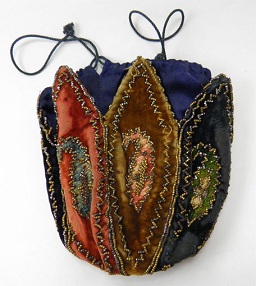
Following the French Revolution, narrow, high-waisted dresses became popular, leaving no room beneath for pockets. Consequently, purses, in the form of “reticules” or “indispensables” as the English called them, came into use, showing that women had become dependent upon handbags. The French parodied the women who carried the delicate bags that resembled previously hidden pockets as “ridicules”.beaded reticule

Victorian era developments in science and industry provided a vast array of styles and fabrics women could coordinate with their outfits. Though pockets returned in the 1840s, women continued to carry purses and spend an enormous amount of time embroidering them to show off for potential husbands, often including the date and their own initials in the designs. Chatelaines attached to the waist belt with a decorated clasp remained popular.

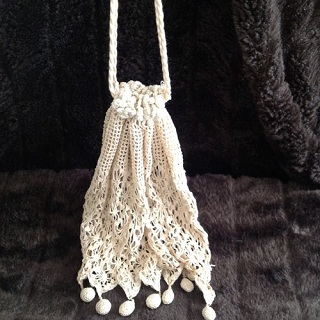
The railroad brought about a revolution in the use of bags. As more people traveled by train professional luggage makers turned the skills of horse travel into those for train travel, and soon the term “handbag” emerged to describe these new hand-held luggage bags. Many of the top names of today’s handbags started as luggage makers (whereas, previously made purses and pouches were made by dressmakers). Hermes bags were founded in 1837, a harness and saddle maker. Loius Vuitton was a luggage packer for the Parisian rich. Modern handbag designs still Crocheted reticuleallude to luggage with pockets, fastenings, frames, locks, and keys.

Early in the 20th century handbags became much more than just hand-held luggage. Women could choose from small reticules, Dorothy bags (now called dotty or marriage bags) with matching robes, muffs, and fitted leather bags with attached telescopic opera glasses and folding fans. Working women used larger handbags, such as the Boulevard bag, leather shopping bags, and even briefcases worn around the shoulder.

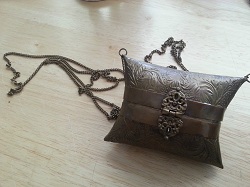
After WWI, the long constricting layers and rigid corseting women wore disappeared. Perhaps the most important development during this period was the “pochette,” a type of handle-less clutch, often decorated with dazzling Tiny metal pursegeometric and jazz motifs, worn tucked under arms to give an air of nonchalant youth. Rules for color coordination grew lax and novelty bags, such as doll bags (dressed exactly like the wearer), became popular. The discovery of King Tutankhamun’s tomb in 1923 inspired purses reflecting exotic motifs.

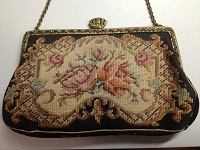
image

Today, purse designs continue to fluctuate, and always will. What sort of purses do you remember using when you were young? In the 1950s I had a pink and white, square plastic purse I loved. I wonder whatever became of it. If I owned that purse now, it would probably be worth a pretty penny.

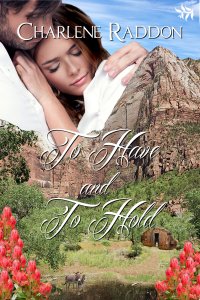
To Have and To Hold by Charlene Raddon - 200Charlene Raddon’s Latest book is To Have and To Hold…

A woman without a prayer…

 A widow with two children, Tempest Whitney had to mortgage everything to repay the money her husband had stolen. But even as she struggles to hold onto her Utah homestead, a scheming rancher buys up her debts, demanding she either get off his land or marry him. Then a dark-haired stranger shows up, claiming to be her dead husband…

A man without a past….

Buck Maddux spent two years in jail for a crime he didn’t commit. Now a death bed promise has brought him to Tempest’s dugout. A man without roots, he doesn’t plan to stay—or to feel so fiercely protective of this feisty beauty he saves from a forced marriage. Suddenly, Buck yearns for a home, a family, a lasting love. But what can he offer Tempest? The surprising answer lies in the forbidden canyons of an ancient Anasazi tribe, where fortune and danger await—along with a passion more precious than gold…

EXCERPT

Riding up to the house, he called out a hello and dismounted. Surrounded by barking dogs he proceeded to water his horse at a well built over a natural spring. From beneath the wide brim of his Stetson he searched for some sign of life. Finally he headed to the house, spurs jangling in his wake. His fist was raised, ready to knock, when the rough plank door swung inward and the business end of a Henry repeating rifle met with his nose.

“Judas!”  He jerked back and stumbled over his own big feet. A cat screeched, letting him know he had mangled its tail. The critter got even by climbing Buck’s leg. Yelping and dancing while he tried to extract the cat, he trampled two or three more felines. Easy to do; half a dozen littered the yard, along with pigs and a flutter of chickens.

“Whoa there, ma’am.”  He held up a hand. “Don’t mean you any harm.”

“What do you mean?” she asked.

The cat took off, kinked tail in the air. Buck checked for damage and decided he’d live. “That’s a mite awkward to explain.”  He took off his hat, wiped his brow on his sleeve and replaced the hat back, buying time while he studied her.

She wasn’t much to look at. The braid hanging to her waist appeared as though crows had been pecking at it. Dun-colored strands fluttering about her head gave her a wild look that belied the delicacy of her face. A strong chin balanced her large eyes and a mouth as stubborn as the mules in the pole corral. A patched apron hung to her scuffed boots and hugged her legs snugly enough hint she wasn’t wearing skirts. He was wondering what might be under the apron when she spat, “Spill it, mister. I haven’t got all day.”

“Think you could put down the gun?” He eyed the rifle with amusement and chagrin. “This might take a while and your arms are like to get tired.”

“Don’t think for a second, just because I’m a woman, that I can’t shoot this rifle,” she drawled. “I hate when men jump to such conclusions. Makes me so angry I start shaking and that makes my trigger finger jittery, if you know what I mean.”

Buck knew. A jittery trigger finger meant he might get shot for no reason. He eyed her speculatively. She wasn’t much bigger than a colt; no problem for a man his size to handle. “I doubt you’d enjoy where they’d put you for shooting a man,” he said, smiling to hide his growing irritation.

“Nobody goes to jail for self-defense. Especially a woman. You going to state your business or not?”

“Are you Tempest Whitney?”

“What’s it to you?”

He sighed. “Name’s Buck Maddux. I ran onto your husband two years ago. He was gut shot and bleeding bad —”

“Maddux!” Her head snapped up and her finger tightened on the trigger. “You yellow-bellied son of a coyote. How dare you come here? Didn’t you cause enough grief robbing that stage and getting my husband killed? Get off my property before I fill you with lead the way the posse did Skeet.”

He threw up his hands as she stepped closer. “Easy, ma’am, I didn’t come here to get you all upset.”

“What did you expect? That I’d welcome you with open arms and invite you in for supper? Just because my husband let you rope him into a stupid robbery doesn’t mean I have to put up with you.”

That did it. Now he was angry. “Hold on a minute here.” His mouth was tight, his voice hard. “I had nothing to do with that robbery, or the Army patrol who shot your husband.”

“Sure. You were just an innocent bystander who happened to be with Skeet when he was caught.”

“As a matter of fact—”

“Raspberry stickers!” she spat. “You plotted that hold-up. You killed my husband as surely as if you’d pulled the trigger yourself.”

Buck’s blood boiled. He told himself it was because she’d accused him of lying, not because she’d come too close to the truth, but the excuse didn’t wash, adding to his fury. In one swift movement, he away snatched her rifle, threw it to the ground, and shoved her against the door jamb. He held her there with his body, her hands pinned above her head, while he stared into amber-sparked brown eyes.

The dogs took up barking again.
————————————————————————-
Click on the links below to buy one of Charlene’s books:

To Have and to Hold

Tender Touch

Forever Mine

The Fear Factor

“I’m convinced that fear is at the root of most bad writing. . . . Good writing is often about letting go of fear and affectation.” – Stephen King

Up in a balloonFear shows up in a number of ways, and hits each of use differently. It shows up a lot in the only workshops I teach.

It shows up in excuses (I’m too old, I’m too busy, I won’t try this because I don’t understand).

It shows up in procrastination (I’ll catch up later, I’ll try the exercises after the class on my own).

It shows up in perfectionism (I’m awful because I didn’t do this right, I failed, I suck, I’m stupid).

It shows up in a refusal to try new things (I’ll post this old story bit instead of writing anything new).

And I can see it every single time. Then we have the brave souls who face their fears dive in and fall on their faces. I applaud that. Because they’re learning. Which is the point of a workshop. It’s supposed to be a safe place to try things, to experiment. Instead, I see so many writers who are afraid to spread their wings—as if one mistake is going to be a disaster.

Folks—we learn from our mistakes. Go out and make more of them.

I am amazed how many people resist this idea. They want to be praised. That’s not good. That’s not going to help you learn. What does help is the rewrite and the revision and the experiment. Try something new. Write a scene. Then rewrite it from a different viewpoint. Just because. Throw stuff out there. Try something in first person if you’ve never done first person. Or in present tense. Just try it out. Tell yourself that:

a) it doesn’t have to be perfect

b) it doesn’t have to be good

c) it can actually be really awful

Just let it be what it’s going to be. Then read (aloud so you catch what you’ve really done) what you’ve written and look at what you can learn from what you did. Look at what works. Look at what doesn’t work. Keep the good stuff.

This happens when I cook, too. I’ve made some awful things—I once put too much baking soda into my gingersnaps. They came out Alka-seltzer hockey pucks—hard and fizzy if you chewed on one. Great for your digestion (if you needed it), and not something anyone would eat (not even the horses would go for them, despite the sugar on the outside). Learned a great lesson on baking soda from that one.

Same applies to my writing. I’ve written awful scenes (and I expect I’ll keep doing that). Sometimes the dialogue clunks like a flat tire. I’ve tried first person, third, second, even. Present tense, past tense—it’s all about stretching those writing muscles and trying new things. You don’t know what really works until you’ve tried it.

I’ve written books that are not for everyone (go read the reviews)—sometimes folks hate my character (hey, it’s better than indifference). And I worry about all of it. I still get the nerves going and I still wonder if I’m any good at any this—no amount of praise ever takes that worry away.

The point of this is you’re never going to get over your fear.

Live with it. Know it’s there. Let it flow into you and out of you again and go write anyway. Use the fear—let it keep you sharp. Let go, too, of the affectations that King talks about—which means get out of the way of your characters. Let them tell you their story and stop pushing them into plots that don’t work. Stop being so damn writerly and just get clean words onto the page.

And if you need more good words from Stephen King buy his book On Writing: Memoirs of a Writing Career. Or read more at: http://grammar.about.com/od/advicefromthepros/a/StephenKingWriting.htm

(First published at https://writersinthestorm.wordpress.com.)

Best Advice from RWA National: The Promise To Your Readers

It was an upbeat conference this year. Editors didn’t look so hunted. Those writers not yet published didn’t look so desperate—probably because the decision to be published is now in their own hands. And the self publishing panels weren’t just about how to format an ebook, but actually had a lot of great info.

My favorite workshop was held by Barbara Freethy, Bella Andre, and Tina Folsom—three ladies who’ve done very well for themselves and who have shown that self published does not mean bad books or terrible sales. The best advice I heard came from Bella Andre who talked about the contract a writer has with a reader—a contract to deliver not just a good read but a certain level of sensuality in the books. She’s established as a secondary identity for a different type of book (and no, I’m not going to tell you the name—you’ll have to hunt it up yourself). But she did the new name because the books offer a different level of sex in the books—it’s a different “type” of book.

Now, I’d been looking at genre for “different”—and thinking that of course that’s why you needed a pen name. But this hit home—of course it’s not genre. It’s more about the feel of the book—what type of book is it. And that got me looking at my own bookshelves again.

I read sexy books—love the good ones. But it’s not my primary read. And that got me thinking.

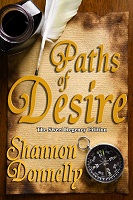
Paths of Desire is a book I did to break out to a larger book and a more sweeping historical. I amped up the sex in the book—probably too much so. It’s a good book—or I think so. But I got to thinking about my readers. I’d had one reader post a one star review—and I think she’s right. It’s not the book for her, but she’s my reader. And it’s a brave new world.

This lead me to do an edit and I’m bringing out Paths of Desire: The Sweet Regency Edition. It’s more like my other Regencies—not exactly the door shutting on the sex (it’s a romance, and these folks become lovers, and that’s a vital part of the plot), but making it more about the emotion and less about the body parts. A new cover and a new ISBN denotes the new version of the book. And now readers can choose which version they like better.

I’m also going to be looking closer at my urban fantasy books, too—maybe I’ll bring out the hot version and the plot version and let readers pick which they prefer. Or maybe I’ll just bring them into the “Shannon Donnelly” version so that no pen name is needed—it’ll be a change of genre, but not a change of tone.

Either way should be interesting.

So what do you think—hot or not? Or is it best to have a choice that you the reader can make in which edition you like best?

Writing Workshops

I’m just starting up the Writing the Regency Workshop online for Outreach International Romance Writers, which works well since I just gave a talk on this at RWA National Conference, too. This had me thinking about what is it that folks need to get right, and I also asked the RWA Beau Monde Chapter about what they thought. Here’s the short form answer:

1 – Basic History. Even if you’re doing alternate history, you need to know some of the basics because this informs the characters–people live within the context of their world, and it helps to know what events formed their parents and grandparents and their family.

2 – —Titles & Class System.  Gossford Park is great to help us Yanks get an idea of a nuanced class system–Americans are used to rich/poor and something in between and that’s about it. Getting this right can be tricky since titles evolved over more than a thousand years, but it’s important–nothing can throw a reader out of a story faster than a title that makes no sense.
—3 – British Sensibilities.  BBC America is a big help here, so is being an anglophile.  This one is another tricky spot since you can end up with characters who don’t seem as if they’ve ever been near England.
—4. Legal Stuff.  If your story premise has anything to do with inheritance or marriage laws, it’s time to break out the research books and make sure the basic premise works. If that doesn’t work the whole story can fall apart on you.
5. —Society’s Attitudes. The 1800’s are similar to our world, but it’s also a different era–and while your characters may rebel against this, they should know what they’re up against. Folks back then knew about a woman’s place, and a man’s place, and that there were no teenagers, just adults and children. All of this can affect your characters.

6. Social/Personal Constraints. Honor mattered, so did duty–and while some folks might shrug those off, others did not and it said a lot about a character who did not take these to heart. This is also the stuff that makes for great conflict so it’s wonderful meat for a writer.

Now, of course, there’s lots more to know–but those are the big ones. We’ll get into the rest in the workshop.

Character Arcs, Plot Lines, and the Synopsis, oh my

My synopsis workshop finished up this past April for RWA’s Outreach International Chapter, and I’ve also been judging in some contests–boy do folks need to figure out their story arc and plot lines (and character arcs, too). This is one place where a synopsis can help you because it highlights every flaw in your story–all the weaknesses come out. Which is why I think editors really ask for these things.

So what are the THREE big flaws that I’m seeing (on a regular basis)?

1) The big one is that there is no plot line or story arc. In other words, the story rambles along and stuff happens.

This usually can be traced back to the main character (your protagonist) not having a strong, clear goal that’s well motivated and which kicks off the main plot line, or the main character’s arc in a more character-driven story. This goal can be as simple as survive a night in a haunted house in order to win a million dollars (motivated by the need for that money to save mom, who is about to lose the family farm), or it can be to win a contest to win her own self respect, or it can be as big as saving the universe. But there’s a couple of important things about this:

A) The main character’s goal must matter to that character–there has to be something personal at stake.

B) There have to be consequences for failure–ones that would shatter than character.

Once these are in place, the character has been set on a path. Now you’ve started a story arc. The stuff that happens now tries to push the character off that path (this is your plot). Worse and worse stuff happens until the character gets faced with a crisis–and this crisis had better be one that pits the character against wants and needs, so that the character has to make very tough choices. This is where the character gets stripped down to their core–to what makes that person tick. (And if you don’t know this, you need to get to know your characters better.)

Now stuff does happen still but it’s all related to the character’s struggles to get what that person wants. And you make it worse for the character by layering  in what a character needs. As in if you’ve stuffed your character into a haunted house for a night, what your character may need is sanity and a sane world, and that haunted house may strip both away from her. Now your character has internal conflict–stay for the money (external want) or leave to be safe (internal need). And now you can add in an antagonist with a conflicting goal.

This is going to complicate the pl0t–and give you more conflict.

Now your antagonist needs to be thought out–as in what does she want and need?

For example, what’s your ghost’s goal in driving everyone out? This is where you do not want to cop out and go for the cliche. In other words, don’t just go for “She’s insane” or “She’s angry because she was jilted.” Those are weak motivations.

Orson Scott Card in his book on Characters & Viewpoint notes that when you’re digging for your character’s motivations, the first three or four things that pop into mind will always be cliches. (If you don’t have this book, go buy it now, then come back to read the rest of this.) These great ideas are cliche because they are cliche–they’ve been used to death. Keep digging for better motivations. This is vital for any antagonist–write this person as if this character is the hero (we’re all heroes in our own stories).

Could be the ghost is trying to protect others from the damnation that caught her–except she’s driving them mad in the process. Or maybe the ghost has a secret she’s trying to hide. Or maybe the ghost is trying to find a body she can inhabit so she can live again. (And see how those cliches creep in as you’re batting ideas around–that’s why you keep writing down ideas.)

Find out what your bad guy wants as a goal. Find out what your bad guy needs, too. We all need love, right? Well, we all need our own internal rationalization systems, too. Even someone who is mad will have their own reasons for doing what they do.

2) The other biggie I see is that in what’s supposed to be a romance, but the romance is put in like an afterthought. The action overshadows the romance, so the story doesn’t seem as if it’s really about two people struggling to build a relationship. This one is tough.

In a romance, the romance is the main plot line. It’s the main story arc. So you have to have thought about both your hero and your heroine. What does each person want from a relationship? What does each one need? This can be different from the action plot line. It could be your heroine needs to save the world from a plague of vampires–that’s the action sub-plot in a paranormal romance. The plot needs to put her in conflict with a hero (and possible love interest). It makes sense that in this case the hero is the head of the vampires–that’ll give you great conflict in both the romantic plot and the action plot. But now you have to figure out what does each person need and want on a personal level–and how are these going to conflict?

Does the heroine need a steady guy? (And what’s her reason for that–did she grow up in an unstable home?) If she needs stable, you want to either pair her up with Mr. Seems-Like-A-Bad-Risk, or with Mr. Stable-But-Boring. And then you add in what she wants. Could be your vampire fighting heroine needs a partner to watch her back–and she gets Mr. Unstable. Or could be she needs a vampire to come over to her side–so she’s got to seduce one into helping her. The trick here is to keep looking for what adds more conflict and more complexity. Pair up the compulsive clean freak with the slob (The Odd Couple is really a great romance disguised by the fact that it has two guys). Layer in reasons for your romantic pair to be attracted to each other–and layer in plenty of personality issues to drive them apart. Make the relationship the focus of the plot.

Then go back to your action sub-plot. Just remember if the main plot line or story arc is all about action, then you’ve got something other than a romance on your hands. In a romance, the relationship is at the center of the story.

3) The third big thing is that every character’s motivations needs to be clear–that means this info must make it onto the page. This is one where I often feel, as I’m reading, as if the writer knows this stuff, but it hasn’t gotten to the page.

There is the story in your head. There is the story on the page. There is the story in the reader’s head. Ideally, all these match. If one is off, the story flops. This is where you want to ask–“Did I put in WHY my character acts this way or feels this way?” In a synopsis, you simply tell the reader–“He hates cats because he was once locked in a closet with ten of them.” You want to make sure the reader understands WHY your character acts as she does.

The other part of this is make sure your reader understands the setup for the story–how the plot line or story arc kicks off. Get a friend you trust to tell the truth to read this, too, and make sure you are not fudging things. It’s too easy to think, “This is good enough.” You need outside eyes here and someone who’ll say, “This doesn’t make sense” or “I don’t believe this.” That is something to fix with stronger motivations. (You can have a character act out of character or do amazing things only if this is sufficiently motivated–if you have cake-making mom suddenly pull out a sword and behead someone there’s got to be something in her background that would explain why she can do this, or she’s doing this because her child is threatened and she’s got adrenaline making her into super-mom.)

Too often I’m reading something and all I think is “why”. Why did that happen? Why does she feel that way. The worst is when a synopsis just says: And they fall in love. Well…why? What’s different about this relationship and love story? What’s motivating the emotion. Again, this is where a friend who will write “why” all over your synopsis can help. Answer every why–or leave the reason for the question coming up out of the synopsis.

There’s other stuff you can do, but if you cover the big three, you’ll have a much stronger book (and a stronger synopsis).