Tag Archive | vegetables

February Foods in Regency England

Shrove Tuesday is the last day before Lent begins on Ash Wednesday, typically falling anywhere from February 3 to sometime in early March. Traditionally, Shrove Tuesday Pancakes were made up as a last indulgence with butter and eggs, or all the things that might have to be given up for the forty days of Lent. In 2026, this will fall on February 17.

George Cruickshank’s print in ‘The Comic Almanack for 1837: An Ephemeris in Jest and Earnest Containing All Things Fitting For Such Work’ done under the penname of Rigdum Funnidos shows a cook tossing such a pancake.
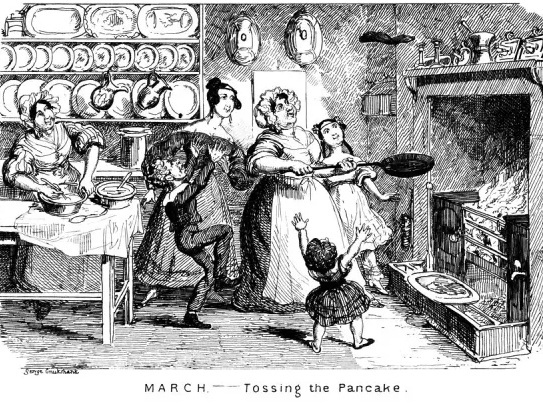
Three children cheer on a cook, dressed in apron over her dress and a cap, while the lady of the house watches, and the kitchen maid stirs the batter. The lady has her hair up in back with curls at the side and a dress taht shows her shoulders--very 1830s. The cook uses an open fire, and the dishes are lined up in cabinet against the far wall. The two girls are in dresses--the older girl looking like a small version of her mother with bloomers showing under her dress--and the boy looks to be in a sailor suit with trousers. The thin, large pancake is in the air as

English pancakes tend to be more like what Americans think of as crepes and were often served with dinner or tea with just a sprinkle of sugar instead of the US idea of a thick breakfast stack with maple syrup poured over top.

Susannah Carter gives the following recipe in The Frugal Housewife (1822) for pancakes:

“In a quart of milk, beat six or eight eggs, leaving half the whites out; mix it well till your batter is of a fine thickness. You must observe to mix your flour first with a little milk, then add the rest by degrees; put in two spoonfuls of beaten ginger, a glass of brandy, a little salt; stir all together, clean the stew pan well, put in a piece of butter as big as a walnut, then pour in a ladleful of batter, moving the pan round that the batter be all over the pan: shake the pan, and when you think that side is enough, toss it; if you cannot, turn it cleverly; and when both sides are done, lay it in a dish before the fire; and so do the rest. You must take care they are dry; before sent to table, strew a little sugar over them.”

There was no baking powder yet to make fluffy pancakes, and the recipe doesn’t call for any type of yeast. While pearlash was around for leavening (you soak wood ash in water, strain it, then boil it until it makes a moist white powder). This wasn’t much in use in England for it doesn’t show up in cookbooks. Barm, also called ale yeast, does show up occasionally in recipes, but commercial yeast was readily available and used not just in bread, such as in cakes and puddings like “Dutch Pudding or Souster.”

From the garden and farm, John Loudon’s 1822 book An Encylopaedia of Gardening offers up this advise, along with vegetables and fruits, with spellings and punctuation the same as from his book:

FEBRUARY Planning and Preparing, Foaling, Start of Early Lambing in fields, Planting trees and bare root plants such as roses, root crops in, Pare and burn grass lands, Spread manure.

Scotch or Strasburgh cabbage, savoys, borecoles, Brussels’ sprouts, and, if a mild winter, cabbage coleworts, brocolis. Haricots, beans, and soup-peas from the seed-room. Potatoes, Jerusalem artichokes, turnip, carrot, parsnip, red-beet, skirret, scorzonera, and salsify. Spinach, if a mild winter. Onions, leeks, garlick, shallot, and rocambole. Sea-kale from covered beds. Lettuce, endive, celery. American and winter-cress. Parsley, if protected, horse-radish, and dried fennel, dill, chervil, &c. Thyme, sage, rosemary, and lavender, from the open garden; dried marjoram, basil, &c. from the herb-room. Rhubarb-stalks from covered roots, anise, coriander and carraway-seeds, from the seed-room; chamomile, &c. from the herb-room. Red cabbage, samphire. Nettle and thistle tops; towards the end, sorrel leaves, and if a mild winter, sauce-alone. Mushrooms from covered ridges. Sea-belt preserved, and occasionally badder-locks.

Hardy Fruits from the open Garden, Orchard, or Fruit-Room. Apples, pears, quinces, medlars, services from the fruit-room. Some plums from branches hung up in the fruit-room. Dried grapes and currants from branches hung up in the fruit-room. Almonds, walnuts, chestnuts, filberts from the fruit-room. Sloes from dried branches hung up in the fruit-room.

Culinary Productions and Fruits from the forcing Department. Kidney beans. Potatoes. Sea-kale, asparagus. Small salads. Parsley, mint, chervil. Rhubarb. Mushrooms. A pine occasionally; grapes, cucumbers, strawberries. Oranges, lemons, olives, pomegranates. Pishamin-nuts, lee chees. Yams, and Spanish potatoes.

  • Borecoles is a type of kale.
  • Haricots are green beans.
  • Jerusalem artichoke is a hardy, starchy root plant that has nothing to do with artichokes, but has more in common with potatoes and mashes up very well.
  • Skirret, also a root plant which means hardy for winter, is said to taste like carrot.
  • Scorzonera is another root vegetable that tastes a bit like an artichoke.
  • Salsify is also call oyster vegetable since it has a oyster-like taste.
  • Rocambole is another name for a shallot, which can still be found in many modern markets.
  • Samphire does still show up in English cooking, and grows in marshy areas. It is from the parsley family, looks like baby asparagus, and has a crisp, salty taste.
  • Sea-belt and bladder-locks are both types of seaweed.
  • Medlars is described as tasting like spiced applesauce.
  • Services are a type of strawberry.
  • Filberts are what is called a hazelnut in the US.
  • Chervril is a herb similar to parsley.
  • ‘Pine’ means a pineapple, which are touchy to grow in England (they do look a bit like a pinecone).
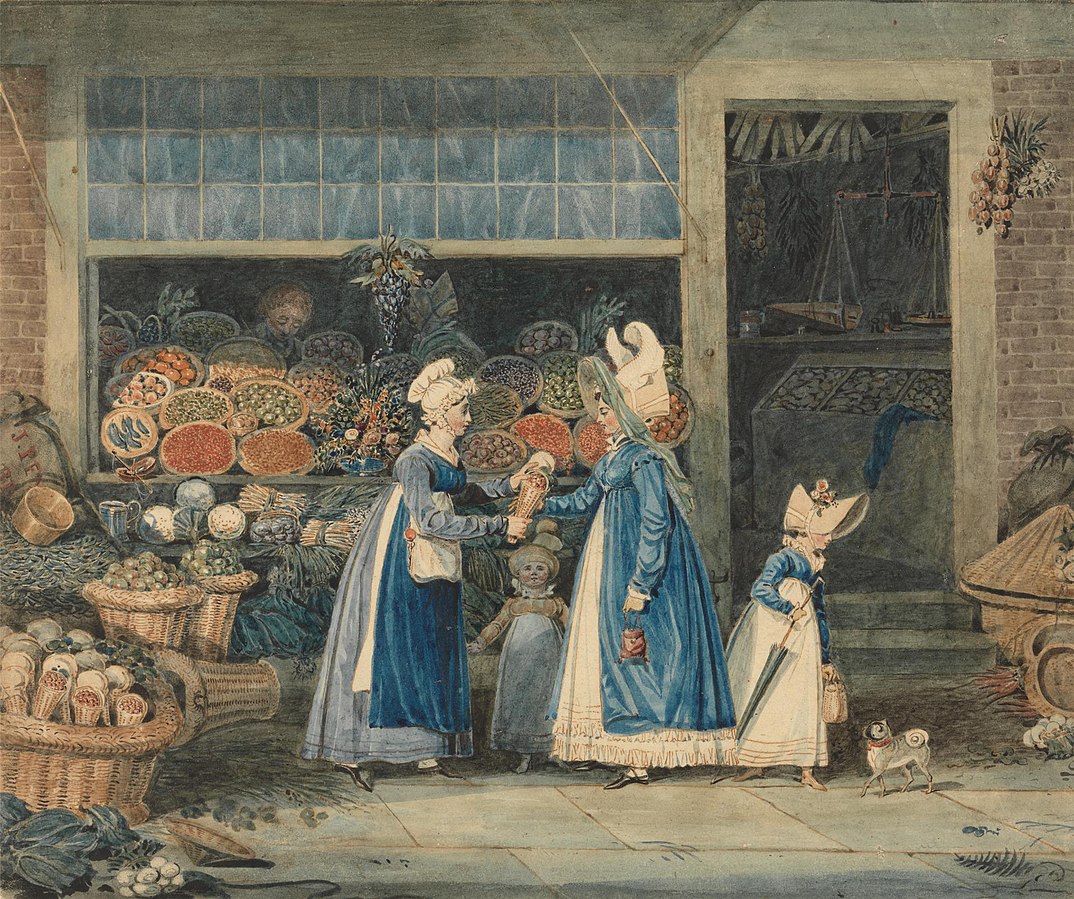
A lady and her daughter buy fruits or vegetables from a woman at a grocer in London
James Pollard The Green Grocer (c. 1819)

January Foods in 1822

John Loudon portrait

In the Regency era, the best gardeners were though to come from Scotland, and John Claudius Loudon certainly helped cement that idea. His portrait at left shows him looking both prosperous and rather Scottish. He is noted as being the first to use the word ‘arboretum’ in his writings, he was a botanist, garden designer, and author, and his wife, Jane Webb, was also a horticulturalist, and author. It was a talented family. An Encylopaedia of Gardening by Loudon speaks to the wide variety of produce available in England in 1822, and also how nuts were linked to fruit. Some reference are very odd to the modern reader:

  • Rocket, of course, is called arugula in the US.
  • Savoys means a type of cabbage, known for crinkled leaves.
  • When he says ‘kidney beans for harricots’ he means that kidney beans replace the French beans (or what is called green beans in the US).
  • Fuci is the plural for Fucus a type of seaweed (obviously, you’d have to be near the sea to get this along with other coastal plants).
  • Borecoles is a type of kale.
  • Jerusalem artichoke is a hardy, starchy root plant that has nothing to do with artichokes, but has more in common with potatoes and mashes up very well.
  • Skirret, also a root plant which means hardy for winter, is said to taste like carrot.
  • Scorzonera is another root vegetable that tastes a bit like an artichoke.
  • Rocambole is another name for a shallot, which can still be found in many modern markets.
  • Elecampane or ‘elf wort’ is one of those medicinal herbs from ancient times, said to be good for ‘lung issues’.
  • Samphire does still show up in English cooking, and grows in marshy areas. It is from the parsley family, looks like baby asparagus, and has a crisp, salty taste.
  • Wild services refers to a small, edible, pear-like fruits from a tree native to England that is now rare.
  • Haws are the red berries from the Hawthorn tree.
  • ‘Pine’ means a pineapple, which are touchy to grow in England (they do look a bit like a pinecone).

  • Filberts is another name for hazelnuts, and nuts in shells used to be a common thing in many stores, but now everything seems to come in a can or a jar.
  • Cloud-berries (or cloudberries) are bright, amber-colored fruits similar to cranberries in that they are tart and need water to thrive. They were once common in England, but not so much anymore.

Loudon speaks of the open garden, a fruit-room, and the forcing-room. The latter would be some sort of hot house or glass-house that allowed for heating to extend the growing season. His spellings and variations on capitalization are also left in place here—standardization of such things is a more modern idea. He does mention some plants if not ruined by rain or frost, which would be common problems, and use of frames (anything placed over a plant to protect it from frost—this could be a large glass jar or burlap or a large metal bell).

Pickling and storing in such places as a herb room, or in barrels in a cold place would be common, as in a ‘fruit-cellar’ or any cold room. As already noted, food storage—potting, pickling, and otherwise preserving—was a vital necessity, along with making certain you got the bugs (called vermine by period sources) off anything grown outside.

Loudon includes general notes, too, for agricultural tasks set out for the year, but let’s just look at the first of the year. I do have to say I would adore a garden large enough to have a ‘forcing department’.

JANUARY

Dealing with rot (in animal hooves and plants), Weaning pigs, Fence work, Fattening Beasts (oil cake and corn), Liming, Improvements, Pruning.

Vegetables from the open Garden or Garden Stores. Strasburg cabbage, savoys, borecoles, Brussels’ sprouts. Kidney beans for haricots, and Prussian and other peas. Potatoes, Jerusalem artichokes, turnip, carrot, parsnip, red beet, skirret, scorzonera, and salsify, from the seed-room. Spinach in mild seasons; also sorrel and white beet. Onions, leeks, garlick, shallot, and rocambole. Sea-kale from the covered beds. Lettuce, endive, celery, American and winter-cress. Parsley, if protected, horse-radish, and dried fennel, dill, chervil, &c. Thyme, sage, rosemary, lavender, from the open garden, and dried marjoram, savory, mint, basil, &c. from the herb-room. Rhubarb-stalks from covered roots; anise, coriander and carraway seeds, chamomile, elecampane, blessed thistle, &c. dried. Red cabbage and samphire. Wild rocket, wild spinach, sauce-alone, and sorrel, if a mild winter. Mushrooms from covered ridges. Sea-belt, or sweet fucus, dried.

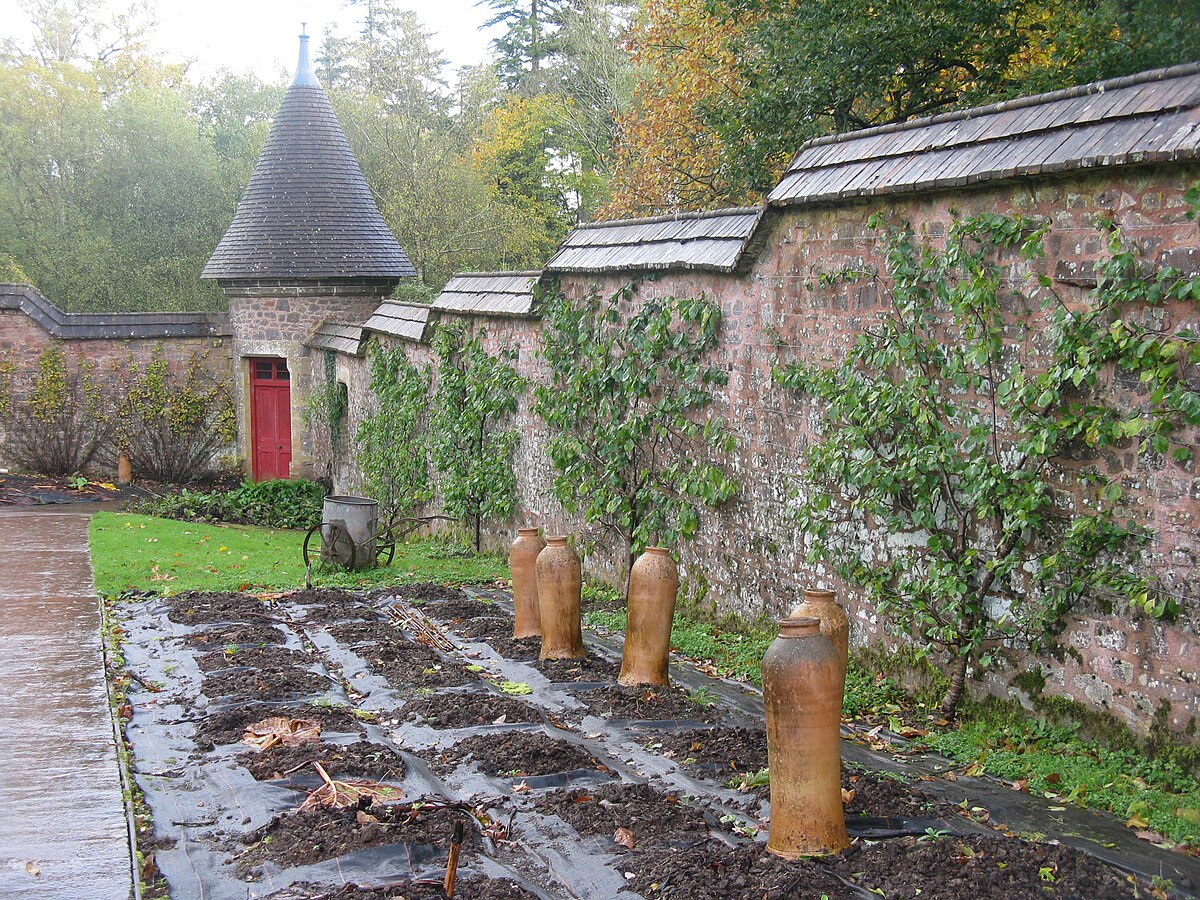
Four clay pots on dirt near a garden wall
Rhubarb forcing pots From geograph.org.uk

Hardy Fruits from the Open Garden, Orchard, or Fruit-Room. Apples, pears, quinces, medlars, services from the fruit-room. Some plums and morello cherries, carefully preserved on the trees. Some thick-skinned gooseberries, currants, and grapes, preserved on the trees. Some dried fruits of the same sorts on branches hung up in the fruit-room. Almonds, walnuts, chestnuts, filberts from the fruit-room. Sloes from the bushes, wild services, hips, haws, and sometimes a few cloud-berries.

A well occupied library opens into a glasshouse with plants. One child looks at a large book held by an adult. A lady holds large harp. A young couple sit by a table while older folks read. In the glasshouse several couples and a lady with a child tour the plants.
Glasshouse design by Humphry Repton, 1816 from Fragments on the Theory and Practice of Landscape Gardening

Culinary Vegetables and Fruits from the forcing Department. Kidney beans. Potatoes. Sea-kale. Small salads. Parsley, Fennel. Rhuharb. Mushrooms. Pines, winter melons, grapes, strawberries, cucumbers occasionally. Oranges, olives, and pomegranates. Malay apple, loquats, and lee-chees. Yams, and Spanish potatoes.

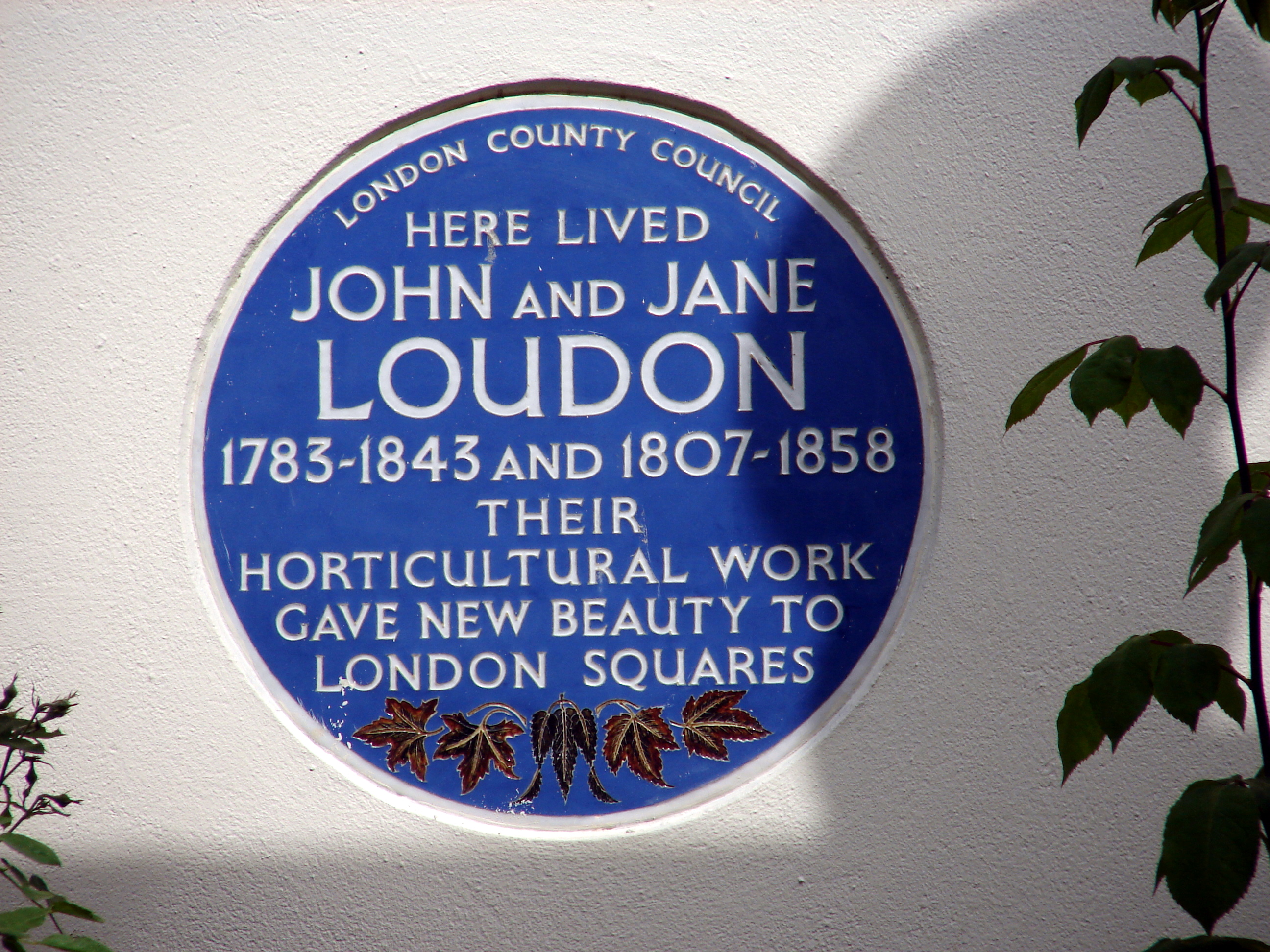
https://commons.wikimedia.org/wiki/File:John_and_Jane_Loudon_(4644568348).jpg
John and Jane Loudon blue plaque at 3 Porchester Terrace, Bayswater, London
London County Council
Here lived John and Jane Loudon
1783-1845 and 1807-1858
Their horticultural work gave new beauty to London squares