Tag Archive | Tea

Lady Catherine’s Salon for Tea

There’s a quote from Shakespeare in Love (wonderful movie, with a terrific script from Marc Norman and Tom Stoppard, and Geoffrey Rush stealing scenes as usual, and as Philip Henslowe, Rush has the lines: “…, allow me to explain about the theatre business. The natural condition is one of insurmountable obstacles on the road to imminent disaster.” That, too is the writing business overall, and as Henslowe goes on to say, “Strangely enough, it all turns out well.” How? Well, that is the mystery.

And that brings me to heading over to Lady Catherine’s Salon next week.

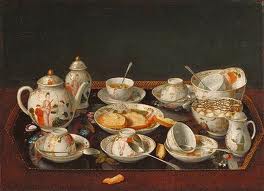
Tea cup and cookie

I’ll be there to answer questions, and post in general about the mystery of writing–and the less mysterious bits–and talk about the research that goes into a Regency, along with talking about some of my favorite books, just doing what one does with tea–talking.

There is good reason that “scandalbroth” was a name for tea–it is the time to swap gossip and brew scandal along with the beverage. I’ll be drinking my favorite right now (Lady Gray, a variation of Earl Gray, but with less bergamot, however, I am very fond of an excellent Gunpowder if it can be hand, or a smoky Lapsang souchong).

So please feel free to join me at the salon…asking those questions you might like to ask. We’ll see what we can do about all that mystery (maybe even create a little more, for every story ought to have a little mystery).

Coffee – As Important as Tea

I’ve just finished up the Regency Food and Seasons workshop for Regency Fiction Writers, and there’s always some ephemera that doesn’t quite make it into the workshop. This one is a poster from 1840 showing coffee being grown, what the leaf and bean looked like, roasting, grinding, and serving it up.

We tend to associate tea drinking with England–thanks to the high tea that came along in the late 1800s. But coffee was just as important a beverage–perhaps even more so–in the late 1700s and early 1800s. Coffee houses became all the rage in the 1600s, and continued to be so into the Regency era in England.

Not everyone was a fan of the coffee house (they also would serve drinking chocolate, tea, and punch, and provided newspapers to read). As reported on The Gazette UK website, “On 29 December 1675, a proclamation by the king was published that forbade coffee houses to operate after 10 January 1676 (Gazette issue 1055), because ‘the Idle and Disaffected persons’ who frequent these establishment have led to ‘very evil and dangerous Effects’ and ‘malicious and scandalous reports to the defamation of His Majesties Government’.” Meaning, of course that folks were talking politics. The notice gave warning that, “after the 10th day of January ensuing, to keep any publick Coffeehouse, or to utter or sell .… any Coffee, Chocolet, Sherbett or Tea, or they will answer the contrary at their utmost Perils’. Licences were to be made void, and if continued to trade, given a forfeiture of £5 per month and then ‘the severest Punishments that may by Law be inflicted’.” Naturally, the whole thing went bust, along with a “Women’s Petition Against Coffee” which reported it made men talk too much–it was, of course, yet another political maneuver that lacked popular support.

Folks kept drinking coffee, grocers added the beans to their stock (along with tea leaves), and porcelain manufacture created lovely tea and coffee sets, some as large as 40 pieces including cups, saucers, pots and everything else needed. Silversmiths also did a good trade, such as for this coffee pot, tea pot, creamer and sugar holder from 1800 made by John Emes, with gilt interiors.

Jane Austen wrote in a letter, commenting on her brother’s habits, that, “It is rather impertinent to suggest any household care to a housekeeper, but I just venture to say that the coffee-mill will be wanted every day while Edward is at Steventon, as he always drinks coffee for breakfast.” Coffee would also be brought into the drawing room with tea after dinner, so that guests could have a choice of beverage.

All these thoughts about coffee come–not just due to my being a coffee drinker, for I also love my morning and afternoon tea–but due to a headline that, ‘Your coffee habit could be linked to healthier aging, study finds‘. Good news for those of us who love that morning coffee…and who are getting up in years.

So drink up and enjoy your coffee…and you can still fit in that afternoon tea as well–green tea, after all, is so good for you as well.

The English Tradition of a “Cuppa”

This October, I’m doing a workshop on Estate Workers for Regency Fiction Writers. One thing that turned up when researching the workshop was the growing importance of tea, sugar and milk in the diet of the average person in England during the long Regency era.

1780 teapot in Brown Betty style made in Staffordshire with Rockingham glaze

We tend to think of tea in Georgian England as a luxury item, but while it started off that way, prices were falling by the late 1700s. The teapot at left dates to 1780 and shows what would become the ‘Brown Betty’ style of Staffordshire pottery, with its dark Rockingham glaze. This is the sort of teapot that could be found in a middling class household, which would include some estate workers. It is far from the highly decorated tea and coffee sets created for the upper class by Wedgewood, Doulton, and others who sought royal patronage.

As noted, like coffee and chocolate, tea had started off an expensive luxury. Duties were put on it because of this, which meant in the 1600s on to the late 1700s it was a main good for smugglers. Random Bits of Fascination notes, “Smuggled tea often came from Holland where it might be purchased for as little as 7 pence per pound.” That means smuggled tea was already drifting down into the middling classes.

The Commutation Act in 1784—pushed forward on the advice of  Richard Twining of the Twinings Tea Company—reduced tea taxes from 119% to 12.5% of the price. It was no longer worth smuggling, and tea drinking spread to the growing middle class and into the working class. Tea became available in multiple prices with different grades available. Some household also provided a tea allowance for servants, and tea leaves would also go from the drawing room, to the housekeeper and on down the line of servants, with inside servants first, and then outside servants.

A New System for Domestic Economy, published in 1823, speaks to, “The universal use of tea, as an article of diet…” and devotes multiple pages to economical types of tea and efficient brewing. It notes, “…the best Green Hyson, at about fourteen shillings per pound…the best Black Souchong at about twelve shillings…the Souchong, since the common leaf at six shillings…” This shows the variety in prices. It also says that two ounces of tea per person per week is a way to economize, with sugar at three quarters of a pound over the week.

Tea shows up in the tightest of budgets at 7d and a ha’penny for 2 oz. (bought at 5s per pound) when the family income is only 24s a week. Lesser incomes than that do not include tea in the proposed budget. At an income of 30s a week, the budget allows a quarter pound of tea for 1s 3d, with sugar for the week also costing the same shilling and thuppence. Milk is only 7d and a ha’penny for the week This shows how tea could be affordable for anyone in the working class, including those on an estate with good wages.

As noted in the paper ‘Importing sobrie ‘tea’: Understanding the tea trade during the Industrial Revolution’ by Kabeer Bora, “Sugared tea and white bread became the nutritional mainstays, it supplanted the traditional produces of milk, cheese, ale, meat & oats.” Tea and sugar begin to be drunk by all but the poorest of the poor, with tea, milk and bread being seen as mainstays of the English diet. This is pushed even more so by factory work that showed up in the Regency era.

Bora goes on to write, “A report of the Factory Enquiries Commission in 1834 showed that many mill owners were allowing workers tea breaks of 15 and 30 minutes in Derbyshire and Lancashire. This break was given to them between lunch and closure (Factory Enquiries Commission, 1834).” Tea, with sugar and milk, is credited with increased calories in the average diet, and with improvements in health overall. The English habit of weak ale and small beer still would continue, but tea would go on in the Victorian era to even become the name for the working class evening meal.

To put all of this into a bit of context in the modern world, today we generally buy tea in bags (not invented until the 20th Century) with a box of tea bags being only around 1.4 ounces in total and holding 20 to 30 tea bags. If you are thrifty, you can get two or three cups from one bag, so 2 ounces of tea for about 7d could go a long way, and a pound of tea, or 16 ounces, is a considerable amount of tea.

Another good source of information is Empire of Tea: The Asian Leaf that Conquered the World by Markham Ellis, Richard Coulton, and Matthew Mauger.

If tea could not be bought, there was the ability to make a tea from the wild fruits, herbs and flowers from any estate garden (if you have horses, an alfalfa–more commonly called lucerne in England– while not the best for a tea, can be made up).

While the old standbys of ale and small beer as drinks for estate workers continued on through the Regency–particularly as the main drink in the fields during harvest time, the idea of a cuppa tea in the evening or early morning was growing. And more on Estate Workers of the Regency era will be in the workshop.

https://regencyfictionwriters.org/academe/

Tea Time

TeaServiceToday we have a guest post from author Ella Quinn on tea — so curl up with a cuppa and enjoy!

Ah, tea. Once could wax eloquently on the subject of tea, and one has. The small leaves have been the topic of erudite, and sometime heated conversation, especially when talk turns to how tea was drunk over 200 years ago. And why, you ask, would one want to discuss that particular matter? Well… because I am a Regency author, and, therefore, I tend to have conversations with other Regency authors on seemingly innocuous matter.

The actual origins of the drink are said to date back to Sichuan province’s Emperor Shen Nung 2737 BC. In China, tea had the reputation of being helpful in treating everything from tumors to making on happy.

teaboxTea was first brought to England from China in the mid-17th Century. It made its debut around the same time as Turkish coffee and hot chocolate. Tea had been drunk on the Continent prior to its arrival in England as Ladies Arlington and Offory developed a taste for it in Holland and brought some home with them. At the time, tea was hideously expensive, one report in 1666 had it as costing 40s a pound when brandy cost 3. Considering the average lawyer earned the equivalent of £20 per year, it is not surprising that only the wealthy could afford to buy it. It was during this century that tea began appearing in coffee houses as well.

While the men were out drinking coffee, tea and chocolate at coffee houses which were morphing into clubs such as White’s, the ladies followed Queen Catherine’s example (she brought her own tea from Portugal) and remained home to drink tea a chocolate. There appear to be several reasons that coffee did not become popular at home, one was the smell, which many found objectionable.

Tea PartyThe earliest painting I found of ladies getting together to drink tea is A Tea Party by Verkolje. Since 17th Century it was customary for the lady or gentleman of the house to actually brew and serve the tea.

By the late 17th Century, green tea in both leaf and powered form, and black tea called Bohea from the Bohea mountain region were being imported. If tea wasn’t expensive enough, the government decided to tax it, and smugglers opted to take advantage of that decision and a trade smuggled tea began. By the 18th Century the beverage had become so popular that no less than at least fourteen different types of tea were available, as were adulterated teas. Smouch making, the mixing of tea with dried ash tree leaves had begun. Because it was easier to hid smouch in green tea, black tea became more popular. At the end of the century, tea was enjoyed by all social classes.

By the 19th Century, tea was also being imported from India and Ceylon. The beverage was drunk at breakfast, in the afternoon (Jane Austen makes mention of it in1804), evening and in times of distress. A while ago, I ran across a quote from a lady stating that one invited friends to “drink tea” and that the term to “take tea” was vulgar. Unfortunately, I can no longer find the reference.

teatableThe popularity of tea also spurred new serving wear, furniture and later in the century rooms in houses were set aside for the purpose of drinking tea.

Now back to the original debate. According to Jane Pettigrew’s A Social History of Tea, which I highly recommend and from whence much of this information has been derived, Tea was drunk with sugar and either sweet milk or cream. It appears that more men preferred cream than did women. Or at least they wrote about it more. When Jane Austen wrote about drinking tea, it was with milk.

Tea plays a large part in my debut novel The Seduction of Lady Phoebe. The hero, Lord Marcus is devoted to tea. Unfortunately, his father will only allow coffee to be served at breakfast. Lady Phoebe, as did most ladies of the time, had her own blend.

Excerpt from The Seduction of Lady Poebe

A low growl from her stomach caught her attention. “I’m famished.”

Marcus nodded. “As am I. When I have a household of my own again, I’ll order breakfast to be served early.”

She turned Lilly toward the gate. “I’ll wager if we go back to St. Eth House now, François, my uncle’s chef, will find something to feed us.”

“Lead on.”

After they entered St. Eth House, Phoebe motioned to Marcus to follow her through the baize door leading to the kitchen.

With a brilliant smile on her face, she approached François, the St. Eth chef de cuisine. “François, we have been riding and are so very hungry. Will you feed us?”

He glanced from her to Marcus. “Oui, milady. Naturellement.”

François gave them each a warm bun with honey before shooing them up the stairs to await their breakfast.

Phoebe took a place at the table and Marcus sat next to her. Ferguson brought tea and she poured them each a cup. The buns were wonderful, tasting of honey and butter. She wondered what François would send up for the rest of their breakfast.

Marcus gave a satisfied sigh. “Phoebe, I can’t thank you enough for the tea. I almost always have to have coffee at home.”

That was very strange. Puzzled, she asked, “Why do you not ask for tea to be served if you don’t like coffee?” It was the first time she’d ever seen him disgruntled.

“I asked for tea once, years ago, and my father gave me coffee. He was so adamant, I never asked again. I still feel like a guest at Dunwood House, as if I’ll be returning to Jamaica. . . .”

THE SEDUCTION OF LADY PHOEBE ~ ON SALE: September, 19, 2013LADY PHOEBE STANHOPE, famous for her quick wits, fast horses, and punishing right hook, is afraid of nothing but falling in love. Fleeing a matchmaking attempt with the only man she despises, Phoebe meets a handsome blue-eyed stranger who sends her senses skittering. By the time Phoebe discovers the seductive stranger is the same arrogant troll she sent packing eight years ago, she is halfway to falling in love with him.

LORD MARCUS FINLEY last saw Phoebe striding regally away, as he lay on the floor with a bruised jaw and a rapidly swelling eye. Recently returned from the West Indies, Marcus is determined to earn Phoebe’s love, preferably before she discovers who he is. Determined to have Phoebe for his own, Marcus begins his campaign to gain her forgiveness and seduce her into marriage.

Can Phoebe learn to trust her own heart and Marcus? Or is she destined to remain alone?

“Lady Phoebe is a heroine Georgette Heyer would adore–plucky, pretty, and well worth the devotion of the dashing Lord Marcus. A marvelous find for Regency romance readers.” — NYT Bestseller Grace Burrowes 

“Ella Quinn’s The Seduction of Lady Phoebe is a passionate tale full of humor, romance, and poignancy. Quinn writes classic Regency romance at its best!” — Shana Galen

Preorder or Buy at:

Amazon US

Amazon UK

B&N

Author Ella Quinn has lived all over the United States, the Pacific, Canada, England and Europe before finally discovering the Caribbean. She lives in St. Thomas, Virgin Islands with her wonderful husband, three bossy cats and a loveable great dane. Ella loves when friends connect with her. Visit her at www.ellaquinnauthor.com, or connect on Facebook, Twitter, or at her blog.