Tag Archive | seasons

Coffee – As Important as Tea

I’ve just finished up the Regency Food and Seasons workshop for Regency Fiction Writers, and there’s always some ephemera that doesn’t quite make it into the workshop. This one is a poster from 1840 showing coffee being grown, what the leaf and bean looked like, roasting, grinding, and serving it up.

We tend to associate tea drinking with England–thanks to the high tea that came along in the late 1800s. But coffee was just as important a beverage–perhaps even more so–in the late 1700s and early 1800s. Coffee houses became all the rage in the 1600s, and continued to be so into the Regency era in England.

Not everyone was a fan of the coffee house (they also would serve drinking chocolate, tea, and punch, and provided newspapers to read). As reported on The Gazette UK website, “On 29 December 1675, a proclamation by the king was published that forbade coffee houses to operate after 10 January 1676 (Gazette issue 1055), because ‘the Idle and Disaffected persons’ who frequent these establishment have led to ‘very evil and dangerous Effects’ and ‘malicious and scandalous reports to the defamation of His Majesties Government’.” Meaning, of course that folks were talking politics. The notice gave warning that, “after the 10th day of January ensuing, to keep any publick Coffeehouse, or to utter or sell .… any Coffee, Chocolet, Sherbett or Tea, or they will answer the contrary at their utmost Perils’. Licences were to be made void, and if continued to trade, given a forfeiture of £5 per month and then ‘the severest Punishments that may by Law be inflicted’.” Naturally, the whole thing went bust, along with a “Women’s Petition Against Coffee” which reported it made men talk too much–it was, of course, yet another political maneuver that lacked popular support.

Folks kept drinking coffee, grocers added the beans to their stock (along with tea leaves), and porcelain manufacture created lovely tea and coffee sets, some as large as 40 pieces including cups, saucers, pots and everything else needed. Silversmiths also did a good trade, such as for this coffee pot, tea pot, creamer and sugar holder from 1800 made by John Emes, with gilt interiors.

Jane Austen wrote in a letter, commenting on her brother’s habits, that, “It is rather impertinent to suggest any household care to a housekeeper, but I just venture to say that the coffee-mill will be wanted every day while Edward is at Steventon, as he always drinks coffee for breakfast.” Coffee would also be brought into the drawing room with tea after dinner, so that guests could have a choice of beverage.

All these thoughts about coffee come–not just due to my being a coffee drinker, for I also love my morning and afternoon tea–but due to a headline that, ‘Your coffee habit could be linked to healthier aging, study finds‘. Good news for those of us who love that morning coffee…and who are getting up in years.

So drink up and enjoy your coffee…and you can still fit in that afternoon tea as well–green tea, after all, is so good for you as well.

What’s the Recipe?

There’s always a big question with any writing—what do you put in and what do you leave out? This is not just confined to scenes and characters, but also to information, particularly to research to make a story come to life.

This may be why I’m also drawn to cooking—it is still the same idea of what do you put in and what is better left out. Food in general is just a terrific topic. When it comes to history, it is fascinating both how tastes change and how much stays the same. For example, the English classic ‘Toad in the Hole’ (such an odd name, since it has no toads and not much in the way of holes) goes back at least to the 1700s. That was a time when cookbooks really started to flourish.

Rolandson Bird Eye View Covent Garden 1811

Cookbooks are both an insight into a period and also something of an insight into a way of thinking. I love that earlier cookbooks use measurement such as “a good handful”. Is that my hand? A small hand? A man’s big hand? And then there’s ingredients such as “blade of mace” (I had to look that one up). Then there’s the spellings to deal with, and how sometimes the instructions leave out some steps, assuming that everyone knows the obvious.

Assumptions—that brings me back to thinking about recipes and the idea of leaving in or out. We sometimes assume someone will know something, but what if the reader doesn’t get it? What if the assumption is wrong? The opposite can be just as bad. We assume the reader doesn’t know so now we slip into overexplaining. Too much detail can be as bad as too little.

One of the keys I find is to make certain the details are always interesting. I find this is true when I did into those old cookbooks.

Two different authors will have the same recipe, but one manage to infuse energy and interest into the writing. This can be done with a point of view put onto the writing. It can also be done with a just a little finesse. There’s a difference between “put the chicken in the pot and boil until done” and “put a fine chicken into a gentle simmer of water and cook until plumped”.

In May I’m doing a workshop for Regency Fiction Writers on Regency Food and Seasons—always good to put those two together (sometimes I think very few people these days know what a truly ripe summer peach tastes like). It’s a workshop I’ve done before, but with history you can always learn more. That means dusting off the writing for the lectures, and more dives down research rabbit holes…and having to make that call as to what should be put in and what is better taken out.

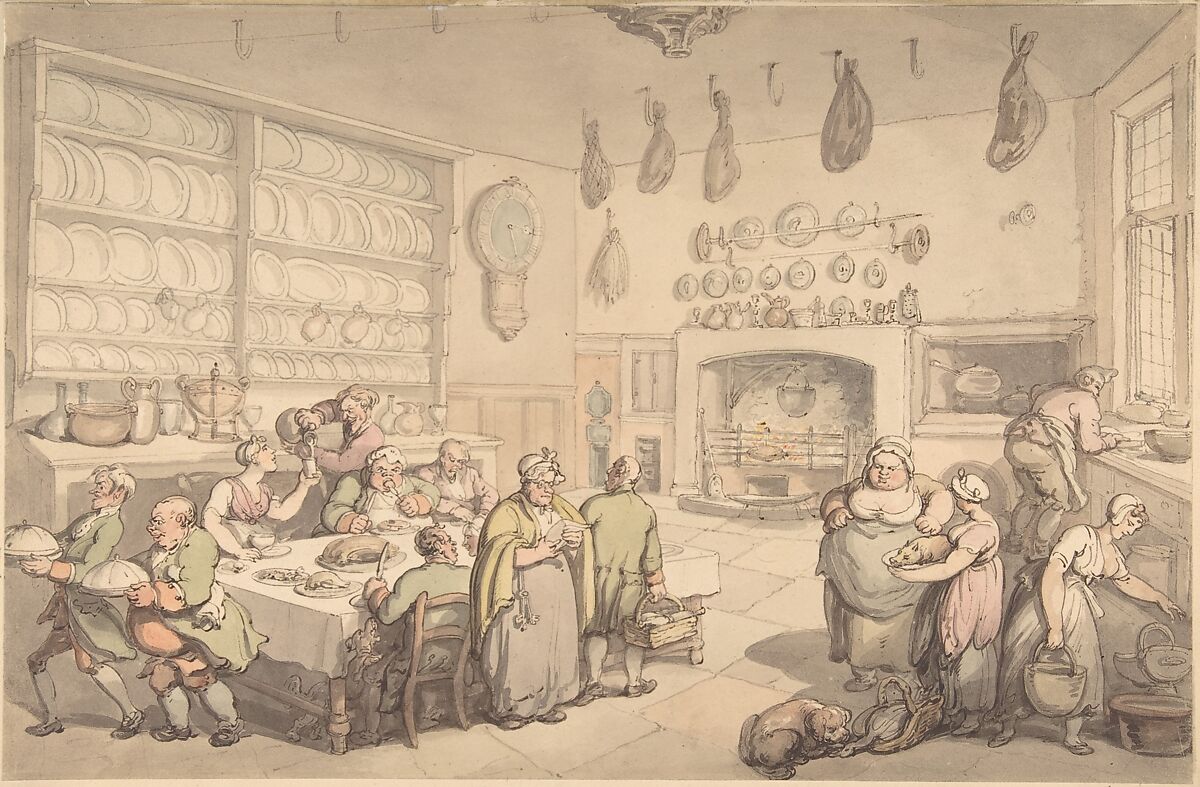
The workshop covers far more than seasons, with a look at kitchens of the era, markets (particularly those in London), a jaunt across the seasons of the year and holiday fare, shops for food in London such as the Italian Warehouses, the eating houses available in places such as London. It’s a broad look at an even broader topic, covering cookbooks of the era which offer up some great recipes, and just some things I couldn’t leave out just because sometimes it’s the cool details that add that spark of insight into a time and place.

Squire's Kitchen Rowlandson

For more about the workshop head to Regency Fiction Writers.

Regency Triva

mealI’m going to be teaching a workshop in June on Regency Food and Seasons because when you write historical romances you tend to end up knowing a lot of odd things. And I love this kind of trivia.

For example, sugar used to come in cones–you’d scrape off what you needed. And recipes usually did not have measures–a goodly handful is often give as amount to use.

Or did you know tea used to be locked up in lovely tea boxes for the tea leaves were far too valuable to leave lying about.Enameled tea box

Or that in the early 1800’s Nicholas Appert won 12,000 francs when he invented a method to preserve food in glass–Napoleon had wanted this for as a means to better preserve food for the French Army. However, this method was not widely used, and canning would not come about until well after the Regency.

Food preservation, however, is ancient, with the more common techniques being salting and smoking, or the use of vinegar to pickle food.

It amazes me, too, how modern folks often don’t think about an era when food was not always available. I garden so I’m always looking forward to my seasonal produce–but what you can grow in England during its seasons is a different world from California or New Mexico where I now live.

Food tastes, too, are quite different.

Captain Gronow remarked on how London Inns always served “‘the eternal joints, or beef-steaks, the boiled fowl with oyster sauce, and an apple tart.'” Hmmm…maybe that’s not too different from modern London pub grub. The English at one point used to eat a lot of lamb (and mutton), too.

For Leg of Mutton, Mrs. Rundell’s recommendation is, “If roasted, serve with onion or currant-jelly sauce; if boiled, with caper-sauce and vegetables.” Personally, I would swap in lamb for the mutton and opt for roasting it. My grandmother who came from Yorkshire insisted on boiling all meat, and nearly made vegetarians out of all of her sons.

hannahGBut I also love digging out bits and pieces such as a “recipt against the plague” given by Hanna Glasse in The Art of Cookery made Plain and Easy. She also offers not one, but two certain cures for the “bite of a mad dog, one of which is both given to the “man or beast” bitten as well as recommending to be bound into the wound. Makes you wonder how big of a problem were mad dogs? Perhaps a large one given that there were no rabies shots.

Back in the 1800’s the day had a different pace to it–lunch was not a common meal, and you have servants for almost all classes except the poor. This makes for a lot of advice coming out in the mid 1800’s for how to deal with servants–one of those lovely problems we all wish we had. Oh, to have to supervise the house maid and oversee the cook instead of having to do for oneself.

All of this makes for a lovely bit of trivia to share.