Tag Archive | recipes

February Foods in Regency England

Shrove Tuesday is the last day before Lent begins on Ash Wednesday, typically falling anywhere from February 3 to sometime in early March. Traditionally, Shrove Tuesday Pancakes were made up as a last indulgence with butter and eggs, or all the things that might have to be given up for the forty days of Lent. In 2026, this will fall on February 17.

George Cruickshank’s print in ‘The Comic Almanack for 1837: An Ephemeris in Jest and Earnest Containing All Things Fitting For Such Work’ done under the penname of Rigdum Funnidos shows a cook tossing such a pancake.
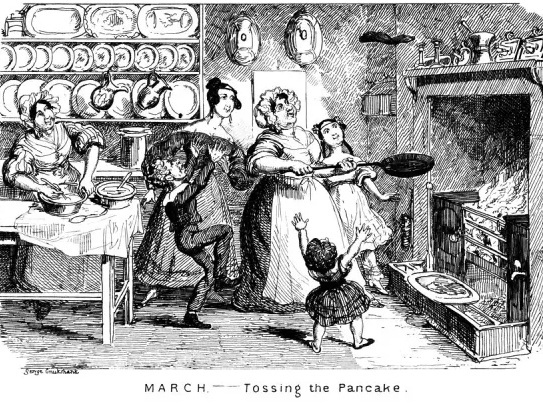
Three children cheer on a cook, dressed in apron over her dress and a cap, while the lady of the house watches, and the kitchen maid stirs the batter. The lady has her hair up in back with curls at the side and a dress taht shows her shoulders--very 1830s. The cook uses an open fire, and the dishes are lined up in cabinet against the far wall. The two girls are in dresses--the older girl looking like a small version of her mother with bloomers showing under her dress--and the boy looks to be in a sailor suit with trousers. The thin, large pancake is in the air as

English pancakes tend to be more like what Americans think of as crepes and were often served with dinner or tea with just a sprinkle of sugar instead of the US idea of a thick breakfast stack with maple syrup poured over top.

Susannah Carter gives the following recipe in The Frugal Housewife (1822) for pancakes:

“In a quart of milk, beat six or eight eggs, leaving half the whites out; mix it well till your batter is of a fine thickness. You must observe to mix your flour first with a little milk, then add the rest by degrees; put in two spoonfuls of beaten ginger, a glass of brandy, a little salt; stir all together, clean the stew pan well, put in a piece of butter as big as a walnut, then pour in a ladleful of batter, moving the pan round that the batter be all over the pan: shake the pan, and when you think that side is enough, toss it; if you cannot, turn it cleverly; and when both sides are done, lay it in a dish before the fire; and so do the rest. You must take care they are dry; before sent to table, strew a little sugar over them.”

There was no baking powder yet to make fluffy pancakes, and the recipe doesn’t call for any type of yeast. While pearlash was around for leavening (you soak wood ash in water, strain it, then boil it until it makes a moist white powder). This wasn’t much in use in England for it doesn’t show up in cookbooks. Barm, also called ale yeast, does show up occasionally in recipes, but commercial yeast was readily available and used not just in bread, such as in cakes and puddings like “Dutch Pudding or Souster.”

From the garden and farm, John Loudon’s 1822 book An Encylopaedia of Gardening offers up this advise, along with vegetables and fruits, with spellings and punctuation the same as from his book:

FEBRUARY Planning and Preparing, Foaling, Start of Early Lambing in fields, Planting trees and bare root plants such as roses, root crops in, Pare and burn grass lands, Spread manure.

Scotch or Strasburgh cabbage, savoys, borecoles, Brussels’ sprouts, and, if a mild winter, cabbage coleworts, brocolis. Haricots, beans, and soup-peas from the seed-room. Potatoes, Jerusalem artichokes, turnip, carrot, parsnip, red-beet, skirret, scorzonera, and salsify. Spinach, if a mild winter. Onions, leeks, garlick, shallot, and rocambole. Sea-kale from covered beds. Lettuce, endive, celery. American and winter-cress. Parsley, if protected, horse-radish, and dried fennel, dill, chervil, &c. Thyme, sage, rosemary, and lavender, from the open garden; dried marjoram, basil, &c. from the herb-room. Rhubarb-stalks from covered roots, anise, coriander and carraway-seeds, from the seed-room; chamomile, &c. from the herb-room. Red cabbage, samphire. Nettle and thistle tops; towards the end, sorrel leaves, and if a mild winter, sauce-alone. Mushrooms from covered ridges. Sea-belt preserved, and occasionally badder-locks.

Hardy Fruits from the open Garden, Orchard, or Fruit-Room. Apples, pears, quinces, medlars, services from the fruit-room. Some plums from branches hung up in the fruit-room. Dried grapes and currants from branches hung up in the fruit-room. Almonds, walnuts, chestnuts, filberts from the fruit-room. Sloes from dried branches hung up in the fruit-room.

Culinary Productions and Fruits from the forcing Department. Kidney beans. Potatoes. Sea-kale, asparagus. Small salads. Parsley, mint, chervil. Rhubarb. Mushrooms. A pine occasionally; grapes, cucumbers, strawberries. Oranges, lemons, olives, pomegranates. Pishamin-nuts, lee chees. Yams, and Spanish potatoes.

  • Borecoles is a type of kale.
  • Haricots are green beans.
  • Jerusalem artichoke is a hardy, starchy root plant that has nothing to do with artichokes, but has more in common with potatoes and mashes up very well.
  • Skirret, also a root plant which means hardy for winter, is said to taste like carrot.
  • Scorzonera is another root vegetable that tastes a bit like an artichoke.
  • Salsify is also call oyster vegetable since it has a oyster-like taste.
  • Rocambole is another name for a shallot, which can still be found in many modern markets.
  • Samphire does still show up in English cooking, and grows in marshy areas. It is from the parsley family, looks like baby asparagus, and has a crisp, salty taste.
  • Sea-belt and bladder-locks are both types of seaweed.
  • Medlars is described as tasting like spiced applesauce.
  • Services are a type of strawberry.
  • Filberts are what is called a hazelnut in the US.
  • Chervril is a herb similar to parsley.
  • ‘Pine’ means a pineapple, which are touchy to grow in England (they do look a bit like a pinecone).
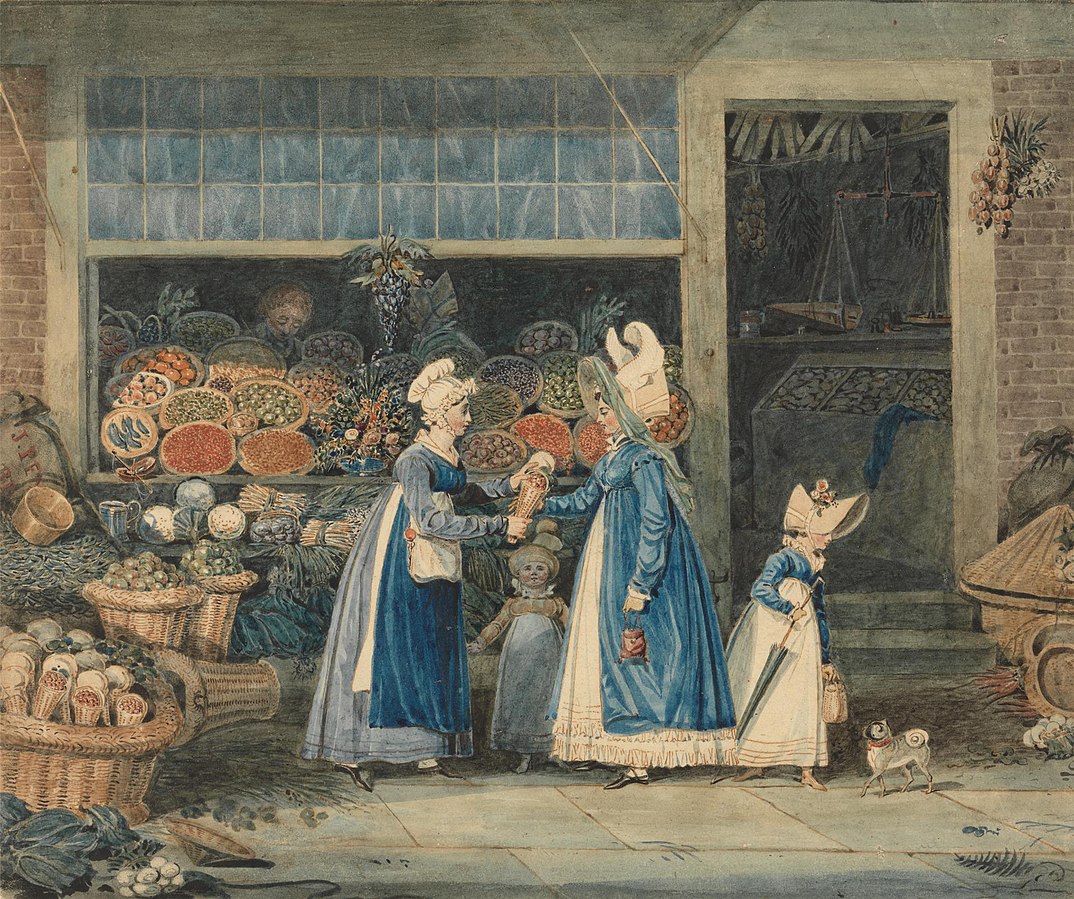
A lady and her daughter buy fruits or vegetables from a woman at a grocer in London
James Pollard The Green Grocer (c. 1819)

Things We No Longer Ask For

I love old cookbooks–they are a glimpse into a past era. They also often have great recipes. Reading Dorothy Hartley’s wonderful Food in England got me thinking about how there are certain foods and drinks we no longer ask for when dining out, such as:

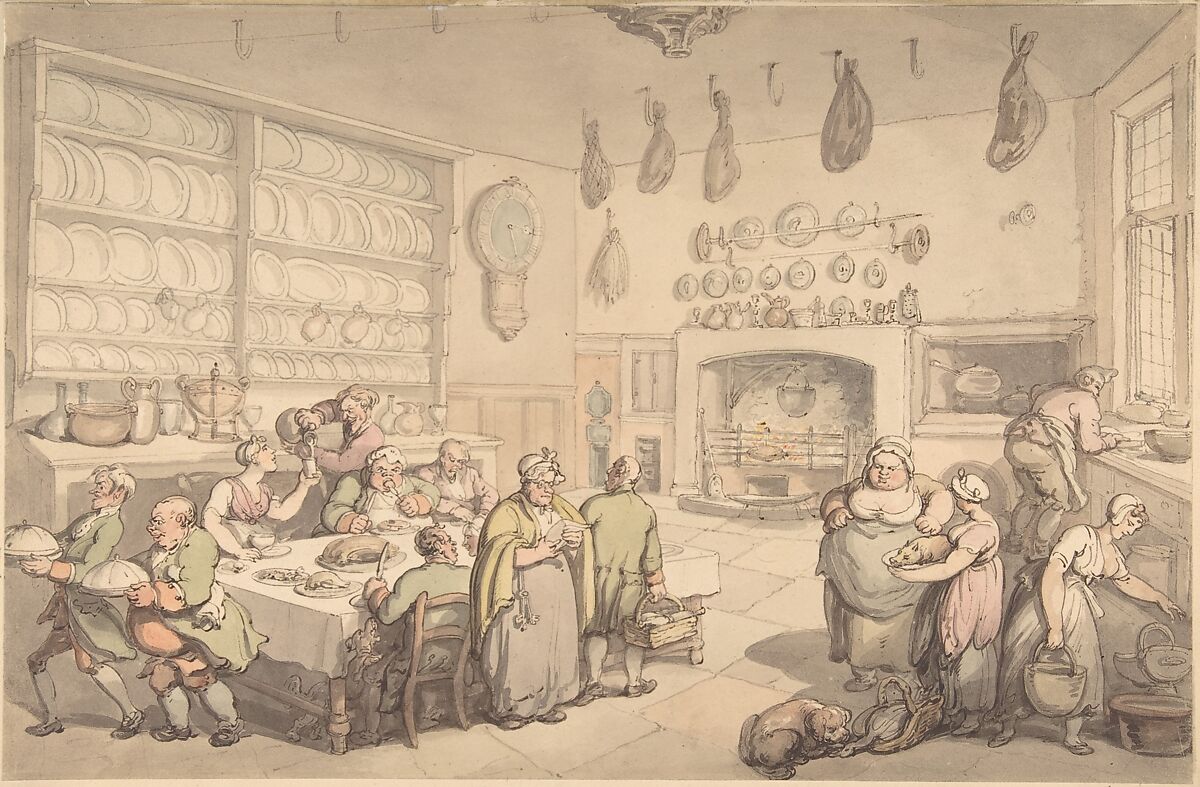
Meat and fish hanging, bread, cooked eggs, glassware, parsnips, lemon, platters on a side table all in  a larder or kitchen

A joint of beef — we have all sorts of fancy cuts these days.

Johnnycakes — these are actually delicious…they are basically a cornmeal fried bread, meaning like a pancake but with more crunch. Easy to make, too.

Mutton — it is still possible to find lamb in some supermarkets, but mutton has gone completely out of fashion (no old sheep for a low cost meal).

Pig cheeks — still available in some parts of the world, and by all accounts, the best part of the pig. Also called pork cheeks, and this goes along with calf cheeks or beef cheeks, a specialty of the Café Procope, one of the oldest cafes in Paris.

cucumber or parmesan ice cream — it is difficult enough these days to find real parmesan cheese.

watercress and egg sandwiches — these can be found in some tea shops still (thankfully), but watercress can be difficult to come by in many modern supermarkets (at least in the US).

gruel — this is an unlovely name and the food has a bad rep from the Victorian era, but some recipes call for butter, brandy, and enough spices to make this a very tasty mean (it’s basically think oatmeal).

A pot of ale — while ale is still around, it usually comes in cans, bottles, or a pint or half pint. The pint pot has long ago been replaced with glass.

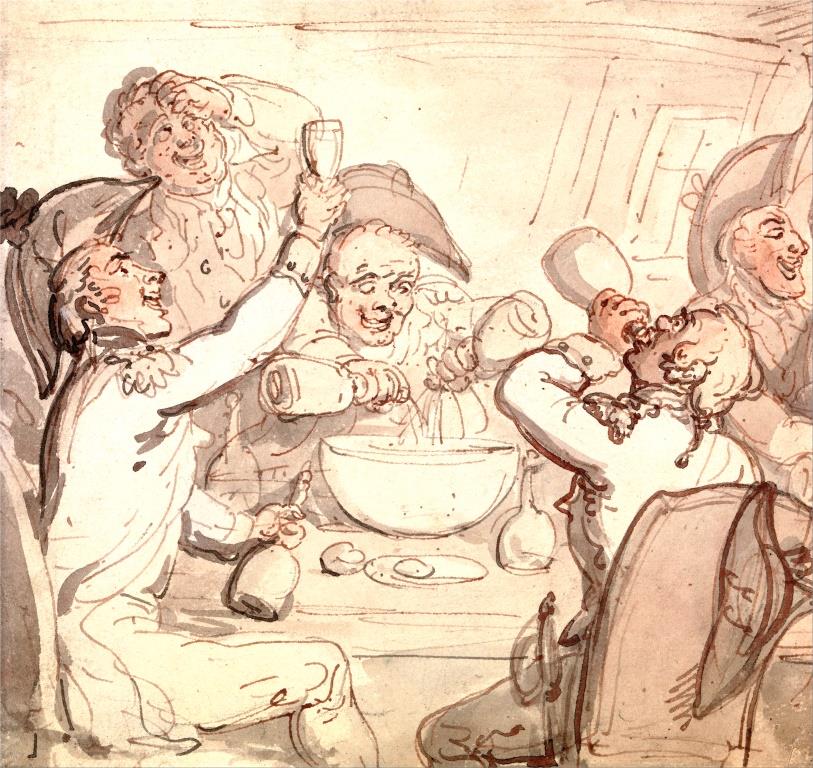
A bowl of punch — this used to be a highly alcoholic drink, but these days folks are more likely to think of punch being a fruity drink without brandy, champagne, rum, and other spirts all mixed together. The bowl is no longer with us either for dipping into with a mug or cup.

A posset — this was a hot drink made from curdled milk and sack or a sweet sherry.

A flip — another drink (more alcohol) usually made with beer, rum, eggs, and heated with a poker (not the one used to stir the fire, but a special poker used just to heat drinks).

A purl — another hot drink made with beer, gin, nutmeg, and sugar.

That is just a few things we generally must make ourselves if we want to sample something from the past (unless we find a place that also likes to keep going with what were once old favorites).

Thomas Rowlandson Naval Officers and a bowl of Punch

What’s the Recipe?

There’s always a big question with any writing—what do you put in and what do you leave out? This is not just confined to scenes and characters, but also to information, particularly to research to make a story come to life.

This may be why I’m also drawn to cooking—it is still the same idea of what do you put in and what is better left out. Food in general is just a terrific topic. When it comes to history, it is fascinating both how tastes change and how much stays the same. For example, the English classic ‘Toad in the Hole’ (such an odd name, since it has no toads and not much in the way of holes) goes back at least to the 1700s. That was a time when cookbooks really started to flourish.

Rolandson Bird Eye View Covent Garden 1811

Cookbooks are both an insight into a period and also something of an insight into a way of thinking. I love that earlier cookbooks use measurement such as “a good handful”. Is that my hand? A small hand? A man’s big hand? And then there’s ingredients such as “blade of mace” (I had to look that one up). Then there’s the spellings to deal with, and how sometimes the instructions leave out some steps, assuming that everyone knows the obvious.

Assumptions—that brings me back to thinking about recipes and the idea of leaving in or out. We sometimes assume someone will know something, but what if the reader doesn’t get it? What if the assumption is wrong? The opposite can be just as bad. We assume the reader doesn’t know so now we slip into overexplaining. Too much detail can be as bad as too little.

One of the keys I find is to make certain the details are always interesting. I find this is true when I did into those old cookbooks.

Two different authors will have the same recipe, but one manage to infuse energy and interest into the writing. This can be done with a point of view put onto the writing. It can also be done with a just a little finesse. There’s a difference between “put the chicken in the pot and boil until done” and “put a fine chicken into a gentle simmer of water and cook until plumped”.

In May I’m doing a workshop for Regency Fiction Writers on Regency Food and Seasons—always good to put those two together (sometimes I think very few people these days know what a truly ripe summer peach tastes like). It’s a workshop I’ve done before, but with history you can always learn more. That means dusting off the writing for the lectures, and more dives down research rabbit holes…and having to make that call as to what should be put in and what is better taken out.

The workshop covers far more than seasons, with a look at kitchens of the era, markets (particularly those in London), a jaunt across the seasons of the year and holiday fare, shops for food in London such as the Italian Warehouses, the eating houses available in places such as London. It’s a broad look at an even broader topic, covering cookbooks of the era which offer up some great recipes, and just some things I couldn’t leave out just because sometimes it’s the cool details that add that spark of insight into a time and place.

Squire's Kitchen Rowlandson

For more about the workshop head to Regency Fiction Writers.

Historical Drinks

Tom and Jerry Taking Blue Ruin (Gin)

Every now and then I find a word that sends me off on a research hunt, and this led me to drink names. While we think of “cocktails” as a modern invention, the word dates back to at least 1798. Etymology.com has cocktail as a “drink made from water, sugar, spirits and bitters” first attested 1798.” So the idea of a drink mixed with all sorts of things is nothing new (Ancient Greeks and Romans mixed all sorts of things into their wines). However, my stumbling across a ‘purl’ being drunk by a man about to get onto a coach on a cold day led me to these other wonderfully named drinks that were often to be found in an inn or even sometimes sold on the street to the common folk in the late 1700s and into the 1800s.

Buttered Beer – this was a great way to add calories to ale or beer to make it into almost a meal. It obviously has butter in it, but might also have eggs and spices and was served hot (must have been lovely on a cold, wet day – an old recipe is here).

Dog’s Nose – so called for it was black and cold and one of my favorite names. It was porter, sugar, gin and nutmeg. However, some recipes call for it being warm, and modern recipes generally use brown sugar (a recipe is here).

Flip – this would be any mixture of beer or ale, mixed with rum or brandy, sugar, spices, and usually eggs. Every inn would have their own version, and the name comes from “flipping” or heating it with a “flip dog” also called a toddy iron (it was like a hot poker) (a recipe can be found in William Kitchner’s 1822 The Cook’s Oracle).

Gin-Twist – gin was usually the hard drink of the lower class, and was often watered down (and given to children for toothache) The twist is gin, lemon, and simple syrup. The word ‘gin’ comes from the Dutch genever and Old French génevrier for juniper (and a recipe is here).

Half-and-Half – this was a way to have the good, expensive beer mixed with something cheaper (as in half ale and half two-penny). In the late 1800s, it became a ‘black and tan’ (no recipes since you just mix two beers or ales or porters, but more information is here).

Lambswool – a cider with a baked spiced apple included, a traditional wassail drink in parts of England (a recipe is here).

Perry – cider made from pears (links here to where you might buy some and it sounds lovely).

Purl – Beer or ale with a shot of gin, often with wormwood or served hot as a means to keep warm (several recipe variations here).

Rum and Milk – gin and milk also shows up, which sounds even worse to me, but rum and milk are at the core of eggnog, so it must work, and milk punches also go far back in time (more on gin and milk is here and on milk punches).

Saffron Bitters – Bitters were sometimes used as a hangover cure (recipes here, and the saffron bitters and tonic water sounds rather good), but on a side note “tonic water” wasn’t around as a phrase until around 1850s, but as of 1789 Schweppe was advertising soda water and seltzer, along with sea water as a purgative. Quinine was also known about and sometimes added to “fizzy water” (fizz in a drink dates to 1812, but fizzy dates to 1885).

Saloop – Richard Valpy French in Nineteen Centuries of Drink in England notes it as “…a greasy-looking beverage, sold much on stalls in the early morning. It was prepared from a powder made of the root of the Orchis mascula, and from the green-winged meadow orchis….like porter, to be a favourite drink of porters, coal-heavers, &c. It is said to contain more nutritious matter in proportion to its bulk than any other known root…” (French’s book can be found here).

Shrub – like punches, all sorts of variations exist but this is a drink typically made with rum or brandy, sugar, and the juice and/or rinds of fruits, particularly citrus (recipes here, along with punch recipes).

Spruce Beer – this is beer obviously flavored with spruce needles, which can be purchased in a dried form today (a Jane Austen recipe is here)

Tewahdiddle – and isn’t that a great word! William Kitchner writes this is “a pint of table beer (or ale, if you intend it for a supplement to your “night cap”), a table-spoonful of brandy, and a tea-spoonful of brown sugar, or clarified syrup; a little grated nutmeg or ginger may be added, and a roll of very thin-cut lemon-peel.” (see Flip for a link to Kitchner’s The Cook’s Oracle.)

St Giles - Tom and Jerry Masquerading it among the Cadgers in the Back Slums in the Holy Land (slang for Irish slums)