The Regency Horse World

Hunter. Carriage horse. Race horse. Town hack. Horses were part of everyday life in Regency England. And the horse world of a few hundred years ago was quite different than its modern counterpart.

RACING


By the start of the 1800’s one of the biggest innovations in horses had already occurred—the Thoroughbred had arrived. Three founding stallions—the Darley Arabian “Manak,” the Godolphin Barb, and the Byerley Turk—had been brought to England in the early 1700’s. When the light, fast and sturdy Arabians were bred with the larger, cold-blooded English mares, the cross produced a horse with size, speed and stamina. It produced the Thoroughbred.

At the same time that the Thoroughbred was being established as a breed, horse racing was also becoming a regulated sport. In 1711, Queen Anne had established regular race meetings at her park at Ascot. Gentlemen organized races for themselves, often “matching” particular horses against each other, and by 1727 a Racing Almanac began to be printed.

Flat and jumping races were also held for women only. Mrs. Bateman wrote in 1723, “Last week, Mrs. Aslibie arranged a flat race for women, and nine of that sex, mounted astride and dressed in short pants, jackets and jockey caps participated. They were striking to see, and there was a great crowd to watch them. The race was a very lively one; but I hold it indecent entertainment.” Some women—such as the infamous Letty Lade, who apparently swore like a coachman—rode and drove to please themselves, but they were the exception in the Regency world.

Around 1750, the gentlemen who regularly met at the Red Lion Inn at Newmarket started the Jockey Club. And in May of 1779, the first Derby was held. By 1791, the Jockey Club had issued the “General Stud Book”, and by the early 1800’s Jockey Club stewards attended every racing meet.

Assize-week was the time for races, for that was when the gentry came into the chief town of the shire for trials and selling harvest. Meet sprang up, and still run, at Newmarket in April and October, York in May, Epsom, Ascot in June, Goodwood, Doncaster, Warwick, Manchester, Liverpool, Chester, Cheltenham, Bath, Worcester, and Newcastle.

Racing, however, was a sport for the rich. Before the Prince Regent quit the racing scene in 1807, his racing stud farm came to cost him 30,000 pounds a year.

FOX HUNTING

For the less wealth, horses still served as sport, primarily for fox hunting. While Thoroughbreds might be seen in the field, one might also see farmers upon their heavier draft horses, such as the Suffolk Punch. Children might well be mounted upon the small but handy Welsh Cob or Welsh pony. And Irish Hunters, with their thick bones and size have always been prized for horses who can go all day and then some.

While fox hunting traces its roots back to the mid-1600’s, the sport did not take its present form of jumping and long runs until after the Enclosure Acts of the 1700’s. By the 1780’s, fox hunting had become the most popular of sports, replacing the more ancient sport of stag hunting.

November to March was, and remains, fox hunting season, starting after the fall of the leaf, when the fields lie fallow, and ending after the last frost, just before the first planting.

Hunt territories varied widely. The fifth Earl of Berkeley hunted an area from Berkeley Castle to Berkeley Square, stretching 120 miles.

By 1810, there were 24 subscription packs—a packs that one could pay to hunt with, as opposed to requiring an invitation from the Master. This would double, so that by the mid-1800s hunting had become more a matter of ‘subscribing’ in exchange for the right to hunt with the pack.

The golden age for hunting in Leicestershire is considered to be 1810 to 1830. During this time, there were as many as 300 hunters stabled in Melton Mowbray—with some gentlemen keeping up to 12 hunters. A gentleman could hunt six days a week with the Quorn, the Cottesmore, the Belvoir, and the Pytchley.

Ladies were also found in the field. Mrs. Tuner Farley hunted for 50 years. Lady Salisbury was master of the Hatfield Hunt from 1775 to 1819. She hunted old and blind, in her sky blue habit, with a groom leading her horse and yelling at her to, “Jump, damn you, my lady.” And from 1788 to 1840, Lord Darlington hunted his own hounds four days a week in Yorkshire and Durham, with his three daughters and his second wife, all in their scarlet habits.

However, between late 1700’s to about mid 1800s, when the jumping pommel was invented for the side saddle, ladies were more likely to be advised to “ride to the meet and home again to work up an appetite.”

While fox hunting was viewed as a sport for everyone, the reality was that it cost money to keep a pack of hounds and hunt them. However, anyone could take a horse and follow, if the master allowed it, and some followed the hunt in their carriages.

CARRIAGES
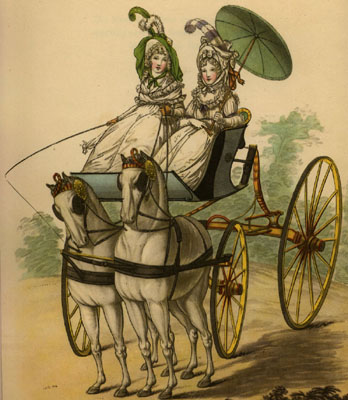
For most families, a carriage was a necessity, and specific breeds of horses were used in harness. The ideal hunter had a long, low stride. But a carriage horse needed high-stepping action, which looks lovely in harness, but which is not always the most comfortable ride.

Carriage breeds of the era included the Yorkshire Trotter, the Norfolk Trotter, the Hackney Horse, the Hackney Pony, and the Cleveland Bay, which is still one of the most desired of carriage horses. Ponies were often used for smaller vehicles, and for ladies. Prints of the era often show ladies driving a matched team of cream ponies–which looks a lovely sight.

Owning and maintaining a horse could be expensive, but there were more affordable options.

John Tilbury of Mount Street in London offered a horse for rent at 12 guineas a month. For 40 guineas, one could hire two hunters and a servant.

Carriages were more expensive than horses, for they had to be custom built. Families with modest incomes would often purchase a carriage second hand, from an advertisement in The London Times. Those who could afford it would have a carriage built to their own specifications.

In Jane Austin’s Northanger Abbey, Mr. Thorpe enthuses over his new carriage, boasting: ‘Curricle-hung, you see; seat, trunk, sword-case, splashing-board, lamps, silver moulding, all you see complete; the iron work as good as new or better’ — and all for fifty guineas.

Chandros Leigh, a distant cousin of Jane Austen, obtained an estimate for a fashionable laundau in 1829. The price of the basic carriage was 250 pounds, which included: ‘plate glass and mahogany shutters to the lights, and plated or brass bead to the leather, lined with best second cloth, cloth squabs, and worsted lace….’ The ‘extras’ ordered including footman’s cushions, morocco sleeping cushions, steps, silk spring curtains, his crest on the door, embossed door handles and full plated lamps. These brought the cost to 417 pounds, 11 shillings and 6 pence, but he was given 60 pounds in exchange for his old carriage.

Carriages for country and for town were generally quite different in build, for they served different purposes. And since carriages were custom built, almost every carriage could be a unique design. Common types of carriages, however, included:

The Phaeton – a four-wheeled, owner-driven vehicle fitted with forward facing seats, usually an open carriage.

The Gig – a two-wheeled vehicles (Whiskey), built to hold two, usually an open carriage.

The Curricle – the “gig” of the quality, built to hold two, which could be two or four-wheels, and which sometimes had a top that could fold down.

A Town Coach – a closed coach that could be drawn by one horse or a pair.

Landau – a four-wheeled vehicle that held four, which was drawn by a pair and built with a removable or folding top.

Barouche – a four-wheeled vehicle drawn by a pair, or by four or even six horses, with an option for a driver, or for post boys to ride and control the horses. Sometimes built with a fold-down top.

(For images, visit –Georgian Times.)

A ‘Drag’ was a slang term for a gentleman’s private coach. It was built much like a mail coach, and often used for race meetings or other outdoor events as it height and roof seats created its own grandstand.

In 1805, smaller Hackney coaches came into use and in 1823 the first Hackney cabs came to London. It was not until 1830’s, however, that the famous Hansom Cabs appeared in London.

Both carriage and road constructions were being developed during the Regency and were not without problems.

Sylas Neville’s diary recorded a 1771 journey on the London to Newcastle stage. It took him two days, traveling day and night, to cover the 197 miles from Stilton to Newcastle.

By the 1780’s, private carriages could cover the distance from Bath to London in 16 to 18 hours. But the Royal Mail coaches were much slower until John Palmer produced a mail coach that left the Rummer Tavern in Bath on August 2, 1784 at four PM, and arrived at the Swan with Two Necks in London by eight AM the next morning. The stage had traveled 119 miles in less than 16 hours!

Up to 1820, most coach horses were changed every ten to eleven miles. Thereafter, to get better speeds, they opted for even less distances, changing about every six miles. But as Mr. Darcy says in Pride and Prejudice, “fifty miles of good road was ‘little more than half a day’s journey.’

With so many road problems, those who wished for speed would often ride.

RIDING: SIDE SADDLE AND ASTRIDE
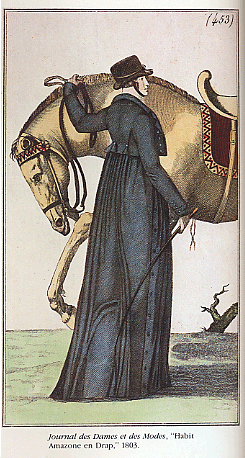
Riders of the 1800’s leaned back and rode with long stirrups that kept their seat in the saddle. Even jockeys rode sitting down square on a horse’s back. And English ‘tack’ or equipment is quite different from its ‘western’ counterpart.

An English saddle has a pommel up front, not a saddle horn. The back of the saddle is the cantle. The saddle is held in place with a girth–not a cinch–and uses stirrup leathers and stirrup irons.

Riders generally carry a hunting whip, which is designed with a crook on the end to open gates, and whip points on the opposite end that can be changed and used to control the hounds. This whip is not actually used to whip the horse.

A lady often used a whip to give a light tap to the horse on the ‘off’ or right side as a command, since her legs hang down on the ‘near’ or left side.

Prior to 1835, a side saddle had only one or two pommels. One turned up to support the right leg, and some had a second pommel which turned down over the left leg. The ‘jumping’ pommel did not exist in Regency times.

A lady’s riding habit had to be cut so that it draped down over the horse’s side, coving ankle and boot in a lovely flow. This drape required that a loop be attached to the hem, so that, when dismounted, a lady could gather up the extra length of skirt. The fabric for a habit was usually a heavy cotton, twill or wool. And due to its cut, a habit can provides any woman with a long stride as much freedom as breeches.

Riding habit styles often copied military fashion, with close cut coats, cravats, and military shakos. Ladies always wore gloves, both to preserve their hands, and to improve their grip upon the reins.

One print from the early 1800 shows a lady strapped into her saddle, but the danger from this would be that if the horse fell the rider would almost certainly be crushed or dragged.

Modern views make it seem as if riding side saddle must be awkward and uncomfortable. In fact, it is neither.

The important factor in riding side saddle is the horse. A comfortable stride and good manners are essential. This does not have to be a placid horse, but should not be a horse with a rough or bumpy stride.

The side saddle requires the rider to sit with a straight back and with hips and shoulders absolutely even. Slightly more weight should be carried on the right hip to compensate for the weight of both legs on the left. Any tilting to one side, leaning or twisting eventually results in a horse with a sore back.

Side saddles have a broad, flat and comfortably padded seat. The right leg goes over a padded leather branch which turns up (the top pommel). The left leg is in a stirrup that is short enough to bring it firmly up against a second pommel which turns down. If the horse plays up at all, the rider must clamp both legs together, gripping these pommels.

On a comfortable horse, riding side saddle soon begins to feel a bit like riding a padded rocking chair. It’s far less tiring than riding astride for the only effort is to sit straight and still.

While it is possible to rise to the trot in a “posting” motion, some claim that this is the real cause of giving a side saddle horse a sore back as it requires too much weight be put in the left stirrup.

Betty Skelton, author of Side Saddle Riding, found that….”As a teenager in the 1920’s, side saddle riding was second nature to me. I found it comfortable and I did not fall off as often as I had done from a cross saddle.” In teaching side saddle, Ms. Skelton has found that a beginner rider can often be comfortably cantering during her first lesson, which is far more progress than most can manage when riding astride.

It is possible for a lady to mound dismount on her own when riding side saddle.

To mount, she holds the reins and whip in the left hand and stands facing the horse, or even slightly towards the horse’s head. Taking the stirrup iron in her right hand to hold it steady, she places her left foot in the iron. With her foot in the iron, she can reach up to grip the saddle. As she hops up, her weight goes to the left foot in the iron and she leverages her weight up.

Instead of swinging her leg over the horse, she pulls her right leg up in front of her and seats herself sideways in the saddle. She then can settle herself with the right leg over the top pommel, the left under the left pommel and in the stirrup.

To dismount, a lady unhooks her right leg, takes her left foot out of the stirrup and simply slides off.

For a gentleman’s saddle, mounting also requires the reins and whip to be held in the left hand. A rider traditionally mounts from the left. The rider stands at the horse’s shoulder, facing the horse’s hind quarters.

With the right hand, the rider turns the stirrup iron sideways. The left foot goes into the stirrup, and the rider may grasp the cantle or back of the saddle with the right hand. He then pushes himself off the ground with the right foot, transfers his weight to the left, stirrup foot, and swings the right leg over the horse’s back to land lightly in the seat.

To dismount, the gentleman kicks his feet out of both stirrups and swings off to the left, the right leg coming over the horse’s back.

By natural inclination, a horse will move out of the way of any rider attempting to leap onto its back with a vault from the rear or a jump from a high point. However, horse may be trained to put up with this behavior.

A groom who leads a horse out for a gentleman or lady will stay and hold the horse’s head. If the gentleman is portly, the groom may also hold the stirrup on the opposite side from the rider to keep the saddle from ending up under the horse’s belly.

In giving a “leg up” to a lady, a groom would not dare to be so bold as to take a lady by the waist, as a rather forward gentleman might. Instead, the groom makes a stirrup from his hands. He then holds his hands low enough to allow the lady to easily step into them with her left foot. Then the groom boosts her lightly into the saddle.

When a groom is unavailable, a mounting block can help, and is particularly recommended to help keep a side saddle even on the horse’s back. This can be a block about two feet in height, or a fallen tree or river bank can serve the same purpose.

In general, horses prefer one horse, one rider. Being creatures of habit, carriage horses also prefer to be driven, not ridden, unless they have been trained for both.

However, with a man’s saddle, it is quite easy to manage two on a horse. The disadvantage is that the lady usually ends up sitting on the pommel, and galloping in this position can be painful on the posterior. For fast flight, it would be best to have the lady sit behind the gentleman and have him hold on to him.

FASHIONS

With all riding and driving, specific fashions evolved in the Regency to denote affiliations.

Each Hunt had its own hunting “colors,” which included a color of coat collar as well as a button insignia. The most fashionable gentlemen in the field might also wear white boot tops to their riding boots. Ladies, too, would wear hunt colors.

The exact origin of the bright red hunting coat—which is actually called a hunting pink—is a little vague, but one theory holds that it was army officers hunting in their scarlet regimentals that started that fashion. Another holds that the tailor Mr. Pink started the fashion, and that the coats took their name from him.

Driving clubs, such as the Four Horse Club or the Four-in-Hand Club, also had specific styles of dress that denoted membership. This included a blue coat with insignia buttons, a yellow and blue stripped waistcoat, a white muslin cravat spotted with black, and white corduroy breeches.

And in the stylish Regency, fashion extended to more than just clothing, for horses and carriages were ways to express ability, style and good Ton.

According to Captain Gronow in his Reminisces, Lord Barrymore drove, “…four splendid greys, unmatched in symmetry, action and power.” While Lord Petersham’s carriages, “…were entirely brown, with brown horses and harness.” Gronow accredits Petersham’s affectation as being due to his love for a widow named Mrs. Brown. Regardless, the color soon became his trademark signature.

Through it all, the horse endured as a symbol of style, as a sport, and as a source of pleasure and delight.

For further reading:

  • Horses and Horsemanship though The Ages, Luigi Gianoli
  • Royalty on Horseback, Judith Campbell
  • Side Saddle Riding, Betty Skelton

Managing POV

Years ago, I was lucky enough to have Jo Beverley judge one of my manuscripts in a contest. Her one comment stuck with me–learn to control viewpoint and you’ll sell. She was right. Now, I’d already tightened up a lot of other craft technique, but viewpoint was a place where I went a bit fuzzy. I wasn’t even aware how much it slipped, but it made me take a really hard look at viewpoint—and to start practicing the habit of only changing viewpoint when I absolutely needed to be in someone else’s POV. This let me cut a lot of the deadwood out of my stories, making them tighter and stronger.

Since then, I’ve since seen a lot of the same old habit I had in contests entries. It’s like something most writers have to go through. And I’ve noticed that viewpoint control actually impacts a whole bunch of other things.

Tighter viewpoint control picks up the pacing. It forces you to show more and tell less (you can’t keep slipping in and out of omniscient POV). Tight control improves characterization, brings in more emotion, and you get a much better story. The reader also tends to be less confused, and becomes more engaged by the character—spending time with anyone (even a character) is a good way to get to know and like that person.

Yet, this is a place where a lot of folks seem to want to be a little loosey-goosey. Folks will say, “But I like to switch POV.” And, yes, switching is fine, but if you’re not doing it for a reason, you may be killing the best parts of your scene. This is where a little more discipline and a little less seat of the pants can help.

And first person viewpoint can help a writer lean a lot. I’ve written a lot of stories in first person, and I still use this technique for scenes that are giving me trouble. Don’t get me wrong, I love third person, but first person is a great way to learn more control. It’s also sometimes the best way to tell a story. But watch using several first persons in a story, that can be tiresome and confusing to a reader unless there are large chunks of time with each character.

With the contest entries I read, I also sometimes get the feeling that some writers may not be aware of what are the viewpoint options. And how do they tighten their control of these.  Managing POV is an important technique to learn, and master.

Viewpoint control is like any other writing technique.  It’s one you have to think about, study, and practice. Once you get really good at it, you can put it in your hip pocket and forget about it—until it comes time to edit and fix problems. And then you need to get back to basics.

I’m doing a workshop on Managing Viewpoint with Savvy Authors this month. Hopefully, this will help folks pick up a few more tips and techniques to bring out the best in their scenes, stories, and characters.  There are techniques that can help you smooth viewpoint transitions. And there are exercises that will strengthen your control of viewpoint.

Even with first person POV, there are ways to improve your control—you can still slip into omniscient from first person if you’re not careful.

And I’m hoping the workshop will remind me, too, of the basics that I always have to keep in mind to tell a good story.

Titles — What’s in a Name?

For some reason known only to the muse of impulses, I stuck up my hand to chair the Orange Rose contest for the Orange County Chapter of RWA when they were looking for such unwise fools as me. Well, it’s turned out to be quite interesting, and a ton of work. As a friend of mine used to say, an experience not to be missed or repeated.

Anyway, I’ve had a lot of titles to view and it’s occurred to me more than once that folks need some help here. A title sets the reader’s expectation. It’s like the first light of dawn–it sets the tone for the rest of the day. It needs to be easy to remember–marketing counts. And it needs to be something to spur the reader to either click on a link/cover or pick up the book off a shelf. (Yes, the cover will help, but the title is part of that cover.)

So it makes sense that you want a catchy title that also intrigues. It’s really nice, too, if the title fits into the theme of a book.

Now, you may say, oh, pish-tosh, the publisher will change the title anyway. Possibly. But a good title is still going to be a good hook into a book (I’ve gotten so I can just about tell from the title alone if a manuscript is going to be good and almost ready for publication, or is going to be one of those manuscript that needs a ton of work ). And if you’ve got a great title, you won’t need to change it.

So, what should be in a title? Here’s my receipe:

It has to evoke the genre. This is critical. For my Regency romances I kept almost all my original titles, such as: A Compromising Situation, and A Proper Mistress. I wanted titles that let the reader know at a glance what kind of book this was.

It has to carry some hint of the theme. Think of titles like Silence of the Lambs. Not only a good hook, but also works into the book when it’s talked about the silence of the lambs before they’re slaughtered.

It has to easy to remember. Mission critical, this one. I recently read a contest entry and I can’t even remember the entry name, except to say it was one I looked at and thought, “How do you even write this one down to remember it?” This is where you can get just too clever.

It needs to fit on a book cover. Yes, the hard fact is that there’s only so much space — in print, or even if you’re going to make a legible image for online. The shorter the title, the bigger a font you can use–hence, the numerous one-word titles around. (Such as Twilight.)

I also like it if I’m not overusing a title that’s been used. Let’s face it, if your book is one of a hundred titled, Passion, how will anyone know to buy your book? (Meaning, when looking for titles, go check Amazon and Google the titles you have in mind.)

Finally, I like a title that doesn’t get too clever with the spelling or the words–this, to me, is just shooting yourself in the foot. A lot of folks do find books on Amazon, or Barnes and Noble, or Google, or other websites. And if the reader can remember the title but the spelling or the words are too weird, a search may turn up nothing.

Which brings us to, does the title look good? Yes, there are attractive words, and words that just make you stumble. You want to look at your title in print and see if it’s balanced or not. If I were to change any titles I’ve done it would be A Much Compromised Lady. It’s a clunky title and never did look that good in print, but I was stuck on the idea of a series with compromise in the title, and I should have listened to wiser council there.

Finally, I just like a title that makes me want to settle down with just that type of book.  If I have a book titled, Space Monkeys from Planet Ten, I expect that book to be fun and silly, and not to be a tragic romance. Likewise, with a book titled, The Moorish Prince, I’m looking for some adventure in there. Because the title gives me that first taste of the story.

So give thought to your titles. Spent time with them. Ask your friends what they think–what kind of book would this set their teeth for? And keep in mind that even if you’re not yet published, you’re marketing your book. Editors and agents get their expectations set by titles, too.

Easy Stuff to Fix – Past Perfect and Dialogue Punctuation

It’s contest judging season again — seems to come along every year with baseball and summer and picnics. And I’m seeing some of the same mistakes I always see. Now some stuff is tough to fix — as in you have a plot that’s not plausible, or wooden characters, or an idea that’s just too tired and cliche. That’s throw out the baby and the bathwater time. But some of this is easy to fix, and folks, you do need to fix the basics. What I’m seeing….

Tense issues. As in past tense, present tense, and past perfect tense (there are others, but these are the three you really need to nail).

Past tense works for most fiction. This is where you write: “He went to the store.” (Went being the past tense verb.)

Present tense is needed for a synopsis (it’s more dynamic), and you can also use it in a story. This is action happening now, as in: “He goes to the store.” (The verb become goes, or is going for present tense.)

Past perfect is where folks seem to really trip up. If you’re in the past tense and you want to write about the past (further in the past that is), you have to switch to past perfect.  As in: “He went to the store, and since he had been given a shopping list by his mother, he knew what to buy.”  Notice the switch to “had been” instead of “was” — that’s past perfect.

(And if you’re still confused, go and buy a copy of Strunk & White’s Element’s of Style. It’s a thin book, easily read in an hour and even easier to keep by your keyboard to sort out this stuff.)

The other thing that crops up a lot is weird uses of commas — commas put in where they are not needed or left out in other spots. That’s not too bad, but you do have to get this right around dialogue.

You use a comma to separate words spoken by a character from any action when (and only when) that action influences what is being said.

So these are all correct:

“You’re wrong,” she said.

“I can’t win,” he told her.

She cleared her throat, and said, “I love you.”

The action here is called an “action tag” by some and notice how these all form one sentence, and therefore use a comma.

The period is used when the action is NOT influencing what is said–when that is a separate thought and therefore should be a separate sentence. As in:

“You’re wrong.” She slammed her hand down on the table.

“I can’t win.” He let out a breath and shook his head.

She cleared her throat.  “I love you.”

Notice a couple of things. First, if you have action, you generally don’t need to attribute the dialogue (as in he said, she said). The reader knows who is speaking because there is action around the dialogue. Second, he said and she said are valid ways to attribute dialogue. It’s the mark of a beginning writer to go crazy with the adverbs and have folks chuckle, laugh, cry out and otherwise try to talk while they are doing something else.

In other words, rewrite when you put down stuff like:

“You’re wrong,” she yelled at him loudly. (If she’s yelling, then loudly is redundant, and the yelled is not letting the dialogue be strong.)

“I can’t win,” he chuckled sadly. (Try chuckling a word and see if you can do it — I dare you.)

She cleared her throat and breathed sexily, “I love you.”   (When in doubt read something aloud — if you cringe or someone laughs, you know you’ve hit melodrama. )

If you feel as if you need to add an adverb to any dialogue before you do this try rewriting the dialogue — dialogue that needs a crutch needs to be stronger so that it stands on its own.

And that’s my rant for the week. Or at least until the next contest I judge.

Book View Cafe

Book View Cafe

Today I’m bringing some of my older Regency romances over to Book View Cafe. It’s a great place to be, plenty of other authors, and it’ll provide me a platform to bring out some new fiction, too.  And I’m hoping to do some more anthologies–I love novellas. There’s no room for mistakes, so the story has to be solid.

Wednesday will be a regular blog day for me at the Book View Cafe blog–I’ve a post live today.

So keep an eye out for more news — as with any new venture, there’s great possibilities, and lots of learning opportunities (that means changes for stuff to go wrong).


It’ Don’t Mean A Thing…

First published at Savvy Authors as “Emotional Writing”. Now revised and update.

As the song goes, “It don’t mean a thing if it ain’t got that swing”…meaning you have to have more than words on a page.

There’s a tension in every story between what’s logical and what’s going to get the reader emotionally invested. That can be a good thing in that tension always adds to a story—if you can get that tension you’re feeling onto the page, you’re ahead of the game. But that’s the art of writing, too. Getting the feeling onto the page. And the truth is, no one can teach you this.

The good news is that you can learn everything else. Structure is structure, be it a short story or a novel. You can learn pacing, scene structure, putting together chapters, building a story, how to add conflict, how to create a character arc, all about plotting and subplots. All of that is technique that can be taught, and all that will serve you well. With that you can move into becoming an excellent wordsmith.

This logical part is also the easy part for some writers—some folks just love making puzzles and putting them together. And, if you do this brilliantly, you can get away with only doing this. The characters and the emotions take a backseat to the intricate plot. If you’re not utterly brilliant, however, this doesn’t work because most folks read for characters. And emotion.

Getting the emotion on the page is where you’re on your own as a writer. It has to come from within you—and it has to be real and honest. This is where that saying comes from that writing is easy—you just have to sit down and open up a vein. If you don’t feel the emotion, the reader’s not going to either. If it doesn’t cut into you, it’s not going to touch a reader.  It don’t mean a thing, if it ain’t got that swing—and you can’t fake it. Because the fake always shows up as fake—the reader always catches you out on the inauthentic.

This is where, too, I see most young (in experience, not age) writers having trouble. They either have not mastered the technique, so they’re tripping over their words—you can sense great stuff, but it’s a stumbling effort. Or they have great technique, but haven’t found a story that strikes their heart—they’re writing a story similar to what they’ve read, not their own stories.

Technique does need to be mastered—an awkward sentence or an unclear paragraph will get in the way of the emotion. It’s like watching an actor trip on the stage and forget his lines—you’re immediately pulled out of the fiction. There’s no faster way to lose the emotional moment. The technique has to flow. But once it’s out of the way, it’s time to invest yourself in the story.

And the story telling has to be there, meaning pace control, scenes that build conflict and characters that come across as living, breathing, irritating, vibrant folks.

Sometimes I wish this was extra “something” that a story needs could be taught. I’ve seen work from very good wordsmiths which just lacks this magical something—this emotion. And it’s something I struggle with in every book. It’s too easy to get caught up with the clever phrase, or the scene I “think” is good because it’s such a great twist. And I forget, once again, that it’s not about me being oh so smart. It’s about me needing to be honest, and digging down in my own emotions. It’s about making myself laugh and cry over the scenes I’m writing. It’s about being true to my characters and getting as deep into them as I can—it’s cutting open that vein.

I struggle not to be a clever writer, or a smart one. I’d rather be someone who opens up my own heart so that maybe the writing will touch someone else. And that’s where it is an art. That’s where you have to practice your craft and practice and practice—and then let go and take a flying leap into what matters most to you. When you write from your own heart, you start to be a writer, not just a wordsmith. That’s when you start to learn how to get emotion into your stories.

And now I need to go off and practice what I blog.

Writing Workshops – How to ?

A friend recently asked about how to do online writing workshops.  So it seemed a good idea to put down what I’ve learned from teaching writing for about ten years now online.

Writing workshop

I’ve taught both workshop classes and online workshops, and there are some big differences. In person workshops give everyone a lot more interaction—you get to see the faces of the people in the workshop, so you can see if there are blank stares, or if folks are getting it. And those taking the workshop can direct some of the information with immediate questions.

This is not to say you can’t ask questions in an online workshop, but so often the question you send in an email or post to the workshop group might not actually be the question you need answered. Communication is an art. But that’s one of the advantages of online—you have to write down your questions, and your assignments.

I’m a big believer in assignments, or exercises. I like the interaction it spawns—when you’re teaching, you get to see if folks are really getting the information, or not. And there’s nothing like practical application to stretch your writing skills.

I also think it’s great to try new things—I like to do that with my own writing skills, just to keep them sharp, and to make sure I keep learning.

Which is a big part of teaching workshops—everyone learns, the instructor included, in a great workshop. There’s an exchange of ideas, approaches, and information. To me, a bad workshop—either online or in person—is one where that exchange, for whatever reason, doesn’t happen.  If students don’t put in, or give back, to the workshop, the whole thing becomes a dull experience—for everyone.

This means the best online workshops have a mix of participants—a few who ask tons of questions, do every exercise several times, and basically throw themselves into it, a few who do some of the assignements, but basically absorb the information, and then a few who lurk, pulling in the bits of information they need.  In person, you often have this same mix, but online, it’s somehow stands out more.

As to structure, the beauty of online is the flexibility. With an in-person workshop, there’s always the limitation of distance and time—the workshop has to be close enough to get to, and it can only last for as long as the room is available. While online workshops always have some time element to them—as in they might last a week, or two, or even a month—that’s more than enough time to cover the subject matter and allow for lots of participation. Time is extended, and since the room is a virtual one, there’s no worrying about ‘driving’ to get to the workshop—or about being late. That’s a luxury for me, too, since I can logon at any time to see questions, post a lecture, or add notes.

I’m also now developing books to go with the workshops—one of the things I’ve found is that folks want to keep and refer back to the material, and with ebooks becoming so popular, it’s going to be easy enough to have ebooks with the material available for those who would like them.  I know I’ve several writing books on my shelves and I refer back to them when I need a refresher course back—that’s what the books will do, and they’ll be a logical extension of the course.

The one thing I’m always trying to get write, too, is the amount of information taught. It’s great to have a workshop with lots of great info, but I’ve taken ones where the information is just too much—I can’t absorb it. Too little information and I start to wonder what I’m doing in that workshop. But the balance is a tricky issue in that what’s too much for one person might be just right for the next. And there’s always the experience issue.

When I taught horseback riding, you’d find great teachers who had gone past the ability to teach beginners. They no longer had the patience for beginners—and they also had been doing this for so long that what seemed obvious to them wasn’t obvious.  The level of experience a writer has can be a big impact in any class—online or in person.  A workshop has to be able to bring the least experienced writer forward with the class—but it cannot drag so much that the most experienced writer is bored. That’s a difficult task.

A range of information can help with this—as can good explanations that more experienced writers can skip past but which will help the less experienced writer keep up.

But I’m always looking for ways to improve the workshops I give—I’ve several set up for the rest of this year, and some already booked for next year, too.

So what do you like most in the workshops you’ve taken online? And what could you live without?

The Dicipline of Time

We’re always stuck with one fact — there’s only so much time. And it’s too damn easy to waste what we have, because, let’s face it, goofing around it easier than writing.

Heck, blogging is easier than facing the blank page.

But, the good news, it’s a habit. Or it can be.

Dawn

Dawn on the ranch

My current habit is two hours every morning.  I’m up with dawn (and my coffee), and even with the move I made recently, the two hours get done because that’s my habit. I used to be a night owl, and I’d do two to four hours, but these days I find I’m fresher in the morning. I do take some time to do edits instead of fresh draft — you have to ease into writing. But no email is allowed until the hours are spent.

There are distractions — the dogs must go out, these days the horses want to be fed. And yet, I get itchy if I don’t get my hours in.

Two hours can go into revisions — such as on getting my books into e-book format (and I’ve just finished up A Dangerous Compromise, so I need a cover now).  If I’m on a roll, and the time allows, it might be more like six hours (or even more). I do like those sprints to the finish. But I don’t think I could do those without the habit.

However, there’s still only so much time and so many ideas, and there are times I just want more time. In truth, I think if I had too much time I’d fritter it, the same way one dollar bills spend easier than hundreds. And I still have other things to do — tend solar panels, these days, and walk to the well for the water.

But it’s still a good question to ask each day — what did I do with my day, and do I have pages to show for my progress? And can I get my hours in tomorrow for sure?

Workshops – Teaching and Taking

I’ve been teaching online workshops now for a few years, and I’ve one coming up for the Show and Tell: An Interactive Workshop course with the Lowcountry Romance Writers, and every one of these is a different beast from the others. There are advantages to online workshops, the best being that you don’t have to drive, and with winter still hanging around, that’s a huge plus. But the other big plus is that, for writing, it’s all about the writing and getting the words down and communicating. That’s a challenge with just text, and so it’s why I’m always adjusting these workshops, and adding new things I’ve learned from my own writing.

Up, up and awayThere are times I feel a lot like a balloon — filled with hot air and not much else, something worth a glance. But the view is always better from up in the balloon. And while maybe I’ve covered the same material before, it only takes one questions that puts everything into a new light and makes it all fresh again.

I’m also a believer in covering the basics over and over again — you do the same thing in dance, you drill. It’s the repetition that actually leads to strong technical skills. That’s true for writing too — you really cannot cover the basics enough.

But all this leads me to think about what someone should expect from an online workshop — what is it possible to get and what is it possible to give. And since I’ve taken a few courses I have opinions about both sides of workshops.

The first job of any teacher is to engage. This means workshops shouldn’t bore. This one can be tricky online because you’re trying to balance conveying a lot of great information with trying not to overload the workshop participants — and everyone has different levels of processing. “The mind can’t absorb what the butt can’t endure” — in a classroom, you can only keeps folks sitting for so long unless you are utterly fascinating. Online that changes. Some folks read faster and some don’t; some folks retain more from what they read, some don’t. So there has to be a fair bit of repeating, balanced with the new information.

And sometimes it just takes saying the same thing several times to make it click. Short sentences help. A lot.

The second job is to inform — and my own criteria is if I get one gem, one golden nugget out of any workshop, it’s worth the price of admission. (And, yes, I’ve had a few workshops where that was missing, but almost every workshop will give you one good bit of advice — everything after that is gravy.)

With the entertaining, and the information snuck in, that covers the basic for any workshop for me. But I do think the best workshops have one more vital element — they’re fully interactive. Teaching has to be a dialogue.

I’ve lurked in workshops and I’ve participated — I always get more from the ones where I dive in and try out new things. I have more fun if I get my hands dirty. And workshops should be a place to fool around and try new things.

I also like teaching workshops more when those taking the workshop are willing to play — give and take is always more fun that either just giving, or just taking.

Which, actually, leads us back to the “show and tell” workshop — fancy that — because stories that both show and tell are also more fun that stories that just show or just tell. It’s all about balance really — in a workshop, or a story. A balance of information and engagement. A balance of give and take. A balance between showing folks how it’s done and telling. And that’s the thing about balance — it’s something that must be maintained. And I think that’s what I’m always looking for in a workshop — a well balanced flow of information.

But what’s your criteria for a great workshop?

Persistence, Polish and Promo Copy

There are two things I regularly forget — just how much a tattoo hurts to get, and just how really difficult it is to get a book done and out the door.

Lady Scandal is now out for Kindle, Nook and on Smashwords. And somehow this ended up taking more time and effort than I thought it would. But it always does.

Lady ScandalThere’s the copy to get right–even though the book has been edited, you can always use yet another edit. And then there’s the cover, and the text formatting. And the promo copy to revise.

I’ve a love/hate relationship to promo copy. Short is much harder to write than long where you can wander. That’s why songs and poems are so damn difficult. And promo copy to encapsulate a book–you try to distill the story down to the core elements, to intrigue without giving too much away. Of course, the good thing about digital is that you can keep fussing with this.

And the bad thing about digital is that you can keep fussing with this.

Years ago, when oil painting, I got a great lesson about that. Unlike with watercolors, where each stroke must be right, with oils you can layer and build textures. I was doing this — until I put that one-too-many brush stroke on the canvas. My persistence for perfection killed that painting. That’s the writer’s dilemma.

What’s enough persistence to get the work done? What’s so much that you’re now going past the point of putting the thing down and getting it out the door? What’s so much polish that you’ve edited the life from the work–what’s needed to get it to the stage that it’s a smooth, easy read?

Persistence means not just doing, but also rechecking yourself at every phase –writing, editing, revising, and yes even putting the book out there. At least with digital you get immediate feedback (you see it selling or not, you get emails or not).

And I think, for writers, it means a pathological optimism to start with–you really do have to start off thinking it won’t be that much work. Now, excuse me, I’ve got some edits to do on the new book, and another digital copy to get out–shouldn’t take me more than a week or two to get it all done, right?