Archives

Coffee – As Important as Tea

I’ve just finished up the Regency Food and Seasons workshop for Regency Fiction Writers, and there’s always some ephemera that doesn’t quite make it into the workshop. This one is a poster from 1840 showing coffee being grown, what the leaf and bean looked like, roasting, grinding, and serving it up.

We tend to associate tea drinking with England–thanks to the high tea that came along in the late 1800s. But coffee was just as important a beverage–perhaps even more so–in the late 1700s and early 1800s. Coffee houses became all the rage in the 1600s, and continued to be so into the Regency era in England.

Not everyone was a fan of the coffee house (they also would serve drinking chocolate, tea, and punch, and provided newspapers to read). As reported on The Gazette UK website, “On 29 December 1675, a proclamation by the king was published that forbade coffee houses to operate after 10 January 1676 (Gazette issue 1055), because ‘the Idle and Disaffected persons’ who frequent these establishment have led to ‘very evil and dangerous Effects’ and ‘malicious and scandalous reports to the defamation of His Majesties Government’.” Meaning, of course that folks were talking politics. The notice gave warning that, “after the 10th day of January ensuing, to keep any publick Coffeehouse, or to utter or sell .… any Coffee, Chocolet, Sherbett or Tea, or they will answer the contrary at their utmost Perils’. Licences were to be made void, and if continued to trade, given a forfeiture of £5 per month and then ‘the severest Punishments that may by Law be inflicted’.” Naturally, the whole thing went bust, along with a “Women’s Petition Against Coffee” which reported it made men talk too much–it was, of course, yet another political maneuver that lacked popular support.

Folks kept drinking coffee, grocers added the beans to their stock (along with tea leaves), and porcelain manufacture created lovely tea and coffee sets, some as large as 40 pieces including cups, saucers, pots and everything else needed. Silversmiths also did a good trade, such as for this coffee pot, tea pot, creamer and sugar holder from 1800 made by John Emes, with gilt interiors.

Jane Austen wrote in a letter, commenting on her brother’s habits, that, “It is rather impertinent to suggest any household care to a housekeeper, but I just venture to say that the coffee-mill will be wanted every day while Edward is at Steventon, as he always drinks coffee for breakfast.” Coffee would also be brought into the drawing room with tea after dinner, so that guests could have a choice of beverage.

All these thoughts about coffee come–not just due to my being a coffee drinker, for I also love my morning and afternoon tea–but due to a headline that, ‘Your coffee habit could be linked to healthier aging, study finds‘. Good news for those of us who love that morning coffee…and who are getting up in years.

So drink up and enjoy your coffee…and you can still fit in that afternoon tea as well–green tea, after all, is so good for you as well.

What’s the Recipe?

There’s always a big question with any writing—what do you put in and what do you leave out? This is not just confined to scenes and characters, but also to information, particularly to research to make a story come to life.

This may be why I’m also drawn to cooking—it is still the same idea of what do you put in and what is better left out. Food in general is just a terrific topic. When it comes to history, it is fascinating both how tastes change and how much stays the same. For example, the English classic ‘Toad in the Hole’ (such an odd name, since it has no toads and not much in the way of holes) goes back at least to the 1700s. That was a time when cookbooks really started to flourish.

Rolandson Bird Eye View Covent Garden 1811

Cookbooks are both an insight into a period and also something of an insight into a way of thinking. I love that earlier cookbooks use measurement such as “a good handful”. Is that my hand? A small hand? A man’s big hand? And then there’s ingredients such as “blade of mace” (I had to look that one up). Then there’s the spellings to deal with, and how sometimes the instructions leave out some steps, assuming that everyone knows the obvious.

Assumptions—that brings me back to thinking about recipes and the idea of leaving in or out. We sometimes assume someone will know something, but what if the reader doesn’t get it? What if the assumption is wrong? The opposite can be just as bad. We assume the reader doesn’t know so now we slip into overexplaining. Too much detail can be as bad as too little.

One of the keys I find is to make certain the details are always interesting. I find this is true when I did into those old cookbooks.

Two different authors will have the same recipe, but one manage to infuse energy and interest into the writing. This can be done with a point of view put onto the writing. It can also be done with a just a little finesse. There’s a difference between “put the chicken in the pot and boil until done” and “put a fine chicken into a gentle simmer of water and cook until plumped”.

In May I’m doing a workshop for Regency Fiction Writers on Regency Food and Seasons—always good to put those two together (sometimes I think very few people these days know what a truly ripe summer peach tastes like). It’s a workshop I’ve done before, but with history you can always learn more. That means dusting off the writing for the lectures, and more dives down research rabbit holes…and having to make that call as to what should be put in and what is better taken out.

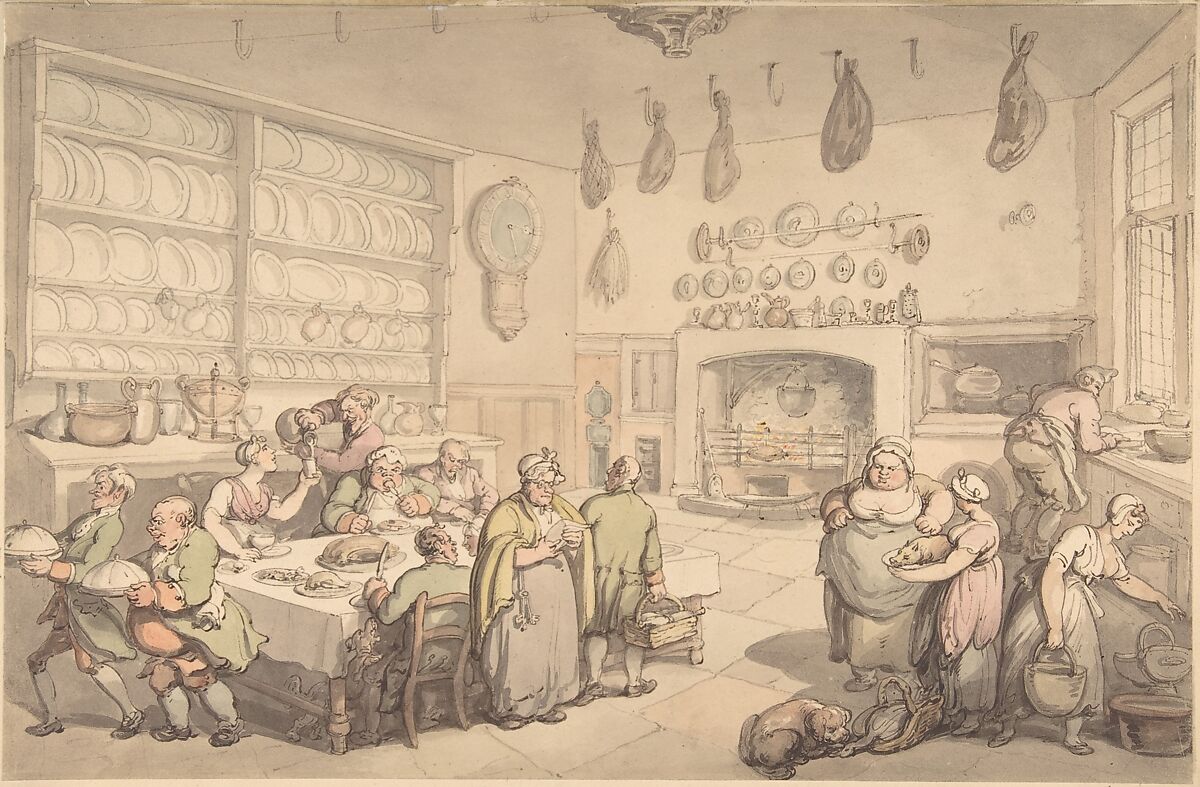
The workshop covers far more than seasons, with a look at kitchens of the era, markets (particularly those in London), a jaunt across the seasons of the year and holiday fare, shops for food in London such as the Italian Warehouses, the eating houses available in places such as London. It’s a broad look at an even broader topic, covering cookbooks of the era which offer up some great recipes, and just some things I couldn’t leave out just because sometimes it’s the cool details that add that spark of insight into a time and place.

Squire's Kitchen Rowlandson

For more about the workshop head to Regency Fiction Writers.

The English Tradition of a “Cuppa”

This October, I’m doing a workshop on Estate Workers for Regency Fiction Writers. One thing that turned up when researching the workshop was the growing importance of tea, sugar and milk in the diet of the average person in England during the long Regency era.

1780 teapot in Brown Betty style made in Staffordshire with Rockingham glaze

We tend to think of tea in Georgian England as a luxury item, but while it started off that way, prices were falling by the late 1700s. The teapot at left dates to 1780 and shows what would become the ‘Brown Betty’ style of Staffordshire pottery, with its dark Rockingham glaze. This is the sort of teapot that could be found in a middling class household, which would include some estate workers. It is far from the highly decorated tea and coffee sets created for the upper class by Wedgewood, Doulton, and others who sought royal patronage.

As noted, like coffee and chocolate, tea had started off an expensive luxury. Duties were put on it because of this, which meant in the 1600s on to the late 1700s it was a main good for smugglers. Random Bits of Fascination notes, “Smuggled tea often came from Holland where it might be purchased for as little as 7 pence per pound.” That means smuggled tea was already drifting down into the middling classes.

The Commutation Act in 1784—pushed forward on the advice of  Richard Twining of the Twinings Tea Company—reduced tea taxes from 119% to 12.5% of the price. It was no longer worth smuggling, and tea drinking spread to the growing middle class and into the working class. Tea became available in multiple prices with different grades available. Some household also provided a tea allowance for servants, and tea leaves would also go from the drawing room, to the housekeeper and on down the line of servants, with inside servants first, and then outside servants.

A New System for Domestic Economy, published in 1823, speaks to, “The universal use of tea, as an article of diet…” and devotes multiple pages to economical types of tea and efficient brewing. It notes, “…the best Green Hyson, at about fourteen shillings per pound…the best Black Souchong at about twelve shillings…the Souchong, since the common leaf at six shillings…” This shows the variety in prices. It also says that two ounces of tea per person per week is a way to economize, with sugar at three quarters of a pound over the week.

Tea shows up in the tightest of budgets at 7d and a ha’penny for 2 oz. (bought at 5s per pound) when the family income is only 24s a week. Lesser incomes than that do not include tea in the proposed budget. At an income of 30s a week, the budget allows a quarter pound of tea for 1s 3d, with sugar for the week also costing the same shilling and thuppence. Milk is only 7d and a ha’penny for the week This shows how tea could be affordable for anyone in the working class, including those on an estate with good wages.

As noted in the paper ‘Importing sobrie ‘tea’: Understanding the tea trade during the Industrial Revolution’ by Kabeer Bora, “Sugared tea and white bread became the nutritional mainstays, it supplanted the traditional produces of milk, cheese, ale, meat & oats.” Tea and sugar begin to be drunk by all but the poorest of the poor, with tea, milk and bread being seen as mainstays of the English diet. This is pushed even more so by factory work that showed up in the Regency era.

Bora goes on to write, “A report of the Factory Enquiries Commission in 1834 showed that many mill owners were allowing workers tea breaks of 15 and 30 minutes in Derbyshire and Lancashire. This break was given to them between lunch and closure (Factory Enquiries Commission, 1834).” Tea, with sugar and milk, is credited with increased calories in the average diet, and with improvements in health overall. The English habit of weak ale and small beer still would continue, but tea would go on in the Victorian era to even become the name for the working class evening meal.

To put all of this into a bit of context in the modern world, today we generally buy tea in bags (not invented until the 20th Century) with a box of tea bags being only around 1.4 ounces in total and holding 20 to 30 tea bags. If you are thrifty, you can get two or three cups from one bag, so 2 ounces of tea for about 7d could go a long way, and a pound of tea, or 16 ounces, is a considerable amount of tea.

Another good source of information is Empire of Tea: The Asian Leaf that Conquered the World by Markham Ellis, Richard Coulton, and Matthew Mauger.

If tea could not be bought, there was the ability to make a tea from the wild fruits, herbs and flowers from any estate garden (if you have horses, an alfalfa–more commonly called lucerne in England– while not the best for a tea, can be made up).

While the old standbys of ale and small beer as drinks for estate workers continued on through the Regency–particularly as the main drink in the fields during harvest time, the idea of a cuppa tea in the evening or early morning was growing. And more on Estate Workers of the Regency era will be in the workshop.

https://regencyfictionwriters.org/academe/

Why You Need a Theme in Fiction

Theme is perhaps one of the most neglected areas of any writing instruction. This may be because it’s highly personal–or because some writers instinctively know how to weave in theme, while others don’t. I had to learn about theme, and its importance to make a story resonate.

I learned about them when I learned about story structure. It’s a vital element. Theme is a writer’s touchstone. It not only makes a story resonate, it tells you want needs to be in a story, and what should be left out.

Using theme in all major turning points makes a story structure work. It creates the main character’s arc.  Think of the movie Casablanca where Rick has the papers of transit–and keeps getting hit with choices about who is he going to give these to–and he starts off all hard-nosed and making choices about selling them, not giving them to anyone who is desperate….but at the end he gives them to Ilsa and her husband so they can escape–those papers are used to SHOW Rick’s changing through the choices he makes and becoming the hero we really want him to be. That’s theme at work.

I’m going to be teaching a workshop on theme for Hearts Through History this October.

We’ll cover:

  • What is theme—a clear definition.
  • Why does a story need a theme?
  • What is too specific, and what is too vague?
  • How to find your theme.
  • Distilling your theme to one sentence.
  • Relating theme to characters.
  • Developing goals and motivations around your theme.
  • Weaving theme into turning points in your story structure.

A great theme can be explored over a lifetime of work—but if you’ve never thought about what theme can do for your stories, or if you struggle with keeping a story on track, this workshop can give you some new writing tools.

Dialogue–What Your Character Doesn’t Say

V for Vendetta QuoteI’m teaching my workshop on dialogue this September, and so it’s a good time to bring up some tips on dialogue. A story can live or die just on dialogue. Bad dialogue will make a character flat and uninteresting, and may even send the reader running from the story–no amount of great action or terrific plot twists will save a story with weak dialogue. But great dialogue can make a reader forget to look for plot holes or poor pacing. That’s because great dialogue is where you characters can shine.

Now, learning to write great dialogue is no easy task. It takes time to figure out how to make fictional dialogue sound better than how folks talk in real life but still sound possible. All of this starts with your characters.

The workshop will go into detail on dialogue–and exercises to improve dialogue skills–but here are a few tips.

1-Get to know your characters. I don’t mean charts or lists, and I mean beyond a few scenes. How does that character lie? What are the verbal habits? Is this person a talker or not? Spend some time away from the story just getting your character talking.

2. Become a habitual eavesdropper. Listen to how real people talk–and jot down notes. Notice how real conversations usually make for terrible dialogue–there are pauses, jumps, repeated phrases and words. It is still useful to pay attention to all this stuff because this is what fiction mimics. Notice how rarely people stick to one topic. Notice slang, and how words are used as leverage. Notice how one person will speak differently to the different people in that person’s life.

3-Close your eyes in the next movie and just listen to the words. Pay attention to how dialogue–and the pauses–are used to reveal character. Listen for the emotional words. Use just your ears to get a sense of rhythm, and so you won’t be distracted by flashy visuals or the actor.

4-Take apart your favorite writers’ works. Yes, this means getting out some markers and marking up the book–ebooks readers also let you mark up books. Pause over the really great dialogue moments and look at how the words are used. Look at word choice, at sentence structure, at paragraphs and how they link.

5-Write a lot of dialogue. Write pages of the stuff. Write just dialogue–fit in any description later. Nothing helps you learn faster than writing–a lot.

6-Get the technical stuff out of the way. Dialogue can clunk with periods in the wrong places, or commas that are missing, or with quote marks that don’t make sense. All of this can trip up the reader. Buy a copy of Strunk & White’s Elements of Style and nail the punctuation so it becomes invisible.

7-Look to give your characters great lines. Think about your favorite actor playing that role–wouldn’t you want him or her to come up to you and gush about having wonderful lines. Let your characters be more witty and better than anything in real life.

8-See how long you can have a character talk and not mention the real topic. This is the art of subtext. Make what the character doesn’t say important. Make the reader want to know what the character isn’t putting into dialogue.

9-Punch and polish, and then polish some more. Great dialogue often comes with revision, rewrites, edits, and then even more edits. Polish those words. Say them aloud to see how they sound. Fall in love with those words and make them wonderful.

10-Keep learning. Some links to help you with that:

http://fictionwriting.about.com/od/crafttechnique/tp/dialogue.htm

http://www.musik-therapie.at/PederHill/Dialogue&Detail.htm

Writing Emotionally Layered Dialogue

Got Subtext? Writing Better Dialogue

Dialogue: Don’t Let’Em Say What You Mean by Shannon Donnelly


It’s About Craft – Showing More, Telling Better

I’m teaching my Show & Tell Workshop for OCC Romance Writers this March. It’s a workshop with a lot of hands-on, because I believe that learning to show more and tell better is a vital part of any writer’s craft.

Now, I know the advice is usually “show, don’t tell”. However, narrative has it’s place in fiction. Writers need to know when to show more, and how to make the telling (or narrative) compelling. Some tips for writers;

1 – Show more by eliminating dialogue tags that tell everything. This means no more tags such as: he taunted, she exclaimed, he smirked, she pouted, he expounded, she tossed back, he leered, she sighed. All of these are telling the reader an emotion. You want to show how a character expresses emotion–readers want to see the characters in action.

Replace every telling dialogue tag with an action that better shows the character expressing an emotion. To do this, you must know your characters. How does your character pout? Does she stick out her lower lip, or bat her eyelashes? Does she fold her arm, or twirl a curl around her finger? How does your character leer? Does he overdo it, making it into a joke, or does his stare strip a woman bare? Show the emotion with actions.

2 – Show more, also, by eliminating places that simply tell the reader information. This is where you the author slip in to add a note.

For example, maybe you want to say something about a man’s grin, that it’s infectious, so you write: His grin widened and Sally found it infectious, so she smiled back.

This is you, the writer, are telling the reader the exact information instead of showing and letting the reader figure things out. Again, you have to know your characters—and this is where you show the grin being infectious, as in: His grin widened. Sally’s lips twitched, lifted; laughter rose like a bubble in her chest. Now you are showing Sally smiling back instead of telling the reader.

3 – Watch those lovely “writerly” phrases. Maybe you’ve come up with a clever line. The trouble is, if you’re deep into a character’s viewpoint and emotion, that clever line could throw the reader out of the scene. You have to look at the overall effect of the line—and you may need to cut it if you’re jumping out of character just to fit in the clever phrase.

For example, maybe you’ve described a woman as: Her honey-blonde hair floated around her, a golden nimbus, a heavenly aura. That’s a fine description. But if you’re in the viewpoint of another woman who actually hates this honey-blond, you’ve gone for the clever phrase instead of showing the enmity between these women. This is where you save this clever phrase for another time and go for information that shows these two women being bitchy with each other.

4 – Do remember to show; get the emotion onto the page. A lot of novice writers forget about this vital part of the story. This is where you’ve got action, but the reader has no idea what the character feels about all that action.

For example, maybe you’ve got an exciting moment where the heroine of the story has jumped out to save a small boy from being hit by a car. She jumps out, grabs the boy. Great stuff. But…what’s she feeling? Is she frightened? Amped up on adrenaline? Is she angry, furious because this is her son and she’s told him five times not to go into the street after his baseball? Is she shaking? Is she covering up her feelings by acting tough because she’s a cop and she thinks cops should show emotion?

Again, you have to know your characters—and you have to give your readers a chance to get to know your characters, too, by putting in those emotions. Once you’ve finished the book (or any scene) go back and look to see if you wove in all those emotional reactions—or did you get just the action?

5 – If you show, don’t tell. Repetition shows insecurity—it means you are the master of your story. Trust the reader to get the information you’ve shown. You don’t have to show a guy slamming out the door and tell the reader in the next sentence: He was so angry he could spit nails. Trust your readers to get what the actions mean.

6 – Cut the clichés. We’re back to needing to know your characters—and needing to know them as unique individuals who do not have cliché actions and reactions. You want to show who your characters are by having them reveal their personalities with their actions and reaction—if you go for cliché actions, the characters become walking clichés, too.

This means no stalking into the room like a panther. No gazing into a mirror and doing an inventory of hair, eyes, and the standard description. No women (or men) who had their hearts broken once and so that person has vowed never to love again.

7 – Show your character in action right away. This is vital. If you want the reader to believe your character is a kick-ass vampire slayer that character has to slay a vampire right off. It’s no good telling the reader this information, you must show the character being what that character is supposed to be. This is why Superman has to be super right off. This is why a crazy cop has to do something crazy right off so that everyone “gets” this is one crazy dude.

Start off by showing your character’s strengths and weaknesses right away—get those onto the page. It’s no good saying your hero is a healer—you have to have the guy heal someone. And it’s no good saying the healing costs him some of his own life each time—you have to show him aging or losing strength each time he heals.

8 – Use narrative to slow the pace. Telling will slow the pace of any story, so it can be used to help you transition the reader into a new scene, or to convey passage of time, or it can be used to set a mood.

9 – Revise, revise, revise. Remember that if anything that is first draft (and sometimes even second) may be rough, and will lean on your own habits. Do you habitually overwrite–that means you need to cut. Or do you habitually underwrite–that means you need to flesh out your scenes.

10 – To quote Mark Twain: “The difference between the right word and the almost right word is the difference between lightning and a lightning bug in a jar.” This goes back to editing your work, and in particular your narrative passages. Is every word the right word? The right mood? The right meaning? And, yes, even the right spelling. Read your work aloud to catch errors, places where a reader will trip up, and just awkward spots.

More tips and tricks in the workshop, but these ten will help bump up your writing.

Wounds & Warriors Workshop

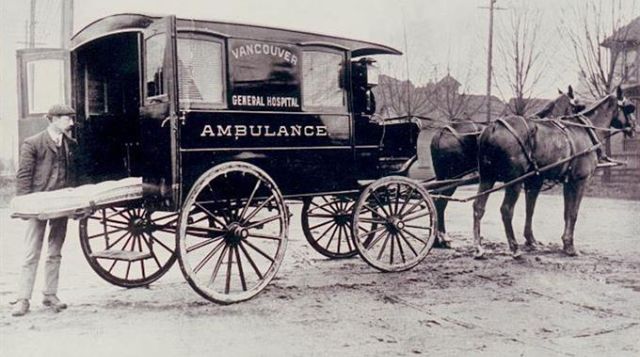
Early AmbulanceThe idea for a Wounds & Warriors workshop for writers after I became an EMT in New Mexico–because too often our characters get hurt and either recover ridiculously fast or have injuries that are just not plausible. What I realized was that most of us get our ideas from movies and TV–and boy do they get it wrong. Which means if a writer wants more accuracy it helps to know what are the common misconceptions and how do you go about better research.

In the Wounds & Warriors workshop I’m teaching in February for the Hearts Through History writers, we’re going to go over a lot of different information—and you’ll have a chance to ask about specific situations, including how your protagonist might care for himself or herself after something bad happens. But it’s good to know a few basics:

  • A person can bleed out quickly. The average person has about five liters of blood—loosing even one liter (one large soda bottle) of blood is bad. Confusion and weakness sets in. That person the bleeding to stop and fluids to be put back in.
  • Head traumas are dangerous—some of the most dangerous ones are those where the person feels fine but was unconscious. This can mean there is an internal bleed and that could kill within forty-eight hours.
  • Almost everything causes nausea—hit on the head, you wake up throwing up or wanting to throw up. Getting shot—your body tries to dump the stomach so it can focus on other things. This is never pretty and so gets skipped over in most fiction.
  • One issue can hide another—and people aren’t always honest about what is the real problem. As Dr. House said, “Everyone lies.” And not always intentionally. Sometimes folks just forget, and this is particularly true when stressed.
  • Children are not small adults—their bodies can’t compensate as well, so when they use up their physical resources, they’re going to crash fast. A sick kid is often a critical kid.
  • Extreme heat and extreme cold are deadly elements—and any injury makes them even more so. If you want to add more tension to a scene, use the weather.
  • CPR can and does save lives. Even more importantly it can mean the difference between someone coming back fully functional or with permanent damage. But a lot of folks are afraid to dive in and help—it take training to make sure you just do what you’ve trained to do.

Ultimately, you want to know what’s plausible for your situation—even if you’re writing about vampires and werewolves, know the rules so you can know how you can break them. Research your injuries before you write them and never assume. You’ll be able to get away from the cliché of that flesh wound in the shoulder that the protagonist survives or the knife fight that somehow ends up with no one disfigured or with permanent damage.

The other thing to keep in mind is for your own safety. What should YOU know (just in case)?

1-Document your medications and history (and get your loved ones to do this). Paper, phone, whatever—just have it written down (VialofLife.com)

2-Keep your document/medications handy! It is so hard in an emergency to make sure these are not forgotten.

3-Do an DNR if you do NOT want CPR or extreme life-saving measures.

4 –Wear a medical ID bracelet and/or necklace for those REALLY important things (as in allergic to penicillin).+

5-Put “ICE” in your phone—“In Case of Emergency” contact, just in case you are in an accident and cannot talk.

6-Educate yourself! Take a CPR class! Know how to stop a bleed. Keep children’s aspirin around if you’re not allergic. (1 in 20 deaths from stroke, heart attacks are the no 1 cause of death in the US, what do you do for allergic shock?) The life you save may be your own.

7-If you—or a loved one—is allergic to something (anything), keep an EPI pen on hand.

8-Keep a “survival/emergency” kit around and fresh! (www.ready.gov/sites/default/files/documents/files/checklist_1.pdf and http://www.redcrossstore.org/item/321406)

9-Remember your pets! They have emergencies, too, and in a disaster they’ll need water and food, and possibly first aid.

Writing Workshops 2020

UPDATE–2020 is almost full!

February 3- 28, 2020 Wounds & Warriors, HHRW

March 16 – April 12, 2020 Show & Tell: An Interactive Workshop, OCCRWA

May 4- 29, 2020 Horse Sense For Your Characters, HHRW

June 1-26, 2020 The Sexy Synopsis, Contemporary Romance RWA

August POV: It’s More Than a Point of View, YRW

September 1-25, 2020 Dialogue: Don’t Let ‘Em Say What You Mean, Contemporary Romance RWA

October 5-30, 2020 THEME: A Vital Element of Fiction, HHRW – NEW WORKSHOP!

There also might be a workshop coming for November!

I’m starting to plan writing workshops for 2020. It was nice to take a year off in 2019, but I find I miss the interaction of the workshops–it’s enjoyable to help other writers find their path.

So far, I have scheduled:

  • February 3- 28, 2020 Wounds & Warriors, HHRW
  • May 4- 29, 2020 Horse Sense For Your Characters, HHRW
  • June 1-26, 2020 The Sexy Synopsis, Contemporary Romance RWA
  • September 1-25, 2020 Dialogue: Don’t Let ‘Em Say What You Mean, Contemporary Romance RWA
  • October 5-30, 2020 THEME: A Vital Element of Fiction, HHRW

I’ll be adding a few more, but in the meantime, for anyone interested in taking a workshop, here are a few tips to get the most from any workshop:

Interact. This may seem obvious-and I’ve lurked in a few workshops, too–but I find that those who ask questions and post exercises get the most from the workshop. You may have to clear the decks to participate. It is hard to juggle too many things all at once, but it can give you better value for your time.

Don’t worry about your ideas. I’ve known many people who are paranoid about ideas being stolen. What I’ve found is that if you give the same idea to two writers, you’re going to have two different books. Don’t sweat the ideas. It is your voice that matters. And if you are still worried, do the exercises with made up stories–it might even spark a new book.

Make mistakes. A workshop is a great place to experiment and learn. I find many people, however, come in with the idea of ‘doing everything right.’ That actually won’t help you learn anything. Use workshops as a place to try new things, to push beyond your comfort zones, and to make mistakes. You’ll get more from the workshop by doing so.

Have fun. Many folks come into workshops with grim determination (this goes along with not making mistakes). Again, workshops are a safe place to let loose, try new things, and be creative. They are places to reconnect with experimentation, which can often get the creative juices flowing.

Use what works for you. In any workshop, if you come out with one great thing learned, that’s a positive. You will find that every writer has a different process–including you. This means what works for one writer may not work for another. This is okay. If something doesn’t work for you, you don’t have to shoot down the idea–just don’t use it. Take what does work, and feel okay about abandoning the rest.

Try new things. If you’ve never written first person, try that. If you’ve never written third person, try that instead. Try out new techniques. This goes along with making mistakes. Yes, what you try may not work, but it may lead to new discoveries.

If you don’t post, do the exercises at home. I am a great believer in writing exercises. I’ve used them to discover my own comfort zone for what I want to write. I’ve used them to improve my viewpoint control, to work on dialogue, to do better narrative. Writing exercises to me are like warm-up for a dancer–they’re vital to improve technique. All my writing craft workshops include exercises–and the writers who get the most from the workshops do them and post them for feedback. However, even if you don’t post the exercises, you will learn a lot by doing them.

And that’s it–some tips on how to get more from an online workshop, particularly one that I might teach.

Plot, Character & Theme

I’m doing my Plotting from Character workshop this November and as usual before a workshop I’ve been thinking about the elements that go into the workshop–and into a story.

Too often what I see in manuscripts is that “stuff happens.” Now, that’s not bad in an action-packed story, except it can end up not being very satisfying to a reader. Ideally, the stuff that happens has something to do with the main character having tough choices that reveal the character of the character, and has even more to do with theme. So let’s start with theme.

The importance of theme is often overlooked. Theme is what the story is REALLY about–it is what is going to resonate with the reader and create a greater satisfaction. Theme is the touchstone for the writer, too. If you get lost, look to theme to get back on track. So…without theme, a story tends to wander. You might even think of theme as the core phrase or question that puts a focus into the story.

This focus helps you set up a core goal that will lead to conflict and then a crisis (or dark moment, where the protagonist must face his or her greatest weakness, and either overcome it, or not, leading to death of the old self, or in a tragic tale, the character’s death for failure.

What does this have to do with ‘plotting from character’?

With theme in place, the writer can start asking–“What characters do I need to explore this theme?” And also–“What needs to happen to face my protagonist with tough choices related to theme?” In other words, it is no longer about coming up with general stuff, but now coming up with events that will test the protagonist based around the theme, or core ideas the protagonist needs to learn.

This helps greatly in avoiding cliches, such as the heroine gets kidnapped, or the hero and heroine have a misunderstanding after the hero’s ex tells the heroine some lie about the hero. Theme and a specific character will generate a very specific story–and this brings a freshness to the story.

How do you apply all this?

Well, theme and character go hand-in-hand. It’s really hard to develop just one of these, so you have to do them together. For example, if you’re story is REALLY about how there is only fear and love, and the stronger of these will overcome the other, then you know you will need a character who has deep fears to overcome, and faces the need to overcome these in order to have a great love. You’re also going to have a character who doesn’t overcome fears, and a character who is fearless. Those combinations will let you best explore that theme. With that in place, you still need to develop the characters–starting with the protagonist–so that the characters do not come across as flat (or cardboard). And you’re going to develop tougher and tougher choices for that protagonist that fit into the main turning points of the story.

This means the action of the story is going to come from your characters–from facing characters with tougher and tougher choices. Because your characters are yours, this helps you avoid any cliche action in the story. That’s plotting from character. But it’s hard to do this without some idea of theme.

Now I will say some writers know how to do this instinctively (I’m not one of them). I also hold that if you know your theme up front, it is a lot easier to weave it into the story–not with a heavy hand, but a light touch that makes the theme (and the story) stronger. Is this easy–no, not really. But it is well worth it for the reader in that you’ll end up with a stronger story that makes the reader keep thinking about that story long after the last page has been read.

Show More, Tell Better

“Writing well is the best revenge.” — Dorothy Parker

We’ve all heard “show, don’t tell” but I prefer to tell folks “show more, tell better.” This is something I use in every Show and Tell workshop I give (and I’m doing one for the RWA FF&P Chapter this July.) There’s a good reason for this. Narrative is actually vital in fiction—there are places where you need to smooth a transition or introduce a scene or a character and ‘telling’ or narrative works best. However, within a scene, it is vital to ‘show’ more of the character’s emotions through the character’s actions.

Like much of the craft of writing, you have to learn how to balance showing and telling by doing—meaning you have to write—and the amount of showing or telling you do varies by the story and the intent of the author.  This is part of your voice as a writer. However, there are some good guidelines that can help you with all of this:

– Where are we? A reader needs to be placed into the story and into every new scene. Do not throw your readers into the deep end without giving them some help, and that means use some narrative to set the story, and you can use narrative to set every scene. This is VERY important if you are writing a story that is set somewhere other than our own reality. The reality of your world must be woven into the story. Use vivid details, meaning weave in as many of the five senses as possible—smells, sounds, tastes, touch, and not just sights.

– When are we? This is just as important as where, and this does not mean not just the era. Think about the details of the time of the year. What’s the weather like? Is it day or night? Is it cold, warm, windy? What are the smells? All these details help the reader settle into the scene as if this moment in time really exists.

– Who is here? An introduction to the characters, particularly to the main characters for that scene and for the story, is important. I’m not talking a laundry list of descriptions, but the reader does need more than tall, dark and handsome. Think about what makes THAT character stand out. What is different about him or her? Is there a scar or a limp? How about height or weight? What about hair? What is the first thing that anyone would notice? Use unique features to start to make characters come to life for the reader. Think of your description as brush strokes of a watercolor that suggests images.

– Why are we here? This doesn’t have to be greatly detailed information, but you need enough background to make a reader care. It’s one of Kurt Vonnegut’s Eight Rules for Writers: “Give your readers as much information as possible as soon as possible. To hell with suspense. Readers should have such complete understanding of what is going on, where and why, that they could finish the story themselves, should cockroaches eat the last few pages.”

As with all writing, you want to edit, polish, revise and make your narrative wonderful. Cut every extra word. Use active voice. Use the right words in the right way. Brilliant narrative is invisible—if a reader is noticing your writing, that reader has fallen out of the story.

Now all this needs to be woven together, stitched in with careful threads. Do not dump tons of narrative into the story—unless it really is brilliant. Narrative can also be woven in with a scene—in other words, it’s never show or tell. These two things can go together.

But what’s good ‘showing’ in a story?

– Punch your dialogue so it’s strong. Know that your dialogue is weak if you find yourself leaning on tags such as: he taunted, she exclaimed, he smirked, she pouted, he expounded, she tossed back, he leered, she sighed. All of these are TELLING the reader an emotion. You want to get your characters onto the page by showing how that person expresses emotion. That includes making the dialogue so good that the reader knows the emotion in the words without having to be told. Another way to think of this is to imagine you are writing a script for your favorite actors—give them great dialogue to speak.

Eliminating every “feel” or “felt”. That is a spot where you flat out told the reader the emotion. Let your characters take actions that express their emotions, and trust the reader to figure things out. This goes along with those tags being used to prop up dialogue. When you say, “He felt angry.” That’s weak to the reader because the reader has nothing to visualize. Every person gets angry in different ways—some folks bottle it up, some turn red, some go pale, some folks yell, some start to cry, some shout. Get your characters onto the page by having them express emotions. It takes more time and more words, but it makes the characters come to life for the reader.

– Keep asking ‘what am I showing the reader about this character’? If you want the reader to believe your character is a kick-ass vampire slayer that character has to slay a vampire right off. It’s no good telling the reader this information, you must show the character being what that character is supposed to be. This is why Superman has to be super. Readers will believe what you show a character doing, not what you tell the reader.

– Watch those lovely “writerly” phrases. Maybe you’ve come up with a clever line. The trouble is, if you’re deep into a character’s viewpoint and emotion, that clever line could throw the reader out of the scene. You have to look at the overall effect of the line—and you may need to cut it if you’re jumping out of character just to fit in the clever phrase.

For example, maybe you’ve described a woman as: Her honey-blonde hair floated around her, a golden nimbus, a heavenly aura. That’s a fine description—lovely telling. But if you’re in the viewpoint of another woman who actually hates this honey-blonde, you’ve gone for the clever phrase instead of SHOWING the enmity between these women. That’s where you save this clever phrase for another time and go for showing these two women being bitchy with each other.

– Do remember to get emotions onto the page. This is where characters are doing a lot of things, but the reader has no idea what the character feels about events. Maybe you’ve got an exciting moment where the heroine of the story jumps in to save a boy from zombies. Awesome! She grabs the boy and chops up the zombie with an ax. Great stuff. But what is she feeling? Is she frightened? Is she angry, furious because this is her son and she’s told him five times not to go out on his own? Is she shaking? Is she covering up her feelings by acting tough because she’s a cop and she thinks cops shouldn’t show emotion?

You have to know your characters to get this onto the page and to do so without resorting to telling the reader a flat “she felt angry that he hadn’t listened to her and had almost died.”

Above all else, if you show, you don’t need to tell. And if you tell, you don’t need to show. Repetition can be useful in places, but with showing and telling if you do both, it conveys to the reader that either you don’t really know what you are doing or you don’t think the reader is very smart. Readers do not like being hit over the head with endless repetition. You don’t have to show a guy slamming out the door and tell the reader in the next sentence: He was so angry he could spit nails. See—even me repeating just a little bit here starts to become boring. Trust your readers—they are actually very smart. And take to heart the phrase—show more, tell better.