March has me planning a garden, buying seeds…and setting up water systems. It looks to be a hot summer, but I have shade ready to keep my plants from burning up. In many places, however, there’s still a worry of frosts–and in Regency England, it was still time to be thinking about the last of winter hanging on. We’ve had St. David’s Day and St. Patrick’s Day in March, but the movable feasts of Good Friday and Easter falls into April this year–more time yet to be thinking of coloring eggs and what sort of special fare to have (I lean into strawberries at this time of year and asparagus, with perhaps a bit of lamb).
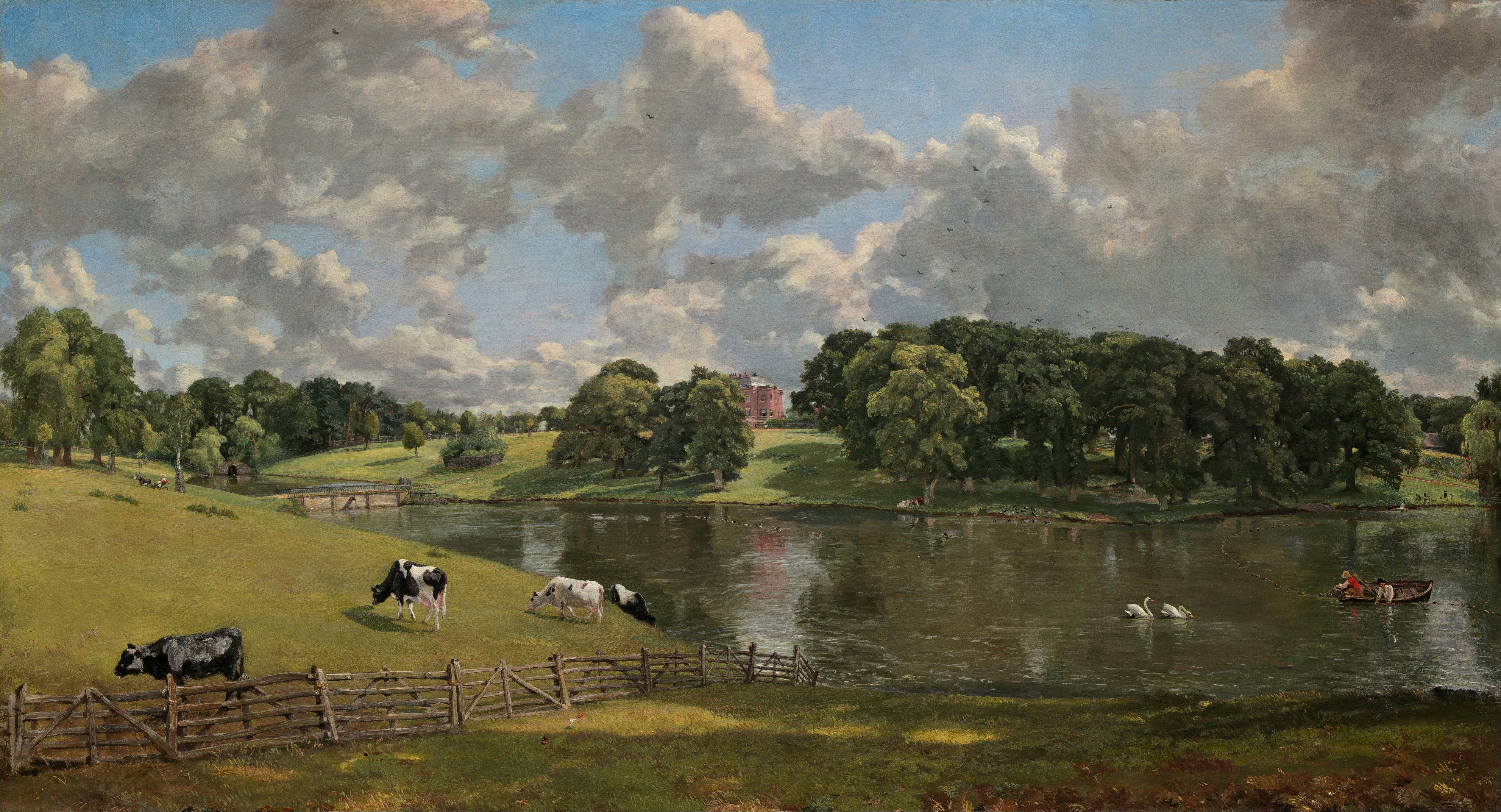
John Constable’s 1816 painting of Wivenhoe Park in Essex
John Loudon’s 1822 book An Encylopaedia of Gardening starts to expand his list of fare available from the garden and here’s what he lists as spring begins, with most herbs coming out early:
March – Extra Brewing, Fattening Beasts, Paring and Burning, Oats and Grass in with other crops, Dealing with Moles, Dairy work, Sheep to pasture.
Culinary Vegetables from the open Garden, or Garden Stores. Brussels’ sprouts, borecoles of sorts, especially the early greens, and Breda cale, brocolis. Haricot beans and soup peas, from the seed-room. Potatoes, Jerusalem artichokes, turnip, carrot, red-beet, parsnip, skirret, scorzonera, and salsify. Spinach occasionally, if mild. Onions from the root-room; Welch onions, ciboules from the garden; garlick, shallot, and rocambole from the root-room. Sea-kale from covered beds. Lettuce, endive, celery, American and winter-cress; also water-cress, burnet and others. Parsley horse-radish, and dried fennel, dill, chervil, &c. Thyme, sage, rosemary from the open garden; and dried marjoram, basil, mint, savory, &c. from the herb-room. Rhubarb stalks from covered roots; anise, coriander, carraway, and other seeds, chamomile, blessed thistle, and other dried herbs. Samphire. Nettletops, dandelion-leaves, bladder campion-tops, watercresses, brook-lime, sauce-alone. Mushrooms from covered ridges. Common and red dulse, sea-belt, and pepper-dulse.
Hardy Fruits from the open Garden, Orchard, or Fruit-room. Apples, pears, quinces, medlars, services from the fruit-room. Some dried grapes. Almonds, walnuts, chestnuts, filberts from the fruit-room.
Culinary Productions and Fruits from the forcing Department. Kidney-beans. Potatoes, radishes. Sea-kale, asparagus. Small salads, onions. Parsley, mint, chervil, sweet marjoram. Rhubarb. Mushrooms. A pine occasionally; grapes, cucumbers, strawberries. Oranges, shaddocks, lemons, olives, preserved pomegranates. quats, pishamin-nuts, leeches, &c. yams, and Spanish potatoes.
Other than odd spellings (such as pishamin for persimmon, and quats for kumquats), here are a few other words that are uncommon these days:
borecoles – comes from the Dutch word boerenkool and is another type of kale (also sometimes spelled cale).
ciboules – is another name for a green onion.
rocambole – this is a variety of garlic.
bladder campion-tops – this is a plant said to be best in spring when tender, and said to have a taste like a pea or asparagus.
brook lime – sometimes spelled as one word, this perennial herb has a peppery taste.
dulse – this refers to sea weed.
shaddocks – this is a fruit similar to grapefruit, and as a native to Southeast Asia would need to be grown inside a glasshouse.
Potatoes, of course, originate in South America, and so came to Spain first, and then spread across Europe and into Great Britain. In the early 1800s in England, the potato was still moving from being food fit for the poor into something that could be a staple across all classes.
Interestingly, what is thought of as a classic English dish–fish and chips–traces its roots to a Sephardic Jewish fried fish brought to England by Portuguese/Spanish immigrants, and then the fried potatoes come to England from Belgium. The first shop said to offer both fried fish and fried potatoes is credited to Joseph Malin, a Jewish immigrant in London who started serving up his fish and chips in the early 1860s.
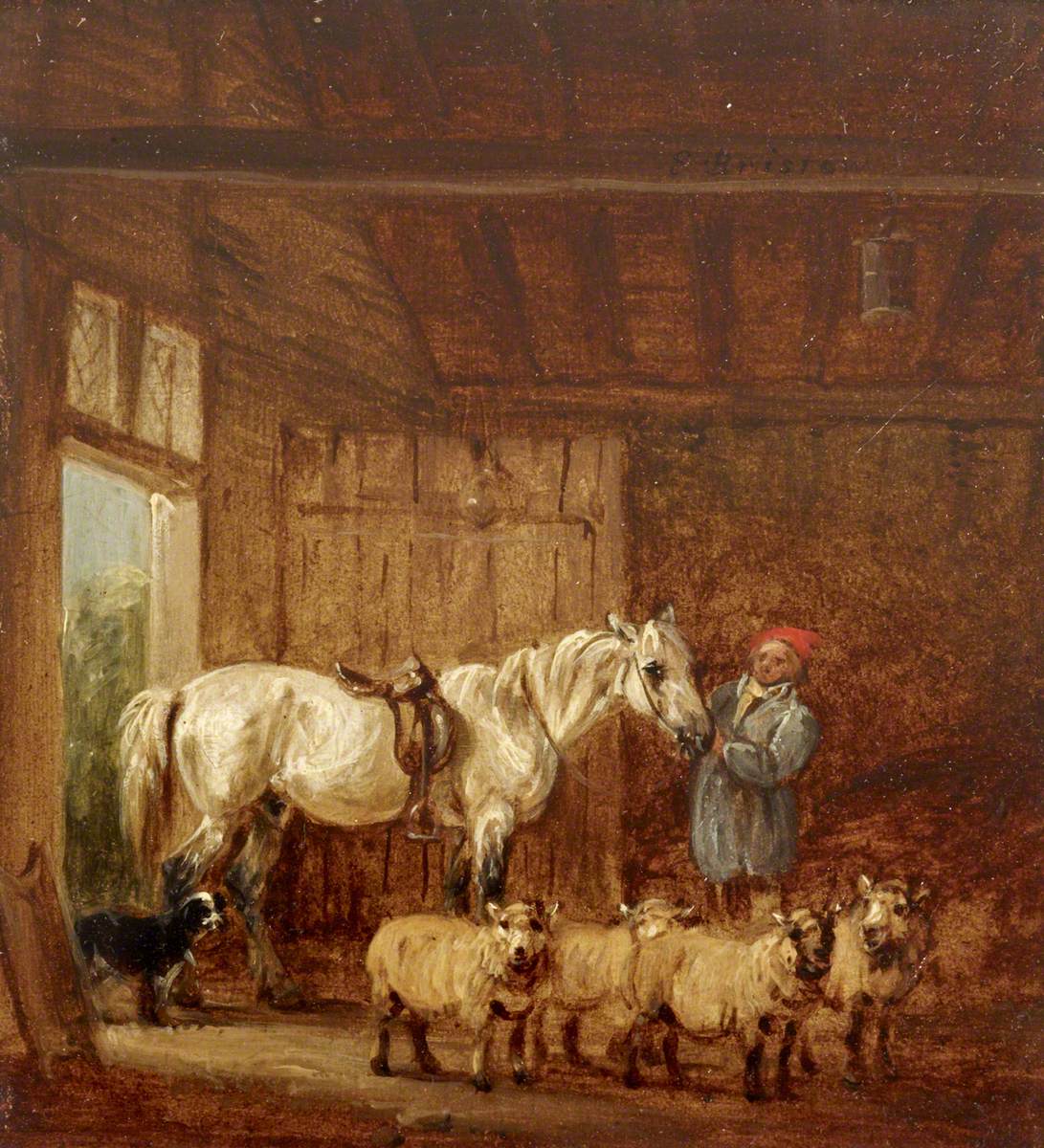
Edmund Bristow’s A White Horse with a Groom, and Sheep in a Barn from the National Trust, Anglesey Abbey
Shrove Tuesday is the last day before Lent begins on Ash Wednesday, typically falling anywhere from February 3 to sometime in early March. Traditionally, Shrove Tuesday Pancakes were made up as a last indulgence with butter and eggs, or all the things that might have to be given up for the forty days of Lent. In 2026, this will fall on February 17.
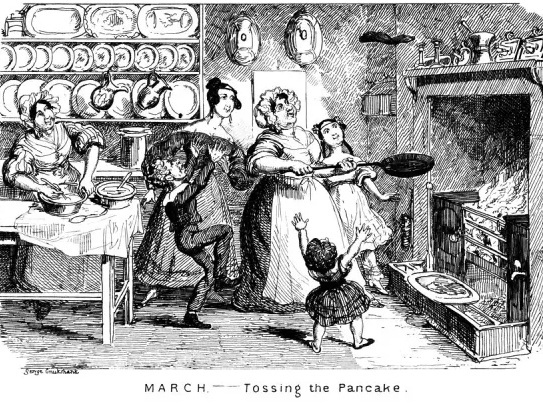
George Cruickshank’s print in ‘The Comic Almanack for 1837: An Ephemeris in Jest and Earnest Containing All Things Fitting For Such Work’ done under the penname of Rigdum Funnidos shows a cook tossing such a pancake.
English pancakes tend to be more like what Americans think of as crepes and were often served with dinner or tea with just a sprinkle of sugar instead of the US idea of a thick breakfast stack with maple syrup poured over top.
Susannah Carter gives the following recipe in The Frugal Housewife (1822) for pancakes:
“In a quart of milk, beat six or eight eggs, leaving half the whites out; mix it well till your batter is of a fine thickness. You must observe to mix your flour first with a little milk, then add the rest by degrees; put in two spoonfuls of beaten ginger, a glass of brandy, a little salt; stir all together, clean the stew pan well, put in a piece of butter as big as a walnut, then pour in a ladleful of batter, moving the pan round that the batter be all over the pan: shake the pan, and when you think that side is enough, toss it; if you cannot, turn it cleverly; and when both sides are done, lay it in a dish before the fire; and so do the rest. You must take care they are dry; before sent to table, strew a little sugar over them.”
There was no baking powder yet to make fluffy pancakes, and the recipe doesn’t call for any type of yeast. While pearlash was around for leavening (you soak wood ash in water, strain it, then boil it until it makes a moist white powder). This wasn’t much in use in England for it doesn’t show up in cookbooks. Barm, also called ale yeast, does show up occasionally in recipes, but commercial yeast was readily available and used not just in bread, such as in cakes and puddings like “Dutch Pudding or Souster.”
From the garden and farm, John Loudon’s 1822 book An Encylopaedia of Gardening offers up this advise, along with vegetables and fruits, with spellings and punctuation the same as from his book:
FEBRUARY Planning and Preparing, Foaling, Start of Early Lambing in fields, Planting trees and bare root plants such as roses, root crops in, Pare and burn grass lands, Spread manure.
Scotch or Strasburgh cabbage, savoys, borecoles, Brussels’ sprouts, and, if a mild winter, cabbage coleworts, brocolis. Haricots, beans, and soup-peas from the seed-room. Potatoes, Jerusalem artichokes, turnip, carrot, parsnip, red-beet, skirret, scorzonera, and salsify. Spinach, if a mild winter. Onions, leeks, garlick, shallot, and rocambole. Sea-kale from covered beds. Lettuce, endive, celery. American and winter-cress. Parsley, if protected, horse-radish, and dried fennel, dill, chervil, &c. Thyme, sage, rosemary, and lavender, from the open garden; dried marjoram, basil, &c. from the herb-room. Rhubarb-stalks from covered roots, anise, coriander and carraway-seeds, from the seed-room; chamomile, &c. from the herb-room. Red cabbage, samphire. Nettle and thistle tops; towards the end, sorrel leaves, and if a mild winter, sauce-alone. Mushrooms from covered ridges. Sea-belt preserved, and occasionally badder-locks.
Hardy Fruits from the open Garden, Orchard, or Fruit-Room. Apples, pears, quinces, medlars, services from the fruit-room. Some plums from branches hung up in the fruit-room. Dried grapes and currants from branches hung up in the fruit-room. Almonds, walnuts, chestnuts, filberts from the fruit-room. Sloes from dried branches hung up in the fruit-room.
Culinary Productions and Fruits from the forcing Department. Kidney beans. Potatoes. Sea-kale, asparagus. Small salads. Parsley, mint, chervil. Rhubarb. Mushrooms. A pine occasionally; grapes, cucumbers, strawberries. Oranges, lemons, olives, pomegranates. Pishamin-nuts, lee chees. Yams, and Spanish potatoes.
Borecoles is a type of kale.
Haricots are green beans.
Jerusalem artichoke is a hardy, starchy root plant that has nothing to do with artichokes, but has more in common with potatoes and mashes up very well.
Skirret, also a root plant which means hardy for winter, is said to taste like carrot.
Scorzonera is another root vegetable that tastes a bit like an artichoke.
Salsify is also call oyster vegetable since it has a oyster-like taste.
Rocambole is another name for a shallot, which can still be found in many modern markets.
Samphire does still show up in English cooking, and grows in marshy areas. It is from the parsley family, looks like baby asparagus, and has a crisp, salty taste.
Sea-belt and bladder-locks are both types of seaweed.
Medlars is described as tasting like spiced applesauce.
Services are a type of strawberry.
Filberts are what is called a hazelnut in the US.
Chervril is a herb similar to parsley.
‘Pine’ means a pineapple, which are touchy to grow in England (they do look a bit like a pinecone).
In the Regency era, the best gardeners were though to come from Scotland, and John Claudius Loudon certainly helped cement that idea. His portrait at left shows him looking both prosperous and rather Scottish. He is noted as being the first to use the word ‘arboretum’ in his writings, he was a botanist, garden designer, and author, and his wife, Jane Webb, was also a horticulturalist, and author. It was a talented family. An Encylopaedia of Gardening by Loudon speaks to the wide variety of produce available in England in 1822, and also how nuts were linked to fruit. Some reference are very odd to the modern reader:
Rocket, of course, is called arugula in the US.
Savoys means a type of cabbage, known for crinkled leaves.
When he says ‘kidney beans for harricots’ he means that kidney beans replace the French beans (or what is called green beans in the US).
Fuci is the plural for Fucus a type of seaweed (obviously, you’d have to be near the sea to get this along with other coastal plants).
Borecoles is a type of kale.
Jerusalem artichoke is a hardy, starchy root plant that has nothing to do with artichokes, but has more in common with potatoes and mashes up very well.
Skirret, also a root plant which means hardy for winter, is said to taste like carrot.
Scorzonera is another root vegetable that tastes a bit like an artichoke.
Rocambole is another name for a shallot, which can still be found in many modern markets.
Elecampane or ‘elf wort’ is one of those medicinal herbs from ancient times, said to be good for ‘lung issues’.
Samphire does still show up in English cooking, and grows in marshy areas. It is from the parsley family, looks like baby asparagus, and has a crisp, salty taste.
Wild services refers to a small, edible, pear-like fruits from a tree native to England that is now rare.
Haws are the red berries from the Hawthorn tree.
‘Pine’ means a pineapple, which are touchy to grow in England (they do look a bit like a pinecone).
Filberts is another name for hazelnuts, and nuts in shells used to be a common thing in many stores, but now everything seems to come in a can or a jar.
Cloud-berries (or cloudberries) are bright, amber-colored fruits similar to cranberries in that they are tart and need water to thrive. They were once common in England, but not so much anymore.
Loudon speaks of the open garden, a fruit-room, and the forcing-room. The latter would be some sort of hot house or glass-house that allowed for heating to extend the growing season. His spellings and variations on capitalization are also left in place here—standardization of such things is a more modern idea. He does mention some plants if not ruined by rain or frost, which would be common problems, and use of frames (anything placed over a plant to protect it from frost—this could be a large glass jar or burlap or a large metal bell).
Pickling and storing in such places as a herb room, or in barrels in a cold place would be common, as in a ‘fruit-cellar’ or any cold room. As already noted, food storage—potting, pickling, and otherwise preserving—was a vital necessity, along with making certain you got the bugs (called vermine by period sources) off anything grown outside.
Loudon includes general notes, too, for agricultural tasks set out for the year, but let’s just look at the first of the year. I do have to say I would adore a garden large enough to have a ‘forcing department’.
JANUARY
Dealing with rot (in animal hooves and plants), Weaning pigs, Fence work, Fattening Beasts (oil cake and corn), Liming, Improvements, Pruning.
Vegetables from the open Garden or Garden Stores. Strasburg cabbage, savoys, borecoles, Brussels’ sprouts. Kidney beans for haricots, and Prussian and other peas. Potatoes, Jerusalem artichokes, turnip, carrot, parsnip, red beet, skirret, scorzonera, and salsify, from the seed-room. Spinach in mild seasons; also sorrel and white beet. Onions, leeks, garlick, shallot, and rocambole. Sea-kale from the covered beds. Lettuce, endive, celery, American and winter-cress. Parsley, if protected, horse-radish, and dried fennel, dill, chervil, &c. Thyme, sage, rosemary, lavender, from the open garden, and dried marjoram, savory, mint, basil, &c. from the herb-room. Rhubarb-stalks from covered roots; anise, coriander and carraway seeds, chamomile, elecampane, blessed thistle, &c. dried. Red cabbage and samphire. Wild rocket, wild spinach, sauce-alone, and sorrel, if a mild winter. Mushrooms from covered ridges. Sea-belt, or sweet fucus, dried.
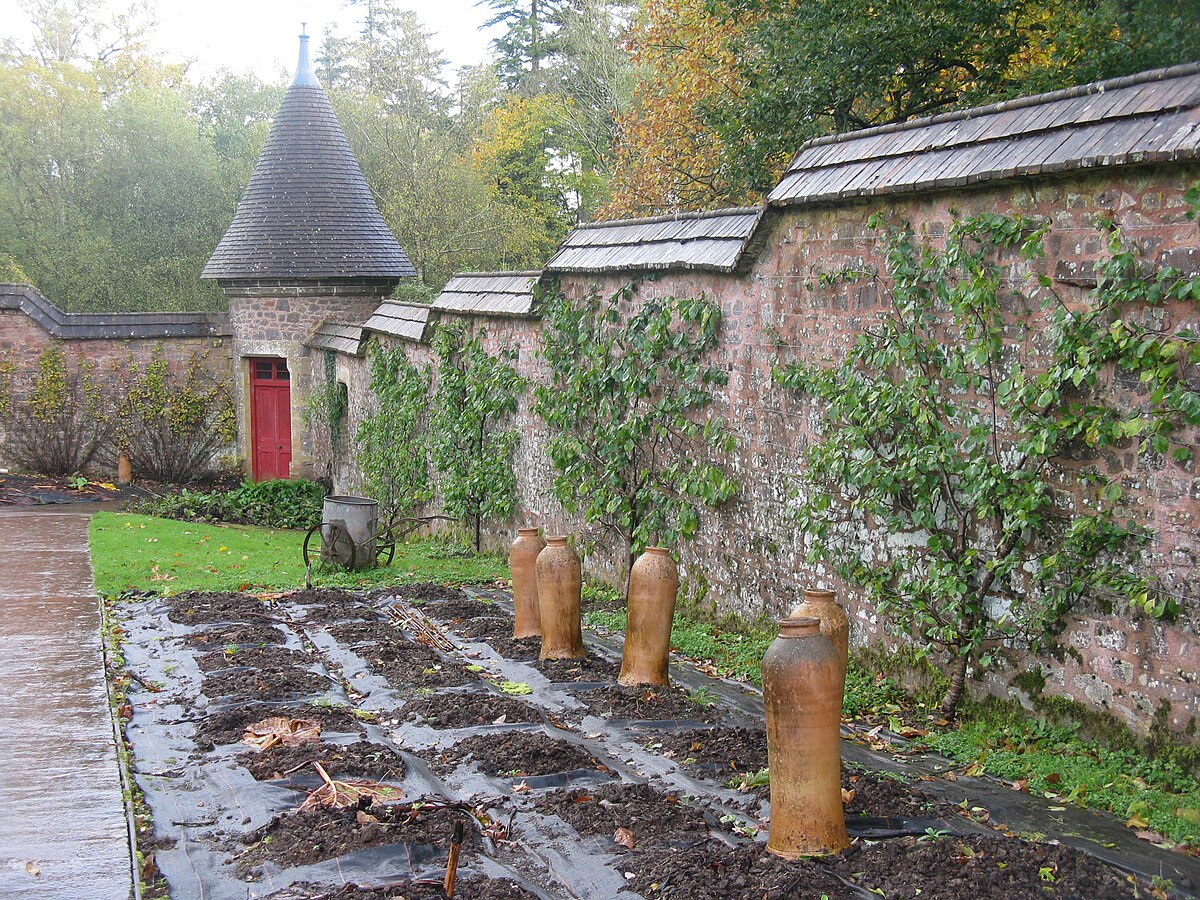
Rhubarb forcing pots From geograph.org.uk
Hardy Fruits from the Open Garden, Orchard, or Fruit-Room. Apples, pears, quinces, medlars, services from the fruit-room. Some plums and morello cherries, carefully preserved on the trees. Some thick-skinned gooseberries, currants, and grapes, preserved on the trees. Some dried fruits of the same sorts on branches hung up in the fruit-room. Almonds, walnuts, chestnuts, filberts from the fruit-room. Sloes from the bushes, wild services, hips, haws, and sometimes a few cloud-berries.
Glasshouse design by Humphry Repton, 1816 from Fragments on the Theory and Practice of Landscape Gardening
Culinary Vegetables and Fruits from the forcing Department. Kidney beans. Potatoes. Sea-kale. Small salads. Parsley, Fennel. Rhuharb. Mushrooms. Pines, winter melons, grapes, strawberries, cucumbers occasionally. Oranges, olives, and pomegranates. Malay apple, loquats, and lee-chees. Yams, and Spanish potatoes.
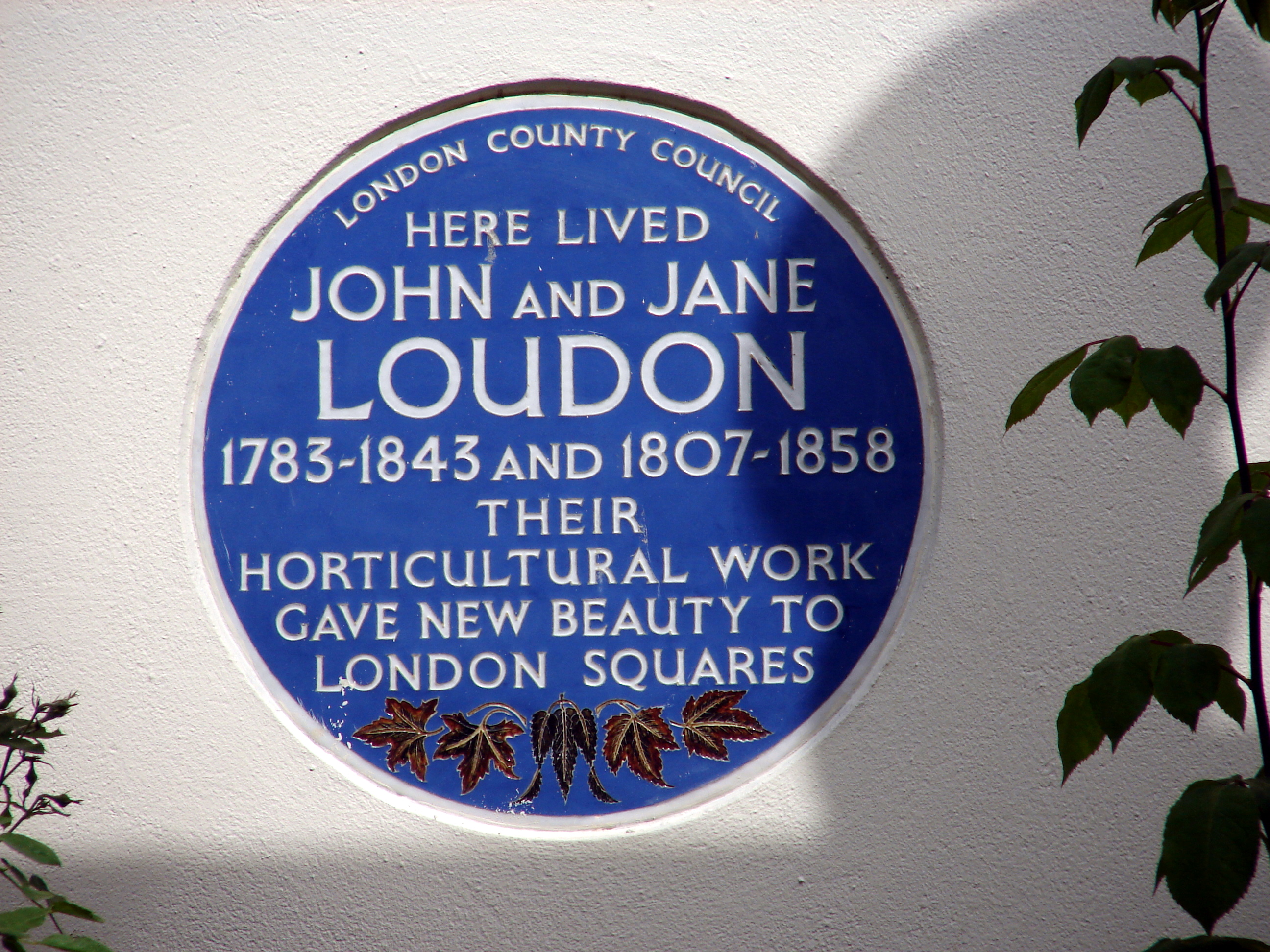
John and Jane Loudon blue plaque at 3 Porchester Terrace, Bayswater, London London County Council Here lived John and Jane Loudon 1783-1845 and 1807-1858 Their horticultural work gave new beauty to London squares
I love old cookbooks–they are a glimpse into a past era. They also often have great recipes. Reading Dorothy Hartley’s wonderful Food in England got me thinking about how there are certain foods and drinks we no longer ask for when dining out, such as:
A joint of beef — we have all sorts of fancy cuts these days.
Johnnycakes — these are actually delicious…they are basically a cornmeal fried bread, meaning like a pancake but with more crunch. Easy to make, too.
Mutton — it is still possible to find lamb in some supermarkets, but mutton has gone completely out of fashion (no old sheep for a low cost meal).
Pig cheeks — still available in some parts of the world, and by all accounts, the best part of the pig. Also called pork cheeks, and this goes along with calf cheeks or beef cheeks, a specialty of the Café Procope, one of the oldest cafes in Paris.
cucumber or parmesan ice cream — it is difficult enough these days to find real parmesan cheese.
watercress and egg sandwiches — these can be found in some tea shops still (thankfully), but watercress can be difficult to come by in many modern supermarkets (at least in the US).
gruel — this is an unlovely name and the food has a bad rep from the Victorian era, but some recipes call for butter, brandy, and enough spices to make this a very tasty mean (it’s basically think oatmeal).
A pot of ale — while ale is still around, it usually comes in cans, bottles, or a pint or half pint. The pint pot has long ago been replaced with glass.
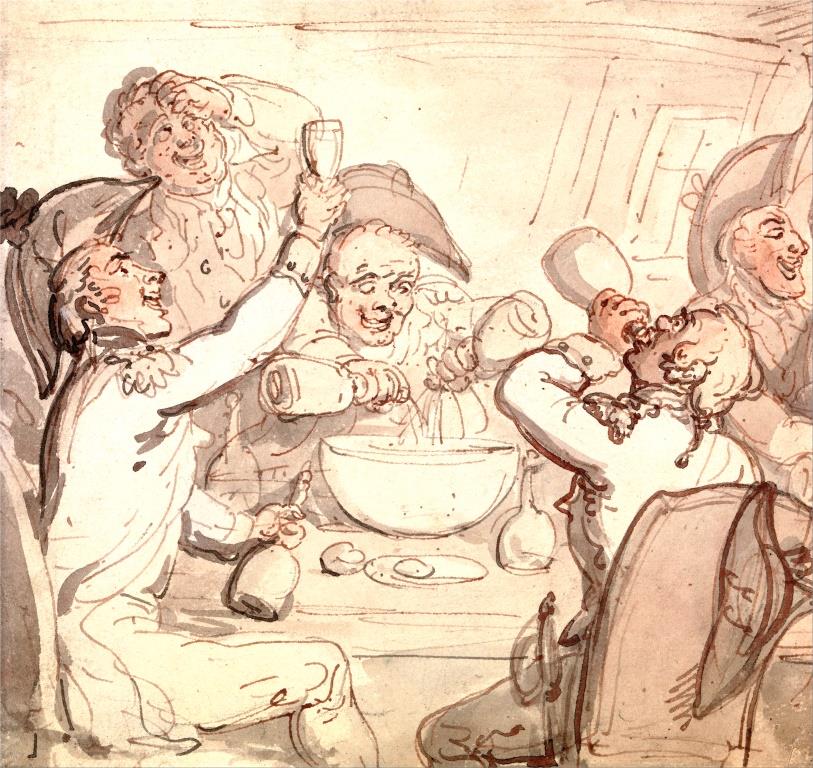
A bowl of punch — this used to be a highly alcoholic drink, but these days folks are more likely to think of punch being a fruity drink without brandy, champagne, rum, and other spirts all mixed together. The bowl is no longer with us either for dipping into with a mug or cup.
A posset — this was a hot drink made from curdled milk and sack or a sweet sherry.
A flip — another drink (more alcohol) usually made with beer, rum, eggs, and heated with a poker (not the one used to stir the fire, but a special poker used just to heat drinks).
A purl — another hot drink made with beer, gin, nutmeg, and sugar.
That is just a few things we generally must make ourselves if we want to sample something from the past (unless we find a place that also likes to keep going with what were once old favorites).
I’ve just finished up the Regency Food and Seasons workshop for Regency Fiction Writers, and there’s always some ephemera that doesn’t quite make it into the workshop. This one is a poster from 1840 showing coffee being grown, what the leaf and bean looked like, roasting, grinding, and serving it up.
We tend to associate tea drinking with England–thanks to the high tea that came along in the late 1800s. But coffee was just as important a beverage–perhaps even more so–in the late 1700s and early 1800s. Coffee houses became all the rage in the 1600s, and continued to be so into the Regency era in England.
Not everyone was a fan of the coffee house (they also would serve drinking chocolate, tea, and punch, and provided newspapers to read). As reported on The Gazette UK website, “On 29 December 1675, a proclamation by the king was published that forbade coffee houses to operate after 10 January 1676 (Gazette issue 1055), because ‘the Idle and Disaffected persons’ who frequent these establishment have led to ‘very evil and dangerous Effects’ and ‘malicious and scandalous reports to the defamation of His Majesties Government’.” Meaning, of course that folks were talking politics. The notice gave warning that, “after the 10th day of January ensuing, to keep any publick Coffeehouse, or to utter or sell .… any Coffee, Chocolet, Sherbett or Tea, or they will answer the contrary at their utmost Perils’. Licences were to be made void, and if continued to trade, given a forfeiture of £5 per month and then ‘the severest Punishments that may by Law be inflicted’.” Naturally, the whole thing went bust, along with a “Women’s Petition Against Coffee” which reported it made men talk too much–it was, of course, yet another political maneuver that lacked popular support.
Folks kept drinking coffee, grocers added the beans to their stock (along with tea leaves), and porcelain manufacture created lovely tea and coffee sets, some as large as 40 pieces including cups, saucers, pots and everything else needed. Silversmiths also did a good trade, such as for this coffee pot, tea pot, creamer and sugar holder from 1800 made by John Emes, with gilt interiors.
Jane Austen wrote in a letter, commenting on her brother’s habits, that, “It is rather impertinent to suggest any household care to a housekeeper, but I just venture to say that the coffee-mill will be wanted every day while Edward is at Steventon, as he always drinks coffee for breakfast.” Coffee would also be brought into the drawing room with tea after dinner, so that guests could have a choice of beverage.
All these thoughts about coffee come–not just due to my being a coffee drinker, for I also love my morning and afternoon tea–but due to a headline that, ‘Your coffee habit could be linked to healthier aging, study finds‘. Good news for those of us who love that morning coffee…and who are getting up in years.
So drink up and enjoy your coffee…and you can still fit in that afternoon tea as well–green tea, after all, is so good for you as well.
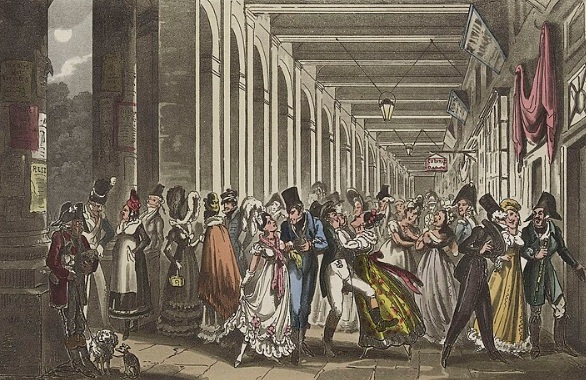
By 1815 the Palais-Royal was already known for being the place to go in Paris not just for a meal, but for gambling, and to indulge in every other vice. John Scott wrote of his visit to the Palais-Royal in 1814: “It is a square enclosure, formed of the buildings of the Orleans Palace; piazzas make a covered walk along three of its sides, and the centre is an open gravelled space, with a few straight lines of slim trees running along its length.”
Scott called it, “…dissolute…wretched, elegant…busy, and idle” The palace began life in the early 1500s as the Palais Cardinal, home to Cardinal Richelieu, but became a royal palace after the cardinal bequeathed the building to Louis XIII. It eventually came to Henrietta Anne Stuart who married Phillipe de France, duc d’Orléans. That’s when it became known as the House of Orléans.
The building was then opened so the public could view the Orléans art collection, and that began the palace’s more public life. Louis Philippe II inherited the royal palace, and the duc renovated the building, and the center garden was now surrounded by a mall of shops, cafes, salons, refreshment stands and bookstores. The Parisian police had no authority to enter the duc’s private property, which meant it became a hub for illegal activity, and the cafés, particularly the Corazza Café, became a haunt of the revolutionaries. During the French Revolution, the duc dropped his title, changed his name to Philippe Égalité and even voted for the death of his cousin to the end monarchy. That didn’t save his own head. But the Palace-Royal continued on.
Scott writes, “The chairs that are placed out under the trees are to be hired, with a newspaper, for a couple of sous a piece; they are soon occupied; the crowd of sitters and standers gradually increases; the buzz of conversation swells to a noise; the cafés fill; the piazzas become crowded; the place assumes the look of intense and earnest avocation, yet the whirl and the rush are of those who float and drift in the vortex of pleasure, dissipation, and vice.”
On the ground floor shops sold “perfume, musical instruments, toys, eyeglasses, candy, gloves, and dozens of other goods. Artists painted portraits, and small stands offered waffles.” While the more elegant restaurants were open on the arcade level to those with the money to afford good food and wine, the basements offered cafés with cheep drinks, food and entertainment for the masses, such as at the Café des Aveugles.
After the Bourbon restoration in 1814, the new duc d’Orléans took back his title and the Palais-Royal kept its reputation for a fashionable meeting place. It was said, “You can see everything, hear everything, know everyone who wants to be found.”
Scott visited Paris during the peace of 1814 and wrote of the shops, “…they are all devoted to toys, ornaments, or luxuries of some sort. Nothing can be imagined more elegant and striking than their numerous collections of ornamental clock-cases; they are formed of the whitest alabaster, and many of them present very ingenious fanciful devices. One, for instance, that I saw, was a female figure, in the garb and with the air of Pleasure, hiding the hours with a fold of her scanty drapery: one hour alone peeped out, and that indicated the time of the day…. The beauty and variety of the snuff-boxes, and the articles in cut-glass, the ribbons and silks, with their exquisite colours, the art of giving which is not known in England, the profusion and seductiveness of the Magazines des Gourmands are matchless.”
The bookshops sold erotic prints along with French classics, and political pamphlets and the restaurants were crowded every evening and night with anyone who could afford the price of a bottle of wine and a fine dinner. Upstairs were the gambling houses and bagnios, and as Scott wrote, “…the abodes of the guilty, male and female, of every description.” Lanters illuminated the crowds that strolled past along with dancing dogs, strolling musicians, singers, and “….Prostitution dwells in its splendid apartments, parades its walks, starves in its garrets, and lurks in its corners.” Scott spoke of “The Café Montansier was a theatre during the revolutionary period…” Just such a café/theater went into Lady Lost, as the place where the heroine Simone, also known as Madame de Mystére, practices her illusions. In March 1815 the Palais-Royal saw more soldiers than it had in ages for Napoleon brought his troops to Paris, chasing out Louis VXIII.
EXCERPT LADY LOST – Jules and Simone dine at the Palais-Royal
Simone stood at the entrance to the Café Lamblin in the Palais-Royal. Even this late, some lingered over their supper. The looking glasses that lined the wall facing the street emphasized the crowd. The other walls, painted white and trimmed with gilt, shone in the light of the Argand lamps set between the silverware and china placed on tables covered with white linen. Ornamental iron stoves warmed the vast space, and four clocks, hung high on the walls, showed the hour as well past eleven. Perhaps three dozen diners remained—gentlemen and ladies, soldiers and courtesans. In Paris, anyone and everyone chose the pleasure of dining out when they had the money to pay the bill. Her mouth watered at the aromas haunting the room—soups and meats, liquors and wines, and the sweet scent of fruit and ices melting into their glasses upon the tables. To her right, behind a barrier and seated on a rise, the lady proprietor took payment from two men who shrugged into their coats and donned hats. Simone handed her cloak to an attendant and waved for Jules to do the same with his outer garments. A waiter appeared, a long white apron around his waist and flapping at his ankles, partly covering a black vest and breeches. With a bow and a snap of his shoes against the marble floor, he showed them to a table and handed over broad, paper menus. Jules stared at the printed sheet. “Not as extensive as that of Le Beauvilliers but far better prices.” Simone glanced around the room. The wine and liquors flowing endlessly—along with coffees—and waiters dodged tables with trays of food and drink. Laughter and conversation rolled across the room. No one in Paris liked to refuse the flow of francs into the hand, not even for so late a meal. She glanced back at Jules. “Prices? Do not be so provincial as to think that is all that matters.” Putting aside his menu, mouth twisted up on one side, he shook his head. Blue eyes gleamed bright. “Oh, but I am just that. A wine merchant who has never before been to Paris, I am amazed by such an extensive printed menu. Order what you wish. I think we can stand the nonsense.” “You may regret that,” Simone told him. She ordered lobster soup from a choice of half a dozen others, cold marinated crayfish, chicken fricassee with truffles in a sauce of leeks and oysters, duck with turnips from an array of roast birds, a side dish of asparagus and one of early peas, a dessert of cheese and nuts, and a bottle of Volney, which Jules sipped and sent away, ordering a Latour instead, which indeed tasted better but would take more coins from his purse. Dishes came and went. Jules kept up an astonishing chatter about Paris, the food, droll comments on the other diners, and everything but what lay between them. She pushed at the peas on her plate with her knife and glanced at Jules. “You manage to say a great deal without saying much of anything.” He held still as only he could, studying her, eyes a sharp blue in the glow of the Argand lamps. “The art of polite discourse. It is second nature. Would you care for more of the duck? I must say, they have a pleasant way with it. The skin is crisp and the taste a delight. They must feed them good corn before they come to the kitchens. Then you may tell me if you think Henri had any part in poor M’sieur Breton’s demise.” Putting down her knife, she propped one elbow on the table and cupped her cheek with one hand. “That is…no, tell me first, what transpired with those men who took you up? Why do you not speak about that?” He pushed at a slice of duck with his fork. “Will you in turn tell me if your brother would have jumped for the chance to meet up with the not-so-good duc in my place?” Straightening, she smoothed the napkin on her lap. “Do we talk of such things here? Where others might listen?” A woman’s laugh pulled her attention to a table with four soldiers and two ladies whose dress—or lack of such a thing—proclaimed their status as those who sold their favors. Jules waved his wine glass at the room. “Everyone else is bent on pleasure of one sort or another. We might be the only sober souls in this fine establishment.” She traced a fingernail along the edge of the tablecloth. “Henri…he would not…no, M’sieur Breton was his friend. A good friend.” “Had he known the man long?” “No, but that is Henri. He charms everyone quickly. We only met the m’sieur after we come to Paris. Now do I get a question?” “It has gone beyond coincidence that your brother is a friend—or perhaps I should say was—friend to the late M’sieur Breton. Now we have the duc embroiled in events—the Butcher of Lyons you named him—and it all has me wondering if your parents might have lived in that charming city. Perhaps during the Revolution? That automaton reveals also that your father was a man who made expensive clockworks for those with money.” With a small shrug, she took up her wine. “What would you have me say?” “You may act as casual as you wish—you are practiced at that with your stagecraft—but I will have the story. Consider it a fair exchange for dinner.” “What of payment in an answer for an answer? I am curious, too, and have questions. Why are you not in London? Do you have no wife, for you keep only the mistresses?” “Multiples is it? You think perhaps I have one woman for each day of the week, or perhaps only one for each season of the year? They are expensive things, and I have no wish to beggar my estate for any such entanglements.” “Then you have casual liaisons? Was that true of the woman you once wanted to marry as if…for one that, you sound as if you don’t want to speak of her at all?” “My past has no bearing on the incidents of tonight. It is yours that stirs my interest. May I serve you more of the chicken? You may then tell me of this tie between yourself and Lyons, for you speak of the past as if it is far too present, and the excesses of Madam Guillotine’s rampage certainly reached everywhere in France. Come now—a straight question and a straight answer. Did the Butcher of Lyons touch your family?” “The past can haunt us all—can it not? What is it you really do in London? Do not the ladies interest you?” “Ah, now you make me into a gentleman who spends all this time only with other gentlemen. I’ve had other things to occupy me—the world has been sorely troubled of late, and ladies…courting takes a great deal of work. There are rides and walks and dancing to be done. Flowers sent, and if you get that wrong they either wilt too quickly or any real interest does the same. Turn your back but once, and the lady is off on some other man’s arm. Now, what of you? I expose myself, but you remain the lady of mystery? Since you ask it of me, I shall be forward as well and ask why you are unmarried?” Holding up her hand, she ticked a count on her fingers. “I do not plan to marry a soldier, and look around just now—that means most men in France. Second…actors. I meet many and I follow Maman’s advice and leave them to flirts only for it never ends well.” “That does not surprise overmuch.” “Third…” She wiggled her fingers and picked up her fork again. “Third is that I do not want to keep a shop, or run a tavern, and even that sort thinks a woman who goes onto a stage is not respectable, but I am!” He reached for one of the plates to serve himself more asparagus that had come out with an excellent white sauce that did tempt her, but she would not allow him to divert her focus. She put her hands in her lap. Glancing at her, he put down the asparagus. “If you will not finish this, I shall. Will you have more of anything else?” She plucked a green spear from the plate and waved it at him. “Answers. Why are you not in the army? Is not every man fighting on one side or another? Why are you really here? We are back to you talking around and about. Do you think I do not know distractions? That is the principle of sleight of hand.” She bit into the asparagus, then licked her fingers. When she held up her hand again, a coin glinted in her finger tips. With a quick move of the other hand, the coin vanished, and she showed him bare palms. Putting down his fork and knife, he fixed his stare on her. Heat bled into her face, but she met that direct gaze of his. For a moment, he pressed his mouth tight and hesitated as if making up his mind about something. Finally, he threw his napkin onto the table. “Very well, if you must know, you must. As to a uniform, it was considered, at least by me, but responsibilities kept me from doing more than that, along with…well, at the time—and this was a long time ago—the woman I wished to court had vapors at even a mention of something so vulgar as fighting and armies. Odd, really, considering she eventually deserted her husband to run off with a sailor. Actually, a captain at the time, although not in the British Navy. However, I also have wretched aim, and while I look very good on a horse, I am not given to charging about. I prefer to think things through and take my time, and that is a quality I found I could put to use elsewhere.” “Bah—you still tell me nothing. What do you mean, ran off? She is alive still? And she was married when you wanted to court her, or she did marry elsewhere after the courting?” “We slip from the more pressing topic at hand—that of your brother’s involvement in a death.” She stiffened. “Do you tell me…did you…? This woman, she is—is no more?” “Please do not speculate. Far too much of that has dogged me over the years. What I will say is that seventeen is a very stupid age, one I am grateful to have outgrown. Also, her husband suffered more than I at that time. But the situation as well as my family history stirred up old talk about my family, for scandal dogs us like hounds on a high scent, even when I should rather leave all of it far behind.”
Every now and then I find a word that sends me off on a research hunt, and this led me to drink names. While we think of “cocktails” as a modern invention, the word dates back to at least 1798. Etymology.com has cocktail as a “drink made from water, sugar, spirits and bitters” first attested 1798.” So the idea of a drink mixed with all sorts of things is nothing new (Ancient Greeks and Romans mixed all sorts of things into their wines). However, my stumbling across a ‘purl’ being drunk by a man about to get onto a coach on a cold day led me to these other wonderfully named drinks that were often to be found in an inn or even sometimes sold on the street to the common folk in the late 1700s and into the 1800s.
Buttered Beer – this was a great way to add calories to ale or beer to make it into almost a meal. It obviously has butter in it, but might also have eggs and spices and was served hot (must have been lovely on a cold, wet day – an old recipe is here).
Dog’s Nose – so called for it was black and cold and one of my favorite names. It was porter, sugar, gin and nutmeg. However, some recipes call for it being warm, and modern recipes generally use brown sugar (a recipe is here).
Flip – this would be any mixture of beer or ale, mixed with rum or brandy, sugar, spices, and usually eggs. Every inn would have their own version, and the name comes from “flipping” or heating it with a “flip dog” also called a toddy iron (it was like a hot poker) (a recipe can be found in William Kitchner’s 1822 The Cook’s Oracle).
Gin-Twist – gin was usually the hard drink of the lower class, and was often watered down (and given to children for toothache) The twist is gin, lemon, and simple syrup. The word ‘gin’ comes from the Dutch genever and Old French génevrier for juniper (and a recipe is here).
Half-and-Half – this was a way to have the good, expensive beer mixed with something cheaper (as in half ale and half two-penny). In the late 1800s, it became a ‘black and tan’ (no recipes since you just mix two beers or ales or porters, but more information is here).
Lambswool – a cider with a baked spiced apple included, a traditional wassail drink in parts of England (a recipe is here).
Perry – cider made from pears (links here to where you might buy some and it sounds lovely).
Purl – Beer or ale with a shot of gin, often with wormwood or served hot as a means to keep warm (several recipe variations here).
Rum and Milk – gin and milk also shows up, which sounds even worse to me, but rum and milk are at the core of eggnog, so it must work, and milk punches also go far back in time (more on gin and milk is here and on milk punches).
Saffron Bitters – Bitters were sometimes used as a hangover cure (recipes here, and the saffron bitters and tonic water sounds rather good), but on a side note “tonic water” wasn’t around as a phrase until around 1850s, but as of 1789 Schweppe was advertising soda water and seltzer, along with sea water as a purgative. Quinine was also known about and sometimes added to “fizzy water” (fizz in a drink dates to 1812, but fizzy dates to 1885).
Saloop – Richard Valpy French in Nineteen Centuries of Drink in England notes it as “…a greasy-looking beverage, sold much on stalls in the early morning. It was prepared from a powder made of the root of the Orchis mascula, and from the green-winged meadow orchis….like porter, to be a favourite drink of porters, coal-heavers, &c. It is said to contain more nutritious matter in proportion to its bulk than any other known root…” (French’s book can be found here).
Shrub – like punches, all sorts of variations exist but this is a drink typically made with rum or brandy, sugar, and the juice and/or rinds of fruits, particularly citrus (recipes here, along with punch recipes).
Spruce Beer – this is beer obviously flavored with spruce needles, which can be purchased in a dried form today (a Jane Austen recipe is here)
Tewahdiddle – and isn’t that a great word! William Kitchner writes this is “a pint of table beer (or ale, if you intend it for a supplement to your “night cap”), a table-spoonful of brandy, and a tea-spoonful of brown sugar, or clarified syrup; a little grated nutmeg or ginger may be added, and a roll of very thin-cut lemon-peel.” (see Flip for a link to Kitchner’s The Cook’s Oracle.)
This October, I’m doing a workshop on Estate Workers for Regency Fiction Writers. One thing that turned up when researching the workshop was the growing importance of tea, sugar and milk in the diet of the average person in England during the long Regency era.
We tend to think of tea in Georgian England as a luxury item, but while it started off that way, prices were falling by the late 1700s. The teapot at left dates to 1780 and shows what would become the ‘Brown Betty’ style of Staffordshire pottery, with its dark Rockingham glaze. This is the sort of teapot that could be found in a middling class household, which would include some estate workers. It is far from the highly decorated tea and coffee sets created for the upper class by Wedgewood, Doulton, and others who sought royal patronage.
As noted, like coffee and chocolate, tea had started off an expensive luxury. Duties were put on it because of this, which meant in the 1600s on to the late 1700s it was a main good for smugglers. Random Bits of Fascination notes, “Smuggled tea often came from Holland where it might be purchased for as little as 7 pence per pound.” That means smuggled tea was already drifting down into the middling classes.
The Commutation Act in 1784—pushed forward on the advice of Richard Twining of the Twinings Tea Company—reduced tea taxes from 119% to 12.5% of the price. It was no longer worth smuggling, and tea drinking spread to the growing middle class and into the working class. Tea became available in multiple prices with different grades available. Some household also provided a tea allowance for servants, and tea leaves would also go from the drawing room, to the housekeeper and on down the line of servants, with inside servants first, and then outside servants.
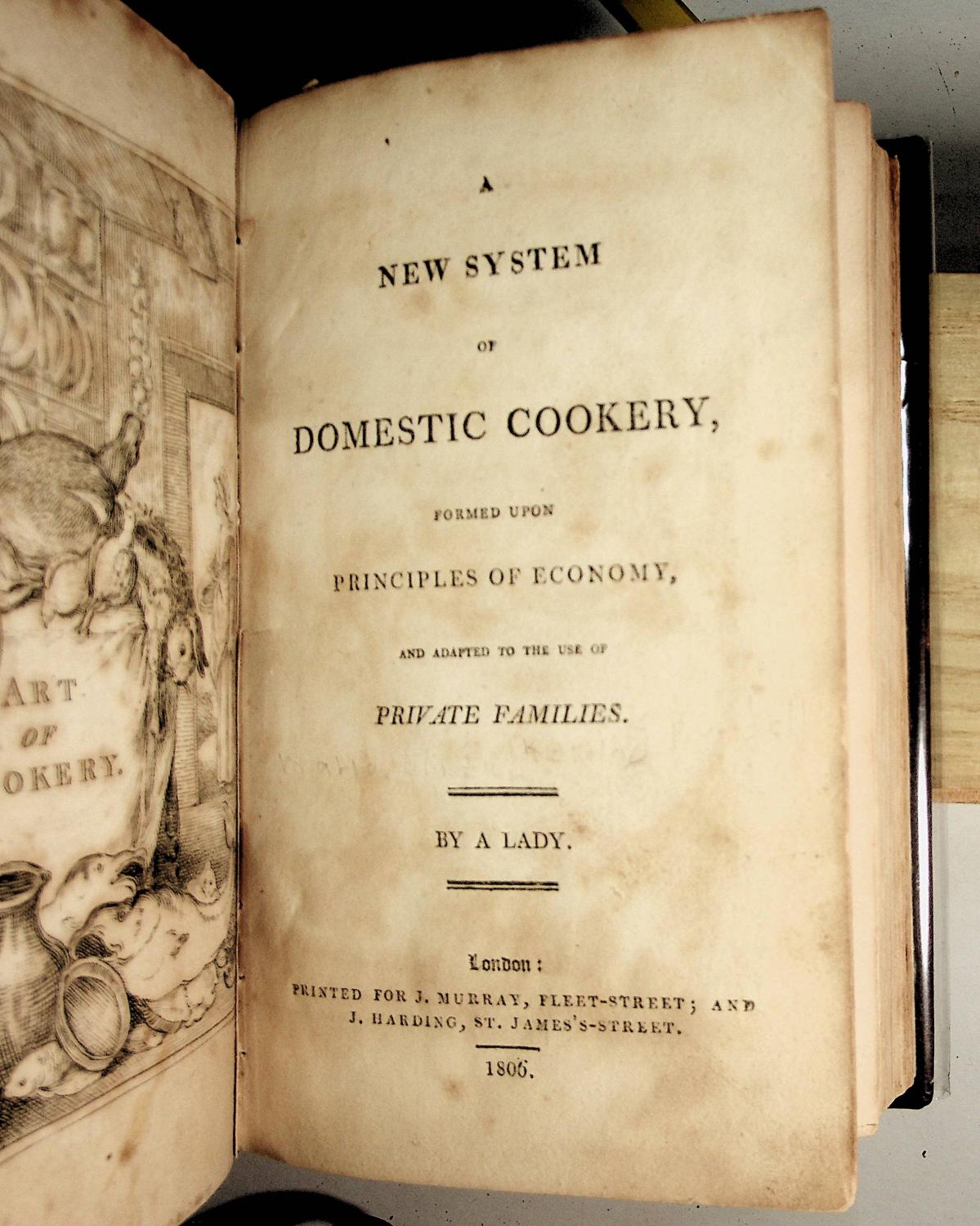
A New System for Domestic Economy, published in 1823, speaks to, “The universal use of tea, as an article of diet…” and devotes multiple pages to economical types of tea and efficient brewing. It notes, “…the best Green Hyson, at about fourteen shillings per pound…the best Black Souchong at about twelve shillings…the Souchong, since the common leaf at six shillings…” This shows the variety in prices. It also says that two ounces of tea per person per week is a way to economize, with sugar at three quarters of a pound over the week.
Tea shows up in the tightest of budgets at 7d and a ha’penny for 2 oz. (bought at 5s per pound) when the family income is only 24s a week. Lesser incomes than that do not include tea in the proposed budget. At an income of 30s a week, the budget allows a quarter pound of tea for 1s 3d, with sugar for the week also costing the same shilling and thuppence. Milk is only 7d and a ha’penny for the week This shows how tea could be affordable for anyone in the working class, including those on an estate with good wages.
As noted in the paper ‘Importing sobrie ‘tea’: Understanding the tea trade during the Industrial Revolution’ by Kabeer Bora, “Sugared tea and white bread became the nutritional mainstays, it supplanted the traditional produces of milk, cheese, ale, meat & oats.” Tea and sugar begin to be drunk by all but the poorest of the poor, with tea, milk and bread being seen as mainstays of the English diet. This is pushed even more so by factory work that showed up in the Regency era.
Bora goes on to write, “A report of the Factory Enquiries Commission in 1834 showed that many mill owners were allowing workers tea breaks of 15 and 30 minutes in Derbyshire and Lancashire. This break was given to them between lunch and closure (Factory Enquiries Commission, 1834).” Tea, with sugar and milk, is credited with increased calories in the average diet, and with improvements in health overall. The English habit of weak ale and small beer still would continue, but tea would go on in the Victorian era to even become the name for the working class evening meal.
To put all of this into a bit of context in the modern world, today we generally buy tea in bags (not invented until the 20th Century) with a box of tea bags being only around 1.4 ounces in total and holding 20 to 30 tea bags. If you are thrifty, you can get two or three cups from one bag, so 2 ounces of tea for about 7d could go a long way, and a pound of tea, or 16 ounces, is a considerable amount of tea.
If tea could not be bought, there was the ability to make a tea from the wild fruits, herbs and flowers from any estate garden (if you have horses, an alfalfa–more commonly called lucerne in England– while not the best for a tea, can be made up).
While the old standbys of ale and small beer as drinks for estate workers continued on through the Regency–particularly as the main drink in the fields during harvest time, the idea of a cuppa tea in the evening or early morning was growing. And more on Estate Workers of the Regency era will be in the workshop.
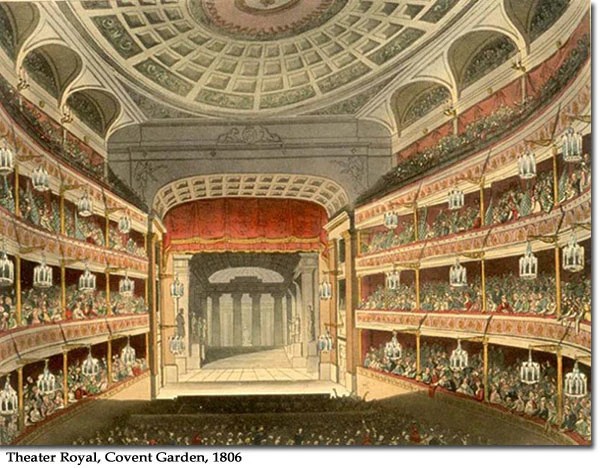
It is easy to think of Regency England’s upper class being full of starch–going to the opera and concerts for classical music and to the theater for Shakespeare and high-brow plays. However, the pantomime was big business and drew in an audience from all classes. The tradition of a Christmas ‘panto’ was already firmly entrenched by the Regency era. In many ways, the pantomime was the forerunner of the modern day stage musical due to Parliament’s Licensing Act 1737 which limited spoken drama to patent theaters–meaning the three Theater-Royals of Drury Land, Haymarket, and Covent Garden. The Theatrical Representation Act 1788 relaxed this to license occasional dramatic performances that lasted up to 60 days, for such theaters as the Lyceum, but most theatrical runs were of a few weeks, or as even as little as a week or two in the countryside.
Since pantomimes were all about comic songs and dance, colorful costumes, and spectacular effects (characters flying in or out, water scenes, falls and leaps, and all manner of action) and a good one drew in paying customers, this was the bred and butter of theaters such as Saddler Wells where Joseph Grimaldi often performed. The pantomime was a huge crowd pleaser, but audiences also expected great performances, and this is where Joseph Grimaldi becomes famous.
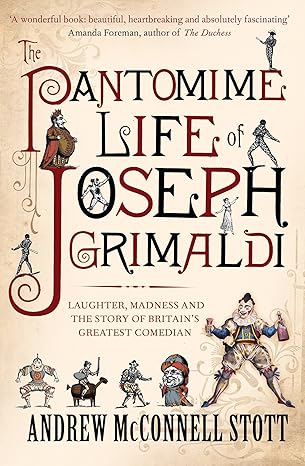
As noted by the description of the book, The Pantomime Life of Joseph Grimaldi: Laughter, Madness and the Story of Britain’s Greatest Comedian Paperback by Andrew McConnell Stott, “…Joseph Grimaldi (1778-1837) was the most celebrated of English clowns. The first to use white-face make-up and wear outrageous coloured clothes, he completely transformed the role of the Clown in the pantomime with a look as iconic as Chaplin’s tramp or Tommy Cooper’s magician. One of the first celebrity comedians, his friends included Lord Byron and the actor Edmund Kean, and his memoirs were edited by the young Charles Dickens.” Stott’s book is excellent not just for his details about Grimaldi’s life, but for details of the theater, both the performances and what went on backstage.
Pantomime is still popular in England, and Mother Goose is again on the London stage (you can catch a look at a modern version on YouTube), but opened as ‘Harlequin and Mother Goose or The Golden Egg’ on Boxing Day in 1806 with Grimaldi playing the Clown to rave reviews. (A summary of that panto can be found here, but all pantomimes used familiar characters, usually those from folk or fairy tales, and often with Harlequin being the star, or he was until Grimaldi’s Clown made that role the main draw.) Even the larger patent theaters put on a pantomime to pull in audiences–the Mother Goose pantomime penned by Thomas Dibbin premiered at Covent Garden.
Stott’s book is excellent for anyone interested in theater or the Regency era–the details are marvelous. Other articles:
In this modern era, we’re accustomed to a huge variety of foods year ’round—we have freezers for storage, air shipment to move food from one hemisphere to the other in any season so the usual fruits and the expected veg are always in stock, and we always have canned good. This was not the case in the Regency-era England.
While there was some cold storage in ice houses, and meat could be hung to be aged, the art of food storage was time consuming. It required skill, space, and money enough or land enough to purchase or grow the food. The most common means to store food were the age-old ways to pickle, salt, or dry. Canning food wouldn’t really take off until the mid 1800s—and would start off being an ordeal to get any sealed-with-lead can open. This meant the seasons mattered when it came to food.
For meats, besides beef and mutton which the English always seemed to have, there might be what was called “house-lamb” or lambs born late in the season and kept inside. Pork was a staple for many, as pigs were low cost to raise. Wild boar could also be had in the country-side. Venison might be served, if you had the land to hunt, and it was no longer held that all the deer belonged to the king. Goose was cooked for more than just the Christmas meal, and there would be turkey, pigeons, chicken, snipes, pheasant, duck, guinea-fowl, woodcock, larks, guinea-foul, and grouse to eat. Dotterals, or a type of plover, could be eaten (also came to mean an old fool), and widgeon, a fresh-water duck, another word with a double-meaning, coming to mean someone feather-brained.
Rabbit came into season in January, and in February there might be duckling, and chicken is noted as by Mrs Rundell in her book Domesty Cookery as “are to be bought in London , most, if not all, the year, but are very dear.”
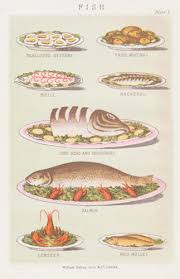
The months ending in “R” held that these were the months for shellfish, and cold months meant seafood would be kept cold as it was transported, so long as the roads weren’t blocked by snow or mud. Cod, turbot, soul, sturgeon, gurnets, dories, and eels joined the list of fish in season in December. Gudgeon might mean a person easily fooled, but it was a small whitefish often used for bait, and was eaten.
Lobster came into season in January, as did crayfish, flounder, plaice, perch,smelts, whiting, prawns, and crab. Oysters were very popular with the English, with oyster houses in London. Oysters were cheap, plentiful and even sold on the street.
Winter was the time for root vegetables such as: leaks, onions, shallots, carrots, turnips, parsnips, beets, and potatoes. Hardy vegetables—and those from hot houses—included cabbage, spinach, cress, chard, endive, cress, lettuces, and herbs. Herbs could also be dried. Some of the vegetables that are not so common now were in season in the winter, including: skirrits, a white root vegetable similar to a parsnip; scorzoneras or black salsify, which is said to taste similar to asparagus or to oysters; cardoons or artichoke thistle, which tastes like an artichoke but you eat the stems.
Nuts are another crop easily stored, and were gathered in September. Walnuts and chestnuts would be available in winter and are native nut trees in England, along with hazelnuts. Acorns from oaks were consider a food fit only for pigs. Beech trees also produced a nut, but they’re tough and more work than considered worth the time. Other non-native nuts were not as popular and are not noted in many recipes from the era, although they could always be imported by those with the money and interest.
Forced asparagus added a delicacy to the usual winter vegetables, and could start to arrive in later winter. Stored apples, pears, and preserved summer fruit appeared on the better, richer tables. Besides the dried or stored fruit, the rich might have hot houses that might produce oranges, grapes, and pineapples, which had arrived in England in the 1600s. There were also medlars and bullace. The medlar is a member of the rose family and produces a brownish fruit that appears in winter and which can be eaten raw like an apple or used in recipes. It has been cultivated since Roman times. The bullace is another member of the rose family and is also called a wild plum. It can be used to make bullace wine, or can be used for pies, but was out of season by December.
By late winter, preserved fruits would be running low in all but houses with large orchards or those with greenhouses that could force fruits. Stored apples and pears would have to serve for families and guests until the expensive forced strawberries of February appeared.
December was also the month when all events seem to lead up to Christmas. Around the third century there was an attempt to fix the day of Christ’s birth by tying it to a fesival of the Nativity kept in Rome in the time of Bishop Telesphorus (between 127 AD and 139 AD). While it was believed the Nativity took place on the 25th of the month, which month was uncertain and every month at one time or another has been assigned as Christ’s mass. During the time of Clement of Alexandria (before 220 AD) five dates in three different months of the Egyptian year were said to be the Nativity. One of those corresponds to the December 25th date. Although various dates were questioned for several generations by the Eastern Church, the Roman day became universal in the fifth century.
First reports of people bringing holly and pine branches into their homes at Christmas-time date from the late Middle Ages. Symbols of life in the dead of winter were placed on windows, mirrors, and in vases, and may have served to keep evil spirits away. Over time, this mythical function of the greens became simply decorative. Evergreen ropes (garlands) were draped over staircase railings, mantels, picture frames, and along ceilings. Fearful that dry branches would catch fire from oil lamps or sparks from the fireplace or heating stove, families waited until almost Christmas Eve to hang the garlands.
Christmas cakes, puddings and mince pies are traditional foods of the season. According to one variation, plum pudding—an old English holiday treat—gets its name not from plums, but from the process of “plumming” meaning raisins and currants are plumped up by warm brandy then molded with suet and a bit of batter.
According to the Oxford Companion to Food, “…Christmas pudding, the rich culmination of a long process of development of ‘plum puddings’ which can be traced back to the early 15th century. The first types were not specifically associated with Christmas. Like early mince pies, they contained meat, of which a token remains in the use of suet. The original form, plum pottage, were made from chopped beef or mutton, onions and perhaps other root vegetables, and dried fruit. As the name suggests, it was a fairly liquid preparation: this was before the invention of the pudding cloth made large puddings feasible. As was usual with such dishes, it was served at the beginning of the meal. When new kinds of dried fruit became available in Britain, first raisins, then prunes in the 16th century, they were added. The name ‘plum’ refers to a prune; but it came to mean any dried fruit. In the 16th century pudding variants were made with white meat…and gradually the meat came to be omitted, to be replaced by suet. The root vegetables disappeared, although even now Christmas pudding often still includes a token carrot…By the 1670s, it was particularly associated with Christmas and called ‘Christmas pottage’. The old plum pottage continued to be made into the 18th century, and both versions were still served as a filing first course rather than as a dessert…”
Mince pies made from mincemeat, which originally had meat in it but shifted from a savory to a sweet, were another traditional fare, with the tradition being that everyone in the household should stir for luck. From the Middle Ages and on it became common to stretch the meat in the pie or mincemeat by adding dried fruit. The reduction in meat continued until only beef suet was left in the mincemeat.
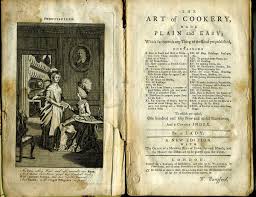
In The Art of Cookery Made Plain and Easy in the mid 1700s, Hannah Glasse gives this recipe:
“Take three Pounds of Suet shread very fine, and chopped as small as possible, two Pounds of Raisins stoned, and chopped as fine as possible, two Pounds of Currans, nicely picked, washed, rubbed, and dried at the Fire, half a hundred of fine Pippins, pared, cored, and chopped small, half a Pound of fine Sugar pounded fine, a quarter of an Ounce of Mace, a quarter of an Ounce of Cloves, a Pint of Brandy, and half a pint of Sack; put it down close in a Stone-pot, and it will keep good four Months. When you make your Pies, take a little Dish, something bigger than a Soop-plate, lay a very thin Crust all over it, lay a thin Layer of Meat, and then a thin Layer of Cittron cut very thin, then a Layer of Mince meat, and a thin Layer of Orange-peel cut think over that a little Meat; squeeze half the Juice of a fine Sevile Orange, or Lemon, and pour in three Spoonfuls of Red Wine; lay on your Crust, and bake it nicely. These Pies eat finely cold. If you make them in little Patties, mix your Meat and Sweet-meats accordingly: if you chuse Meat in your Pies, parboil a Neat’s Tongue, peel it, and chop the Meat as finely as possible, and mix with the rest; or two Pounds of the Inside of a Surloin or Beef Boiled.”
Gingerbread cakes were also a common holiday treat that had come to England from Germany. Seven Centuries of English Cooking gives this recipe adapted from Hannah Glasse’s book:
1 lb. (3 1/3 cups) Flour
1 Tsp. Salt
1 Tbsp. Ground Ginger
1 Tsp. Nutmeg
6 oz. (3/4 cup) Butter
6 oz. Caster (confectioner’s) Sugar
3/4 lb. (1 cup) Treacle (or Corn Syrup)
2 Tbsp. Cream
(Note: She gives tablespoon as Tabs, but this has been changed here to the more common tbsp.)
Eggnog possibly developed from a posset, or a hot drink in which the white and yolk of eggs were whipped with ale, cider, or wine. The nog in the name came from a noggin, or a small, wooden mug. It was also called an egg flip from the practice of rapidly pouring the drink to mix it, or flipping the drink. It was a rich drink with milk, egg, brandy, madeira or sherry and fit for any celebration but came to be associated with Christmas.
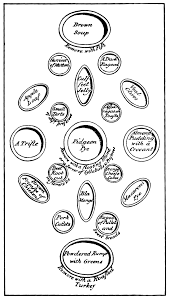
Trifles are also traditionally associated with Christmas, although they might be had for any special occasion in the Regency, or any elegant dinner. Elizabeth Raffald included a trifle recipe that is very modern sounding with macaroons, wine, cream, and sugar. The difference comes from adding cinnamon and “different coloured sweetmeats” which are not generally found in modern trifles.
Another English tradition were sugarplums, a confection traditionally made from sugar-coated seeds. The earliest mention dates to 1668. The Oxford Companion to Food also lists comfits as, “…an archaic English word for an item of confectionery consisting of a seed, or nut coated in several layers of sugar…In England these small, hard sugar sweets were often made with caraway seeds, known for sweetening the breath…”
Cakes of all shapes and sizes were included at festive holiday rituals long before Christmas. Ancient cooks prepared sweet baked goods to mark significant occasions. Many Christmas cookies we know today trace their roots to Medieval European cake recipes. According to foodtimeline.com, “By the 1500s, Christmas cookies had caught on all over Europe. German families baked up pans of Lebkuchen and buttery Spritz cookies. Papparkakor (spicy ginger and black-pepper delights) were favorites in Sweden; the Norwegians made krumkake (thin lemon and cardamom-scented wafers).”
Foodtimeline.com also notes, “The fruit cake as known today cannot date back much beyond the Middle Ages. It was only in the 13th century that dried fruits began to arrive in Britain…Early versions of the rich fruit cake, such as Scottish Black Bun dating from the Middle Ages, were luxuries for special occasions. Fruit cakes have been used for celebrations since at least the early 18th century when bride cakes and plumb cakes, descended from enriched bread recipes, became cookery standards…”
Households also celebrated not just according to the season, but also to the customs of the area. In the Regency, local customs in the countryside might well be used for the celebrations.
For one of my books, Under the Kissing Bough, I needed a Christmas wedding and customs that suited the countryside around London. In ancient days, a Christmas wedding would have been impossible for the English Church held a “closed season” on marriages from Advent in late November until St. Hilary’s Day in January. The Church of England gave up such a ban during Cromwell’s era, even though the Roman Catholic Church continued its enforcement. Oddly enough a custom I expected to be ancient—that of the bride having “something borrowed, something blue, and a sixpence in her shoe”—turned out to be a Victorian invention.
English Christmas customs are those carried down through the ages: the Yule log from Viking winter solstice celebrations, the ancient Saxon decorations of holy and ivy, and the Celtic use of mistletoe on holy days, which transformed itself into a kissing bough. The wassail bowl—a hot, spiced or mulled drink—was another tradition left over from the Norse Vikings.
Celebrations continued to mix tradition and religion when the Twelfth Night feast arrived on January 5, which combine the Roman Saturnalia with the Feast of the Epiphany, when the three wise men were said to have paid tribute to the Baby Jesus.
In Edinburgh, Scotland, Hogmanay is the special New Year’s celebration. But Twelfth Night celebrations for the Epiphany (when the wise men came to see the baby Jesus) are the big event. This is followed by Plough Monday, which is the traditional start to the new agricultural year. Since there’s not much work for a farmer in the winter, plough men would blacken their faces and drag a decorated plough through town asking, “Penny for the ploughboys.”
Molly dancers (a black faced Morris dancer) also came out in East Anglia on Plough Monday. And many towns, such as Whittlesey, had the tradition of men or boys dressing up as Straw Bears to add to the entertainment.
Shrove Tuesday fell in February (the last day before Lent begins on Ash Wednesday). Traditionally, Shrove Tuesday was the day to indulge, so pancakes were a traditional food as the butter, fat and eggs might all be things to give up for the forty days of Lent.









 Shannon Donnelly's Fresh Ink