Archives

Regency Corinthians, Dandies, Rakes and Young Blades

In Regency romances these days, it seems as if every gentleman back then was a rake. But there were actually several sets to which a gentleman might  belong.

Almost all Regency gentlemen gambled, drank, played hard, hunted, went shooting and generally indulged in excess, carnal and otherwise, following a tone set very much by the Regent.  The Prince turned 49 in 1811 when he became Regent of England, putting him past the age where either “young” or “blade” could be aptly applied to him, but there were other men gentle by birth—though not necessarily by manner—who looked to belong to certain distinct fashionable sets which excelled in specific areas.

Lord Byron

Lord Byron in Turkish Dress

It can be difficult to tell the difference between these different set, and quite often a gentleman had overlapping interests.  There were rakes who were good enough sportsmen to be called “Corinthians,” and Corinthians who also belonged to the dandy set by virtue of the care they took with their dress.

Lord “Beau” Petersham was one such man.  Born in 1780, Charles Stanhope, Viscount Petersham, later became the Earl of Harrington in 1829.  He was said to resemble Henry IV, and he emphasized this by growing a small, pointed beard. He designed his own clothes and made famous the Petersham overcoat and the Harrington hat. He was also noted for his brown coach, clothing, and servant’s livery—a color said to have been chosen for his devotion to a widow named Brown.  However, in 1831 he married a Covent Garden actress named Maria Foote who was seventeen-years his junior. His was also noted for his snuff and tea mixes, and Gronow said of his sitting-room that, “…all round the walls were shelves, upon which were placed tea-canisters, containing Congou, Pekoe, Souchong, Bohea, Gunpowder, Russian, and many other teas, all the best o the kind; on the other side of the room were beautiful jars, with names in gilt letters, o finnumerable kinds of snuff….”

Petersham owned a snuff boxes for each day of the year and according to Priestley in The Prince of Pleasure, took care to “…choose one that suited the weather, not risking a cold by using a light snuffbox in an East wind.”

Lords Alvanley and Sefton were other examples of dandies who also had sporting interests.

William Arderne, Baron Alvanley, was famous for his wit, his dinner parities, his dress and his eccentricities.  He insisted that an apricot tart be on the sideboard, no matter the time of year, after he was served a cold one that he liked. He also put out his candle by throwing it across the room—with his valet wisely remained alert in case it should start a fire and have to be put out. A hard rider to hounds, Alvanley was one of the best liked men of his set.

Lord Sefton, William Philip Molyneux, was a cousin to Petersham. Society wits dubbed him “Lord Dashalong” for his driving style, and his matched bays were quite famous.  He rode in steeplechases and was so fond of coursing greyhounds against each other as a sport that he devoted part of his estate to raising rabbits for the chase.

Even with examples of gentlemen who had diverse interests, there are still distinctions that can be made between these various sets.  Byron is quoted as having said, “I like the Dandies, they were always very civil to me.”  This shows that while the distinctions between these sets were fine, they existed.

George Brummell

George Brummell (1815)

To see this illustrated, one can look at the most famous of dandies, George Bryan “Beau” Brummell who led the dandy set for a number of years.  As Captain Gronow states, “All the world watched Brummell to imitate him, and order their clothes of the tradesman who dressed that sublime dandy.”  He also reports that, “The dandy’s dress consisted of a blue coat with brass buttons, leather breeches, and top boots; and it was the fashion to wear a deep, stiff white cravat, which prevented you from seeing your boots while standing.”

In Life in Regency and Early Victorian Times, Chancellor marks the world of the dandies as “…that portion of St. James’s, bounded by Piccadilly and Pall Mall, St. James’s Street and Waterloo Place, was the ne plus ultra of fashionable life…”  Obviously with a mention of Waterloo Place, this puts this area a touch later than the Regency, but St. James’s did mark the center of the fashionable gentleman’s world.

Brummell was on terms with the Prince Regent, and his closest friends included the Dukes of Rutland, Dorset, and Argyll, Lords Sefton, Alvanley, and Plymouth.  As Gronow states, “In the zenith of his popularity he might be seen at the bay window of White’s Club, surrounded by the lions of the day, laying down the law, and occasionally indulging in those witty remarks for which he was famous.”

Wit was as much a hallmark of the dandy as were his clothes—indeed, everything about the dandy had to bespeak style, including his dress, his manners, and his furniture.  Understated elegance was what Brummell strove for and he is quoted as saying, “If John Bull turns round to look after you, you are not well dressed; but either too stiff, too tight, or too fashionable.”

As a gentleman, Brummell rode to hounds, following that sporting fashion.  But it is reported that he never rode past the first field for he did not want to stain his white boot tops with mud, and so retired to the nearest inn.  This is what sets him as a true dandy, caring more for his appearance than anything.  A true Corinthian would have distained such a poor showing, for, in general, Corinthians sought to excel in the sporting world.

Shakespeare has his Prince Hal proclaim in Henry IV, “They take it already upon their salvation, that though I be but prince of Wales, yet I am king of courtesy; and tell me flatly I am no proud Jack, like Falstaff, but a Corinthian, a lad of mettle…”

A lad of mettle was what the Regency Corinthian sought to prove himself.

Bartleby’s defines a Corinthian as “A gentleman sportsman who rides his own horses on the turf, or sails his own yacht. A member of the pugilistic club, Bond Street, London” which references the Pugilistic Club formed in 1814 as the meeting-place of the aristocratic sporting element, often called “The Fancy.”

The Corinthian was, above all, a sporting man.  He drove his own horses, boxed, ride to hounds, shot and strove to be among the elite of this group would undertook these expensive as well as athletic endeavors.

Military men, too, might aspire to sporting excellence. Wellington was said to have a “bad seat” on a horse, but he certainly loved to hunt.  His officers could keep packs of hounds, and while foxes might be scarce in Spain and Portugal, there were rabbits enough to hunt. Winter was also the time when the army had to wait out the winter before a spring campaign, and as Harry Smith wrote in his autobiography, “At this period of the year (February, March) the coursing in this part of Spain is capital, and by help of my celebrated dog Moro and two other excellent ones, I supplied the officers’ mess of every Company with hares for soup.” Smith kept greyhounds to chase the hares, a sport far older than fox hunting, and his life is superbly fictionalized in Georgette Heyer’s The Spanish Bride.

There were more than a few Corinthians who also excelled at excessive dissipation, and who could be called rake, or “rake-hell,” or “rake shame.” It took more than a little womanizing for a Regency gentleman to earn the status of rake.  Prostitutes were so numerous that guidebooks were put out to describe the women, their specialties, and what they might not do.  Most gentlemen kept a mistress, and even titled married women considered discreet affairs the norm. But a gentleman who went beyond conventions, who preyed upon young women, or even children, or who undertook perversions, was deemed unacceptable. These rakes ignored convention and morality.  Two such examples of this are Lord Barrymore and the Duke of Queensberry.

Born in 1768, Richard Barry became the Earl of Barrymore in 1773.  He took to living to please himself, and earned the nickname “Hellgate.” His brother, Henry Barry, became “Cripplegate” for his crippled foot, and his other brother, the Honorable Reverend Augustus Barry, was called “Newgate” because that was the one gaol he had kept clear of.  His sister, who became Lady Milfort, was called “Billingsgate” for the foul language she used.

Barrymore rode his own horses in races, then went deeply into debt building his racing stables and gambling on his horses. It is said that he was a whip equal in skill to any professional coachman.  He also organized boxing matches, bet on them, and was accounted a good boxer himself.  In 1792 he married Miss Goulding, niece of the notorious Sir John Lady and Letty Lade—a woman who had been the mistress of the highwayman known as “Sixteen String Jack.” Sir John was not a respectable person, but he was a noted whip, and had driven a coach and four round the tiny horse sale yard at Tattersalls—a remarkable feat.  Instead of marrying to settle down, Barrymore had to make a scandal of even this.  He received permission from Sir John to marry Lade’s niece, but Barrymore decided to elope with his bride anyway, setting Society to talking about such disgraceful behavior.

While Lord Barrymore lived up to the image of a dissolute and dashing young blade, the Duke of Queensberry, known as “Old Q” for the initial he had painted on his carriage instead of his crest, was more the classic old rake. He also was a noted race-horse owner, gambler and driver, traits of a true Corinthian.

William Douglas had become the Earl of March in 1731, and then inherited the dukedom of Queensberry in 1786 when his cousin died.  Fabulously wealthy, he never married.  He adored young Italian opera singers, and was said to have been a member of the notorious “Hellfire Club.”  Like a true rake, he neglected his estates of Drumlanrig, Dumfries, and Galloway, and lived for his own pleasure.

While Georgian, the Hellfire Club is worth a brief mention in that gossip made it a standard (abet a low one) for scandalous debauchery.  It was not actually called the Hellfire Club by its members.  Started in 1746 by Sir Francis Dashwood, its name, like its members and its activities, were kept secret.  It was called either The Friars of St Francis of Wycombe, The Monks of Medmenham, The Order of Knights of West Wycombe, or The Order of the Knights of St Francis.  Stories held that members included the Earl of Sandwich, the son of the Archbishop of Canterbury, William Hogarth, the Earl of Bute, the Marquis of Granby, and even the Prince of Wales, and that they indulged in everything from orgies to Satan worship.  What they really did is unknown, but it is very likely that they held orgies with prostitutes and probably performed invented Pagan ceremonies that were relatively harmless.

By the Regency, Dashwood and his club had been replaced by other clubs—some every bit as scandalous.

There were numerous gentlemen’s clubs in Regency London, and a gentleman’s clubs also denoted his status within each set.  Some clubs were founded for the purpose of eating, some for drinking, some for wit and society, some for debauchery, some for gambling, some for sports.  Many of them had whimsical rules, such as a club founded by Lord Barrymore which ruled that “if any member has more sense than another he be kicked out of the club.”

Most gentlemen belonged to several clubs. Waiter’s was considered the domain of the dandy, but closed in 1819 after becoming infamous as a place where too many gentlemen were ruined with deep play (which was also suspected of being rigged play).  White’s was considered the most exclusive, and was where Beau Brummell held court in the famous bow-window with Lord Alvanely, the Duke of Argyle, Lord Worcester, Lord Foley and Lord Sefton. Opposite White’s stood Brooks’s, a club that, through its patronage by Whig families, became known as the place for liberals.  Members included the radical and the artistic, such as Edmund Burke, Sir Joshua Reynolds, David Garrick, Horace Walpole, Edward Gibbon, Richard Sheridan, and the Prince of Wales.  Finally, a sporting minded gentleman might join Boodle’s with its focus on heavy gambling, or The Marylebone Cricket Club which played at Lord’s, or might aspire to the Bensington Driving Club, founded in 1807, or the more elite Four-Horse Club.

The Four-Horse club met in George Street, Hanover Square, and drove to Salt Hill to dine.  Members had be noted whips, drove four horses attached to a barouche carriage and had the right to wear the yellow-striped blue waistcoat and black spotted neckerchief insignia of the club.  Membership was so exclusive that the club counted only around thirty members or so, and included Lords Barrymore, Sefton, Worcester and Fitzhardinge, Sir John Lade, Sir Henry Peyton, Sir Bellingham Graham as well as other noted whips.

M. Simond, writing about his visit to England in 1810, might well have been writing of the Four-Horse club when he said, “I have just seen the originals of which Matthews gave us a faithful copy a few days ago in Hit or Miss—the very barouche club; the gentlemen-coachmen, with half-a-dozen great coats about them—immense capes—a large nosegay at the button-hole—high mounted on an elevated seat with squared elbows—a prodigious whip—beautiful horses, four in hand, drive in a file to Salthill, a place about twenty miles from London, and return, stopping on the way at the several public houses and gin shops where stage-coachmen are in the habit of stopping for a dram, and for parcels and passengers; the whole in strict imitation of their models and making use, as much as they can, of their energetic professional idiom.”

For boxing, there was Daffy’s Club, which The London Spy reported was held at Tom Belcher’s at the Castle Tavern in Holborn.  Boxing matches were also held at Fives Court in St. Martin’s Street.

Just as each set had its customary haunts and clubs, slang terms also defined a gentleman’s interests.  Some dandies, such as Sir Lumley “Skiffy” Skeffington spoke with a lisp.  (Many in the liberal Devonshire set also copied the Duchess of Devonshire’s lisp to denote their status as Whigs.)  With his lisp and his appearance as “a thin pallid little man with sharp features and rouged cheeks, and the atmosphere of a perfume shop,” Skeffington was almost the archetype of a dandy. He wore colored satin suits, penned plays and was said to spend eight hundred pounds a year on his clothes.  Actually, while Skeffington was a friend of Brummell’s and the Regent, he was actually too fashionable to meet Brummell’s standards for understated taste.

The Corinthian, in turn, adopted boxing terms or the slang of the coachman on the road.  It should be noted that are differences between London “thieves cant” often used by the young bucks about town, and the language of the Fancy.

As examples, Pierce Egan’s Life in London; or, The Day and Night Scenes of Jerry Hawthorn, Esq., and his elegant friend, Corinthian Tom, accompanied by Bob Logic, the Oxonian, in their Rambles and Sprees through the Metropolis shows his heroes—Tom and Jerry—using the slang of the Fancy as Tom shows his country cousin Jerry about town.  Egan calls his hero “one of the fancy, but not a fancy man…”  And said of him that while he was as home waltzing at Almacks, he was not a dandy.

Egan also published Boxiana as a serial put out between 1811 and 1813, and he was a well known figure in the sporting world.  Captain Grose’s Dictionary of the Vulgar Tongue provides a reference to the thieves cant used by the London underworld, and which might be employed by a young gentleman going slumming in brothels or gaming hells.

In addition to imitating the lower classes of London, young gentlemen looked to imitate the professional coach driver who handled the mail and stage coaches.  They might done a “Benjamin” (the greatcoat worn by coachmen) while seeking to “handle the ribbons” (hold the reins), and “spring the team” (put a team into a canter); “feather it” (drive very close to obstacles), managing both the “leaders” and the “wheelers” (the front pair and rear pair of a four horse team) over a “stage” (the distance between one change of teams and the next—usually 10 to 20 miles).

For others, it was not the professional coachman but the professional boxer who became the hero to emulate.

Gentleman Jackson's

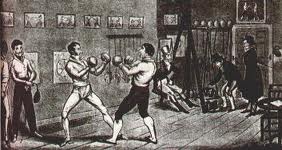
Boxing at Gentleman Jackson's

Fist fighting begun to replace sword or cudgel sports during George I’s reign.  Though it was illegal, betting made it enough of an attraction to draw nobility as well as common folks.  The first official champion of England was James Figg, who was also an expert swordsman and who later opened a School of Arms.

Later, Jack Broughton, who was champion of England from 1734 to 1750, invented the “mufflers” or boxing gloves that were used for practice only since all prize-fights were fought with bare fists.  Called “the father of British pugilism” Broughton drafted the rules that were used before and during the Regency.  (It was not until 1866 that the Queensberry Rules were developed by the 8th Marquis of Queensberry and John G. Chambers.)

Broughton’s rules outlawed hitting below the belt, striking an opponent who was down (which included being on his knees). Wrestling holds were allowed only above the waist.  Every fighter had a gentleman to act as umpire, with a third to referee disagreements. When a fighter was knocked down, he had 30 seconds to get up—or have help getting up—and then he had to be placed at the corner of a 3-foot square that was drawn in the center of the ring.

As was common for retiring champion boxers, when John Jackson retired after willing the champion title in 1795, he opened the Bond Street School of Arms at Number 13. Jackson won the championship in a hard-fought match with Daniel Mendoza, but it was his school which brought him fame.

Jackson, known as “The Gentleman,” was friends with fencing instructor Henry Angleo, who had a school next door and who urged his students to alternate with lessons from Jackson—which made sense for Jackson advocated footwork and the science of targeting a hit.

Everyone went to Jackson’s, even Lord Byron, the lame poet.  When tasked with keeping such low company Byron insisted that Jackson’s manners were “infinitely superior to those of the fellows of the college whom I meet at the high table.”  That no doubt contributed Jackson’s nickname and his success.

Other boxing champions of the Regency era included: Jack Bartholomew, champion from 1797 to 1800.  Jem Belcher who often wore a blue scarf marked with white spots and blue centers around his neck, which became known as the Belcher neckcloth, and soon sporting mad young bucks were wearing any scarf of garish color with spots.  “Hen” Pearce, “The Game Chicken,” who held the title from 1803 to 1806 when he retired.  John Gully who won the championship in 1807 and retired in 1808 to open a racing stable. And Tom Cribb became the champion in 1808, winning a famous bout against African-American Tom Molineaux on December 18, 1810. Cribb went on to hold the champion title until 1822.

As an interesting footnote, Tom’s less famous brother, George had about five fights, and lost all of them—some men simply were not cut out to be Corinthians, dandies, or rakes.

Fencing at Henry Angelo's

Fencing at Henry Angelo's

Writer’s Reference Shelf

If you do a search on Amazon.com for “writing,” over 50,000 books show up.  That’s a lot and doesn’t even include the other great reference a writer might use, such as books slang, foreign phrases, and grammar.  So I thought I’d share what’s on my writer’s reference shelf, the books I’ve found the most useful and helpful with craft and the inevitable questions that crop up for the odd bits and pieces sometimes necessary to create characters.

Techniques of a Selling Writer, Dwight Swain

This is a book I recommend in almost every workshop.  My paperback copy has Post-it notes stuck onto pages, and a cracked spine, and pages falling out, and it stays right by my computer.  The blub on the back says: “This book provides solid instruction for persons who want to write and sell fiction, not just to talk and study about it.”  Swain is brilliant.  His prose is clear, and he breaks down basic structure–beginnings, middles, ends–in such a way that you can’t help but become a better writer.  For me, this book had so many, ‘ah ha!’ moments.  If you struggle with “plot” and structure this is a great book.  If you struggle with how to break your story down and put it into a synopsis, this is a great book.  However, I know some writers who find that Swain doesn’t speak to them as well as Jack Bickman.  Bickman was a student’s of Swain and so he teaches the same concepts, but with a slightly different approach.  You might try Bickman’s works, but first go out, buy and read Techniques of a Selling Writer.  Trust me, it’s money well spent.

The Elements of Style, Strunk & White

While you can read this slim book–my copy is 92 pages, including the index–front to back in a short time, it is designed for reference.  Have a question about what words need a hyphen?  There’s an answer on pages 34-35.  Unsure about when to use ‘which’ or ‘that?’  Page 59.  This is a book to help you add the gleam of polish to your writing.  The index makes and table of contents makes it easy to look up topics that may be rattling your brain.  And, let’s face it, we all have bad stylistic habits as writers that we pick up and sometimes really need to clear out.  I use this book a lot during the editing phase just to make sure that every unnecessary work or unclear phrase is cleaned up and out.

What’s What, A Visual Glossary of the Physical World, Fisher Bragonier Jr.

Most libraries will have a copy of What’s What.  My local library was where I first discovered this book, but I soon had to have my own copy.  The book is just what it says; drawings and photos of all sorts of things and places with information of the names of everything.  This is fabulous for a) you know the name of something and can’t quite remember it or b) you need your character to know the name of things because of that character’s profession and you haven’t a clue.  Need to know all the parts of a sailboat?  Or maybe a hot air balloon?  Or what all those medieval arms are called and the parts of a knight’s armor?  This is the kind of book I occasionally get lost in, it’s got so much wonderful trivia.

Characters & Viewpoint, Orson Scott Card

Orson Scott Card is one of the top names in Science Fiction, and you can see where he gets his reputation for good writing in this book. Card says of it (on the back cover), “This book is a set of tools: literary crowbars, chisels, mallets, pliers, tongs, sieves, and drills.  Use them to pry, chip, beat, yank, shift, or punch good characters out of the place where they already live: your memory, your imagination, your soul.”  I say buy the book and a highlighting pen.  You’ll learn things you didn’t know, you’ll get ideas, and best of all it’ll makes you want to get back to the computer to apply the knowledge.

Write Away, Elizabeth George

This is subtitled “One Novelists Approach to Fiction and the Writing Life.”  Elizabeth George is a New York Times Best Selling mystery author, and this book is based on the writing courses she’s taught.  This is not your basic how to plot or writing book.  This is about a writer getting inside her own fiction in a detailed, methodical fashion and telling you how she makes it work.  It’s a fabulous book–but it can also be deep going.  I found myself having to read, stop and process, and then go back and reread passages.  But the purest gold often comes from the deepest mines where you have to sweat to get it out.

Goal, Motivation & Conflict, Debra Dixon

Published by Gryphon Books, the book is a companion to the workshop that Debra Dixon teaches. She also teaches novel writing and has written several romances.  The book is one I end up recommending more than any other because it’s packed with sound, good advice about how to punch up a scene or a story with stronger characters and that means stronger conflict.  Buy it.

What’s My Motivation?

No wonder most folks think they suck at plotting—they do. Lately, I’ve read implausible plots, overly melodramatic plots only missing the villain twirling a mustache, plots so tangled there’s no way you can get the synopsis to five pages and have it make sense, and complex plots where the romance (and the character) are lost in the action. How do you fix this? It all goes back to character.

To quote Robert Mckee “character is story and story is character.” A good story comes from good characters—folks with clear goals and motivations that make sense. The plot then is actually pretty easy—you throw things (events) at those characters that will hit on their weak points (take them off track from their goals) and hit their buttons for their internal issues. The plot tests the characters you’ve created.

If you haven’t done the homework of creating strong characters to start—that means well developed characters—those story people are going to be feel pushed through a contrived plot. This will give you implausible, melodramatic, tangled, and/or too complex plots. This is because you’ll be using action to make up for weak conflict due to weak characterization.

I’m going to be doing my Plotting from Character workshop again soon, and from what I’ve seen in contests lately, a lot of folks could use this. If you start with character, plotting gets a lot easier. And characters need a few things to work well in fiction:

Goals – everybody wants something. Even the character who wants for nothing will still have something that he or she wants and needs – a story is about a character whose life is pushed out of balance. And the goal for that character is to fix this imbalance—to get back to a happy place. Goals work best when they are a specific thing that represents achieving that goal—which is how you end up with things like the Maltese Falcon (it’s something tangible folks can be after—having it in your hands means goal achieved).

Negative goals (to avoid some event), aren’t so great unless you also have a clock running—as in stopping the bomb from blowing up becomes a positive due to that ticker. But something like avoiding marriage is a little harder—since it’s a negative, the reader doesn’t knows when the character has achieved this goal (Is he married now? Married now? How about now?) See—that’s not going to give you a tangible “he made it” goal.

Motivations – to go along with the goals, fictional character needs good reasons for their actions, for their goals. Fictional folks have to make a lot more sense than real people.  And motivations work best if deeply rooted in the characters psyche—the deeper, the better. As in, a motivation that comes from a key, formative event the character’s childhood is much stronger than a motivation that comes from a recent event. For example, a character that needs to find a new job because she’s been fired—that’s motivation, yes. It matters, but it hasn’t been made personal. A deeper motivation comes from that character having been raised poor. So what if she saw her mother crying over a broken down car when she was ten and vowed never to be that person. Now, she’s got strong motivation to get that new job. The motivation has been made personal. And notice how you also want to tie this motivation to a key moment in that character’s life so it will resonate—and you can use that scene then in the story.

Internal Needs – this relates to motivations, and also to goals. Stories work best with lots of conflict, so you want to develop characters with strong internal needs. And hopefully these are going to be in conflict with their goals. So the character who is out of work and needs that job—and has motivations from being poor in childhood—if she’s got the internal need for respect, and she’s offered a menial job with no respect, now her external goals and internal needs are in conflict. She wants the job (external), but she needs respect (and won’t get it from the job). So what does she give up? She’s in conflict, which is always good stuff for fiction. How the character then resolves this conflict becomes part of your plot—and reveals this character’s true colors.

Motivations – just as with goals, internal needs have to be motivated. (Remember, fictional folks have to make sense—much more so than real people.) So this character needs an event in his or her formative years that leaves him or her with deep reasons to have these internal needs. And, again, you want to tie this motivation to deep, core issues—could be the character is compensating for a handicap, and respect isn’t just about being respected.

Characters should have such strong goals and needs that the character (and the reader) should feel as if that character’s “self” will be destroyed by giving up either the goal or need.

And then you throw in the romance (if you’re writing a romance).

Once you create your main character, now you design the love interest, and all the other characters. The love interest is someone with a conflicting goal, conflicting internal needs, and motivations that are just as deep and strong. In other words, this is both the ideal person, and the totally wrong person. This is a soul mate (and I use the definition that soul mates are those people who push all your buttons—they make you grow).

You develop goals and motivations for all characters—in other words, you never have a bad guy who is bad just because he is bad. And you look to develop goals and motivations that go beyond clichés. (Trust me, your first few ideas for goals and motivations will be cliché—that’s why they pop up so readily. As Orson Scott Card advises in Characters & Viewpoint, dig deeper.)

And, very important, you want the story’s antagonist—the person up against the protagonist—to have conflicting goals. Only the protagonist or the antagonist should be able to win the day (and for more on this, study up on Bob Mayer’s talk on Conflict Lock – he’s bestselling author and he knows what he’s talking about).

Theme – this is what helps you with all this goals and motivations stuff, and with all the secondary characters you need. If your theme is about how love heals, you’re going to need hurt characters, and folks who’ve never been hurt by love. You’ll need folks who haven’t been heeled by love—and those who have. You need all sides of the theme. And the main character is going to be at the center of that theme.

Now, with characters and theme shaping up, you can plot. Meaning you look at your main character and you keep asking—What is the worst thing that could happen to this person? You ask this many, many times and jot down the answers. What could prevent this person from getting his or her goal? What would force this person to give up his or her goal? What would push this person to the extreme to get his or her goal or meet his or her needs? Keep pushing, keep making it worse. (Action movies are great to take apart for this sort of stuff—look at Indiana Jones, and how his life just gets harder and harder and harder.)

These ideas for obstacles that the main character must overcome can then be shaped into the main turning point actions—the plot that will test your character. It will also test the main character’s relationship—the romance. You put just as much strain there as you do for any action.

As you do this, you’re coming up with events to throw at your character, but this is not the time to decide yet how your character will act—that come from knowing your character and putting your character into these bad, bad situations. In other words, you set up the obstacle course—your characters decide how to run that course. The story comes out of the characters dealing with worst case scenarios.

Two things about this—first, you need to structure the action so that tension and conflict rises. In a good story, things go from bad to worse—not the other way around. Second, you’ll develop subplots around the main plot, but it’s the main action line—the main character’s driving goal, motivations for this, and obstacles (or turning points)—that should be the main focus. The main story arc must have the main character at its heart—the main character must resolve the story (or fail at this, which makes it a tragedy). And this should be the last set of story points to be resolved. (Subplots can start sooner than the main story, but should be all wrapped up before the main story is in order to create the most satisfying story.)

Notice how all this plotting now comes out of the characters that you set up. Your characters give you your theme, they start to suggest events you’ll need in the story to block them from their goals. For example, you know the woman who need a new job is going to start off applying for new positions—and maybe that’s not so exciting, so you start her where she’s just been turned down for the 100th time. But she starts off trying to do this the easy way—that’s so your story can build and get worse. You know you’re going to make things worse for her—she’s going to be face with choices. Maybe even asked to commit murder in order to make a million dollars. But she’s not going to be asked that right away—that’s going to come after she’s been tested, and tested, and tested more. That’s going to come when she’s more than desperate. That’s going to come when she has so few other choices this extreme one seems a viable option.

Once you get the ideas and characters down in writing, you’re going to check in with a writer friend. You’re going to look at this from all angles to see if it makes sense. If it’s plausible. If every character is well motivated with strong goals. You do this because it’s too easy to think you’ve got it all buttoned up when you don’t. And you’ll find you have stuff worked out in your head that doesn’t make it onto the page—you want to always make sure to get the story on the page as close to what’s in your head.

What this means it that you won’t be coming up with cliché conflict (the heroine is kidnapped and the hero saves her)—conflict will be very specific to the characters you’ve created because it will be deeply rooted in individual pasts. You won’t be stuck with how to escalate conflict and tension, because you’ve got goals and you’re going to take away all the easy ways for that character to reach his or her goals. You won’t be caught with a romance that relies on misunderstandings or mistaken assumptions to create problems in the relationship—problems will be built into your characters.

Just keep in mind—it’s all about the characters.

How to get More from Online Workshops

Having taught and taken online workshops, I’ve some thoughts on how I think folks can get more bang for the buck. I’ve also taught in classrooms and at conferences, and it’s a whole different animal when you go online.

The good news is that most online workshops are cheep–there’s no overhead for classroom space, no issues about traveling to the workshop (which can be wearing if the workshop runs for more than a day or two), and you get to attend when you have the time.

The bad news is that both the instructor and the attendee miss out on face to face interaction: that’s bad, because a good instructor can gauge where/how a class is going by the interest shown in the attendee’s eyes–you can’t do that online.

With an upcoming online workshop on Writing Regency Set Novels that I’m teaching for Lowcountry Romance Writers this August, and one on Show And Tell: An Interactive Workshop, for OCC RWA chapter in September, I’ve been thinking about things that attendees can do to make the class more interesting–and to get more from the workshop.

1-Participate. In every online workshop, there are the lurkers, the participants who don’t participate. I’ve been one of them more than once. There are a hundred reasons to lurk in the electronic shadows, including lack of time, however, I’ve always gotten more out of the workshops where I’ve participated. This may mean trying some writing exercises, or just asking questions.

2-Ask questions to the group. Each workshop there’s at least one person who wants to communicate outside the workshop. As the instructor, I can’t do that–everyone benefits from every question and every answer. So ask those dumb questions to the group.

3-Stay on topic. This one’s hard. In a classroom, it’s easy to get off topic and to bring the workshop back on topic. These side branches can be useful. But online, getting off topic tends to snowball into anarchy. If you have a question that’s off topic, preface this so that you let everyone know you’re aware this may be off topic. Or find a way that it fits into the overall workshop theme and structure. Do keep in mind that you signed up specifically to get information on the workshop topic.

4-Follow the structure. This one’s very difficult. Online is a great equalizer–meaning it’s too easy to ignore posting guidelines, and to start side conversations, and to wander off on your own path. Unfortunately, if you do this in an online workshop, you take the workshop with you — meaning you’re missing out on what the instructor had planned. And remember you can always ask questions about how flexible the structure is to help you get the information you need.

5-Let the Instructor instruct. Side comments can be a great way to participate, but again, if you hijack the workshop away from the instructor, chances are you’re going to miss out on the benefits the instructor might be able to give you of that person’s experience and knowledge.

6-Give good feedback. If something clicks for you, don’t forget to post the “ah ha” moment. That may help someone else and will help the instructor.

7-Keep asking questions. If something doesn’t click for you, look to rephrase the question and try again. Provide more detailed information in follow ups. Communication online can be tricky since you don’t have someone’s face and body language to read–you just have words. This is good in that we’re supposed to be writers–we’re supposed to communicate. But we also have to always check back with our words to see if what we intended made it onto the page.

Whenever I take an online class, I try to follow the above guidelines–I don’t always succeed. Sometimes the workshop assignments seem more work than I’m willing to tackle at that moment. Sometimes I just feel like hanging back.

But I know that I get back from any workshop what I put in–that includes the workshops that I teach. And I figure if I get one gold nugget of information, I’m that much a better writer.

As an instructor, I love the attendees who contribute ideas, and comments, and who participate. They make the workshop more interesting for me as well as for others. And I have to keep reminding myself when I take a workshop to be that brave soul who steps up and participates fully, instead of being the lurking writer who likes to sit back and observe.

The Regency Horse World

Hunter. Carriage horse. Race horse. Town hack. Horses were part of everyday life in Regency England. And the horse world of a few hundred years ago was quite different than its modern counterpart.

RACING
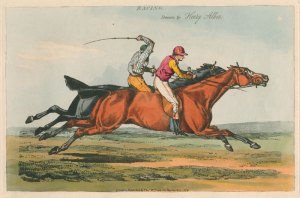
 

By the start of the 1800’s one of the biggest innovations in horses had already occurred—the Thoroughbred had arrived. Three founding stallions—the Darley Arabian “Manak,” the Godolphin Barb, and the Byerley Turk—had been brought to England in the early 1700’s. When the light, fast and sturdy Arabians were bred with the larger, cold-blooded English mares, the cross produced a horse with size, speed and stamina. It produced the Thoroughbred.

At the same time that the Thoroughbred was being established as a breed, horse racing was also becoming a regulated sport. In 1711, Queen Anne had established regular race meetings at her park at Ascot. Gentlemen organized races for themselves, often “matching” particular horses against each other, and by 1727 a Racing Almanac began to be printed.

Flat and jumping races were also held for women only. Mrs. Bateman wrote in 1723, “Last week, Mrs. Aslibie arranged a flat race for women, and nine of that sex, mounted astride and dressed in short pants, jackets and jockey caps participated. They were striking to see, and there was a great crowd to watch them. The race was a very lively one; but I hold it indecent entertainment.” Some women—such as the infamous Letty Lade, who apparently swore like a coachman—rode and drove to please themselves, but they were the exception in the Regency world.

Around 1750, the gentlemen who regularly met at the Red Lion Inn at Newmarket started the Jockey Club. And in May of 1779, the first Derby was held. By 1791, the Jockey Club had issued the “General Stud Book”, and by the early 1800’s Jockey Club stewards attended every racing meet.

Assize-week was the time for races, for that was when the gentry came into the chief town of the shire for trials and selling harvest. Meet sprang up, and still run, at Newmarket in April and October, York in May, Epsom, Ascot in June, Goodwood, Doncaster, Warwick, Manchester, Liverpool, Chester, Cheltenham, Bath, Worcester, and Newcastle.

Racing, however, was a sport for the rich. Before the Prince Regent quit the racing scene in 1807, his racing stud farm came to cost him 30,000 pounds a year.

FOX HUNTING

For the less wealth, horses still served as sport, primarily for fox hunting. While Thoroughbreds might be seen in the field, one might also see farmers upon their heavier draft horses, such as the Suffolk Punch. Children might well be mounted upon the small but handy Welsh Cob or Welsh pony. And Irish Hunters, with their thick bones and size have always been prized for horses who can go all day and then some.

While fox hunting traces its roots back to the mid-1600’s, the sport did not take its present form of jumping and long runs until after the Enclosure Acts of the 1700’s. By the 1780’s, fox hunting had become the most popular of sports, replacing the more ancient sport of stag hunting.

November to March was, and remains, fox hunting season, starting after the fall of the leaf, when the fields lie fallow, and ending after the last frost, just before the first planting.

Hunt territories varied widely. The fifth Earl of Berkeley hunted an area from Berkeley Castle to Berkeley Square, stretching 120 miles.

By 1810, there were 24 subscription packs—a packs that one could pay to hunt with, as opposed to requiring an invitation from the Master. This would double, so that by the mid-1800s hunting had become more a matter of ‘subscribing’ in exchange for the right to hunt with the pack.

The golden age for hunting in Leicestershire is considered to be 1810 to 1830. During this time, there were as many as 300 hunters stabled in Melton Mowbray—with some gentlemen keeping up to 12 hunters. A gentleman could hunt six days a week with the Quorn, the Cottesmore, the Belvoir, and the Pytchley.

Ladies were also found in the field. Mrs. Tuner Farley hunted for 50 years. Lady Salisbury was master of the Hatfield Hunt from 1775 to 1819. She hunted old and blind, in her sky blue habit, with a groom leading her horse and yelling at her to, “Jump, damn you, my lady.” And from 1788 to 1840, Lord Darlington hunted his own hounds four days a week in Yorkshire and Durham, with his three daughters and his second wife, all in their scarlet habits.

However, between late 1700’s to about mid 1800s, when the jumping pommel was invented for the side saddle, ladies were more likely to be advised to “ride to the meet and home again to work up an appetite.”

While fox hunting was viewed as a sport for everyone, the reality was that it cost money to keep a pack of hounds and hunt them. However, anyone could take a horse and follow, if the master allowed it, and some followed the hunt in their carriages.

CARRIAGES

For most families, a carriage was a necessity, and specific breeds of horses were used in harness. The ideal hunter had a long, low stride. But a carriage horse needed high-stepping action, which looks lovely in harness, but which is not always the most comfortable ride.

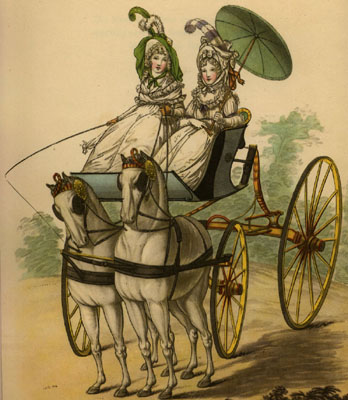
Carriage breeds of the era included the Yorkshire Trotter, the Norfolk Trotter, the Hackney Horse, the Hackney Pony, and the Cleveland Bay, which is still one of the most desired of carriage horses. Ponies were often used for smaller vehicles, and for ladies. Prints of the era often show ladies driving a matched team of cream ponies–which looks a lovely sight.

Owning and maintaining a horse could be expensive, but there were more affordable options.

John Tilbury of Mount Street in London offered a horse for rent at 12 guineas a month. For 40 guineas, one could hire two hunters and a servant.

Carriages were more expensive than horses, for they had to be custom built. Families with modest incomes would often purchase a carriage second hand, from an advertisement in The London Times. Those who could afford it would have a carriage built to their own specifications.

In Jane Austin’s Northanger Abbey, Mr. Thorpe enthuses over his new carriage, boasting: ‘Curricle-hung, you see; seat, trunk, sword-case, splashing-board, lamps, silver moulding, all you see complete; the iron work as good as new or better’ — and all for fifty guineas.

Chandros Leigh, a distant cousin of Jane Austen, obtained an estimate for a fashionable laundau in 1829. The price of the basic carriage was 250 pounds, which included: ‘plate glass and mahogany shutters to the lights, and plated or brass bead to the leather, lined with best second cloth, cloth squabs, and worsted lace….’ The ‘extras’ ordered including footman’s cushions, morocco sleeping cushions, steps, silk spring curtains, his crest on the door, embossed door handles and full plated lamps. These brought the cost to 417 pounds, 11 shillings and 6 pence, but he was given 60 pounds in exchange for his old carriage.

Carriages for country and for town were generally quite different in build, for they served different purposes. And since carriages were custom built, almost every carriage could be a unique design. Common types of carriages, however, included:

The Phaeton – a four-wheeled, owner-driven vehicle fitted with forward facing seats, usually an open carriage.

The Gig – a two-wheeled vehicles (Whiskey), built to hold two, usually an open carriage.

The Curricle – the “gig” of the quality, built to hold two, which could be two or four-wheels, and which sometimes had a top that could fold down.

A Town Coach – a closed coach that could be drawn by one horse or a pair.

Landau – a four-wheeled vehicle that held four, which was drawn by a pair and built with a removable or folding top.

Barouche – a four-wheeled vehicle drawn by a pair, or by four or even six horses, with an option for a driver, or for post boys to ride and control the horses. Sometimes built with a fold-down top.

(For images, visit –Georgian Times.)

A ‘Drag’ was a slang term for a gentleman’s private coach. It was built much like a mail coach, and often used for race meetings or other outdoor events as it height and roof seats created its own grandstand.

In 1805, smaller Hackney coaches came into use and in 1823 the first Hackney cabs came to London. It was not until 1830’s, however, that the famous Hansom Cabs appeared in London.

Both carriage and road constructions were being developed during the Regency and were not without problems.

Sylas Neville’s diary recorded a 1771 journey on the London to Newcastle stage. It took him two days, traveling day and night, to cover the 197 miles from Stilton to Newcastle.

By the 1780’s, private carriages could cover the distance from Bath to London in 16 to 18 hours. But the Royal Mail coaches were much slower until John Palmer produced a mail coach that left the Rummer Tavern in Bath on August 2, 1784 at four PM, and arrived at the Swan with Two Necks in London by eight AM the next morning. The stage had traveled 119 miles in less than 16 hours!

Up to 1820, most coach horses were changed every ten to eleven miles. Thereafter, to get better speeds, they opted for even less distances, changing about every six miles. But as Mr. Darcy says in Pride and Prejudice, “fifty miles of good road was ‘little more than half a day’s journey.’

With so many road problems, those who wished for speed would often ride.

RIDING: SIDE SADDLE AND ASTRIDE
Riders of the 1800’s leaned back and rode with long stirrups that kept their seat in the saddle. Even jockeys rode sitting down square on a horse’s back. And English ‘tack’ or equipment is quite different from its ‘western’ counterpart.

An English saddle has a pommel up front, not a saddle horn. The back of the saddle is the cantle. The saddle is held in place with a girth–not a cinch–and uses stirrup leathers and stirrup irons.

Riders generally carry a hunting whip, which is designed with a crook on the end to open gates, and whip points on the opposite end that can be changed and used to control the hounds. This whip is not actually used to whip the horse.

A lady often used a whip to give a light tap to the horse on the ‘off’ or right side as a command, since her legs hang down on the ‘near’ or left side.

Prior to 1835, a side saddle had only one or two pommels. One turned up to support the right leg, and some had a second pommel which turned down over the left leg. The ‘jumping’ pommel did not exist in Regency times.

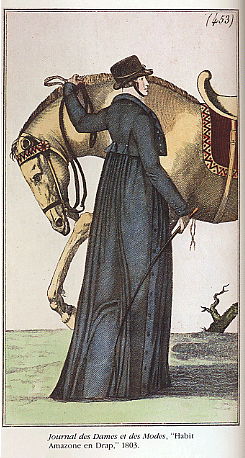
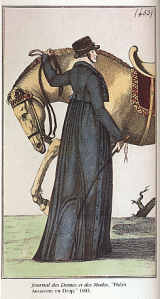
A lady’s riding habit had to be cut so that it draped down over the horse’s side, coving ankle and boot in a lovely flow. This drape required that a loop be attached to the hem, so that, when dismounted, a lady could gather up the extra length of skirt. The fabric for a habit was usually a heavy cotton, twill or wool. And due to its cut, a habit can provides any woman with a long stride as much freedom as breeches.

Riding habit styles often copied military fashion, with close cut coats, cravats, and military shakos. Ladies always wore gloves, both to preserve their hands, and to improve their grip upon the reins.

One print from the early 1800 shows a lady strapped into her saddle, but the danger from this would be that if the horse fell the rider would almost certainly be crushed or dragged.

Modern views make it seem as if riding side saddle must be awkward and uncomfortable. In fact, it is neither.

The important factor in riding side saddle is the horse. A comfortable stride and good manners are essential. This does not have to be a placid horse, but should not be a horse with a rough or bumpy stride.

The side saddle requires the rider to sit with a straight back and with hips and shoulders absolutely even. Slightly more weight should be carried on the right hip to compensate for the weight of both legs on the left. Any tilting to one side, leaning or twisting eventually results in a horse with a sore back.

Side saddles have a broad, flat and comfortably padded seat. The right leg goes over a padded leather branch which turns up (the top pommel). The left leg is in a stirrup that is short enough to bring it firmly up against a second pommel which turns down. If the horse plays up at all, the rider must clamp both legs together, gripping these pommels.

On a comfortable horse, riding side saddle soon begins to feel a bit like riding a padded rocking chair. It’s far less tiring than riding astride for the only effort is to sit straight and still.

While it is possible to rise to the trot in a “posting” motion, some claim that this is the real cause of giving a side saddle horse a sore back as it requires too much weight be put in the left stirrup.

Betty Skelton, author of Side Saddle Riding, found that….”As a teenager in the 1920’s, side saddle riding was second nature to me. I found it comfortable and I did not fall off as often as I had done from a cross saddle.” In teaching side saddle, Ms. Skelton has found that a beginner rider can often be comfortably cantering during her first lesson, which is far more progress than most can manage when riding astride.

It is possible for a lady to mound dismount on her own when riding side saddle.

To mount, she holds the reins and whip in the left hand and stands facing the horse, or even slightly towards the horse’s head. Taking the stirrup iron in her right hand to hold it steady, she places her left foot in the iron. With her foot in the iron, she can reach up to grip the saddle. As she hops up, her weight goes to the left foot in the iron and she leverages her weight up.

Instead of swinging her leg over the horse, she pulls her right leg up in front of her and seats herself sideways in the saddle. She then can settle herself with the right leg over the top pommel, the left under the left pommel and in the stirrup.

To dismount, a lady unhooks her right leg, takes her left foot out of the stirrup and simply slides off.

For a gentleman’s saddle, mounting also requires the reins and whip to be held in the left hand. A rider traditionally mounts from the left. The rider stands at the horse’s shoulder, facing the horse’s hind quarters.

With the right hand, the rider turns the stirrup iron sideways. The left foot goes into the stirrup, and the rider may grasp the cantle or back of the saddle with the right hand. He then pushes himself off the ground with the right foot, transfers his weight to the left, stirrup foot, and swings the right leg over the horse’s back to land lightly in the seat.

To dismount, the gentleman kicks his feet out of both stirrups and swings off to the left, the right leg coming over the horse’s back.

By natural inclination, a horse will move out of the way of any rider attempting to leap onto its back with a vault from the rear or a jump from a high point. However, horse may be trained to put up with this behavior.

A groom who leads a horse out for a gentleman or lady will stay and hold the horse’s head. If the gentleman is portly, the groom may also hold the stirrup on the opposite side from the rider to keep the saddle from ending up under the horse’s belly.

In giving a “leg up” to a lady, a groom would not dare to be so bold as to take a lady by the waist, as a rather forward gentleman might. Instead, the groom makes a stirrup from his hands. He then holds his hands low enough to allow the lady to easily step into them with her left foot. Then the groom boosts her lightly into the saddle.

When a groom is unavailable, a mounting block can help, and is particularly recommended to help keep a side saddle even on the horse’s back. This can be a block about two feet in height, or a fallen tree or river bank can serve the same purpose.

In general, horses prefer one horse, one rider. Being creatures of habit, carriage horses also prefer to be driven, not ridden, unless they have been trained for both.

However, with a man’s saddle, it is quite easy to manage two on a horse. The disadvantage is that the lady usually ends up sitting on the pommel, and galloping in this position can be painful on the posterior. For fast flight, it would be best to have the lady sit behind the gentleman and have him hold on to him.

FASHIONS
With all riding and driving, specific fashions evolved in the Regency to denote affiliations.

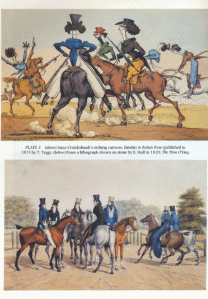
Each Hunt had its own hunting “colors,” which included a color of coat collar as well as a button insignia. The most fashionable gentlemen in the field might also wear white boot tops to their riding boots. Ladies, too, would wear hunt colors.

The exact origin of the bright red hunting coat—which is actually called a hunting pink—is a little vague, but one theory holds that it was army officers hunting in their scarlet regimentals that started that fashion. Another holds that the tailor Mr. Pink started the fashion, and that the coats took their name from him.

Driving clubs, such as the Four Horse Club or the Four-in-Hand Club, also had specific styles of dress that denoted membership. This included a blue coat with insignia buttons, a yellow and blue stripped waistcoat, a white muslin cravat spotted with black, and white corduroy breeches.

And in the stylish Regency, fashion extended to more than just clothing, for horses and carriages were ways to express ability, style and good Ton.

According to Captain Gronow in his Reminisces, Lord Barrymore drove, “…four splendid greys, unmatched in symmetry, action and power.” While Lord Petersham’s carriages, “…were entirely brown, with brown horses and harness.” Gronow accredits Petersham’s affectation as being due to his love for a widow named Mrs. Brown. Regardless, the color soon became his trademark signature.

Through it all, the horse endured as a symbol of style, as a sport, and as a source of pleasure and delight.

For further reading:

  • Horses and Horsemanship though The Ages, Luigi Gianoli
  • Royalty on Horseback, Judith Campbell
  • Side Saddle Riding, Betty Skelton

Managing POV

Years ago, I was lucky enough to have Jo Beverley judge one of my manuscripts in a contest. Her one comment stuck with me–learn to control viewpoint and you’ll sell. She was right. Now, I’d already tightened up a lot of other craft technique, but viewpoint was a place where I went a bit fuzzy. I wasn’t even aware how much it slipped, but it made me take a really hard look at viewpoint—and to start practicing the habit of only changing viewpoint when I absolutely needed to be in someone else’s POV. This let me cut a lot of the deadwood out of my stories, making them tighter and stronger.

Since then, I’ve since seen a lot of the same old habit I had in contests entries. It’s like something most writers have to go through. And I’ve noticed that viewpoint control actually impacts a whole bunch of other things.

Tighter viewpoint control picks up the pacing. It forces you to show more and tell less (you can’t keep slipping in and out of omniscient POV). Tight control improves characterization, brings in more emotion, and you get a much better story. The reader also tends to be less confused, and becomes more engaged by the character—spending time with anyone (even a character) is a good way to get to know and like that person.

Yet, this is a place where a lot of folks seem to want to be a little loosey-goosey. Folks will say, “But I like to switch POV.” And, yes, switching is fine, but if you’re not doing it for a reason, you may be killing the best parts of your scene. This is where a little more discipline and a little less seat of the pants can help.

And first person viewpoint can help a writer lean a lot. I’ve written a lot of stories in first person, and I still use this technique for scenes that are giving me trouble. Don’t get me wrong, I love third person, but first person is a great way to learn more control. It’s also sometimes the best way to tell a story. But watch using several first persons in a story, that can be tiresome and confusing to a reader unless there are large chunks of time with each character.

With the contest entries I read, I also sometimes get the feeling that some writers may not be aware of what are the viewpoint options. And how do they tighten their control of these.  Managing POV is an important technique to learn, and master.

Viewpoint control is like any other writing technique.  It’s one you have to think about, study, and practice. Once you get really good at it, you can put it in your hip pocket and forget about it—until it comes time to edit and fix problems. And then you need to get back to basics.

I’m doing a workshop on Managing Viewpoint with Savvy Authors this month. Hopefully, this will help folks pick up a few more tips and techniques to bring out the best in their scenes, stories, and characters.  There are techniques that can help you smooth viewpoint transitions. And there are exercises that will strengthen your control of viewpoint.

Even with first person POV, there are ways to improve your control—you can still slip into omniscient from first person if you’re not careful.

And I’m hoping the workshop will remind me, too, of the basics that I always have to keep in mind to tell a good story.

Writing Workshops – How to ?

A friend recently asked about how to do online writing workshops.  So it seemed a good idea to put down what I’ve learned from teaching writing for about ten years now online.

Writing workshop

I’ve taught both workshop classes and online workshops, and there are some big differences. In person workshops give everyone a lot more interaction—you get to see the faces of the people in the workshop, so you can see if there are blank stares, or if folks are getting it. And those taking the workshop can direct some of the information with immediate questions.

This is not to say you can’t ask questions in an online workshop, but so often the question you send in an email or post to the workshop group might not actually be the question you need answered. Communication is an art. But that’s one of the advantages of online—you have to write down your questions, and your assignments.

I’m a big believer in assignments, or exercises. I like the interaction it spawns—when you’re teaching, you get to see if folks are really getting the information, or not. And there’s nothing like practical application to stretch your writing skills.

I also think it’s great to try new things—I like to do that with my own writing skills, just to keep them sharp, and to make sure I keep learning.

Which is a big part of teaching workshops—everyone learns, the instructor included, in a great workshop. There’s an exchange of ideas, approaches, and information. To me, a bad workshop—either online or in person—is one where that exchange, for whatever reason, doesn’t happen.  If students don’t put in, or give back, to the workshop, the whole thing becomes a dull experience—for everyone.

This means the best online workshops have a mix of participants—a few who ask tons of questions, do every exercise several times, and basically throw themselves into it, a few who do some of the assignements, but basically absorb the information, and then a few who lurk, pulling in the bits of information they need.  In person, you often have this same mix, but online, it’s somehow stands out more.

As to structure, the beauty of online is the flexibility. With an in-person workshop, there’s always the limitation of distance and time—the workshop has to be close enough to get to, and it can only last for as long as the room is available. While online workshops always have some time element to them—as in they might last a week, or two, or even a month—that’s more than enough time to cover the subject matter and allow for lots of participation. Time is extended, and since the room is a virtual one, there’s no worrying about ‘driving’ to get to the workshop—or about being late. That’s a luxury for me, too, since I can logon at any time to see questions, post a lecture, or add notes.

I’m also now developing books to go with the workshops—one of the things I’ve found is that folks want to keep and refer back to the material, and with ebooks becoming so popular, it’s going to be easy enough to have ebooks with the material available for those who would like them.  I know I’ve several writing books on my shelves and I refer back to them when I need a refresher course back—that’s what the books will do, and they’ll be a logical extension of the course.

The one thing I’m always trying to get write, too, is the amount of information taught. It’s great to have a workshop with lots of great info, but I’ve taken ones where the information is just too much—I can’t absorb it. Too little information and I start to wonder what I’m doing in that workshop. But the balance is a tricky issue in that what’s too much for one person might be just right for the next. And there’s always the experience issue.

When I taught horseback riding, you’d find great teachers who had gone past the ability to teach beginners. They no longer had the patience for beginners—and they also had been doing this for so long that what seemed obvious to them wasn’t obvious.  The level of experience a writer has can be a big impact in any class—online or in person.  A workshop has to be able to bring the least experienced writer forward with the class—but it cannot drag so much that the most experienced writer is bored. That’s a difficult task.

A range of information can help with this—as can good explanations that more experienced writers can skip past but which will help the less experienced writer keep up.

But I’m always looking for ways to improve the workshops I give—I’ve several set up for the rest of this year, and some already booked for next year, too.

So what do you like most in the workshops you’ve taken online? And what could you live without?

Workshops – Teaching and Taking

I’ve been teaching online workshops now for a few years, and I’ve one coming up for the Show and Tell: An Interactive Workshop course with the Lowcountry Romance Writers, and every one of these is a different beast from the others. There are advantages to online workshops, the best being that you don’t have to drive, and with winter still hanging around, that’s a huge plus. But the other big plus is that, for writing, it’s all about the writing and getting the words down and communicating. That’s a challenge with just text, and so it’s why I’m always adjusting these workshops, and adding new things I’ve learned from my own writing.

Up, up and awayThere are times I feel a lot like a balloon — filled with hot air and not much else, something worth a glance. But the view is always better from up in the balloon. And while maybe I’ve covered the same material before, it only takes one questions that puts everything into a new light and makes it all fresh again.

I’m also a believer in covering the basics over and over again — you do the same thing in dance, you drill. It’s the repetition that actually leads to strong technical skills. That’s true for writing too — you really cannot cover the basics enough.

But all this leads me to think about what someone should expect from an online workshop — what is it possible to get and what is it possible to give. And since I’ve taken a few courses I have opinions about both sides of workshops.

The first job of any teacher is to engage. This means workshops shouldn’t bore. This one can be tricky online because you’re trying to balance conveying a lot of great information with trying not to overload the workshop participants — and everyone has different levels of processing. “The mind can’t absorb what the butt can’t endure” — in a classroom, you can only keeps folks sitting for so long unless you are utterly fascinating. Online that changes. Some folks read faster and some don’t; some folks retain more from what they read, some don’t. So there has to be a fair bit of repeating, balanced with the new information.

And sometimes it just takes saying the same thing several times to make it click. Short sentences help. A lot.

The second job is to inform — and my own criteria is if I get one gem, one golden nugget out of any workshop, it’s worth the price of admission. (And, yes, I’ve had a few workshops where that was missing, but almost every workshop will give you one good bit of advice — everything after that is gravy.)

With the entertaining, and the information snuck in, that covers the basic for any workshop for me. But I do think the best workshops have one more vital element — they’re fully interactive. Teaching has to be a dialogue.

I’ve lurked in workshops and I’ve participated — I always get more from the ones where I dive in and try out new things. I have more fun if I get my hands dirty. And workshops should be a place to fool around and try new things.

I also like teaching workshops more when those taking the workshop are willing to play — give and take is always more fun that either just giving, or just taking.

Which, actually, leads us back to the “show and tell” workshop — fancy that — because stories that both show and tell are also more fun that stories that just show or just tell. It’s all about balance really — in a workshop, or a story. A balance of information and engagement. A balance of give and take. A balance between showing folks how it’s done and telling. And that’s the thing about balance — it’s something that must be maintained. And I think that’s what I’m always looking for in a workshop — a well balanced flow of information.

But what’s your criteria for a great workshop?

Setting up for Digital

Some things just seem simple–digital publication is one of those. Upload a file and presto, right? But there are a few things that you want to figure out first—it’s another case of a little planning going a long way.

ISBNS

The ISBN is an industry standard for identifying a book. If you want full control of your book listing, buy your own ISBNs, which you can do through Bowkers at myidentifiers.com

You can buy a single ISBN for $125, or a premium one for $185, or buy 10 at a time for $250. Assigning them is a bit of a pain.

The ISBN is not actually in use until it is applied to a book. To do this, you’ll need the book cover, your bio, your book description, a PDF of your book, and an Excel file saved in the CSV format with the Search Engine Optimization (SEO) terms you want to use.

After you buy your ISBN, login to myidentifiers.com and follow the tabs and fields to set up all the information. You can also replace an older print ISBN if that print edition has gone out-of-print.

Include pricing and sales areas (countries where you’re selling), and check back in a few days to confirm your ISBN has been activated for that digital publication. It usually takes only a day or two to get this set up.

Then you can do that “easy file upload” for digital publication on Amazon Kindle, B&N Nook, and Smashwords.

Smashwords

Smashwords.com is both easier in some respects, and more difficult in others. They do provide a lot of information readily available on their site. The first step is to sign up and set up an account. Set up payment methods and create a profile. Click on the PUBLISH button to start the publishing process.

Fill out all the forms. Set your price (and Smashwords offers a cool graph to show what you’ll be making on any book for each price point). Be honest about if your book contains adult material (explicit sex or graphic violence). Upload your correctly formatted book and your cover. And remember to include the wording that Smashwords requires at the front of your book.

IMPORANT: Always take a look at the preview to make sure your book appears as you want it formatted. If you need to, adjust the text in the file and upload that again to correct any formatting errors or typos.

With the ISBN manager at Smashwords, you can add your ISBN or let Smashwords give this to you. If you’re having Smashwords do your ISBN, but you’re doing your own Kindle and Pubit uploads, set up Smashwords first so you have the ISBN to add other places.

Before you do that final submit, read the legal stuff (the Terms). This is a contract you’re signing with your mouse click.

It can be minutes to hours to actually have the book upload. It will then show as pending approval (that’s okay).

In Smashwords, select DASHBOARD, and now set your distribution for this book with the Distribution Channel Manager.

You can let Smashwords distribute to all formats, including Kindle and Nook. However, you’ll make higher royalties if you do your own Amazon and BN distribution. For Smashwords, I opt out of Amazon and BN formats. I opt into Apple (which requires an explicit opt in selection).

NOTE: Your book will appear in Smashwords right away, but will not be listed there as “premium content” until it’s approved. Check back every few days to make sure it is approve, or if the format needs to be adjusted (and also to see how you’re sales are doing).

UPDATE TO SMASHWORDS: They now allow both short descriptions, and long descriptions of up to 4000 characters. If you have books on Smashwords, you may want to update your descriptions. I’m using the short descriptions for review promos, and then adding in more details about the story in the long descriptions.

B&N PUBIT

For uploading to the Nook via Pubit, this again starts with reading up on the process on their site, and creating an account, this time at pubit.com. B&N requires a credit card to create an account. This is in case a book is returned (for example, you’ve sold 20 books, but one person decides to send it back, but B&N has already paid you for 20 books; they use the credit card to account for that one return). Some folks don’t like this but I had no issues.

When your account is set up, head to Add a Title.

One nice thing about PubIt is that you can save your work as you go (very handy that). So you can add some info, go away, fuss with promotional copy, and come back and add that.

As with all other formats, once you upload your book, make sure you check out how it will look with the preview option (PubIt automatically brings this up for you to view, which is a nice feature). You can also mark if the book is part of a series.

You can add up to five reviews, including reviewer names and quotes. You can post excerpts from the reviews, but you should get clearance from the reviewers before you use their copywritten work.

NOTE: While BN’s PubIt doesn’t require you to have an ISBN, I’ve found it’s easier to add this up front, instead of trying to update the ISBN at a later time. Everything else is much easier to update (cover, copy, reviews, descriptions, even pricing).

Amazon Digital Text Platform- Kindle

UPDATE: Amazon has renamed this to the “Kindle Direct Publishing”. They’re also now putting out a newsletter with useful tips and advice. The old link below still works, but the new link is: https://kdp.amazon.com.

The options at Amazon can be confusing: they have Create Space, and Kindle, and their Associates Program. To actually sell a book on Kindle, you want to head to: https://dtp.amazon.com. If you don’t have an existing Amazon account, you can create it. Again, Amazon provides a lot of information about the process on their site (including a video). The details can be a little overwhelming, so you may want to tackle the basics first, and then improve your publishing and promoion.

NOTE: To help promote your book you’re also going to want an Author’s page at https://authorcentral.amazon.com.

As with PubIt and Smashwords, you’ll need to set up all your account information so you can get paid.

Again, you enter your book title, cover, and upload your book. Make sure you spell your name as the author correctly. Again, make sure you preview how the book looks on Kindle.

You can mark if this is a series (same as for PubIt). You can set your pricing and opt out of DRM. Add in your ISBN if you have one. When you save your information, the book will go into a pending mode. Once approved, the book will be listed for sale.

And there you have it – the easy (or almost) steps to digital publishing.

Twelve Steps to a Digital Format

There’s lots of information out there about eBook format. But in converting my print books, I’ve streamlined this to a simple twelve steps. You can get fancier if you know what you’re doing. My choice is go to for a clean format. So, here’s the twelve easy steps.

Twelve Steps to a Digital Format

STEP 1 – Put your book into a single file in Microsoft Word. I had my chapters split into multiple files, so the first step was a lot of cut and paste. I did have electronic versions of my work, but not the same ones as in print. This meant either scanning the books or manually inputting my edits. I went with the latter and made this part of my editing process.

Other ways you can do this might include a search the Internet to see if someone’s done the work for you and you can grab an electronic version (yes, those pirate sites have a use). You can invest in a scanner and OCR software that converts the scanned image into text—the cost will be about $300 – $400 for a full setup. Or you can pay for a print book to electronic conversion: about two to three dollars a page to get all the work done for you. If you’re still going it on your own….

STEP 2 – With your book file open, use the SELECT function. Select ALL and set the font to Ariel or Times Roman. Electronic readers like consistency and these are about the most Web-safe fonts around. I use Times Roman for the bulk of the book, but I put the title and front copy into Ariel.

STEP 3 – Set the font to 12 or 14 point, no smaller and no larger.  I like to set the title and chapter headings to 14 point and use 12 point for everything else.

STEP 4 – Remove all TAB marks. To do this, use the REPLACE function, select MORE and SPECIAL CHARACTERS. Put the tab mark in the field to “find” and nothing in the replace area and that will remove them all.

STEP 5 – Use the REPLACE function to search and replace all double spaces with single spaces (do this a couple of times to catch all of them).

STEP 6 – Set your paragraph indents with the PARAGRAPH function. Set INDENTATION to SPECIAL, FIRST LINE, with LEFT set to .2″ or .3″ (you can go up to .5″ but I think the smaller option looks better in the electronic readers).

STEP 7 – Use the PARAGRAPH function to set spacing to single space.

STEP 8 – Remove all headers and footers—deleted them.

SEPT 9 – Remove any page breaks between chapters.

STEP 10 – Center your chapter headings and number chapters as in “Chapter One” – that’ll help to automatically generate a table of contents. Put only a single blank line space between chapter headings and the text – that’s both before and after.

STEP 11 – For breaks within a chapter, use a simple mark such as the asterisk (*) which electronic readers can handle.  Center this and put a single blank line space before and after.

STEP 12 – Put dedications and reviews up front since this is free preview content.

Your format should look something like this (without the blue text which is just here to make the book text stand out)…

Opening Page:

A PROPER MISTRESS

Shannon Donnelly

For Marsha —
may you always find the courage to choose happiness

Bookseller’s Best Finalist, Golden Quill Finalist, Orange Rose Finalist

“With its excellent characterization, polished prose, and humor, Donnelly’s latest Regency is a supremely satisfying, deftly plotted delight.” – Booklist, American Library Association, John Charles

“…delightfully offbeat romp with an engaging set of young lovers and a good cast of supporting players…highly enjoyable” — Romantic Times Top Pick – 4½ Stars

“I highly recommend A PROPER MISTRESS, and can’t wait for Ms. Donnelly’s next book….” — Five Roses – Escape To Romance, Marlene Breakfield


CHAPTER ONE

“Beauty ain’t required, but she’s got to catch the eye,” Theodore Winslow said, striding across the small salon, one hand fisted behind his back and the other gesturing in the air. “I mean, I’m supposed to be smitten. But she can’t be at all acceptable—only she can’t be too coarse, either,


A chapter break will look similar to this:

“Why, you’re hardly more than a boy yourself! Why ever do you want to go hiring a woman from this house to act as your bride?”

CHAPTER TWO

At the sight of a short, curvaceous redhead being thrust into the room, Theo started to smile. But those tempting, full lips parted and her words cut into him like a butcher’s knife. Hardly more than a boy!

And a scene break will look something like this:

“Well, you want to make sure you ain’t a trout with your mouth gapping open to be hooked by this flash gent, or any other. Remember that, or you’ll be agreeing to more than you think you will now. And just you remember, too, every woman may have her price, but every man has his limits. Most of ’em start with his purse. Now, let’s see how those dresses look. You’re going to have to be dazzlin’, ’cause it’s going to take us longer than a quarter hour to turn you out in style.”

#

By the time Sallie finished, Molly no longer recognized herself. Nell and Harriet, seeing the door open to Jane’s forsaken room, had poked their heads in—eyes sleepy and hair tumbled and still in their night wrappers. Sallie’s house kept late hours and late mornings. Sallie bustled them out, saying to Molly afterwards, “Never does to stir up jealousy, and you don’t want them thinking you’re stealing their trade.”

———————-

If you know what you’re doing, you can get fancier about the formatting. Or if you pay someone to do this for you, they can do the fancy stuff.

While this may sound like a lot of work, I found it to be not all that difficult, it just takes some time. I’m averaging two to three weeks to get a book formatted and that’s working only weekends and evenings and doing all the edits. It’s going faster the more I do this (I’m getting a process down). Basically, this requires patience and persistence, something every writer needs in buckets.

Save your file as both a standard word .DOC or .DOCX.  Also save the file as a PDF version (this will allow you to give away free PDF copies to readers, and you’ll need this format, too, if you set up an ISBN).

NOTE: Smashwords also requires specific text at the front of your book about being published at Smashwords, so you want to set up a separate file with this info:

Published by Shannon Donnelly at Smashwords.com

Copyright 2010 Shannon Donnelly

Discover other works by Shannon Donnelly at Smashwords.com


That’s it. Twelve steps. The part that really takes the work is getting the writing done in the first place.