Tag Archive | writing

Writers Come out of the Closet

Hi, my Name is Shannon, and I’m a Writer

It’s taken a long time for me to get comfortable with saying, “I a writer.” Part of this is due to the fact that I’ve always written—it’s just something you do…well, something I do. Part of this is due to the looks you get when you say this. Eager anticipation mixes—yes, they really do want to say they’ve met a real author—with half-hidden skepticism, and then you get The Question.

The Question comes phrased one of two ways. It’s either, “Oh, what do you write?” This comes with an implication that maybe you write technical manuals, or non-fiction, or something that means of course you don’t write anything meaningful—as if somehow none of that other stuff counts. (Is this because we’re taught in school that only “literary fiction” is of real value?) Or you get, “What have you written lately?”

Now, no one asks an accountant, “What taxes have you filed lately.” Or asks any other profession to somehow provide credentials to prove your claim. Lawyers do not have to whip out briefs; doctors do not need to show their latest prescription and case file. But a writer…you have to name your books, your stories, and I’ve thought sometimes that I should just carry a resume to show folks who ask. And here’s the thing—you tell them you write romances (or whatever genre, if you’re so lucky as to have a single genre), and you mention your story titles, and you get a blank look back. You’ve kicked their puppy, burst their balloon, salted their punch. Somehow you’ve disappointed. You’re not quite “a name” (or at least not the name they were looking for), yet you’re a writer. You’re not writing what they read, or what they want to tell people they read. The person doing the pop quiz has nothing to take home—no bragging rights for having met “a real author” (of real books, the definition of which changes depending on who is doing the reading).

It’s worse before you publish. It doesn’t get much better after you publish. So you start holding back. You duck the question. You keep it under wraps or wave it off, and you only answer if your significant other brags about you thus forcing you into The Question.

And when it comes time to file taxes, you hover over the words and put either a slash (as in I’m a web producer/writer), or you just put down the day job. Never mind that you’re working at a job that pays way less than minimum wage and doing it for love—those folks used to be admired, and now if you’re not a “professional” somehow you’re not legitimate. And never mind that you’re incurring all the cost of a business (equipment, supplies, training, sales letters, proposals to solicit work). Nope—somehow none of that really counts.

It’s worse before you publish. It doesn’t get much better after you publish. There’s still that edge of guilt—oh, yeah, well a real writer would have _______. Fill in the blank. A real writer would have won awards, been on best seller lists, sold fifty books…it’s like being an alcoholic in reverse. Instead of saying, “Well, I’m not an alcoholic because I don’t drink in bars.” (Or whatever excuse works.) It’s, “Well, I’m not a writer because I don’t write serious fiction.” (Or whatever excuse works.)  The excuse is all about excusing yourself from being a real writer. Meaning you can play around with the craft. Make it a hobby. You don’t have to think of yourself as a craftsman and artist and act that way—you don’t have to own the job.

I did this for a long time—longer than I should have. I had a day job. It paid well. I had a social life. I had family. I had lots of stuff going on. But I wrote at night and sent off manuscripts and took vacations from the writing when it wasn’t going so well. I quit a dozen times and started back at it even more times when the stories wouldn’t leave me alone (and when I got so grumpy from not writing that I couldn’t stand myself). And then I figured out I had to take it—and myself—seriously. If I wanted to be a writer, I needed to write.

I got comfortable with thinking of myself as a writer—still hated to say anything. I hung around with “real writers” who’d sold books. I kept at it. And I sold some books. I won awards. And I still didn’t feel comfortable with the title of “writer.” Author wasn’t so bad—I could do that at book signings because I had the dammed books in front of me so if someone asked The Question (and, yes, they did, even with the books sitting there), I could just gesture like Vanna. Here’s the goods—go ahead and give me that look, I dare you! But the rest of the time…

Well, still struggling. After all a real writer makes her living from books. Well, that’s what I do now, and guess what…I’m almost comfortable with the word. And I’m thinking it’s about time I do more than get comfortable with it. I need to own it. Looks from folks be dammed, it’s what I do.

Nowadays, I can talk about what I write a bit better. The looks still come, particularly when I cannot whip out a book to show someone—eBooks are great for a lot of things, but not so much for ego validation. The comfort zone is widening. I still aspire to more…to best seller lists, and to that ever elusive deal that someone will bring the validation I’ve wanted.

But I’ve figured out there’s never going to be enough of that from the outside. No deal will bring reassurance—I’ll always wonder afterwards if I can live up to it, or if they just got the wrong person by accident. No award will be enough, and no lists will make me into what I want to be. If it’s coming from the outside that means it goes away, too—the outside stuff always does.

It’s got to be an inside job, this idea that you’re a writer. That I’m a writer. It’s got to be grabbed and believed and fought for and defended. It’s got to take root so deep that it’s part of saying your name. It’s what you do—it’s who you are. You’re a writer because you write. Good stuff. Stuff to be excited about and want to tell folks about and grin like a loon when you talk—and make it into more than just a hobby, because it’s part of your soul, your heart, your being.

So…time to jump out of the closet and off the cliff. I’m Shannon, and I’m a writer. Now, what do you call yourself?

What’s the Book About?

I’m doing my “Sexy Synopsis” workshop for Outreach RWA Chapter this March — link here — and the workshop always has me thinking about how most writers dread the synopsis, but it really is a great tool. The two big dreads seem to be:

1 – If I write a synopsis, I won’t want to write the book, and

2 – How can I possibly condense my great, big wonderful book into a couple of pages?

(Yes, folks, a synopsis really should be only about 2 – 3 pages — anything more and you’re talking a detailed outline, which is a different animal.)

I started calling this workshop the “sexy synopsis” since a synopsis really should be short, stylish and cover the basics — you want to sell the book. And it’s not just about selling the book to editors and agents.

You’ve got to sell your book to readers, too.

In other words, the synopsis is really just slightly longer back cover copy. It answers the basic question–what’s the book about? (And you cannot flippantly say, oh, about 200 pages.)

But how do you answer those two basic dreads?  Well, you can take the workshop, but here’s some quick easy tips.

1 – Start with the big stuff — like theme and the core conflict. Bob Mayer does a great workshop on core conflict, and he’s teaching this soon, so I recommend it highly. This will get your idea down to just a single line, meaning you’ve got a lot of the work on your synopsis done right there.

2 – Focus on only the main character and main plot.

3 – Know what’s your selling point, and make sure that’s there — as in, if the book is funny, make sure the synopsis has a light tone, too.

4 – Be sure to include the ending — this is where a synopsis is different than back cover copy. The synopsis must have the resolution so that it shows the book has a satisfactory ending.

5 – Cut extra words.

6 – Read your synopsis aloud. Preferably to a friend whose never heard this story or ideas — that will tell you if you’re telling a story that makes sense.

7 – Think of your synopsis as the “bedtime story” version of your story — hit only the ‘good parts’, but make sure you do have good parts scenes mentioned.

8 – Shorter is harder — know this is going to be work going in and you won’t be so frustrated when it takes ten drafts to get even close to anything approaching ten pages that make sense.

9 – If all else fails, tape record yourself telling the story to a friend, and make sure you set a time limit of getting the telling done in less than five minutes.

10 – Don’t take it too seriously. The book still matters more than the synopsis. But, here’s the thing, if the synopsis comes out bad or flawed or with big holes in it, time to look at your book structure. The synopsis can be an early warning that you really have not fully thought out your story — make sure you pay attention to what the synopsis tells you. It can save you lots of headaches in revisions.

Most of all, remember that a synopsis is a guide–not a bible. Leave yourself room to diverge, and leave your characters room to grow. Let the story surprise you. And if the story wants to go in a new direction, let it. You can always change the synopsis later.

Also keep in mind that if you get stuck or lost, go back to your synopsis. Sometimes those few pages can be key to guiding you out of the woods and into finishing your story.

New Cover, New Book – Paths of Desire

Paths of DesirePaths of Desire comes out as an eBook this week—my first venture both into self-publishing and my first Regency Historical romance. I’ve been bringing out my backlist of Regency romances, and that’s encouraged me to take this next step.

There are several reasons to take “Paths” on this path, the main one being I really want the book out in print and in reader’s hands. It’s a book about courage and stepping out onto risky paths, so it seems to be one that really fits into new ventures.

It’s a book I wrote a few years back—my step into writing a longer Regency Historical. But it ended up being smack in the middle between being a Historical romance and a Historical novel—there are elements of both, and therefore it’s a hard book to market to publishers. Traditional publishers don’t know what to do with it. It covers ten years, a long time for a romance, and the hero is a married man—unhappily so. That’s a really hard sell to any romance publisher. But that’s something I wanted to deal with in this story. Fiction is a place to look at life, and romances can tackle issues of infidelity and what does it mean to love someone when you have ties to others. Yes, I could have pulled that out, changed the character to better fit the market, but this one stuck with me—this story needed to be told.

It’s a story about paths crossing—about how sometimes the timing for a relationship isn’t right, and then it is. The heroine struggles with her own issues—her need for security after having grown up on the streets of London and seen her younger brother die due to not having the money for a doctor. And also her realization that her acting talents are never going to get her to the top of her craft—limitations are a hard thing for anyone to come to terms with. The hero has both a loveless marriage with a wife who doesn’t really like sex, and a wanderlust that keeps taking him from home—he’s an adventurer, and the wrong man to love if you’re looking for that illusion of security. As with all my books, I wanted to give all the characters a “star moment” in the book—that was fun. It was great fun to research London theaters of the early 1800’s and to also be able to use Lady Hester Stanhope in a story—she’s the larger than life type of character that you could never hope to create and have believable because she defies all the conventions of the time.

So “Paths” is about to take its own path—and it’s actually been hard to let it go (compulsive editing and checking and I know I’ve still left typos in there or formatting stuff where Word is not playing nice with eBook formatting). But it’s been an adventure to get this ready to go out in the world—it’ll be another one to see if readers like something that’s a little different. But that’s the point of the book—we all have to find our own paths, and the courage to follow them if we’re to be worthy of our desires.

Look for Paths of Desire as Amazon Kindle eBook, exclusive to Amazon until April 2012.

The Desert Island Test

It’s contest judging season, and I have to say most of the manuscripts I’ve seen lately have been failing my “desert island” test. It’s a test I put my own plot ideas through—and it sorts out if all you have going is external conflict.

The question to ask is: If I dropped the hero and heroine in my romance onto a desert island, would there still be any conflict? If the answer is no, you know you’ve put all the conflict into external circumstances. There’s a problem with this.

Stories need conflict—the more the better. When you short-change your characters by having them only focus on external issues, you’re short-changing the romance and the reader. We all have issues. And the hero and heroine in a romance need to have personal issues that relate to the external ones you create to the plot—but these should be core issues. Issues so deep that dropping these two people onto a desert island would result in more than a few arguments—it might even result in separate living quarters on opposite sides of the island.

A good demonstration of this actually showed up in the second Pirates of the Caribbean movie. Captain Jack and Elizabeth are stuck on a desert island. Now these two are not the hero and heroine of a romance—the movie’s action/adventure—but you get instant conflict. She has ideas about how he should be acting, and he has ideas about getting drunk on rum, and since she’s here maybe he’ll have sex with her. The rum goes into an alert fire, thanks to Elizabeth. And now he’s ready to feed her to the sharks. She’s proper—he’s not. She’s focused on being active, facing their situation, taking charge—he’s focused on trying to avoid most everything, particularly the situation. You have personality conflicts showing up in action. That’s what makes a good romance into a great one.

Here’s the trick with this—it’s no good just giving a character arbitrary personal issues. These issues have to rub against the other person’s issues—if she likes cats, he has to be  dog guy, and vice versa. They have to be motivated in the character’s past—that makes the character more believable as a real person. And they work best if they have something to do with the external issues as well. As in, if these are cat and dog people, animals should probably come into the external problems (which is why you see stories about shape shifters and he’s a wolfman and she’s a cat-person quite literally—that’s amplified personal conflict since cat and dogs don’t even speak the same language).

For example, if you have a heroine who has been brought up a tom-boy, she’s going to have a pretty blunt way of taking action. She’s going to be insecure about having much skill with feminine grace, and she may end up pushy and take-charge. This is going to rub against a guy who is also take-charge and who has a pretty blunt way of taking actions. This is where being too much alike creates as much friction as does two opposites. I used this in Barely Proper for part of the conflict between here and heroine. I also did something similar in Under the Kissing Bough—the hero and heroine are two people with deep insecurities. They have different ways of hiding that they don’t feel adequate, but their insecurities keep cropping up and coming between them. For A Proper Mistress I went for the opposites. The heroine is level-headed and practical—she’s had to be due to her past. The hero is a bit of a wild cannon. They both learn from each other—she learns to enjoy spontaneity, and he learns a bit about responsibilities. So their issues become strengths to the other person—that makes for a very satisfying relationship, and a satisfying read.

So take a look at your characters—what would happen if you dropped them onto a desert island? Would they get along fine? Would one take charge and the other would allow it and all is good? Or would they fight and argue best plans for rescue? Would one be all about accepting the situation while the other is fighting it? Would one be exploring the island while the other hugs the beach, refusing to go into the dark jungle? How would their personalities clash—and how would their personalities complement each other?

Free Books at Amazon — What’s All the Fuss?

Amazon’s launched their “Select” program — meaning that Amazon Prime members can read enrolled books for free. These books have to be exclusive to Amazon for now. Authors decided if they want to opt in or not, and are compensated from a pool of funds that all participating authors share in based on total number of books read through the program. And you would think from all the fuss that the sky is falling yet again. (It used to be falling about every couple of years, but technology has accelerated this so that it’s falling at least once a month now.)

Personally, I think it’s an author’s decision what to do with his or her own writing. Give it away, sell it to the highest bidder, sign a contract with a publisher (a good one, or a even one that’s going to make your life hell)…it’s a personal choice and we all get to make ’em.

For Amazon’s program, I did sign up. I’ve two books enrolled, and I’m about to bring out a new book and put it in the program. It’s an experiment, but isn’t everything right now in this ever shifting market. However, what really got me excited about the program is that fact that it works like a digital library.

As a kid, I got my reading start in the local library. I still remember the pleasure of getting my very own first library card so I could check out my own books (instead of checking them out under my mum’s card). Free books at the library made me into a life-long reader. So free books online–a way for folks to access books and read more. That’s fantastic.

I don’t expect to get rich or famous from the program — I’m one of many authors. I do hope I’ll get additional exposure and perhaps sales of other books will go up — I know if I like a book, I don’t just want a copy from a library, I want a copy at hand. I don’t really think of this as “losing sales” — a sale isn’t a sale until money has exchanged hands, so I think folks looking for free books are folks looking for free books.

As to what anyone thinks of the program, I recommend taking a deep breath and going and reading the actual terms. There’s a lot of not quite true facts being batted around, and a whole lot more about how this is going to put other folks out of business, and given the number of books that are out there I think this is more than unlikely. There are tons of books out there, and exclusive distributions have been around for a long time in a lot of different outlets.The sky is not falling, publishing is not dead, books are still going to be around, and that means we’ll have booksellers, too.

It’s up to each author to decide for yourself if it’s right for you or not. Make the call that you can live with. If you don’t like the terms, don’t opt in. If you do, try it out. It’s that simple. No one is an idiot or a fool for making a choice here. And that’s the real joy of being an author right now–there are choices. Lots of them. And if you just want to post your books for free on your site, go for it. We all write for different reasons, and it’s about time we started to celebrate that diversity of choice.

Rules of the Written Road

Kurt Vonnegut came up with eight rules for writing fiction, nicely referenced in an interview with Andrew O’Hagan, and noted there by O’Hagan as: “His rules for good writing are entirely bogus – he knew it, too – but they are not un-useful. Rules are just a bunch of things someone adorned into precepts while they were on the way to getting it wrong, but Vonnegut got it right now and then so we’d do well to listen.”

Vonnegut’s work, like his work, is more than “not un-useful” and it got me to thinking if I have rules. But then my love/hate relationship with rules kicks in–there is much to be said for wandering off any well-troden path. Something Vonnegut agreed as well with when he said, “The greatest American short story writer of my generation was Flannery O’Connor….She broke practically every one of my rules but the first. Great writers tend to do that.”

Now I do hold that extraordinary talent can get away with almost anything–and everything.  However, I’m pretty damn sure most folks over-estimate their talent by a huge factor.  Talent also, like a charming relative, can wear out its welcome way too fast if that’s all there is–auditions for any reality show prove this over and over again.

So…rules, or no rules? Or do you try a compromise and call them guidelines? But then I’m always suspicious of compromise in art–it tends to lead to a mush that no one can love.  Or, to put it another way, mix all your colors and you get bland gray mud. So how about  we say that it’s not bad to know the rules, use them, and ignoring either at your peril or only because they don’t work. But this brings us back to folks abusing the rules, ignoring them, and not necessarily coming up with a good story.

Also, writers being writers, the temptation to be clever crops up, as when Vonnegut’s advises to “Start as close to the end as possible.”   That’s about as much use as telling someone, “Start in the right place.”  Well, duh.  If one knew that, a whole host of other writing problems would be solved in an instant.  But the rest of his rules are good ones to lean on.

It’s also useful to have things boiled down by a pro like Vonnegut to what’s really important.

Personally, I find the last one the most useful:  Give your readers as much information as possible as soon as possible.

Seems to me that most folks mistake ‘tension or suspense’ as coming from a reader not knowing something. In truth, suspense comes from the reader knowing a lot and a character missing out on some key info, or just a plain old fashioned ticking clock going.  But there’s a caution here, too–too much information is as dangerous as too little.  You can overload a reader.  So the trick is:

Give your readers as much IMPORTANT information as possible as soon as possible–and make sure it’s interesting.

This automatically helps with not wasting anyone’s time.  Also, it cuts down on repetition. Saying something once is interesting. More than that and your now wearing on the nerves.

Two, three and four are all solid.  But ‘how ‘ to do all this becomes the question, so we have to expand this one…

Give the reader at least one character he or she can root for–as in you need to show that character early on doing things that earns a reader’s sympathy. We all admire talent, grace, good deeds. You can have a character get away with a lot if you set up a few traits the reader will fall for right off the bat.  Sympathy (by understanding someone) is an awesome hook.

Good to remember, too, that what you tell a reader often doesn’t stick. What you show, stays forever.  (i.e.–only bad guys kick the dog.)

Every character should want something, even if it is only a glass of water. This goes for every character and every scene. And again, is best shown by showing the character doing stuff to get what he or she wants.  The other shoe that needs to fall here is that something or someone should stand between the character and his or her goal. Conflict is what keeps any story popping.  Doesn’t have to be world-ending stuff, but does need to be there, or you’re back to wasting someone’s time. So could add here…

Every character should want something, even if it is only a glass of water–and something or someone should come between the character getting that want satisfied.

This also actually then ties into the advice that, Every sentence must do one of two things: reveal character or advance the action. If you’ve written a character who wants something, then what you’re writing is more likely to reveal something about that character (the want does that) and advance the action. Keep in mind that this does not mean ‘no description.’  Used right, descriptions can reveal everything.

And all of this then fits into, Be a sadist. Give a character a ‘want’–then you find ways to keep the candy from reach. Or give the character the candy, and have it blow up. Take joy in your work–in making life more complicated, making goals harder to reach, and raising stakes for failure to unbearable.  It’s not so much sadism as tough love–put your characters though the worst things possible so they can come out the other side knowing themselves better.

Now for the tricky bit–Write to please just one person.  There is a danger in getting too many opinions, particularly if the input comes too early.  It’s like opening the oven to see if the souffle is done–the thing usually falls flat on you.  Alternately, you’re going to have to show your work at some point unless it is just for you.  So, really, this to me is…

Write to please just one person–but learn to edit and take advice once the writing is done.

If one other person sees a mistake, maybe they’re wrong. Two people, same flaw–time to look at the pages. Closely. Three folks…ignore that at the peril of either appearing stupid in print or not even getting to that point. In this world, keeping the writing close is not a bad thing. But if your goal is to publish and be accessible, then eventually you not only have to open the window, but you have to throw your work there.

So those are my rules, I guess. My guidelines. I reserve the right to throw them out, but only if the story really, really, really needs something different.

The Balancing Act

Adobe Walls Going UpWe’re building a house–it’s a passive solar adobe straw bale hybrid, meaning we’re inventing some things as we go and learning a lot. And we’re working damn hard. As in laying actual adobe bricks. Which also means my life’s out of balance. Again. This happens with obsessive-compulsive types, but I can’t moan too much about being that type since it also helps with the writing. But…a little more balance is needed. As in I need to carve out my writing time again.

I was doing great with this. Up an hour or so early. Get my coffee, sit down and write. Even a few pages is great, and I could often do five or ten before the day got cooking. Then it got cold. And dark. A warm bed is now too much of an invitation to lounge. It’s not going to get warm again for more than a few months–meaning I need to adjust my schedule, or I’m going to have to bite the bullet and get out of bed. Since the latter is not too likely, I’m going to try other things. Such as making sure I have my priorities sorted out. And pulling out the pages to mess with them every day, even if it’s only for a few minutes here and there.

It’s all part of the balancing act–one I have to go through every few months (or sometimes every few weeks). Get enough sleep, enough food, enough solitude–too much company and my brain gets too busy.  A little bit of “bored” time is a good thing. So is a little bit of daydreaming time. But there always seems to be other things making demands on my time. Which is when I have to remember what’s important. And, yes, house done before winter would be a very, very good thing — warm place to write…mmmmmm. But I’ve got a book that’s begging to be finished. For a writer, you’ve got to write.

Cat’s Cradle – Behind the Story

Cat's Cradle There’s a story behind every story–this one is about Cat’s Cradle, which is now available at Amazon for Kindle, BN.com for Nook, and at Smashwords. And I have to start this off by saying I’m partial to this story–ridiculously so, for a couple of reasons.

The first reason is this is the first Regency novella that I wrote. That’s not to say this is the first short fiction I’d written. I’d actually cut my writing teeth on shorter works before I went after novels–in fact, I wasn’t sure I could write anything longer than fifty pages or so until I’d written a longer work. But I’m a believer that structure is structure. Meaning if you can structure a story, you can structure a story. The nice thing about starting off working in shorter form is that there’s no room for wandering. In a novel, you can put in side bits, you can mess around a bit, you can basically add fluff. You can get lost. In a novella or short story, every word counts, so they all have to be right. You have to keep your focus. And I love working within the restrictions that applied.

The second reason this story holds a special place in my heart is that when I was asked if I’d like to do a kitten story, I knew I wanted the cats/kittens to be integral to the plot–they could not be stuck in there for window dressing (I hate that kind of story). With that in mind, I applied my theory of idea hunting–I went mining my past.

Now, I’ve heard it said that some writer write about their own lives and some steal other people’s lives for their source. I’m not sure which group I fit into–I’ve done both. But I do find that mining my own past tends to make for stronger stories. And I’d had this cat.

Stripey showed up one summer day when my brother and I were eating lunch on the back patio. She was–as she was named–a grey-striped cat with white patches. She was also hungry. And I was not about to eat the baloney in my sandwich. (I have never liked baloney and still do not eat the stuff.) Stripey was happy to help out with the sandwich, and since she hung around for more handouts, she became my cat. (I seem to recall there was also shameless begging on my part, but the end result is that Stripey stayed long enough to give us three litters of kittens.)

Most of time Stripey was the most timid of cats. She was the cat other cats chased–the weakling into whose face all felines kicked metaphorical sand. Until she had kittens. Then she became Stripey the Tiger, capital GRR. No one messed with her kittens–or her when she had kittens to look after. She also had one other habit. Her idea of the proper place to raise the kittens was in the garage.

We had an old dresser in the garage and my dad stored his tools and bits and pieces there. Stripey also insisted on having her kittens in the bottom drawer, which wouldn’t close. No matter what kind of beautiful kitten basket we made her, the kittens came into the world in that dresser. We’d try putting the kittens into the basket for her. Soon, she’d be trotting back to the garage, one kitten at a time dangling from the hold she had on the scruff of their necks. Eventually, we gave way to her demand that the kittens spend their first few weeks in the garage–as I said, she was more than decisive with kittens in her charge.

Stripey’s story became the story of “Bea” who insists on having her kittens in one place, even if that place proves inconvenient for her owner. And that became the catalyst (sorry about the pun) for the romance in the story.

Of course, a cat alone a romance does not make. Meaning I needed a hero and heroine to go with the cat. Obviously, such a protective mother as Stripey needed an owner with the same inclination–like cat, like owner. And so the hero would have to pose a threat to my heroine’s offspring (but the husband would have to be out of the scene). Thankfully, my muse presented me with two very good candidates–Ash and Evelyn. This also gave me a chance to do a fresh take on the “proper spinster” (the heroine’s not actually a spinster), and the bad boy (Ash isn’t that bad, either, but he does have a past that’s not all that savory).

One thing I’ve found with short stories or novellas–you have to limit the characters. Too many characters and you either cannot do justice to everyone or the story expands into a novel (that’s a tale for another day about Under the Kissing Bough and how that came to be written). But Evelyn needed boys–two youngsters, because it raised the stakes for her to have kids to look after. And Ash needed someone, too, because it’s no fun having the hero talk to himself or spend all his time brooding and thinking–besides, long-time servants are as good as family and families always cause the best additions of conflicts for characters. So that rounded out the cast to about six (including Bea, the cat–the kittens are a little too young to be more than “spear carrying” kittens). And there’s a couple of walk-ons, but a novella could handle that.

And so Cat’s Cradle was written. It’s one of those blessing stories–it flowed from start to finish, and I loved writing every bit of it. I got to have fun, and to put in those little bits I love in a story. I don’t know that it’s one of my best works, but it’ll always be a special story for me. I’m more than delighted that it’s available again, now as an e-book.

A Sexy Synopsis

The synopsis–we all hate writing them, and yet, it’s one of the most valuable tools a writer has. And it’s not just about condensing the story–for me, it’s really more about if I have an idea for where the story is going and  a clear handle on the conflict. It’s a place where flaws shine big and bright, which means I need to fix them in the book, too. But, oh, have I written some very, very bad synopses.

What set me on the course to learn how to do a better job of this was my first synopsis. Like many writers, I just wrote. And then I heard about RWA’s Golden Heart contest. Ah, ha–a way to get to an editor faster than through a slush pile. But I needed a synopsis to enter. So I wrote one–twenty pages of details about the book. Thank heavens, this was a time when you still got feedback from this contest, and some kind soul pointed out I really needed to condense my synopsis and do a better job of just telling the story.

With that in mind–and now as a member of RWA–I set about to learn how to do a better job.

One of the best tools came to me through Dwight Swain’s book Techniques of the Selling Writer.

I still reference his book when it comes to writing a new synopsis. His advice is to boil your story down to some immediate, big picture information.

  • Who is the main character, and what is the situation this character is coming out of?
  • What does this person want?
  • What’s keeping this person from his or her goal?
  • What are the consequences–the bad outcome–from this character not getting his or her goal?

This was great. This allowed me to write an opening paragraph for each of my characters in the romance. The next year I went on to final in the Golden Heart–but I still wasn’t satisfied. Yes, it was progress, but it wasn’t a win and it wasn’t a sale (my ultimate goal). So I kept at it. And I kept learning. I’d go listen to anyone talk about writing a synopsis, and gradually I learned I not only needed a good synopsis, but I could use that to show me if I had weaknesses in my book (if the middle of a synopsis is vague, the real problem is probably not enough conflict to keep the story going).

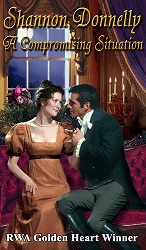
I was happy with the book, and the synopsis I wrote for A Compromising Situation–and the book won the Golden Heart and sold. That was a huge win.

A Compromising Situation

The synopsis then turned into a sales tool for me. From it, I was able to pick out possible cover scenes–because I knew by then that you needed a couple of key scenes in the synopsis to show the relationship developing. I was able to help focus cover copy, and also to write promotional copy that I could use on my website.

Now I realized just how powerful–although still painful–a synopsis could be.

Here’s the opening for that synopsis for A Compromising Situation.

After breaking her heart once years ago, MAEVE MIDDEN now only longs to find a position as a governess in a house full of young girls, where she might have a permanent position and a place to belong.  But can she settled for that after she falls in love with COLONEL ANDREW RICHARD DERHURST, now LORD ROTHE, a man far above her in station, a man who is supposed to be her employer, a man who may not be able to return her love?

And here’s how it fits into Dwight Swain’s advice:

Who is the main character, and what is the situation this character is coming out of:

  • After breaking her heart once years ago, MAEVE MIDDEN

What are the consequences–the bad outcome–from this character not getting his or her goal?

  • …now only longs to find a position as a governess in a house full of young girls, where she might have a permanent position and a place to belong.

What’s keeping this person from his or her goal?

  • …far above her in station, a man who is supposed to be her employer

What are the consequences–the bad outcome–from this character not getting his or her goal?

  • …who may not be able to return her love?

Notice the consequences are not world-ending. This was (and is) a story about people and so the consequences are deeply personal–and, for Maeve, a woman who has experienced rejection before, this type of rejection is deeply wounding. This would be a loss that would scar her.

By this point I’d learned how to stick to the main plot points in the synopsis, to focus on the conflict and the relationship since this was a romance, and I’d learned how to be very picky about each word used in the synopsis so that it was crafted to convey a tone and feel for the story (there’s no sense writing an action-packed synopsis if your story is a character study).

And I’m still learning.

Which is also why I’m still giving the synopsis workshop. Except these days a synopsis has to be even shorter, and even more able to catch someone’s interest. Which is why I call this a “sexy synopsis“. It’s got to be like a little black dress. It’s got to be something you can wear anywhere, and that’s useful as well as sexy–but it has to cover all the vital parts.

Just like the perfect little black dress,  a synopsis can take a lot of work to find all the right parts–the parts that flatter as well as fit. So if you, too struggle with your synopsis, head on over to the workshop at ORIW to pick up more tips and help for learning to get a synopsis that’s more than just something you need for writing contests and queries.

Showing More, or Lessons from Your Favorite Actors

The old adage given to most young (and I mean young in writing years, not in age) is: “show don’t tell.” Good advice, and while there’s a place for story telling in any story, showing is important enough to get top billing. You can see this in action in any decent film with good actors at work.

Actors have to show more–telling in a movie gets you boring exposition or, even worse, the deadly monologue from the bad guy as he explains evSilent Film Becky Sharperything. When you’re working in a visual media, telling ends up being talking heads. So movies have to show more–and actors have to put their characters into action. But novelists get to cheat.

In a novel or short story, the writer can just put down the words: “He was angrier than he’d ever been in his life.” Not great prose, but the reader gets the idea. Give that to any actor, and you’d end up with an actor struggling how to show that on the screen. So that’s one way a novelist can switch over from telling too much to showing more–imagine your favorite actor in the role.

What would an actor do to show this character’s anger on the screen? Would his jaw tense, his fists bunch? Would he hit something? Or would he smile, pull out a gun and shoot someone. Would he turn away, and turn back with a punch? Or would he offer up a cutting remark? It’s those little bits of business that an actor uses to better show their character in action–to put the characterization on screen. And it’s just those bits of business that a novelist needs to create to make a character come to life on the page.

Years ago, I took some improve classes. They were fun, and I was going out with an actor–and it was a great way to meet other cute guys, too. It was also great to get my head wrapped around thinking like a character, instead of myself. I had to start thinking about “how do I get this emotion across” or “how do I show this better?”  And that’s a great exercise for a writer, too–to act out your scenes.

Silent Film Star Theda BaraAnd this is where I study my favorite actors, too. How is he underplaying this scene–getting everything across with just a twitch, or a tilt of the head, or a slump of the shoulders? How is she making me see and feel the sorrow her character is dealing with–and not just with tears? I look for the honest performances–the ones that seem effortless, but which have had all the hard word done before the actors show up in front of the camera. I look for the actors who may know how to overplay a scene for farce, but who also know how to pull back and let their characters listen and react in ways that help me start to understand their characters.

All of this has gone into the Show and Tell workshop I teach–and which I’m giving for OCC RWA chapter this September (starting Sept 11). And it does seem to be the show part that most folks are working on, and which gives them the most trouble.

But narrative is a part of any story or novel–the narrative is often the stitching that holds all those great “showing” scenes together (which is why the workshop is called Show AND Tell).

Regency Actor GarrickHowever, next time you’re watching a favorite TV show or movie, or at the next play you go to, start to watch like a writer (or another actor, or the director). Look for those little bits of business that put a twist on the dialogue, or which reveal a ton about what the character is thinking or feeling. Would you have done something differently in that scene? Chosen to play it another way? Study the pros–and then write a scene that would earn the undying love of your favorite actor if you were to give them such a juicy, emotional scene with so much character hidden in the actions that show us the real person.