Tag Archive | writing

Plotting from Character

rosesI’m going to be teaching a workshop soon on this because it’s something I see in a lot of contest manuscripts–there’s a good start and then the synopsis slips into cliches or takes a left into what comes across as a contrived plot. This comes from forcing a set plot onto the characters instead of developing characters that bring their own conflicts and issues to the party.

Robert McKee who teaches one of the best classes there is on story structure states: story is character and character is story—if you change the story you must change your characters and if you change your characters your story will change.

What this means is that if you approach the plot (the things that happen) from the aspect of forcing certain actions to happen, you’re going to end up with a contrived story—the reader won’t believe the events because they are forced onto the characters. This is where you end up with the heroine kidnapped because she does something stupid, or the hero believes his girl is cheating on him just because he sees her with another guy, or some other external events forces the characters to do stupid things that really don’t match the character’s character.

To avoid this, you look for the story to come from the characters—you set up your characters to generate the plot (the things that happen) because the characters make choices. Those choices have consequences that generate new problems and the need for new choices.

So, how, exactly, do you go about doing this?

1. Start at the deepest point: for every character, find that person’s core need. (And, yes, you need to do this for all your characters, good guys and bad, and secondary characters, too.) Know what every character wants most in this life.

2. Find out why that character needs that one thing. When looking for these motivations for a character’s core need, discard the first two or three ideas. And look for motivations that happen early in life—we’re all shaped most strongly by those things that happen in our formative years.

3. In a romance, set up a potential mate who can’t provide that need for your main character (and know who really is the main character in the story).

4. Decide if your characters recognize their needs and motivations.

5. Go beyond he’s hot and she’s sexy for characters to click emotionally, mentally, and on levels beyond physical.

6. Layer.  Add traits that are strengths and ones that are weaknesses, make them compliment and contrast.

7. Give every character a secret.  Maybe even one that stays hidden in that story.

8. Focus the story on one character’s specific growth—that is your protagonist, and that person’s growth is at the heart of the book. Yes, in a romance you have a hero and a heroine, but one of them needs to be the main focus.

9. Put in clear, specific goals for each character. Avoid negative goals (she wants to avoid being killed)—the reader won’t know if the character archives this goal since it’s an avoidance goal. And make it tangible—a goal to be rich doesn’t mean much since one person’s rich might be a thousand dollars while another’s is a hundred million. In every scene, every character needs a goal. And your characters need a specific, tangible goal that sets the story into action.

10. Make sure every choice (and every failure) has consequences. It’s no good having a character whose goal is a “so what” goal. The character’s life, or at least their image of themselves, should be on the line. If the hero doesn’t get that promotion, he’s got to lose his wife, his home, and never be able to work in that profession again. If the heroine doesn’t find the three hundred dollars to keep her car, she should lose her child because she can’t keep a job and keep food on the table. There have to be costs for failure, otherwise why should the reader care.

Finally, if you get stuck for what happens next, go back to your characters and play the “what if” game with them. Look at throwing more obstacles at your character—how will that person react to this new problem? For example, if your heroine has to get a contract signed to get that promotion to VP to be able to afford the medical bills for her mother’s cancer, what if she finds out the contract is with a mobster? Is she still going to go for it? Or what if the guy does sign—and then shows up dead the next day? What does she do now? Or what if in the middle of the business meeting, she has an asthma attack? How will she handle that?

Look for how to make things worse for your characters—but always look at the story evolving from your characters reactions to those obstacles. Instead of thinking, “Oh, and then this will happen in the story and my character will do that.” Go for thinking, “What if this happens—how would I react to that if I were this person?” And let your story evolve from your characters so that your story is really about your characters, and your characters are your story.

And if you need to know more (or put this into practice), come and take the workshop–we’ll do some hands-on work with this.
Getting More From Online Workshops

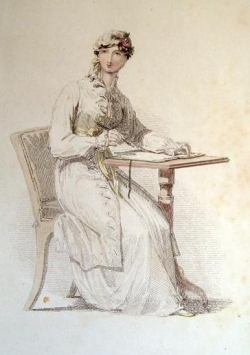
writingdeskI’ve been teaching (and taking) online workshops for a number of years now, and they’re always tricky beasts. The instructor can’t see the students’ eyes, so there’s no using glazed stares to realize the students aren’t getting it, and no seeing the spark of understanding. There’s also a slow down in communication–questions have to be written out and answers written out, and back-and-forth becomes a bit harder. And witting comments can sometimes come across as snide insults (from the instructor or the student). So how do you deal with this and still do an online workshop and get something out of it?

Here’s my recommendations. (And since I’m doing three back-to-back workshops this summer–Plotting from Character July 8 – Aug 4, Writing the Regency Set Novel July 22 –  Aug 18, and a Storytelling Workshop Aug 5 – Sept 1–I hope folks will take notes of what can improve your workshop experience.)

1-Interact–a lot! The more you put into the workshop, the more you’ll get out of it. I’ve “lurked” in some online workshops and I never found them as useful as when I participated. This can be with questions or assignments.

2-Offer feedback. This can be praise or suggestions for what might work for you better. Be polite, but do offer feedback (this is so helpful to me when someone suggests a new idea).

3-Ask your questions. Even if it seems dumb or basic, ask anyway. You might also help someone who is just too shy to ask.

4-Make mistakes. Forget the idea of “doing it right.” Every workshop someone will post the phrase, “I hope I did this right.” It drives me nuts. First because there is no “right” in writing–there’s what works, or doesn’t work. And second because if you were pro and slick at everything why would you need (or take) this workshop? Go in with the mind-set that you’re there to screw up and make mistakes–you’ll learn more from mistakes.

5-Use emoticons. Semi-colon, close parenthesis are great to add a smiley face 🙂 to let folks know you intend to be funny here. For a long time I didn’t use them and I think I ended up with a lot of folks not understanding my humor to try and make a point.

6-Relax and have fun. Workshops should be a safe place. You don’t have to impress anyone there. It’s a place to take risks and try new things and see what works and what doesn’t work.

7-Remember you are getting one person’s point of view. Every writer has a different process. It’s great to find out what works for someone else–and often those tips can help your own process. But not everything that works for someone else will work for you. That doesn’t mean you’re a failure–or that you are not a writer. It means your process is different. Try new things out. But discard what doesn’t work for you. Run everything past the filter of your own writing process and style.

Above all, use the workshop as a reason to get yourself writing! Remind yourself you paid money for that class, so use that as your reason (excuse) to get up early or stay up late to read the lessons and do the writing assignments. Make your writing your first priority, at least for the duration of the workshop!

Emotion

emotionI’ve been thinking about emotion on the page, probably just because I’ve been working on the emotional edit for Diana’s story (Lady Chance). It’s a tough thing to do, and probably the most important–if you can’t feel with the characters, how can you feel for them?

I suspect this is also something that cannot be taught to other writers–lord knows, folks have tried. But you either get into the characters and connect with them or you don’t–that goes for readers and writers. And it’s so easy to get caught up in all the technical stuff–the sentence structure, the words, the punctuation, the descriptions, making the setting work, and covering up plot holes. That’s when you forget the story has to have a heart. The story has to get your blood pumping, it has to pull you in, and it has to connect you to the characters.

It’s why I think every writer falls in love (a little at least) with their fictional creations–we bleed with them, cry with them, laugh with them. And then we want to know what happens after the last page too–which is where sequels are so much fun.

This also makes me wonder if we don’t all read for specific emotions. A mystery when we want tension and danger and excitement, and a cozy mystery when we want that cup of hot tea and scones and to curl up with something comfortable. A romance for…well, duh, romance. A paranormal when we want the world on the page to be weirder than it is in reality (getting harder to get that all the time). Maybe that’s why books have developed those marketing tags–they tell us what we’re going to be reading so we can settle down with the emotion of choice.

And maybe that’s really the heart of our craft–learning to write with that heart that appeals, with that emotion that connects not just strongest to us, but to readers as well. That’s not only a hard thing to learn, but even harder to carry off.

Details, Details, Details

One of the biggest challenges with any historical novel is getting the details right. In the modern world, you can often go experience something instead of pulling the research out of the book. You can talk to a doctor, or a cop, or an EMT and get a lot of great details that you need. With any historical, the details often have to come second-hand from someone’s research.  The biggest trick in all of this is what’s enough?

The first thing you will always want to do with a cool fact is to share this–too many cool facts dug up in research and you can end up with a travel guide, not a story. This is where a reader can help a lot.

Border BrideWith my Regency novella, Border Bride, I wanted the details for the elopement to Gretna Green to be as accurate as possible–and I had dug up a lot of great details from Cary’s Itinerary (a terrific travel guide of the era). Handing the story to a reader, however, turned up the issue that the story was now reading like a travel guide, too. Too many details got in the way of the story. A little editing and the story was back up front where it needed to be.

Stolen AwayFor Stolen Away, another Regency novella, again a carriage ride featured in the story–more elopements, but this one not voluntary on the bride’s part. This was where my experiences with horses helped a lot–I know what it’s like to ride in a carriage and a cart, so those details came easily. But, again, the details had to be there to support the story.

But what do details give you?

Details are what make the world come alive for a reader. And the right details make the difference between a flat one-dimensional character and a fully alive character. This is where you have to know your world and your people. It’s more than just the color of someone’s eyes–it’s about how does that person express emotion (what details give away the emotion to the reader). It’s about the tastes, smells, sounds, and other senses that bring the world alive–what’s the weather like (and does the character like cold weather or hot?)? Sounds and smells are often overlooked details, and are some of the most evocative in terms of putting the reader into a place and time.

Silver LinksIn Silver Links, another Regency novella, the coastline became an important setting–the couple in the book met in Devon, near the coast. The smells of the sea became a part of the book–the sounds, too. And the heroine’s retreat from London to Devon was a vital part of the story. It both gave the heroine time to think about her problems, but it also became a symbol of renewal in the story.

And that’s something else that details provide–they become part of the story’s theme (which is why Silver Links is named that–it’s named that for the links of necklace that is broken, and it’s symbolic of the links of trust broken in the story as well).

So next time you’re reading–or writing–think about what are the right details for the scene? What do you need to put the reader in the room with the characters? What details will work with your theme?

Look for details that are not cliche–these will tend to leap to mind, so dig past them. Go for the detail that comes to mind after you’ve discarded four or five other ideas. Maybe the first idea that comes to mind are flowers and the scent of them–but that’s been used so often (flowers for love, flowers for death). That’s a good time to think deeper–to look at your characters and what would be meaningful to those characters. In a historical novel, those details need context, too. And that’s where you go back to your research to find the right detail you need–but just that one right detail.

Backstory vs. Story

One of the most common bits of advice given to young writers is to cut the first three chapters–this is often good advice. Many a manuscript that I’ve read in contests could have used the first one, two, or even the first fifty pages cut. It’s all backstory, not story. Now, don’t get me wrong–a lot of times the writer needs to have written these pages. Writing helps you get to know the characters, but then you have to ask, “Does the reader really need to know this” and, “Does the reader need to know this in right up front?” Very often, the backstory, but it’s set up stuff. So how do you know what’s backstory.

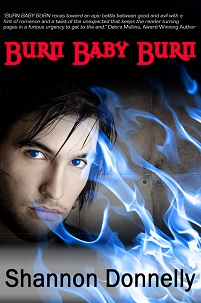
1-Things that happen before the incident that sets the main story in action all belong to Burn Baby Burnbackstory. In Burn Baby Burn, the main story starts with the heroine finding a half-demon baby on her doorstep. That’s what I want on page one to kick off the story. There are small bits of information that need to be woven in later, but having Zie (our heroine) find trouble on her porch sets the action moving. However, I still needed to know more about Zie and Josh (her partner), so I had backstory to write–but that backstory didn’t belong in the story. (You can read these pages in a free PDF here.)

2-Things that impact the character may be needed in the story–but hold onto them until they are absolutely needed. Again, in Burn Baby Burn, I had information about the characters and how they met, but there were also secrets that each of the characters were keeping. I wanted the characters to hang onto these secrets for as long as possible. Josh, the hero, had to give up his secret earlier than Zie, but Zie’s secret was one she was ready to carry to her grave–it’s a huge moment for her to trust Josh with her past, and so hanging onto this information gave it impact in the story.

3-Weave in what the reader does need to know as if it were a strong spice–meaning keep it to a sentence or three, not a paragraph or three. The key word here is “weave.”  Obviously, some backstory helps the reader into the story. You need setting and some background in order for the reader to settle into a scene. Too little information is like throwing a reader into the deep end of a pool and the reader may leave the story rather than try to muddle through. (Or the reader just may not care because there’s so little to care about.) If you think of your story like a good stew, you want a rich flavor–but you don’t want the first spoonful to overwhelm the reader. Or, if you want to use the metaphor of weaving, think of your backstory as threads. You want threads in the weave, not a big lump.

4-Look for the story to start as close to the start of the main story arc as possible. In a romance, this means you want the main characters on the pages and meeting up and having major conflict issues as soon as possible. In other stories, such as Urban Fantasy, you want to get the reader into the fantasy–and the big issues for the characters–right away. The one way to break this rule is if you can make the writing–and the information–utterly fascinating, go ahead and put in a lot of background. However, this takes a lot of talent and work.

5-When in doubt, start with conflict–start when the main character’s life is pushed out of balance. Any character who is in trouble is pretty much automatically in conflict–that character has to decide what to do next. That’s at least going to give you something interesting for the character to do (and so you have a greater chance of grabbing the reader’s interest). In Burn Baby Burn, Mackenzie Solomon is a demon hunter–so finding a half-demon baby on her doorstep gives this character an immediate problem. She has to make immediate choices–she has a problem in her life (and conflict over what to do next). In the next book in the series, Riding in on a Burning Tire, she wakes to find security from work pointing guns at her–an obvious, immediate problem. Stories that start off with the characters faced with choices and conflict and a lack of balance in their lives will tend to pull the reader in more so than a story that starts with a character getting into a car and going to work and nothing happening.

6-Watch out for using action that is only action at the star of a book. This is one of those double-edged swords–done right, action can give you a great action opening. But there are dangers. If you throw the reader into the middle of bank robbery, the reader has no idea who to root for–the robbers or the cops? If you toss the reader into the middle of action, and the writing is not clear and crisp, you can confuse and lose your readers. Action that is just action might give a movie a big bang opening, but if the writing is not brilliant, this can be boring on the printed page. In general, focus more on the characters who are in trouble–strong characters will better pull the reader into your story.

Where Book Ideas Come From

The question most asked of writers might be: Where do you get your ideas? John Cleese, when asked this, likes to reply that he has a little old lady in Cheltenham who gets hers from another fellow and he gets his from…well, you get the idea. He’s making a point that you can’t really pin down where ideas come from: they come from nowhere and everywhere.

Burn Baby BurnThe idea for Burn Baby Burn came from a reader’s conference (thank you RomCon). A bunch of writers and readers were sitting around talking books and covers and what not, and the penchant for babies on book covers came up…and i said the only way I’d put a baby into a book is if the baby was half-demon and trouble on someone’s doorstep. Well…hun–there’s the idea. Naturally, if you have a half-demon baby, it’s going to arrive on a demon hunter’s doorstep–the job of a writer is to make life worse for the characters. From there the story started its own path.

Now the idea can also be about a character–I once had a dream about a woman watching young girls play on a lawn and wishing they were her girls. That become a story about a governess who keeps ending up with girls who don’t need a governess (A Compromising Situation). But an idea is not enough–and sometimes the idea needs to simmer (not forever, however).

A Compromising Situation

Ideas are launch points which then require a writer to sit and write. Characters and complications need to be worked out. Backstory and motivations need to be developed. If you’re lucky, the characters jump onto the page, ready to play their parts with everything in place. Some characters, however, need to be coaxed–and some need more complications that will twist the story (and the idea) into new directions.

But that idea–like the theme–is a touchstone. It’s the place you go back to when you’re stuck. It’s the phrase that makes you–and the readers–excited about a book (and you need a lot of excitement to finish a book). NY Times Bestselling writer Bob Mayer calls this the Kernel Idea. And, like a kernel of grain, it’s got to be planted, watered, fed, and not overexposed to bad weather–too much exposure will kill anything.

So if you’re looking for ideas–look around you. Look at the people you know, eavesdrop on conversations, get into lively discussions, and pay attention. They’re all there waiting for you.

New Book, New Genre

Burn Baby BurnWriting in a new genre always has its risk–in some ways, you’re starting over. Folks who have read my Regency romances may not like the new book, Burn Baby Burn, which is Urban Fantasy. That may seem a huge jump, but it wasn’t–and was a lot like old home week for me. I started off writing YA Horror stories (which I loved to do). And paranormal/Urban Fantasy has a lot in common with writing Regencies–it’s all about the world building…and the characters. The setting wasn’t hard, either–I grew up in and around LA, and I’m very fond of the place. It’s no longer my stomping grounds, but the City of Angels was a natural backdrop for a series about demons/angels and the folks who are trying to keep them from tearing apart everything in between.

The other fun part of Burn Baby Burn were the characters. Great characters are always fun, and when you have demon hunters, who have to get along with demonic jinn (otherwise known as genies), freelancers in the paranormal gray space, and charming charmers who may just be too powerful for anyone’s good…well it’s all good from a writer’s view. All of this made for a great change of pace for me…which is something writers need at times.

We all need to stretch every now and then and try new things and just do stuff because it’s fun. We all start writing with stories in our heads–it’s just that sometimes you get too caught up in the “what will sell” mode and you forget that you started off this adventure to amuse yourself. If other folks come along with you on the ride, that’s great. But it’s also gravy. It’s the bonus that comes after you’ve written the story and sent it on its way to have its own life.

Cool Gus Publishing has given the book a great cover. So even if folks who love the Regency stories (and there will be more of those) don’t like this book, it should find it’s own audience. There’s also going to be more books in this series–that was something else I’ve been wanting to do.

When you write, you fall in love with your characters. They become (or you hope they become) folks that you just want to hang with. I’m particularly fond of these characters–Zie and Josh, and Marion and Felix. They’re not hard to hang with. So it’s going to be fun to head out with them on their next adventure. I hope others feel that way, too.

And isn’t it great that there’s so many avenues for authors these days to bring books out and try new things, and find just the readers who like those types of books.

Getting the Good Stuff In First

There’s one think about all young writers (and I mean young by number of books written not age)–they all want to hold back on stuff. This crops up either in a synopsis (but I want to make the agent/editor want to read the book so I don’t want to tell the secret or big surprise), or in the manuscript (but I want the reader to get to the last part of the book before I reveal this big twist).

Darling writer–you’re not going to get that agent/editor to read the book nor are you going to get the reader to the last part of the book if you hold back on all the good stuff.

Get the good stuff in first. Or look at it this way–does a flower say, “Oh, I’m only going to blossom half way because I want to hold back.” No–it goes all out to give you its best as soon as it can.

Lead with your best. It is not wise or kind to hold back on this because basically you’re risking boring the reader (or worse, confusing the reader). Lead with your best because that’s the best way to hook a reader.

Ah, but now I hear you ask, “What about mystery? What about suspense? What about my great surprise?” Mystery and suspense comes from keeping information from your CHARACTERS (not from your readers). Play fair with the readers. Give them all the stuff they need to know. Then put in suspense by having your characters in the dark–make the characters struggle with understanding everything. Also, keep in mind that most readers don’t really want huge shocks or surprises–they can be very uncomfortable and if not handled well will throw the reader right out of the story.

So get the good stuff in first–it will give you happy readers who can’t wait to turn the page to see what the characters are going to do next. Getting all the good stuff up front, right where it’s going to temp readers into reading more.

Now I hear you say, “But if I use up all the good stuff up front then what goes into the rest of the book.” This is where you have to put in even better stuff. This is where your job as a writer comes into play–you think up even better stuff and get that to the reader as soon as you can.

LOVE YOUR VILLAINS

NY MetNothing marks a writer as a beginner as clearly as the cliché bad guy. This is the bad guy who is ugly inside and out with no redeeming qualities—this is the “boo-hiss” melodrama mustache twirling villain. And this is an easy fix in any story.

What’s that easy fix? Lots of things can help, but here are five quick fixes:

1. What does this character’s mother love about him or her?

Give ever character a mother. In the animated movie Despicable Me, it was funny that the main character (a villain) was largely motivated to please his mother. His opponent—another bad guy—was motivated to please his father. This gave both characters additional dimension and something we all can relate to since we all have parents.

Now the character’s mother may not be someone who bakes apple pie—maybe she’s a bank robber, or she murdered her husband, or she’s otherwise no dang good. But figure out what does she love—and how does she hope her son or daughter turns out better? Maybe she’s proud her daughter is a hit-man? Maybe she thinks her son is just misunderstood? Maybe she thinks tough love will give him a better backbone? Maybe she thinks if she just harps enough at her daughter the girl will marry well? Parents matter—even to a villain.

2. What does this character love?

We all have our favorites—even if it’s just a kind of ice cream. Alan Ladd in This Gun for Hire earned his way into fame portraying a cold blooded killer—but the killer had a soft spot. He loved cats. He’d look after stray kittens, was kind to them—and he was a sociopath. Because of that one soft spot—that love—he was more than just another guy with a gun. That’s what you want for your bad guys—find out what they love and show it in the story. Make it important.

3. Why does this character do bad things?

Motivations matter—they really matter for your villains. It’s not enough that the bad guy wants the heroine for his wife (no matter that she hates him). Why does he want this? Does he really want her money? Is he obsessed with earning her love for another reason? What are the deep, deep roots for what the villain wants?

A villain who just wants to take over the world is dull—it’s been overdone. So give him better reasons. Look at real people—Alexander the Great wanted to take over the world. And his basic reason was to show up his father who’d been good at conquering, too. (See how you get back to parents so easily.) No one is born bad, so what twisted your villain into someone who does bad things?

4. What would make this character a hero?

Turn the story around and look at it from the villain’s point of view. What actions would make this character a hero? We’re all heroes in our own story—we do things that may be wrong but at the time we think we have good reasons and they are right actions. Even Hitler thought he was saving Germany and building an empire that would last a thousand years—in his mind, he was restoring his people to greatness (the problem being it was his ideas of “his” people).

Maybe your villain has great reasons for doing what he or she must do—maybe she or he even regrets the need for bad actions. Or maybe your villain has no regrets—what must be done for the good of all must be done. Righteous villains can be really scary people.

5. Give your villain a trait you’d love to have.

Make your villains easy for you to love (makes ‘em easier to write, too). Give them, a trait or traits, you’d love to have. Maybe your villain is a decisive person, able to make up her mind at once. Maybe your villain is like Cruella de Ville and is a style-monster. Maybe your villain sings opera and keeps songbirds.

Make this trait also matter to the story—Cruella’s obsession with black and white fashion drives the story in 101 Dalmatians.

It’s that kind of love/hate that keeps readers intrigued with any bad guy—and you’ll have a lot more fun writing a villain you’d also love to be.

Originally posted at Writers in the Storm blog.

The Fear Factor

“I’m convinced that fear is at the root of most bad writing. . . . Good writing is often about letting go of fear and affectation.” – Stephen King

Up in a balloonFear shows up in a number of ways, and hits each of use differently. It shows up a lot in the only workshops I teach.

It shows up in excuses (I’m too old, I’m too busy, I won’t try this because I don’t understand).

It shows up in procrastination (I’ll catch up later, I’ll try the exercises after the class on my own).

It shows up in perfectionism (I’m awful because I didn’t do this right, I failed, I suck, I’m stupid).

It shows up in a refusal to try new things (I’ll post this old story bit instead of writing anything new).

And I can see it every single time. Then we have the brave souls who face their fears dive in and fall on their faces. I applaud that. Because they’re learning. Which is the point of a workshop. It’s supposed to be a safe place to try things, to experiment. Instead, I see so many writers who are afraid to spread their wings—as if one mistake is going to be a disaster.

Folks—we learn from our mistakes. Go out and make more of them.

I am amazed how many people resist this idea. They want to be praised. That’s not good. That’s not going to help you learn. What does help is the rewrite and the revision and the experiment. Try something new. Write a scene. Then rewrite it from a different viewpoint. Just because. Throw stuff out there. Try something in first person if you’ve never done first person. Or in present tense. Just try it out. Tell yourself that:

a) it doesn’t have to be perfect

b) it doesn’t have to be good

c) it can actually be really awful

Just let it be what it’s going to be. Then read (aloud so you catch what you’ve really done) what you’ve written and look at what you can learn from what you did. Look at what works. Look at what doesn’t work. Keep the good stuff.

This happens when I cook, too. I’ve made some awful things—I once put too much baking soda into my gingersnaps. They came out Alka-seltzer hockey pucks—hard and fizzy if you chewed on one. Great for your digestion (if you needed it), and not something anyone would eat (not even the horses would go for them, despite the sugar on the outside). Learned a great lesson on baking soda from that one.

Same applies to my writing. I’ve written awful scenes (and I expect I’ll keep doing that). Sometimes the dialogue clunks like a flat tire. I’ve tried first person, third, second, even. Present tense, past tense—it’s all about stretching those writing muscles and trying new things. You don’t know what really works until you’ve tried it.

I’ve written books that are not for everyone (go read the reviews)—sometimes folks hate my character (hey, it’s better than indifference). And I worry about all of it. I still get the nerves going and I still wonder if I’m any good at any this—no amount of praise ever takes that worry away.

The point of this is you’re never going to get over your fear.

Live with it. Know it’s there. Let it flow into you and out of you again and go write anyway. Use the fear—let it keep you sharp. Let go, too, of the affectations that King talks about—which means get out of the way of your characters. Let them tell you their story and stop pushing them into plots that don’t work. Stop being so damn writerly and just get clean words onto the page.

And if you need more good words from Stephen King buy his book On Writing: Memoirs of a Writing Career. Or read more at: http://grammar.about.com/od/advicefromthepros/a/StephenKingWriting.htm

(First published at https://writersinthestorm.wordpress.com.)