This October, I’m doing a workshop on Estate Workers for Regency Fiction Writers. One thing that turned up when researching the workshop was the growing importance of tea, sugar and milk in the diet of the average person in England during the long Regency era.

We tend to think of tea in Georgian England as a luxury item, but while it started off that way, prices were falling by the late 1700s. The teapot at left dates to 1780 and shows what would become the ‘Brown Betty’ style of Staffordshire pottery, with its dark Rockingham glaze. This is the sort of teapot that could be found in a middling class household, which would include some estate workers. It is far from the highly decorated tea and coffee sets created for the upper class by Wedgewood, Doulton, and others who sought royal patronage.
As noted, like coffee and chocolate, tea had started off an expensive luxury. Duties were put on it because of this, which meant in the 1600s on to the late 1700s it was a main good for smugglers. Random Bits of Fascination notes, “Smuggled tea often came from Holland where it might be purchased for as little as 7 pence per pound.” That means smuggled tea was already drifting down into the middling classes.
The Commutation Act in 1784—pushed forward on the advice of Richard Twining of the Twinings Tea Company—reduced tea taxes from 119% to 12.5% of the price. It was no longer worth smuggling, and tea drinking spread to the growing middle class and into the working class. Tea became available in multiple prices with different grades available. Some household also provided a tea allowance for servants, and tea leaves would also go from the drawing room, to the housekeeper and on down the line of servants, with inside servants first, and then outside servants.
A New System for Domestic Economy, published in 1823, speaks to, “The universal use of tea, as an article of diet…” and devotes multiple pages to economical types of tea and efficient brewing. It notes, “…the best Green Hyson, at about fourteen shillings per pound…the best Black Souchong at about twelve shillings…the Souchong, since the common leaf at six shillings…” This shows the variety in prices. It also says that two ounces of tea per person per week is a way to economize, with sugar at three quarters of a pound over the week.
Tea shows up in the tightest of budgets at 7d and a ha’penny for 2 oz. (bought at 5s per pound) when the family income is only 24s a week. Lesser incomes than that do not include tea in the proposed budget. At an income of 30s a week, the budget allows a quarter pound of tea for 1s 3d, with sugar for the week also costing the same shilling and thuppence. Milk is only 7d and a ha’penny for the week This shows how tea could be affordable for anyone in the working class, including those on an estate with good wages.
As noted in the paper ‘Importing sobrie ‘tea’: Understanding the tea trade during the Industrial Revolution’ by Kabeer Bora, “Sugared tea and white bread became the nutritional mainstays, it supplanted the traditional produces of milk, cheese, ale, meat & oats.” Tea and sugar begin to be drunk by all but the poorest of the poor, with tea, milk and bread being seen as mainstays of the English diet. This is pushed even more so by factory work that showed up in the Regency era.
Bora goes on to write, “A report of the Factory Enquiries Commission in 1834 showed that many mill owners were allowing workers tea breaks of 15 and 30 minutes in Derbyshire and Lancashire. This break was given to them between lunch and closure (Factory Enquiries Commission, 1834).” Tea, with sugar and milk, is credited with increased calories in the average diet, and with improvements in health overall. The English habit of weak ale and small beer still would continue, but tea would go on in the Victorian era to even become the name for the working class evening meal.
To put all of this into a bit of context in the modern world, today we generally buy tea in bags (not invented until the 20th Century) with a box of tea bags being only around 1.4 ounces in total and holding 20 to 30 tea bags. If you are thrifty, you can get two or three cups from one bag, so 2 ounces of tea for about 7d could go a long way, and a pound of tea, or 16 ounces, is a considerable amount of tea.
Another good source of information is Empire of Tea: The Asian Leaf that Conquered the World by Markham Ellis, Richard Coulton, and Matthew Mauger.
If tea could not be bought, there was the ability to make a tea from the wild fruits, herbs and flowers from any estate garden (if you have horses, an alfalfa–more commonly called lucerne in England– while not the best for a tea, can be made up).
While the old standbys of ale and small beer as drinks for estate workers continued on through the Regency–particularly as the main drink in the fields during harvest time, the idea of a cuppa tea in the evening or early morning was growing. And more on Estate Workers of the Regency era will be in the workshop.



 I’m doing a
  This is a huge issue in any book—it was one I faced in A Cardros Ruby. In an early draft, the heroine came off as too cranky and hard-edged. She was not likeable. Now, she had her reasons for being how she was, but she wasn’t someone you wanted to root for. That meant she needed major work to bring in some things to make her likeable. I had learned about this when I wrote the heroine of A Dangerous Compromise. She’s a spoilt girl who eventually redeems herself—or at least shows a good side—but that came too late in the story for many readers who just didn’t warm to her. And I can understand that.
 I’m teaching a
 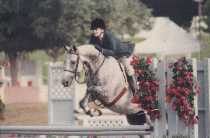 All this means horses have always been part of my life. My aunt—also a horsewoman—taught me to ride side saddle. I went to England to get my riding instructor’s certificate and learned to drive carriage horses—and I got to hunt (meaning vast amounts of time standing about, then galloping to a new cover and more standing about, but it’s all on horseback, so not a bad time at all). I’ve shown hunters, jumpers, dressage, three-day, and did a year of western riding, and now only ride the trail for fun—my show days are behind me.
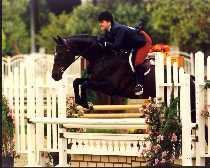 I’ve also been bucked off, rubbed off on a tree, had a horse fall with me, dealt with barn sour, rearing horses, dirty stoppers, and a load of other problem horses. I’ve galloped race horses (and you really do have to get up all too early for that), and then I’ve had wonderful horses who would do anything for me–including the splendid Drake shown in the photo above (who hated to be left out and insisted on always having his stall door open so he could join in the fun), and the handsome Woody (the photo on the left) who was a perfect hunter, but never got the hang of fast turns in jumper classes.
 I judge a fair number of writing contests–my way of giving back since I learned a lot both from entering and judging. One thing almost always pops out–experienced writers know how to punch dialogue. And nothing marks a writer as a “beginner” as much as flat dialogue.

 Shannon Donnelly's Fresh Ink