Tag Archive | story

Tension in The Story

One of my favorite quotes about writing comes from Kurt Vonnegut (and if you haven’t read the classic Slaughterhouse Five, I recommend it highly). In Vonnegut’s 8 Rules for Writing, he notes, “Every character should want something, even if it is only a glass of water.” That is a brilliant observation, and this provides natural tension for any scene or the opening of a story.

The actual definition of tension is anything stretched tight. This gives any writer a lot of room. The reader’s curiosity about a character’s background can be stretched out until it becomes tight. A character’s quest for a goal can be stretched very tight with failure after failure. The reader’s interest in how a romance achieves a satisfying ending is yet another way to stretch tension.

All this means is that every character always needs to want something in every scene—this creates automatic tension since the question exists of will that character get it or not, and if so how will the character go about getting that desire.

The other brilliant part of Vonnegut’s rule here is that the want can be simple—it doesn’t have to be world peace or victory over evil, although those are certainly options. Small wants can lead to stories with lots of tension if that want means a lot to the character—or to the reader.

In any romance, the tension is never will they end up together. The tension comes from the HOW—how will this romance end in up a relationship that lasts. In a murder mystery, the tension is HOW will the murder be caught, and this can be wonderfully dark in a mystery where the murderer is also the protagonist. In a horror story the tension is about HOW will the evil be defeated—and it must be defeated, not just avoided, for the world to come back to normal.

All this leads me to the summary that tension needs to start with the first line of the story—that is where the first pull on the reader needs to happen. This means this is a great place for the protagonist to express a desire that is going to lead to the reader asking about how that character is going to get

The desire doesn’t have to be stated as the obvious—it can be implied. The opening line for Slaughterhouse Five is, “All this happened, more or less.” The reader knows there is a narrator who wants to tell a story—and the tension is started with a tug on reality. What is the more, what is the less? That question pulls on the reader, giving us some tension.

It can also be the first paragraph that gives the tug on the reader—that first start of tension in the story. In a novella I write, Border Bride, it starts: “She had been mad to agree to this. Stark, staring mad. So of course it must be love.” The inference is that the viewpoint character wants this madness to be love—she has a desire. The tension is set in the doubt underneath this that perhaps she is wrong, which is why she is doubting the action she is taking. That is the first tug that not all is right in this character’s world.

I think too often writers who are just learning their craft think they have to have big conflict, or big tensions, when it is often the tug, tug, tug of smaller events that better build the tension of the story, taking the reader along step by step into another world.

This is one reason why I love writers such as Elizabeth Daly, a mystery writer who set her books in the 1940s—when she was writing. Check out this wonderful opening line to Unexpected Night, “Pine trunks in a double row started out of the mist as the headlights caught them, opened to receive the car, passed like an endless screen, and vanished.” Wonderfully understated. The want is implicated—the viewpoint character wants to get somewhere. It doesn’t need the obvious stated. It’s also moody, sets the tone for a mystery, and the reader can settle down to enjoy a master story teller at work, caught in the subtle tension of where are we and who is heading into these mists?

Elizabeth George, another master of the craft, opens What Came Before He Shot Her—a why done it—with, “Joel Campbell, eleven years old at the time, began his descent towards murder with a bus ride.” We have tension galore in this line—and we wonder why this boy might want to kill someone. A want, and a tug on the reader. In the opening to The Vine Witch—a luscious novel that should be read and reread—by Luanne G. Smith, we have, “Her eyes rested above the waterline as a moth struggled inside her mouth. She blinked to force the wings past her tongue, and a curious revulsion followed. The strangeness of it filtered through her toad brain until she settled on the opinion that it was best to avoid the wispy yellow-winged ones in the future.” The tug is the, that bit of tension—a toad? Why is she a toad? What happened? She—the toad—might want a meal, but not out of this moth. What will happen next? The promise is here of a world that beckons us inside.

We also have Jane Austen who gives us the much quoted opening from Pride and Prejudice, “It is truth universally acknowledged that a single man in possession of a good fortune must be in want of a wife.” Again, we have a narrator’s voice—an assurance from the first line that we can settle back and trust we will be amused and entertained. But the tension is there. Why is this such a truth—is it really? Who is this man with a good fortune, and what wife does he want? The questions are implied, which is what makes this such a good draw. The reader gets the fun of reading the implications behind the statement.

So this is what the opening of the story should do—it should start to tug on the reader with a want, an implication, a promise of a good read ahead in this story. The tug can be a big one, or a small one, but it must be there. This is the start it says, this is the beginning of the ride—this is not all the stuff that came before, or the background. It offers the tension of want unfulfilled, a need unmet, a curious moment that beckons the reader to step into another world. The background is teased in with other tugs on us—we want to know more because of that tension introduced, and always made greater with more and more tugs. It can be a slender thread that keeps pulling on the reader, but pull we must by offering characters who want things, and questions we raise with a promise of answer coming later if you but keep reading.

How do you Plot?

notquietThere are as many ways to plot as there are writers. However, one thing I’ve learned over the years is that if you have an idea where you’re going, it can save you from having to do massive revisions. This is not to say you have to know every detail. Sometimes knowing too much can keep you from writing the story–you feel as if it’s already been told.

A balance between too much and too little is my happy spot. I want to know the big moments in every act. I want to know the character arc I’m building–and I want that arc to be the story arc. That’s where I see a lot of writers get into trouble–they build an action arc instead.

Now action can be great–in a mystery, or SF, or a Western. It’s not so good in a romance, which has to be character based. And character-based stories are what I prefer. But character-based stories need to be plotted from the character (not the action). This idea is what led me to my Plotting from Character workshop, which I’m teaching this September for the Contemporary Romance Writers.

handsThe idea behind the workshop is that if you plot from trying to think up actions to happen, you’re more than likely going to end up pushing your characters around as if they are paper dolls. The characters are going to come across as one-dimensional and not well motivated to take the actions demanded by the plot (because the plot is being pushed onto them, not pulled from who these characters are). The other problem is the plot is going to seem contrived–the author will have to manipulate the characters to make these actions happen. That’s going to strain the reader’s ability to believe in these characters (and their situations).
How do you avoid this? Well, that’s the point of the four-week workshop. But there are some tips:

  1. Create one main character–this is your protagonist. I know this seems obvious, but it is amazing how many writers write as if they are really unsure who is the protagonist. This is not the narrator. This is the character who changes the most in the story (and who faces the most problems).
  2. Create an external goal for the main character that is tangible, so the reader knows if the character gets it or not. (There should be consequences for failing to achieve the goal. Failure should be personally costly to the main character. And those consequences are the motivation for wanting this goal.) This will drive your action and needs to be known to the reader as soon as possible (in the first ten pages is best).
  3. Figure out the main characters’ person’s core internal need. This should be something in conflict with that character’s goal so you get automatic conflict for that character between what that person wants and needs.
  4. Make sure you have strong motivations (the why) for a character’s core need. Discard the first three or four ideas (those will be clichés).
  5. Internal motivations are strongest if tied to a specific event in the character’s formative years—create these scenes (you may use them in the story).
  6. WHY is the most important question to keep asking and answering–why would this person act this way? Why do they want that thing? Why must they do this now? Never stop asking this question.
  7. Have a theme in mind–it will help you enormously as you shape all your characters and the story. Theme helps you figure what to put in and what to leave out.
  8. Create secondary characters around the main one, with clear needs, goals and motivations for every character–and with more and more conflict.
  9. Layer in strengths and weaknesses for all your characters–develop them so characters do more than show up to advance a plot.
  10. Leave room for your characters to surprise you.

Obviously, there is more to the art of plotting from characters. But if you keep the story focused on your characters–and keep asking would this person really do this?–then your stories are going to become much stronger.

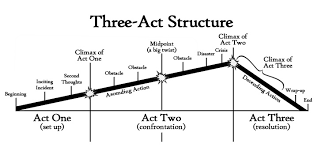
3act.png


Better Stories

cakeI read a lot of manuscripts as contest entries and a lot of them have the same basic problem–the story doesn’t start on page one.  It’s far too easy for a writer to get caught up in the details. Those details are necessary to make the fictional world come to life. You can focus so much on the right word or the right sentence or fixing the paragraph that you forget that readers want a great story. That’s the most important thing.

A few years back I noticed there were workshops on all parts of writing–dialogue, pacing, showing and telling, viewpoint. I teach a few of those and they’re important. But even more important is how to make all of this come together in a way that makes for a great story. Think of it this way–you can have flour, sugar, eggs, milk, salt, baking powder and still make a terrible cake. It takes knowing not just the list of ingredients, but how much do you need and when these should be added, and how to mix and bake them–you can’t just throw them all in a bowl and expect something wonderful.

That’s why I do a workshop on storytelling. I’m teaching it again this September for RWA’s OCC. It is a dense class with a lot of information but the focus is on story–on getting a great story onto the page. Meaning it’s about looking at the list of ingredients–viewpoint, dialogue, pacing, showing and telling–and how to mix them together into something tasty.

So…are you focusing on story? On your characters? Or are you too focused on details?

Plotting from Character

rosesI’m going to be teaching a workshop soon on this because it’s something I see in a lot of contest manuscripts–there’s a good start and then the synopsis slips into cliches or takes a left into what comes across as a contrived plot. This comes from forcing a set plot onto the characters instead of developing characters that bring their own conflicts and issues to the party.

Robert McKee who teaches one of the best classes there is on story structure states: story is character and character is story—if you change the story you must change your characters and if you change your characters your story will change.

What this means is that if you approach the plot (the things that happen) from the aspect of forcing certain actions to happen, you’re going to end up with a contrived story—the reader won’t believe the events because they are forced onto the characters. This is where you end up with the heroine kidnapped because she does something stupid, or the hero believes his girl is cheating on him just because he sees her with another guy, or some other external events forces the characters to do stupid things that really don’t match the character’s character.

To avoid this, you look for the story to come from the characters—you set up your characters to generate the plot (the things that happen) because the characters make choices. Those choices have consequences that generate new problems and the need for new choices.

So, how, exactly, do you go about doing this?

1. Start at the deepest point: for every character, find that person’s core need. (And, yes, you need to do this for all your characters, good guys and bad, and secondary characters, too.) Know what every character wants most in this life.

2. Find out why that character needs that one thing. When looking for these motivations for a character’s core need, discard the first two or three ideas. And look for motivations that happen early in life—we’re all shaped most strongly by those things that happen in our formative years.

3. In a romance, set up a potential mate who can’t provide that need for your main character (and know who really is the main character in the story).

4. Decide if your characters recognize their needs and motivations.

5. Go beyond he’s hot and she’s sexy for characters to click emotionally, mentally, and on levels beyond physical.

6. Layer.  Add traits that are strengths and ones that are weaknesses, make them compliment and contrast.

7. Give every character a secret.  Maybe even one that stays hidden in that story.

8. Focus the story on one character’s specific growth—that is your protagonist, and that person’s growth is at the heart of the book. Yes, in a romance you have a hero and a heroine, but one of them needs to be the main focus.

9. Put in clear, specific goals for each character. Avoid negative goals (she wants to avoid being killed)—the reader won’t know if the character archives this goal since it’s an avoidance goal. And make it tangible—a goal to be rich doesn’t mean much since one person’s rich might be a thousand dollars while another’s is a hundred million. In every scene, every character needs a goal. And your characters need a specific, tangible goal that sets the story into action.

10. Make sure every choice (and every failure) has consequences. It’s no good having a character whose goal is a “so what” goal. The character’s life, or at least their image of themselves, should be on the line. If the hero doesn’t get that promotion, he’s got to lose his wife, his home, and never be able to work in that profession again. If the heroine doesn’t find the three hundred dollars to keep her car, she should lose her child because she can’t keep a job and keep food on the table. There have to be costs for failure, otherwise why should the reader care.

Finally, if you get stuck for what happens next, go back to your characters and play the “what if” game with them. Look at throwing more obstacles at your character—how will that person react to this new problem? For example, if your heroine has to get a contract signed to get that promotion to VP to be able to afford the medical bills for her mother’s cancer, what if she finds out the contract is with a mobster? Is she still going to go for it? Or what if the guy does sign—and then shows up dead the next day? What does she do now? Or what if in the middle of the business meeting, she has an asthma attack? How will she handle that?

Look for how to make things worse for your characters—but always look at the story evolving from your characters reactions to those obstacles. Instead of thinking, “Oh, and then this will happen in the story and my character will do that.” Go for thinking, “What if this happens—how would I react to that if I were this person?” And let your story evolve from your characters so that your story is really about your characters, and your characters are your story.

And if you need to know more (or put this into practice), come and take the workshop–we’ll do some hands-on work with this.