Tag Archive | Regency Romance

The Palais-Royal: Dissolute, Elegant, Busy and a Setting in Lady Lost

Palais-Royal arcade, soldiers and women in empire dresses. Lanterns glowing overhead under the arches.

By 1815 the Palais-Royal was already known for being the place to go in Paris not just for a meal, but for gambling, and to indulge in every other vice. John Scott wrote of his visit to the Palais-Royal in 1814: “It is a square enclosure, formed of the buildings of the Orleans Palace; piazzas make a covered walk along three of its sides, and the centre is an open gravelled space, with a few straight lines of slim trees running along its length.”


Scott called it, “…dissolute…wretched, elegant…busy, and idle”
The palace began life in the early 1500s as the Palais Cardinal, home to Cardinal Richelieu, but became a royal palace after the cardinal bequeathed the building to Louis XIII. It eventually came to Henrietta Anne Stuart who married Phillipe de France, duc d’Orléans. That’s when it became known as the House of Orléans.


The building was then opened so the public could view the Orléans art collection, and that began the palace’s more public life. Louis Philippe II inherited the royal palace, and the duc renovated the building, and the center garden was now surrounded by a mall of shops, cafes, salons, refreshment stands and bookstores. The Parisian police had no authority to enter the duc’s private property, which meant it became a hub for illegal activity, and the cafés, particularly the Corazza Café, became a haunt of the revolutionaries. During the French Revolution, the duc dropped his title, changed his name to Philippe Égalité and even voted for the death of his cousin to the end monarchy. That didn’t save his own head. But the Palace-Royal continued on.


Scott writes, “The chairs that are placed out under the trees are to be hired, with a newspaper, for a couple of sous a piece; they are soon occupied; the crowd of sitters and standers gradually increases; the buzz of conversation swells to a noise; the cafés fill; the piazzas become crowded; the place assumes the look of intense and earnest avocation, yet the whirl and the rush are of those who float and drift in the vortex of pleasure, dissipation, and vice.”


On the ground floor shops sold “perfume, musical instruments, toys, eyeglasses, candy, gloves, and dozens of other goods. Artists painted portraits, and small stands offered waffles.” While the more elegant restaurants were open on the arcade level to those with the money to afford good food and wine, the basements offered cafés with cheep drinks, food and entertainment for the masses, such as at the Café des Aveugles.


After the Bourbon restoration in 1814, the new duc d’Orléans took back his title and the Palais-Royal kept its reputation for a fashionable meeting place. It was said, “You can see everything, hear everything, know everyone who wants to be found.”


Scott visited Paris during the peace of 1814 and wrote of the shops, “…they are all devoted to toys, ornaments, or luxuries of some sort. Nothing can be imagined more elegant and striking than their numerous collections of ornamental clock-cases; they are formed of the whitest alabaster, and many of them present very ingenious fanciful devices. One, for instance, that I saw, was a female figure, in the garb and with the air of Pleasure, hiding the hours with a fold of her scanty drapery: one hour alone peeped out, and that indicated the time of the day…. The beauty and variety of the snuff-boxes, and the articles in cut-glass, the ribbons and silks, with their exquisite colours, the art of giving which is not known in England, the profusion and seductiveness of the Magazines des Gourmands are matchless.”


The bookshops sold erotic prints along with French classics, and political pamphlets and the restaurants were crowded every evening and night with anyone who could afford the price of a bottle of wine and a fine dinner. Upstairs were the gambling houses and bagnios, and as Scott wrote, “…the abodes of the guilty, male and female, of every description.” Lanters illuminated the crowds that strolled past along with dancing dogs, strolling musicians, singers, and “….Prostitution dwells in its splendid apartments, parades its walks, starves in its garrets, and lurks in its corners.”
Scott spoke of “The Café Montansier was a theatre during the revolutionary period…” Just such a café/theater went into Lady Lost, as the place where the heroine Simone, also known as Madame de Mystére, practices her illusions.
In March 1815 the Palais-Royal saw more soldiers than it had in ages for Napoleon brought his troops to Paris, chasing out Louis VXIII.

Scott’s book, A visit to Paris in 1814, was published in 1816.
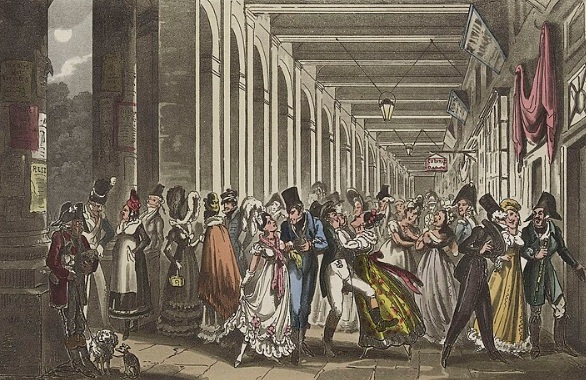
Palais-Royal 1815, a crowded scene of ladies and gentlemen cavorting. A beggar musician and two dogs stand to the left. Overhead are the lanterns and the opening to the gardens is shown between the pillars.

EXCERPT LADY LOSTJules and Simone dine at the Palais-Royal


Simone stood at the entrance to the Café Lamblin in the Palais-Royal. Even this late, some lingered over their supper. The looking glasses that lined the wall facing the street emphasized the crowd. The other walls, painted white and trimmed with gilt, shone in the light of the Argand lamps set between the silverware and china placed on tables covered with white linen. Ornamental iron stoves warmed the vast space, and four clocks, hung high on the walls, showed the hour as well past eleven. Perhaps three dozen diners remained—gentlemen and ladies, soldiers and courtesans. In Paris, anyone and everyone chose the pleasure of dining out when they had the money to pay the bill. Her mouth watered at the aromas haunting the room—soups and meats, liquors and wines, and the sweet scent of fruit and ices melting into their glasses upon the tables.
To her right, behind a barrier and seated on a rise, the lady proprietor took payment from two men who shrugged into their coats and donned hats. Simone handed her cloak to an attendant and waved for Jules to do the same with his outer garments. A waiter appeared, a long white apron around his waist and flapping at his ankles, partly covering a black vest and breeches. With a bow and a snap of his shoes against the marble floor, he showed them to a table and handed over broad, paper menus.
Jules stared at the printed sheet. “Not as extensive as that of Le Beauvilliers but far better prices.”
Simone glanced around the room. The wine and liquors flowing endlessly—along with coffees—and waiters dodged tables with trays of food and drink. Laughter and conversation rolled across the room. No one in Paris liked to refuse the flow of francs into the hand, not even for so late a meal.
She glanced back at Jules. “Prices? Do not be so provincial as to think that is all that matters.”
Putting aside his menu, mouth twisted up on one side, he shook his head. Blue eyes gleamed bright. “Oh, but I am just that. A wine merchant who has never before been to Paris, I am amazed by such an extensive printed menu. Order what you wish. I think we can stand the nonsense.”
“You may regret that,” Simone told him.
She ordered lobster soup from a choice of half a dozen others, cold marinated crayfish, chicken fricassee with truffles in a sauce of leeks and oysters, duck with turnips from an array of roast birds, a side dish of asparagus and one of early peas, a dessert of cheese and nuts, and a bottle of Volney, which Jules sipped and sent away, ordering a Latour instead, which indeed tasted better but would take more coins from his purse.
Dishes came and went. Jules kept up an astonishing chatter about Paris, the food, droll comments on the other diners, and everything but what lay between them.
She pushed at the peas on her plate with her knife and glanced at Jules. “You manage to say a great deal without saying much of anything.”
He held still as only he could, studying her, eyes a sharp blue in the glow of the Argand lamps. “The art of polite discourse. It is second nature. Would you care for more of the duck? I must say, they have a pleasant way with it. The skin is crisp and the taste a delight. They must feed them good corn before they come to the kitchens. Then you may tell me if you think Henri had any part in poor M’sieur Breton’s demise.”
Putting down her knife, she propped one elbow on the table and cupped her cheek with one hand. “That is…no, tell me first, what transpired with those men who took you up? Why do you not speak about that?”
He pushed at a slice of duck with his fork. “Will you in turn tell me if your brother would have jumped for the chance to meet up with the not-so-good duc in my place?”
Straightening, she smoothed the napkin on her lap. “Do we talk of such things here? Where others might listen?” A woman’s laugh pulled her attention to a table with four soldiers and two ladies whose dress—or lack of such a thing—proclaimed their status as those who sold their favors.
Jules waved his wine glass at the room. “Everyone else is bent on pleasure of one sort or another. We might be the only sober souls in this fine establishment.”
She traced a fingernail along the edge of the tablecloth. “Henri…he would not…no, M’sieur Breton was his friend. A good friend.”
“Had he known the man long?”
“No, but that is Henri. He charms everyone quickly. We only met the m’sieur after we come to Paris. Now do I get a question?”
“It has gone beyond coincidence that your brother is a friend—or perhaps I should say was—friend to the late M’sieur Breton. Now we have the duc embroiled in events—the Butcher of Lyons you named him—and it all has me wondering if your parents might have lived in that charming city. Perhaps during the Revolution? That automaton reveals also that your father was a man who made expensive clockworks for those with money.”
With a small shrug, she took up her wine. “What would you have me say?”
“You may act as casual as you wish—you are practiced at that with your stagecraft—but I will have the story. Consider it a fair exchange for dinner.”
“What of payment in an answer for an answer? I am curious, too, and have questions. Why are you not in London? Do you have no wife, for you keep only the mistresses?”
“Multiples is it? You think perhaps I have one woman for each day of the week, or perhaps only one for each season of the year? They are expensive things, and I have no wish to beggar my estate for any such entanglements.”
“Then you have casual liaisons? Was that true of the woman you once wanted to marry as if…for one that, you sound as if you don’t want to speak of her at all?”
“My past has no bearing on the incidents of tonight. It is yours that stirs my interest. May I serve you more of the chicken? You may then tell me of this tie between yourself and Lyons, for you speak of the past as if it is far too present, and the excesses of Madam Guillotine’s rampage certainly reached everywhere in France. Come now—a straight question and a straight answer. Did the Butcher of Lyons touch your family?”
“The past can haunt us all—can it not? What is it you really do in London? Do not the ladies interest you?”
“Ah, now you make me into a gentleman who spends all this time only with other gentlemen. I’ve had other things to occupy me—the world has been sorely troubled of late, and ladies…courting takes a great deal of work. There are rides and walks and dancing to be done. Flowers sent, and if you get that wrong they either wilt too quickly or any real interest does the same. Turn your back but once, and the lady is off on some other man’s arm. Now, what of you? I expose myself, but you remain the lady of mystery? Since you ask it of me, I shall be forward as well and ask why you are unmarried?”
Holding up her hand, she ticked a count on her fingers. “I do not plan to marry a soldier, and look around just now—that means most men in France. Second…actors. I meet many and I follow Maman’s advice and leave them to flirts only for it never ends well.”
“That does not surprise overmuch.”
“Third…” She wiggled her fingers and picked up her fork again. “Third is that I do not want to keep a shop, or run a tavern, and even that sort thinks a woman who goes onto a stage is not respectable, but I am!”
He reached for one of the plates to serve himself more asparagus that had come out with an excellent white sauce that did tempt her, but she would not allow him to divert her focus. She put her hands in her lap.
Glancing at her, he put down the asparagus. “If you will not finish this, I shall. Will you have more of anything else?”
She plucked a green spear from the plate and waved it at him. “Answers. Why are you not in the army? Is not every man fighting on one side or another? Why are you really here? We are back to you talking around and about. Do you think I do not know distractions? That is the principle of sleight of hand.” She bit into the asparagus, then licked her fingers. When she held up her hand again, a coin glinted in her finger tips. With a quick move of the other hand, the coin vanished, and she showed him bare palms.
Putting down his fork and knife, he fixed his stare on her. Heat bled into her face, but she met that direct gaze of his. For a moment, he pressed his mouth tight and hesitated as if making up his mind about something.
Finally, he threw his napkin onto the table. “Very well, if you must know, you must. As to a uniform, it was considered, at least by me, but responsibilities kept me from doing more than that, along with…well, at the time—and this was a long time ago—the woman I wished to court had vapors at even a mention of something so vulgar as fighting and armies. Odd, really, considering she eventually deserted her husband to run off with a sailor. Actually, a captain at the time, although not in the British Navy. However, I also have wretched aim, and while I look very good on a horse, I am not given to charging about. I prefer to think things through and take my time, and that is a quality I found I could put to use elsewhere.”
“Bah—you still tell me nothing. What do you mean, ran off? She is alive still? And she was married when you wanted to court her, or she did marry elsewhere after the courting?”
“We slip from the more pressing topic at hand—that of your brother’s involvement in a death.”
She stiffened. “Do you tell me…did you…? This woman, she is—is no more?”
“Please do not speculate. Far too much of that has dogged me over the years. What I will say is that seventeen is a very stupid age, one I am grateful to have outgrown. Also, her husband suffered more than I at that time. But the situation as well as my family history stirred up old talk about my family, for scandal dogs us like hounds on a high scent, even when I should rather leave all of it far behind.”

Lady Lost is Available March 20, 2025

Lady Lost

Lady Lost – Coming March 2025

Lady Lost

Some stories just take more time—and this one took ages! Part of this is due to the research needed for Paris in 1815. Part is just due to Jules being a reticent character who took a bit of coaxing before he finally agreed to this. Another part comes from the interruptions of life. But at last Lady Lost, the third book in the Ladies in Distress series, is done and coming out March 2025.

Below is an excerpt from the book…

Chapter One
Paris, March 1815

She stepped onto the stage in a ripple of smoke, shadows dancing on the white plaster of the wall behind her. Jules sat straighter in his chair.
The illusion of fog was a good one. It would hide any trap doors. The actress took one step forward, into the light of the stage lamps. Makeup left her oval face pale and perfect—a slash of dark, arched eyebrows, a curve of a red mouth. Under her black cape and hood, the brown of her elaborately arranged hair showed through glistening white powder. Her skirts rustled and the spangles on her gown glinted. The dress belonged to a previous generation, but the woman moved with the grace of youth. She swept the room with a look…a challenge…arrogance in the dark eyes.
For an instant, their stares clashed.
Awareness shot through Jules and tingled on his skin. The woman commanded the stage—and his attention.
Her gaze seemed to linger a heartbeat longer before it shifted. He let out a breath.
With a wave of her hand and a burst of smoke, she conjured a box with thin legs onto the stage. A good trick from Madam de Mystére, otherwise known as Simone Raucourt, the featured act. She was his connection to Henri Allard…and the missing courier.
Shifting restless in his chair, Jules glanced around the theater. It was more of a café with its tables and chairs, and its black-and-white checkered floor. Past splendor haunted the décor with bits of carved columns in dark corners. Two chandeliers clung to the ceiling as if desperate to hold onto past glory, their crystals dusty and dim. The crowd had quieted. Those sober enough to give their attention leaned forward. For an instant, irritation surged that he must wait for his answers.
“Patience, patience,” he muttered, keeping his words in French, not English, his accent that of his old governess who herself had come from Paris.
He let his gaze slip back to the stage.
The woman proceeded to conjurer a bouquet of violets—the symbol for this rebirth of Bonaparte’s Empire. She transformed them into a deck of cards and back again, and threw a few into the audience. They cheered. More cards appeared from the ether. Fanning them out, she changed the suits all to hearts. She managed several other sleights of hand. Coins did not go over well, but scarves in the tricolors of France’s Revolutionary flag had the audience going wild.
Turning to the box she’d summoned onto the stage, she beckoned with a slim, pale hand. An oddly still monkey in a blood-red coat rose from inside the box to perch on its top.
Jules had seen more than a few automata—mechanical beings that ran on some sort of clockwork with gears and cams, metal discs with the edges notched to create instructions. Most played an instrument, while others could write or draw. One, he recalled with a smile, had been an extraordinary swan made from silver. It caught fish from glass rods that appeared to be reflective water.
This mechanical monkey sat before a tiny harpsichord, bits of black hair glued to its head and the backs of its paws. Glass eyes shone in the lamplight with the illusion of life. The uncanny creature mimicked playing a sweet tune, its paws moving over the keys, which depressed on their own. The music obscured the click and creak of the mechanism. Madam de Mystére sang along, a plaintive melody about home and loss.
She had a good voice, a deep contralto that would enchant anyone. An ache wound through her song. The audience quieted. Some stared into their drinks. A few wiped a tear. No doubt everyone here knew someone who had died for France—the wars drained more than a few villages of every able-bodied man. Jules turned his drink on the table once, like winding a watch that might turn time back to better years. The conjurer had power, he had to give her that. Her emotions seemed heartfelt. Perhaps she, too, had lost a brother or father to the wars. He tightened his fingers around his tumbler.
Life had left him wary of maudlin sentiment.
He shifted on the chair and wished he could pull off his boots. He knew himself not in a mood to be pleased. The hour for his dinner had long passed, this café stank of onions, wet wool and the acid of inferior wine, and his feet ached from tramping over this damp city.
Allowing the last note to trail off into silence, the actress held still. The spangles on her dress sparked with each breath. She lifted her hand. The automaton did the same, a small pistol slipping down its coat sleeve and into its mechanical grip.
The audience gasped. Jules did not.
The female magician held up a card. A sharp report stung the air and sulphury gunpowder bloomed. The woman turned the card so all could see the image of the king shot through the center. The symbolism could not be clearer—royalty shot dead. Cheers rose, along with stomping.
Deciding he’d seen enough, Jules stood and gathered his hat and gloves. He tossed a coin onto the table and made for the door at the side of the stage pausing long enough to speak to a waiter to ask directions and pushing a few francs into the man’s hand.
On his way to the dressing rooms upstairs, he spotted a spray of violets on the floor, one tossed into the audience by Madam de Mystére. He hesitated, and then gave into impulse. He swept up the tiny purple flowers. He brought them to his nose only to have silken petals brush his skin. That left him wondering if the woman who had thrown the flowers was as false as the violets.

OCC Book Buyer’s Best Finalist – Davinia’s Duke

Davinia's DukeI am so behind things–that’s what happens when you spent the summer teaching an EMT-Basic class (you end up reviewing lectures and tests, as if you were taking the class yourself). But that’s done–everyone passed (yeah!). And now I can catch up on new.

Some of the best news is that Davinia’s Duke is a finalist in the OCC RWA chapter’s Book Buyer’s Best contest for novellas. This is delightful not just because OCC was once my home chapter back when I lived in California, but because it’s a contest judged buy booksellers and readers.

So thank you, OCC, and thank you readers and book buyers!

The novella took longer to write than it ought to have–life interfered, and then the story stalled out, and shorter is always harder than longer. It’s also a quiet story–mostly just people on the page talking, which is one of my favorite kinds of stories, but not everyone thinks that in a world where if there’s not an explosion or a big fight scene it’s just not exciting. It is nice to know there are other readers looking for something a little quieter.

The indieBRAG Medallion

Davinia's DukeDavinia’s Duke–my most recent Regency romance novella–has been awarded the indieBRAG Gold Medallion. I’m delighted by this–it is my second independently published book to earn the medallion, which is awarded based on ten categories. This award is a boost for authors who publish independently–promotion is always hard to come by.

The other thing that is wonderful is the award encourages independent writers to make sure they have good editing, and good copy editing. Again, both those things can be difficult to come by. A good editor will improve the work without messing up the writer’s voice. A really good editor can also point out glaring problems that really do need to be fixed–pacing problems, plot holes, or just stuff that doesn’t make sense. Let’s face it, we all get lost in the woods at some point and need someone else to point out a better path.

Copy editors are then just as important–not only to catch the typos (the ones that hide from your eyes because your brain insists on making the correction in your head and not on the page), but to also finish untangling things that crept into the story.

I had very good editing from Leigh Kaye, and a great copy edit from Red Adept Editing, and a cover that fit the story from What the Hay Designs, which all goes to show that a book needs a team behind it, and not just a writer.

I also think that it is the writer’s job to first produce as clean a story as possible in the very beginning–and I used some beta readers just to make sure the story worked. My philosophy is that as the writer, I should know where the flaws exist to begin. If the early readers don’t catch them, then the magic act has worked. If they do catch the issues, then it’s time for revisions. And I like to get all those revisions done early. Because, guest what–yes, every new word on the page introduces problems for more plot holes and pacing issues and other mistakes. First draft is always first draft and needs another draft or two for some polish. However, the caution there is that it is possible to polish out the emotion on the page–so that’s where experience helps and some caution.

So…here’s to a nice, shiny gold medallion on the book, and to independent authors who publish their works! May we all strive for great stories with great characters.

My First Pre-Order — Davinia’s Duke

This is the first time I’ve done a pre-order….wheee, a new book coming out. It’s been some time. So what’s on pre-order?

Davinia's Duke: A Regency Romance NovellaA too perfect duke, a very imperfect lady…is it the perfect match or a perfect disaster?

A duke in need of a wife…

The dukes of Everley always marry at thirty–but the current duke has left choosing a bride far too late. Arriving at a country house party for a Valentine’s ball, he expects to find one suitable young lady to be the next duchess. He doesn’t expect to find the woman he once kissed in a garden–the woman who was the bane of his life for a season, and who might be the only woman who can save him from becoming a far too proper duke.

A lady in need of her own life…

Davinia has never forgotten that one kiss in a garden—but she has also been married, widowed, and intends to keep her niece from making the mistake she nearly made when she allowed the Duke of Everley to kiss her. But when the house becomes snow-bound, Davinia begins to realize there is a warm-hearted man under the weight of a title. Is it too late to correct past mistakes and rekindle a love she thought lost?

This was a story that took a long time–why do I keep forgetting that shorter often means harder. Everything has to be just so in a novella. Life got in the way…weather got in the way…and being away from a story means it takes time to pick it up again.

The story is due out July 23, right with the Beau Monde conference where I’m speaking. I still have a ton of things to do before then (like start on the next story, which I’m already researching and outlining). But it is fun to have a new story coming out!


Speaking About Writing…

tbm4

I’m delighted to announce that The Beau Monde, the Regency chapter of the Romance Writers of America has asked me to be their keynote speaker at this year’s conference in July. This is not just a lovely honor–it feels to me like a continuity of writers. It’s been 25 years since The Beau Monde was started–that’s a generation. And my how the world has changed, particularly for writers. I think that’s actually one of the attractions to Regency England–it’s a world that is safely in the past, with all the changes done and over with, and a much easier world to navigate in many ways. (Of course, you still have wars, and you have a lack of penicillin, other bad medical care, and not much in the way of rights for women or anyone else other than a rich, white male, oh, and let’s not forget the desperately poor along with some other problems–but let’s not dwell on the negative.)

One of the advantages of writing about the good stuff in the Regency is that it is possible to provide an escape back to a world that’s a little less complicated, a whole lot slower, and a lot of style. But I’m jumping  ahead of myself–it’s off to New York (not my favorite place it the world, but I am looking forward to a cross-country drive to see a bit more of the US) for The Beau Monde conference.

In the meantime, I have a Regency romance novella to finish up!

Settings & More

ballroomtuilarisIt’s always tough to figure out where to start a story–and I find a lot of this applies to the setting for the story. Some settings automatically suggest themselves. The opening of Lady Scandal seemed automatic–if an English lady is fleeing from Paris when the peace of 1803 breaks down, the story is going to open in Paris. For the follow up book, Lady Chance, the setting wasn’t so obvious.

Lady Chance takes up Diana’s story–she was a secondary character in Lady Scandal, and she met a French captain and they sparked. But in taking up Diana’s story, the question was when would she have a chance to meet up and have a happy ending with her captain?

With England and France at war from 1803 to 1814, that’s a long time. Would Diana meet her captain when he was a prisoner of war in England? Or what about meeting during the Peninsular war in Spain? Could there be any good outcome in either of those situations, and did I want to get into Spain and the problems there–particularly with things going badly for the French army.

I did have some scenes I wrote, with the idea of Diana and her captain meeting up after the battle of Vitoria–there was a thought of having some fun chasing after the Spanish treasure that went missing. However, those scene stalled out early on. The setting was fun…but it wasn’t really working. Which led me back to Paris.

paris_russiansParis in 1814 was a lot of excitement–and fun. It was a city overrun by armies, and by the English arriving, and the possibilities seemed vast for any story. There was also the glitter factor–let’s face it, slogging around the muddy Spanish countryside or being able to use the settings of Paris left me wanting to write about Paris.

Now, I’ve never been a huge fan of Paris, but then I visited–I won a trip there, which is another story–and fell in love. Paris isn’t just a city of light, it’s a city dense in history–it escaped the destruction of many wars, and you can turn a corner and see how a street looked exactly in 1814. Paris loves its museums–and the art, oh, the art! And since Paris only made a brief appearance in Lady Scandal, with Lady Chance I’d have time to dive into more of the city–the old gates, the houses, the cafes, the gaming salons and the shops. The setting proved to be as much fun as the story.

I’m thinking ahead to the next book in the series–Lady Lost–and I think Paris will again be part of the story. There’s even more to dive into with that setting. But we’ll see if we take up with Napoleon’s hundred days, or just after Waterloo, for both times are again rife with plots and schemes, and plenty of great dramatic material.

Lady Chance 01_smREAD AN EXCERPT FROM LADY CHANCE

Only at Amazon.com

“That is a deathtrap! An explosion waiting to go off!” Diana put her hands on her hips.

Taliaris turned with a startled glance. “What? Where is the girl who once traveled with Gypsies? Who rode a donkey cart? Who did not seem to mind anything that was a new experience?”

“She, thankfully, had her adventures and learned to set idiotic notions aside.” She let her hands fall. With a shiver, she pulled her cloak tighter. “I did not think you knew about the cart.”

“Oh, we followed you and your aunt most diligently—from Paris to the coast. A pretty girl is always remembered.”

Diana gave a huff. “Flattery will not get me into that.” She gestured to the boat moored at the riverside quay. It was not a large ship, perhaps thirty feet from bow to stern, but steam puffed from the back where a boxed engine of some sort squatted. Metal gleamed in the moonlight, and a soft, chugging sound came from the boat . She gave a sniff and asked, “Why can you not have stout watermen to row us?”

Taliaris stepped from the quay and into the steam ship. It swayed but did not sink—not a point it its favor, Diana decided. He held out a hand for her. “I have already paid for our tour. And the Seine is the best way to see Paris. Besides, we are not stepping into an untested invention. In France, we have had steam in use for years. You English will soon be wanting nothing but its more reliable power.”

She grimaced. “Rely upon it to explode, you mean. I read about just such a contraption tried upon rails in London years ago which ended in disaster due to too much power trapped in too small a space.” She tried to stand her ground, but since he kept his hand out, his eyebrows arched and his expression expectant, Diana could see no options. Oh, she could abandon the evening with him, but that was not a choice. Jules wanted her close to Taliaris. She gave another sniff and she put her hand in his.

He didn’t wait for more. Putting his arm around her, he swept her into the steam ship. She gave a squeak and closed her eyes tight, clutching at him, her heart beating quick and expecting… Well, she had not expected him to be so strong. Taliaris set her down, but she was reluctant to let go. She like his scent, how it clung to her. She liked how she felt in his arms—sheltered, an unusual sensation for her. The boat rocked under her feet, and water lapped gently against the stone quay. The scent of water—and burning coal—gave a tart tang to the air, mixing with the spice from Taliaris. She opened her eyes and peered around Taliaris’ broad form to where the steam engine puffed and hissed.

“The devil’s own noise. How can this be the best of anything?” Still gripping his arm, she glanced up at him and asked with a small amount of hopeful pleading, “Are you quite certain you do not have watermen?”

A smile twisted up Taliaris’ mouth. He pulled away from her hands and left her. “Abandoned already,” she muttered, shivering a little under her cloak. She swayed again as the boat bobbed. Sitting down before she fell down seemed a wise idea, so she did. The wooden bench was only a little damp, and she had her cloak and gloves to save her gown from ruin and her skin from the worst of it. She turned to look back at the stern.

Taliaris stood talking to the three sailors who obviously managed the boat—rough fellows all of them, with dark hair and eager eyes once Taliaris produced a coin purse and coins coming out of it. One sailor scrambled to cast off the moorings, another headed to the belching engine, and the ship turned its bow into the river. Diana gripped the edge of the bench and bit down on another panicked squeak. She began to honestly think this was a devilish invention, and Taliaris a beast for bringing her onto it. Was he testing her? Trying to terrify her? Or simply inured to danger from too many years of battles?

Easily making his way to her, Taliaris took her hand and pulled her to her feet. A brazen thing to do, she thought. He ought to wait for her to offer her hand, but then she had already quite made up her mind he was utterly and refreshingly lacking in the qualities of a gentleman. He guided her to the bow and settled her on seats with cushions. That was an improvement. The boat chugged along with a not unpleasant, rhythmic sound. She lifted her face into the breeze. Spray from the water touched her cheeks, but she preferred that to the faint, oily smell that came off the engine.

Stretching out on the seat next to her, Taliaris began to talk about the steam power that was become so popular. “Andre Dufour—a man I know—it is his cousin who owns the Mirabelle. He built her two years ago and she has had no accidents.”

“Yet, you mean.” She threw out the words with a challenge and glanced over her shoulder to the white steam, winding its way up from a funnel. “At least it also provides warmth—a pleasant thing on a night, but what of a hot summer day?”

“You are determined to see nothing but bad in this.”

“And you are an optimist when it comes to new contraptions. I did not expect that of you.”

“You think a man who fights knows only how to fight? That was not the example set by the Emperor. Innovation. That is the key to win battles in these years. To build nations. The Emperor sought to make Paris—to make France—first among all.”

Diana locked her hands around one knee and leaned against the back of the bench. She tipped her head to the side. Might as well dig a little to see if she could pull out information that Jules would find useful. “You still admire Bonaparte even though he is now banished to a small island?” she asked.

“Politicians gave him up. He would have fought for France still, would have defended Paris. I know he wrote to the Convention to tell them so. I had friends on his staff, but the cowards in Paris…” Shaking his head, he let the words trail off. His mouth had pulled down, and she could sense the impatience flowing off him. He obviously did not care much for politicians.

“But what?” she prompted.

He glanced at her, his eyes dark and unreadable in this dim light. Shadows danced over his face, easing the lines the years had put on him, but showing the hard edges he had acquired. “This is not a night to speak of sad things. You wished to see Paris, did you not? Let us see what is good and right before us.” He swept out a hand, and Diana turned to stare at the city. Perhaps that was better—safer. For that old tug of attraction to him still pulled on her. She drew in a sharp breath and stared at Paris.

Music floated to the river from nearby great houses, and illuminations for the new king still flickered on some of the buildings. Taliaris gestured to the lights. “Candles or carbonic gas is lit within transparencies affixed to the windows. Would you call that a danger, too? Another unsafe invention?”

Diana slipped a sideways glance at Taliaris. She found him watching her, his arm slung across the back of the bench behind her. If she shifted an inch, his fingers would touch her shoulders. She stayed still. She was not quite certain she wanted to forget anything between them—not the bad, or the good. “Tell me more of what innovations you would have. Would you back them with your own investment?” And do you need funds from others for that—would that tempt you onto the wrong path?

He gave a snort that might have been a laugh. “My family will be lucky enough to keep our lands, I think. But others will come out of these times with titles to their names and money in their pockets.” She could not see his face, but he sounded tired and a little frustrated.

“Oh, do not be so surly.” She waved a gloved hand at him, brushing off his tone and his words. “Bonaparte restored titles and lands to those he favored and those who kept him in power. Do not chide your new king for planning to do the same.”

“Spoken like a true daughter of a monarchy.”

She stiffened. His words held a harsh bite, and she found she resented them being thrown at her—by him of all people, a…a mere soldier. “Your last king would have done better if he had acted with far harsher measures when his troubles first began. He might have kept his head, or at the very least saved his wife and son and prevented his daughter’s suffering!” She bit off the rest of it. She was saying more than she should—and she was here to pull words from him. Instead, she was flinging opinions at him. That would get her nowhere.

But it seemed it had.

Taliaris’ mouth curved in an inviting and warm smile—he looked honestly amused and some of the tension in him seemed to ease.

Overhead, stars glittered bright, splashed across the sky in lush abandon. The moon glimmered pale on the eastern horizon like a fat bowl tonight. It seemed a night for the romantic—for forgetting the past perhaps.

Taliaris’ voice dropped to a low murmur near her ear and his breath brushed her skin. “Meaning he should have sent those who talked revolution to prison, as does your king and your princely regent? I have heard you like to tout how free you are, you English. But I also read of how you treat those who print complaints—anyone who speaks or writes that kings are a thing of the past is soon locked away. Your England fears any real freedom.”

“And it worked so well to have a Committee for Public Safety instead—to behead anyone who dared speak against your glorious Revolution, to call everyone citizen even when more than a few were using that as an excuse to gain enormous power. When you killed your king and queen you invited a war upon France and paved the way for a dictator. What sort of freedom is that?” Skin hot and pulse quickening, Diana threw her hands wide. Taliaris gave a short laugh, and she glared at him. “You think it amusing for a woman to express her views? Of all the patronizing and—”

“Hush.” He put a finger to her lips. “I think you sound a woman who bottles what she thinks up far too much, so it comes all out in a burst. Tell me, do your Englishmen not want to listen to you speak of politics?”

Diana pressed her lips tight—they tingled slightly from his touch. Taliaris did not wear gloves and his skin had been warm, his finger slightly calloused. She sank back upon the bench. Just who was pulling words out of whom this evening? Her shoulders brushed against Taliaris’ hand, but she had her cloak between her skin and his touch. She did not move away. It was too chilly an evening, she told herself, and then danced away from that lie.

Settling back into a flippant tone, she told him, “First off, they are not all my Englishmen—well, one was, and yes, he did listen, but I do not think he particularly cared. Chauncey was not the least political.”

“And second?”

She gave a wave of her hand. Let us get back to trying to know what you think and plot—or if you plot anything, she told herself. “There is no second. Do Frenchwomen not speak their minds? I had heard your emperor did not much care for intellectual women, or so Madam de Stale has told the world.”

“I speak of the women of the Revolution. They fought for freedom. Or they tried. My mother was one of those who embraced the principals—liberty, equality, fraternity. She held those to be everyone’s rights, rich or poor, titled or not.”

Ah, now we get to someplace interesting. She tipped her head to the side. It seemed that he came from a family of revolutionaries. Her parents would have been horrified if she had ever brought him home—her father had been a staunch Tory from a family of even stauncher Tories. She only said, “I cannot think that gained her much. It is far easier to join one group by hating another.”

“That sounds as if you have experience of such a thing.”

She lifted one shoulder in a small shrug. Why not trade him something of her past in the hopes he would say more—so far he’d been maddeningly vague, meaning either he was very good at keeping his secrets or he had none to share. She glanced at him and said, her voice light with scorn, “Politics are everything when it comes to angling for a marriage during the London season. One learns the art of compromise, the ability to negotiate under pressure, and the value of hiding one’s true desires in order to advance one’s long-term goals. And, of course, family must be put first.”

“So the individual is sacrificed? What you want does not matter? And there is no such thing as equality.”

She gave a laugh at such an idea—equality within the London marriage mart, where wealth and beauty mattered most? Absurd! “Not much fraternity, either, not amongst too many ladies with too few eligible gentlemen. I hold France to blame for that.” She drew off one glove and tapped a finger on his arm where the gold braid and buttons of his uniform glinted in the light from the illuminations on the river’s shores. “How can any young man resist the lure of a dashing uniform? You should know about that. It left London’s ballrooms—and most of the bedrooms—frightfully empty.”

“Yours was not.” He threw out the words in a flat tone, and she could not tell if he was mocking her or not.

She turned away and folded her hands in her lap. This was not a direction she wanted to take in any conversation. “That is an assumption.”

His voice dropped so low that she barely heard it over the thump of the steam engine. “Do you say your husband did not love you? He did not want you?”

Lips pressed tight, she glanced back at the engine and the shallow wake arrowing out behind the ship. Traces left behind them—that all they had now, an imprint from the past that faded almost as soon as it had been made. She was done with this line of questing—Jules would have to wait to find out if Taliaris wanted his emperor back or not. Although she was starting to think he was as little a political animal as she.

“Do we turn around now?” she asked and forced a bright tone into her voice. “I think I have seen enough of Paris by night. I think it must be prettier during the day. At least now that spring is come perhaps some flowers may bloom. But it has grown chilly.”

“No.” He took her chin in his hand, his fingers gentle, but his touch still forced her to face him. “You do not get to evade my questions.”

EXCERPT FROM LADY CHANCE

Lady Chance 01Available on Amazon.com

FROM LADY CHANCE…

Giles glanced down at his English girl. That pretty bow mouth of hers had taken on a mulish set. She arched one eyebrow. He thrust out his elbow for her to take his arm. “Is it possible you are called Lady Chance because there is such a high probability you will throw yourself into trouble?”

“Would you rather I throw you into trouble? If so, tell me how I may oblige in that manner.”

“You would oblige me more if you did not insist on this.”

“Oh, no, my dear Giles. Too much gratifying of such whims as those would lead to spoiling your glum countenance. You might actually smile and we cannot have that. You would cease to be the stern major and your mystery might unravel.”

Giles had no time to answer. They had crossed the room. His uncle watched their approach with speculation bright in his silver-gray eyes. Françoise stood still, his arms folded and his shoulders hunched, looking ridiculously young, more like a boy than a man. After his first glance at Diana, Françoise straightened and appreciation warmed his eyes.

Giles made the introductions in French and finished by saying, “This is my graceless brother who has no time for me now he has come to Paris.”

“No, no, Giles—that is too unkind. You paint me as a care-for-nobody when it is you who are always called off for some parade or duty.” Turning to Diana, Françoise put a hand over his heart. “I assure you, milady. I have left my card three times at my brother’s lodging. But he is a hero now and has no time for family.”

Eyes bright, Françoise grinned. He shared the same tea-brown eyes as his brother and the same deep-brown hair. However, Françoise wore his hair long. The light caught chestnut mixed with the darker shades in soft waves and the silky strands almost invited a touch. Diana’s heart tightened. Giles had once been just so open-faced.

She glanced at Giles and saw his frown had not softened to his brother’s teasing. She tapped Françoise’s arm with her fan. “You must not pull your brother’s tail, although it is nearly irresistible. I am certain he thought only of his family when he put on a uniform. But now you must tell me of the entertainment to be had in Paris, for I am newly arrived and have not seen the city in years.”

Nodding, Paul-Henri smiled. “Not since your aunt had to flee with you back to England, I understand.”

Françoise’s enthusiasm dimmed. He glanced once at his uncle and back to Diana. His expression dropped into a cool mask. “My mistake, milady. I took you…your French is very good. You have not the mangling of our words like most English.”

“That is flattery indeed. I had a French governess. But now, because I am English, I lose all my charm?”

Françoise’s cheeks pinked. He stammered out a denial, but Giles’ uncle interrupted again. “Oh, we all much admire you English, but we do so better when you are at a distance.”

“Sir!”

“No, Giles,” Diana said, opening her fan to ply it. “Pray, do not rebuke your uncle for the truth. It is as refreshing as a winter’s breeze.”

Paul-Henri gave a shrug. “Paris can be chilling to those unaccustomed to its shifting winds.”

Diana put her head to the side to consider. She was not yet certain if she liked this man. She had the sense of being weighed by him and found a little wanting. In such a case, she had no difficulty living up to his very low expectations.

She put on a vapid smile. She had perfected it years ago to bore unwanted suitors into abandoning her. “Oh, la, sir! You make a jest. Chilling indeed.” She added an empty laugh. Paul-Henri frowned. She turned to Giles’ brother. “And you also wish us foreigners to blazes? What was your recent fuss about—a republic, was it not? But that cannot be right, for you had yourself an emperor in its stead.”

The color lifted high and bright in Françoise’s face. “The ideals of the Republic still live! And the rights we had under—”

“Françoise,” Paul-Henri said, his tone sharp. He lifted his cane to wave it between Françoise and Diana. “Do not bore the lady. Milady, forgive us. We have forgotten how to entertain. You asked about amusements. Françoise, did you not see a play just the other evening—a delightful diversion?”

Paul-Henri forced the conversation onto safer topics, although Giles’ brother, Françoise, could not seem to recall the plot of what he had seen. Diana fixed a smile in place, nodded when it seemed necessary, and watched Giles from the corner of her eyes.

He seemed willing to allow his uncle to lead the conversation. However, Diana had the impression that Giles was only proving to her why she should take no interest in his relatives. Paul-Henri did not seem to think much of the English. Françoise obviously not only did not wish to be here but had nothing to say to an Englishwoman. The young man moved from reluctant to positively sullen. Diana would have laughed except that would have mortified the poor lad. The uncle seemed content to allow his nephews their moods, but he was quite skilled at orchestrating events.

He managed to pack off both gentlemen, taking Giles to task for not fetching Diana refreshments and sending Giles’ younger brother to call for their carriage so they might leave. Left alone with the older gentleman, Diana closed her fan and wondered why he wanted a word with her. She did not have long to wait for an answer.

Paul-Henri placed both hands on the carved head of his cane and gave a nod. “You need not bother with the smiles. You are very good at them, but as an old dissembler to a younger one, I urge you not to waste your talents.”

She stiffened for an instant, but let out a soft breath and kept her smile. “Oh, it is never a waste to practice one’s skills. I had not trotted out this particular expression in ages. It must be almost as rusty as my accent.”

“No, both are excellent. But if you were as vapid as you have just seemed, Giles would not have looked at you as he did earlier.”

“What look would that be?”

His smile widened. “You might be good for him, milady. Or you might be his death warrant.”

“Really, now—so dramatic!”

He lifted a hand. The gold ring on his little finger caught the light. Like his nephews he wore no gloves. Unlike his nephews, he had soft, white hands. “These are times of high drama. And your cousin, Lord Sandal, is it not? He is placed to decide such things? Or perhaps he is just another English come to visit. It is so difficult to tell who is who these days.”

Diana silently had to agree with him. And why were all these Taliaris men so interested in Jules? She folded her hands together in front of her, feeling more like a schoolgirl than she had in years. “Sir, we could fence with each other for hours and as entertaining as that might prove it would advance nothing. Perhaps you would care to come to a point about something?”

“Or perhaps not. You do know that my nephew plans to return to Bordeaux to the family vineyards. He seeks a life that is all too…quiet.” He made the word sound worse than exile.

Diana could not resist looking out over the crowd to find Taliaris. Would such pastoral peace be good for him? Or would the lack of action leave him bored and fat? Or would the countryside be just the respite he needed from the world? She glanced back at his uncle. “You mean he is not for the likes of me? He needs a quiet wife to go with such a life?”

“I did not say that. Perhaps he knows his own desires—or perhaps he only thinks of a change without knowing just what sort of difference he needs, eh? But Giles returns with a glass of something for you and his scowl for me. Lead him a merry dance, milady. I think that is what is best for him just now.”

“And you, sir? What is it you seek from this evening? This introduction, which you now have? I played to your lead, but I think your trump did not yet take the hand.” He looked at her, his stare sharpening. Diana smiled. “We should play cards someday, sir. I think you are not often well-matched, and I should like to empty your pockets.”

His mouth twitched. He took her hand and bowed over it. “I am never matched, well or otherwise. And I do not play at games. Enjoy this visit, milady, but keep your bags packed.”

She frowned at his words. But Giles returned to her side, and she had to turn to take the glass he held out to her. She sipped the wine, something white and dry, and gave a small shrug. “Very well, I shall say it.” He lifted one eyebrow in inquiry. She shook her head for an answer. “You had the right of it. I should not have forced an introduction. Your uncle now thinks I am a flighty woman—or at least the wrong sort of woman. And your brother has no love for anything—or anyone—English. And I thought my family difficult! But they are, for Jules has deserted me, or at least has taken himself off somewhere. Shall we scandalize everyone with a second dance? Or perhaps we could flee for a walk along the Seine and air that does not reek of perfume and too many schemes?”

He stared at her for a moment. His eyes seemed so dark as to be almost black and she could not read what expression lay in the depths. But he took her hand—a dreadfully forward habit of his—and started for the stairs.

Regency Triva

mealI’m going to be teaching a workshop in June on Regency Food and Seasons because when you write historical romances you tend to end up knowing a lot of odd things. And I love this kind of trivia.

For example, sugar used to come in cones–you’d scrape off what you needed. And recipes usually did not have measures–a goodly handful is often give as amount to use.

Or did you know tea used to be locked up in lovely tea boxes for the tea leaves were far too valuable to leave lying about.Enameled tea box

Or that in the early 1800’s Nicholas Appert won 12,000 francs when he invented a method to preserve food in glass–Napoleon had wanted this for as a means to better preserve food for the French Army. However, this method was not widely used, and canning would not come about until well after the Regency.

Food preservation, however, is ancient, with the more common techniques being salting and smoking, or the use of vinegar to pickle food.

It amazes me, too, how modern folks often don’t think about an era when food was not always available. I garden so I’m always looking forward to my seasonal produce–but what you can grow in England during its seasons is a different world from California or New Mexico where I now live.

Food tastes, too, are quite different.

Captain Gronow remarked on how London Inns always served “‘the eternal joints, or beef-steaks, the boiled fowl with oyster sauce, and an apple tart.'” Hmmm…maybe that’s not too different from modern London pub grub. The English at one point used to eat a lot of lamb (and mutton), too.

For Leg of Mutton, Mrs. Rundell’s recommendation is, “If roasted, serve with onion or currant-jelly sauce; if boiled, with caper-sauce and vegetables.” Personally, I would swap in lamb for the mutton and opt for roasting it. My grandmother who came from Yorkshire insisted on boiling all meat, and nearly made vegetarians out of all of her sons.

hannahGBut I also love digging out bits and pieces such as a “recipt against the plague” given by Hanna Glasse in The Art of Cookery made Plain and Easy. She also offers not one, but two certain cures for the “bite of a mad dog, one of which is both given to the “man or beast” bitten as well as recommending to be bound into the wound. Makes you wonder how big of a problem were mad dogs? Perhaps a large one given that there were no rabies shots.

Back in the 1800’s the day had a different pace to it–lunch was not a common meal, and you have servants for almost all classes except the poor. This makes for a lot of advice coming out in the mid 1800’s for how to deal with servants–one of those lovely problems we all wish we had. Oh, to have to supervise the house maid and oversee the cook instead of having to do for oneself.

All of this makes for a lovely bit of trivia to share.


The Regency Meal, or Food, Glorious Food

Hanna GlassThere is something wonderful about food. Why else would we watch shows about cooking, buy cook books, and even enjoy reading (and writing) about food. Regency England was also an era that enjoyed its food.

There was interest enough in food skills that by 1765 Hanna Glasse’s The Art of Cookery, Made Plain and Easy had gone into nine editions, selling for five shillings if bound. (Back then, one could buy unbound books and have them custom bound to match the rest of the books in one’s library.) Hanna’s book remained popular for over a hundred years. However, her recipes can be difficult to translate into modern terms–the quantities often seem aimed to feed an army, as in this recipe for ‘An Oxford Pudding’:

“A quarter of a pound of biscuit grated, a quarter of a pound of currants clean washed and picked, a quarter of a pound of suet shred small, half a large spoonful of powder-sugar, a very little salt, and some grated nutmeg; mix all well together, then take two yolks of eggs, and make it up in balls as big as a turkey’s egg. Fry them in fresh butter of a fine light brown; for sauce have melted butter and sugar, with a little sack or white wine. You must mind to keep the pan shaking about, that they may be all of a light brown.”

I’ve yet to try this recipe, and when I do I’ll probably substitute vegetable oil for suet, but it does sound tasty.

Amounts in older cookbooks are also often confusing to the modern reader, often listing ingredients to be added as handfuls, as in the rue, sage, mint, rosemary, wormwood and lavender for a “recipt against the plague” given by Hanna Glasse in The Art of Cookery made Plain and Easy.

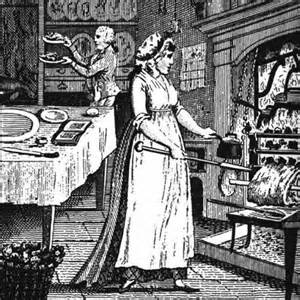
Brighton KitchenThe time spent on making these recipes could also be considerable. This was an era when labor was cheap, and if one could afford servants, they could provide that labor.  The Prince Regent’s kitchen in Brighton was fit for a king of a chef, and large enough to allow an army of cooks, pastry chefs, under cooks, and scullery maids. It also sported windows for natural light as well as large lamps, and pillars in the shape of palm trees to carry on the exotic decor of the rest of the Brighton Pavilion. Elaborate dishes could be concocted both for the well and the sick.

Shank Jelly for an invalid requires lamb to be left salted for four hours, brushed with herbs, and simmered for five hours. There are few today who have time for such a recipe, unless they, too, are dedicated cooks.

Sick cookery is an item of importance as well for this era. Most households looked after their own, creating recipes for heart burn or making “Dr. Ratcliff’s restorative Pork Jelly.” Coffee milk is recommended for invalids as is asses’ milk, milk porridge, saloop (water, wine, lemon-peel and sugar), chocolate, barley water, and baked soup. (Interestingly, my grandmother swore by an old family recipe of hot water, whisky, lemon and sugar as a cough syrup, and that’s one recipe I still use.)

As interest expanded, and a market was created by the rise of the middle class, other books came out. Elizabeth Raffald had a bestseller with The Experienced English Housekeeper. The first edition came out in 1769, with thirteen subsequent authorized edition and twenty-three unauthorized versions.

Dinner_FromMrsHurstDancingIn 1808, Maria Rundell, wife of the famous jeweler (and a correction is needed here–I started reading how there was confusing about her being wife of the jeweler or a surgeon. It seems she married Thomas Rundell, brother of Philip Rundell, who was the jeweler. So she was the sister-in-law, not wife, but she did some out with her book, published by John Murray) came out with her book A New System of Domestic Cookery for Private Families. This book expanded on recipes to also offer full menu suggestions, as well as recipes for the care of the sick, household hints, and directions for servants. This shows how the influence of the industrial revolution had created a new class of gentry, who needed instructions on running a household, instructions that previously had been handed down through the generations with an oral tradition. The rise of the “mushrooms” and the “cit”, merchants who’d made fortunes from new inventions and industry, created a need for their wives and daughters to learn how to deal with staff and households.

Any good wife had much to supervise within a household, even if the servants performed much of the actual work.

A household would make its own bread, wafers, and biscuits, brew its own ale, distill spirits, and make cheese. In the city, some of these would be available for purchase. Fortnum and Masons specialized in starting to produce such ‘luxury’ goods (jams and biscuits, or what we Americans would call cookies).

In London, wines would be purchased from such places as Berry Brothers, a business still in existence as Berry Bros & Rudd. Establish in the late 1600’s at No. 3 St. James’s St., the store initially supplied coffee houses with coffee and supplies. They expanded into wines when John Berry came into the business due to marriages and inheritance. Berrys went on to serve individuals and London clubs such as Boodles and Whites with coffee, wines, and other goods. They put up their ‘sign of the coffee mill’ in the mid 1700’s, and Brummell as well as others used their giant coffee scale to keep an eye on his weight and keep his fashionable figure.

Laura Wallace offers more information on wines and spirits of the Regency (http://laura.chinet.com/html/recipes.html. She notes Regency wines: port, the very popular Madeira, sherry, orgeat, ratafia, and Negus, a mulled wine. Other wines you might find on a Regency dinner table include: burgundy, hock (pretty much any white wine), claret, and champagne (smuggled in from France).

For stronger spirits, Brandy was smuggled in from France. Whiskey, cider, and gin were also drunk, but were considered more fitting for the lower class. (Whiskey would acquire a better cachet in the mid to late 1800’s, due to the establishment of large distilleries and after it again became legal. The Act of Union between Scotland and England in the early 1700’s and taxation drove distillers into illegal operation. After much bloodshed, and much smuggling, the Excise Act of 1823 set a license fee that allowed the distillery business to boom.)

For weaker fare, ale, porter, and beer were to be found in almost any tavern, and would be brewed by any great house for the gentlemen. Water as a beverage, was often viewed with deep suspicion, wisely so in this era, but lemonade was served.

As Laura Wallace notes on her site, “port, Madeira and sherry are heavy, ‘fortified’ wines, that is to say, bolstered with brandy (or some other heavy liquor). Port derives its name from the port city of Oporto in Portugal. Madeira is named for an island of Portugal…

“Madeira is particularly noted as a dessert wine, but is often used as an aperitif or after dinner drink, while port is only for after dinner, and historically only for men. ‘Orgeat’ is… ‘a sweet flavoring syrup of orange and almond used in cocktails and food.’ Ratafia is…a sweet cordial flavored with fruit kernels or almonds.”

In the country, a household functioned as a self-sufficient entity, buying nothing other than the milled flour from the miller (although many great houses might also grown their own wheat and mill it), and perhaps a few luxuries that could not be produced in England, such as sugar, tea, coffee, chocolate, and wines that could not be locally produced. Fish could be caught locally; sheep, beef, and pigs were raised for meat as well as hides and fat for tallow candles; chickens, ducks, and other tame birds were raised for eggs and for their feathers (useful things in pillows); wild birds, deer and other game could be hunted on great estates; bees were raised for honey and wax candles of a high quality; breweries and dairies were found on every estate, and every house would have its kitchen garden with vegetables and herbs. Berry wines could be made in the still room, along with perfumes, soaps, polishes, candles and other household needs. Many of the great houses also built greenhouses or orangery to produce year round, forcing early fruits, vegetables, and flowers, and providing warmth for the production of exotics such as oranges and pineapples. (The concept of heating with local hot springs had been introduced to England by the Romans, and was still around in Regency Era, and many new innovations were also being introduced for better heating and water flow into homes.)

For a gentlemen who lived in the city without a wife or a housekeeper, cheap food could be purchased from street vendors in London, but most meals would be taken at an inn, a tavern, or if he could afford it, his club. Many accommodations provided a room, and not much more, with the renter using a chamber pot that would be emptied into the London gutters, and getting water from a local public well (and this shared water source accounted several times for the spread of cholera in London). Cheaply let rooms had no access to kitchens. Hence the need for a good local tavern, or to belong to a club.

According to Captain Gronow, remembering Sir Thomas Stepney’s remarks, most clubs served the same fare, and this would be, “‘the eternal joints, or beef-steaks, the boiled fowl with oyster sauce, and an apple tart.'” From this remark about the poor quality of food to be had, the Prince Regent is said to have asked his cook, Jean Baptiste Watier to found a dining club where a gentleman could have a decent meal. Headed by Labourie, the cook named by Waiter to run the club, it served very expensive, but excellent meals. It was no wonder that a single gentleman might well prefer to perfect his entertaining discourse so he might be invited to any number of dinners at private houses.

As with all eras, in the Regency, meals provided a social structure for life.

a simple mealTo start the day in London, a fashionable breakfast would be served around ten o’clock, well after most of the working class had risen and started their day. The Regency morning went on through the afternoon, when morning calls were paid. In London, five o’clock was the ‘morning’ hour to parade in Hyde Park. A Regency breakfast party might occur sometime between one and five o’clock in the afternoon.

During morning calls, light refreshments might be served.  Ladies might have a ‘nuncheon’ but the notion of lunch did not exist. Also, the lush high tea now served at most swank London hotels actually originated as a working class dinner, and was perfected by the Edwardians into an art form, but was not a Regency meal.

In London, the fashionable dined between five and eight, before going out for the evening. This left room for a supper to be served as either a supper-tray that might be brought into a country drawing room, or as a buffet that would be served at a ball. Such a supper would be served around eleven but, in London, this supper could be served as late as nearly dawn.

Country hours were different than city hours. In the country, gentlemen would rise early for the hunt or to go shooting. Breakfast would be served after the hunt, with only light refreshments offered before hunting. These hunt breakfasts might be lavish affairs, and if the weather was good, servants might haul out tables, silverware, china, chairs and everything to provide an elegant meal. Again, tea might be taken when visitors arrived in the country, and this would include cakes being served, along with other light sweets.

Dinner then came along in the Regency countryside at the early hour of three or four o’clock. This again left time in the latter evening for a tea to be brought round, with light fare, around ten or eleven. A country ball might also serve a buffet or a meal during the ball, or a dinner beforehand.

From the Georgian era to the Regency the method for serving dinner changed. “…as soon as they walked into the dining-room they saw before them a table already covered with separate dishes of every kind of food…,” states The Jane Austen Cookbook.

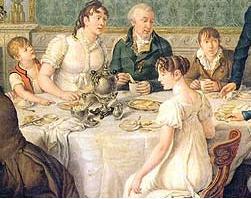
Family MealThe idea was that with all courses laid on the table, those dining would choose which dishes to eat, taking from the dishes nearest. It was polite to offer a dish around. Food in History notes, “It was a custom that was more than troublesome; it also required a degree of self-assertion. The shy or ignorant guest limited not only his own menu but also that of everyone else at the table. Indeed, one young divinity student ruined his future prospects when, invited to dine by an archbishop who was due to examine him in the scriptures, he found before him a dish of ruffs and reeves, wild birds that (although he was too inexperienced to know it) were a rare delicacy. Out of sheer modesty the clerical tyro confined himself exclusively to the dish before him….”

This style of serving dinner was known as service à la française. During the Regency this was replaced by service à la russe in which the dishes were set on a sideboard and handed around by servants.