Tag Archive | historical drinks

Things We No Longer Ask For

I love old cookbooks–they are a glimpse into a past era. They also often have great recipes. Reading Dorothy Hartley’s wonderful Food in England got me thinking about how there are certain foods and drinks we no longer ask for when dining out, such as:

Meat and fish hanging, bread, cooked eggs, glassware, parsnips, lemon, platters on a side table all in  a larder or kitchen

A joint of beef — we have all sorts of fancy cuts these days.

Johnnycakes — these are actually delicious…they are basically a cornmeal fried bread, meaning like a pancake but with more crunch. Easy to make, too.

Mutton — it is still possible to find lamb in some supermarkets, but mutton has gone completely out of fashion (no old sheep for a low cost meal).

Pig cheeks — still available in some parts of the world, and by all accounts, the best part of the pig. Also called pork cheeks, and this goes along with calf cheeks or beef cheeks, a specialty of the Café Procope, one of the oldest cafes in Paris.

cucumber or parmesan ice cream — it is difficult enough these days to find real parmesan cheese.

watercress and egg sandwiches — these can be found in some tea shops still (thankfully), but watercress can be difficult to come by in many modern supermarkets (at least in the US).

gruel — this is an unlovely name and the food has a bad rep from the Victorian era, but some recipes call for butter, brandy, and enough spices to make this a very tasty mean (it’s basically think oatmeal).

A pot of ale — while ale is still around, it usually comes in cans, bottles, or a pint or half pint. The pint pot has long ago been replaced with glass.

A bowl of punch — this used to be a highly alcoholic drink, but these days folks are more likely to think of punch being a fruity drink without brandy, champagne, rum, and other spirts all mixed together. The bowl is no longer with us either for dipping into with a mug or cup.

A posset — this was a hot drink made from curdled milk and sack or a sweet sherry.

A flip — another drink (more alcohol) usually made with beer, rum, eggs, and heated with a poker (not the one used to stir the fire, but a special poker used just to heat drinks).

A purl — another hot drink made with beer, gin, nutmeg, and sugar.

That is just a few things we generally must make ourselves if we want to sample something from the past (unless we find a place that also likes to keep going with what were once old favorites).
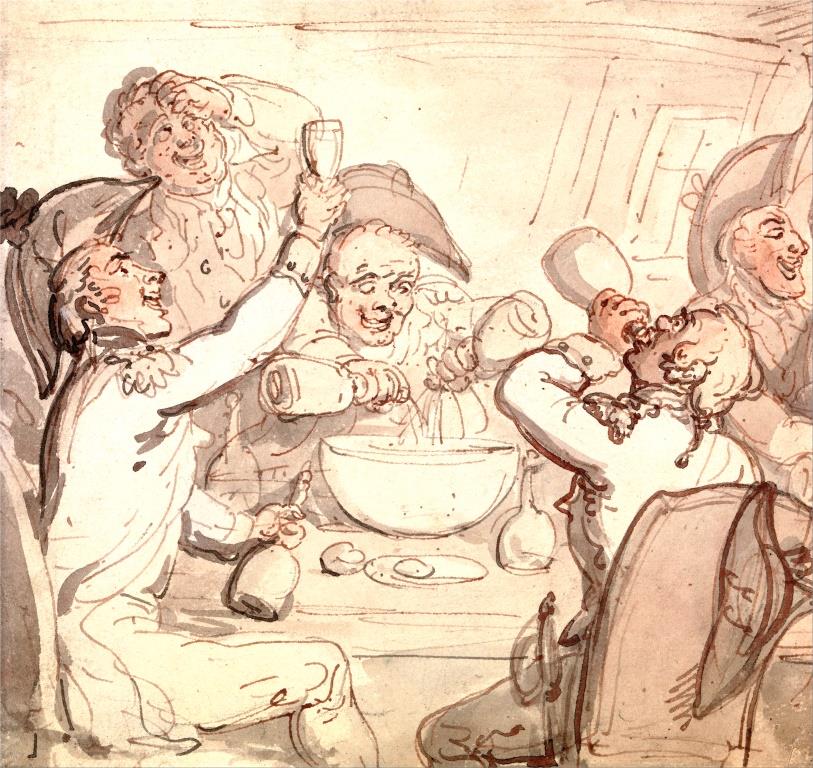
Thomas Rowlandson Naval Officers and a bowl of Punch

Historical Drinks

Tom and Jerry Taking Blue Ruin (Gin)

Every now and then I find a word that sends me off on a research hunt, and this led me to drink names. While we think of “cocktails” as a modern invention, the word dates back to at least 1798. Etymology.com has cocktail as a “drink made from water, sugar, spirits and bitters” first attested 1798.” So the idea of a drink mixed with all sorts of things is nothing new (Ancient Greeks and Romans mixed all sorts of things into their wines). However, my stumbling across a ‘purl’ being drunk by a man about to get onto a coach on a cold day led me to these other wonderfully named drinks that were often to be found in an inn or even sometimes sold on the street to the common folk in the late 1700s and into the 1800s.

Buttered Beer – this was a great way to add calories to ale or beer to make it into almost a meal. It obviously has butter in it, but might also have eggs and spices and was served hot (must have been lovely on a cold, wet day – an old recipe is here).

Dog’s Nose – so called for it was black and cold and one of my favorite names. It was porter, sugar, gin and nutmeg. However, some recipes call for it being warm, and modern recipes generally use brown sugar (a recipe is here).

Flip – this would be any mixture of beer or ale, mixed with rum or brandy, sugar, spices, and usually eggs. Every inn would have their own version, and the name comes from “flipping” or heating it with a “flip dog” also called a toddy iron (it was like a hot poker) (a recipe can be found in William Kitchner’s 1822 The Cook’s Oracle).

Gin-Twist – gin was usually the hard drink of the lower class, and was often watered down (and given to children for toothache) The twist is gin, lemon, and simple syrup. The word ‘gin’ comes from the Dutch genever and Old French génevrier for juniper (and a recipe is here).

Half-and-Half – this was a way to have the good, expensive beer mixed with something cheaper (as in half ale and half two-penny). In the late 1800s, it became a ‘black and tan’ (no recipes since you just mix two beers or ales or porters, but more information is here).

Lambswool – a cider with a baked spiced apple included, a traditional wassail drink in parts of England (a recipe is here).

Perry – cider made from pears (links here to where you might buy some and it sounds lovely).

Purl – Beer or ale with a shot of gin, often with wormwood or served hot as a means to keep warm (several recipe variations here).

Rum and Milk – gin and milk also shows up, which sounds even worse to me, but rum and milk are at the core of eggnog, so it must work, and milk punches also go far back in time (more on gin and milk is here and on milk punches).

Saffron Bitters – Bitters were sometimes used as a hangover cure (recipes here, and the saffron bitters and tonic water sounds rather good), but on a side note “tonic water” wasn’t around as a phrase until around 1850s, but as of 1789 Schweppe was advertising soda water and seltzer, along with sea water as a purgative. Quinine was also known about and sometimes added to “fizzy water” (fizz in a drink dates to 1812, but fizzy dates to 1885).

Saloop – Richard Valpy French in Nineteen Centuries of Drink in England notes it as “…a greasy-looking beverage, sold much on stalls in the early morning. It was prepared from a powder made of the root of the Orchis mascula, and from the green-winged meadow orchis….like porter, to be a favourite drink of porters, coal-heavers, &c. It is said to contain more nutritious matter in proportion to its bulk than any other known root…” (French’s book can be found here).

Shrub – like punches, all sorts of variations exist but this is a drink typically made with rum or brandy, sugar, and the juice and/or rinds of fruits, particularly citrus (recipes here, along with punch recipes).

Spruce Beer – this is beer obviously flavored with spruce needles, which can be purchased in a dried form today (a Jane Austen recipe is here)

Tewahdiddle – and isn’t that a great word! William Kitchner writes this is “a pint of table beer (or ale, if you intend it for a supplement to your “night cap”), a table-spoonful of brandy, and a tea-spoonful of brown sugar, or clarified syrup; a little grated nutmeg or ginger may be added, and a roll of very thin-cut lemon-peel.” (see Flip for a link to Kitchner’s The Cook’s Oracle.)

St Giles - Tom and Jerry Masquerading it among the Cadgers in the Back Slums in the Holy Land (slang for Irish slums)