I’m delighted to announce that Lady Lost–the final book in the Regency Ladies in Distress series–was awarded the IndieBRAG Gold Medal.
Books are judged by readers and rated on the quality of the writing, characters, and even the covers. This is particularly rewarding since the story took forever (and a day) to actually get finished–some characters just are not very good at showing up on the page right away.
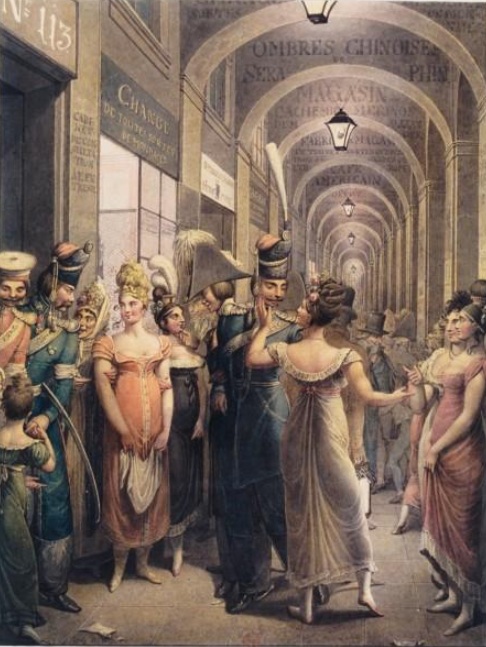
The other issue was research into Paris and France in 1815, with Napoleon returning from exile, the fun of using the Palais Royal in the story–seen in an 1815 painting at left with the courtesans of Paris and the troops that occupied the city after Waterloo.
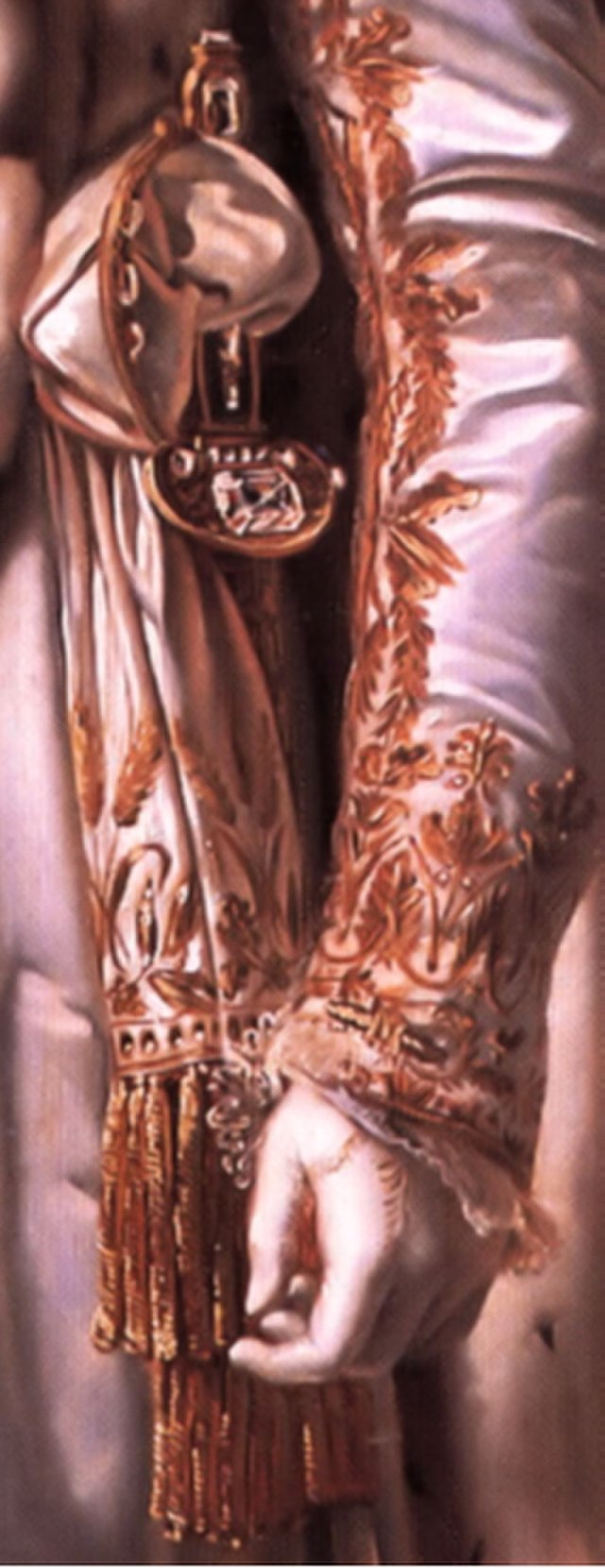
I also wanted to weave in a mystery having to do with the Regent Diamond, which was taken from Paris by Napoleon’s Empress, the Archduchess Marie Louise of Austria (she took it with her to Austria in 1814 and it had to be returned. It is shown at right mounted into the hilt of Napoleon’s coronation sword, and almost lost in the folds of sash and gold trim, and all the robes and glitter that Napoleon insisted on wearing (talk about a man who was insecure about his less than royal background),
I also wanted to use Joseph Fouché, the duc d’Otrante, who was Napoleon’s head of the Secret Police, and then fell out with the Emperor. Lots of great stories there, with spies and counterspies, and a Paris on edge as it waited for what would come next in March of 1815.
All this meant looking for details that would make the story come alive–and weave in the story of Jules, Lord Sandal who is on a errand to help ing Louis, who has fled Paris, and his involvement with the illusionist, Madame de Mystére, otherwise known as Simone Raucourt. A lord and a stage actress made for a great couple and plenty for them to talk about what with her still holding revolutionary ideals.
One of the biggest challenges was to map out Paris–Napoleon did a lot of building, but Baron Haussmann changed Paris even more in the mid 1800s.
A Visit to Paris in 1814 by John Scott was of use, as was John Quincy Adam’s diary for his travels in 1815, including a stay in Paris. It was more than fun to research the elegant restaurants, such as’ the Café des Mille Colonnes, noted for its gilt columns, mirrors, and having the madam of the business sit on a chair that once housed the Viceroy of Italy, and was purchased for twelve thousand livres! Edward Planta’s 1816 A new picture of Paris; or, The stranger’s guide to the French metropolis while set a little after the date I wanted was helpful. But I was sad that I couldn’t find a place to include a scene with Monsier Leroy.
Louis Hippolyte Leroy founded the House of Leroy, and billed himself as “Fashion Merchant of her Majesty the Empress [Joséphine]”. His house named Maison Boutin, stood at rue de la Loi, which is now rue de Richelieu. He was ahead of his time in that he did not do the designs, but bought them from designers, and sold ensembles–meaning head to toe, hat to shoe, and everything else to go with a dress.
The cut scene is here:
Jules kept up a patter of nonsense. Something about how the rue de Richelieu was named for some cardinal of fame, and came to be called rue Royale, and then rue de la Loi before the Emperor restored its name. Simone did not want to think about such things. She had faint memories of the Terror from when she’d been a girl—mostly the fear in everyone’s eyes, the lack of an audience in any play, the need to always have a caution about what one said. She shivered. It seemed those times had never truly left Paris.
When the coach stopped, she tried to pull herself together. Jules had given her back her house key and she held it in one clenched fist, letting the metal bite through her thin glove leather. “Where?”
“Maison Boutin.” Jules said, handing her down from the carriage. “Monsieur Leroy dresses royalty, duchesses…and my mother.”
“And offers prices to go with?” Simone muttered. She glanced at the front door with footmen either side in pale blue livery, their black collars starting to gleam with damp. Jules hurried her past them, out of the wet. Inside, the luxury made her catch her breath and then wince at the contrast to her ruined rooms. More footmen carried silver trays with crystal goblets that gleamed in candlelight. Clients lounged on brocade sofas and chairs, and prints of exquisite garments hung on the walls. Women walked into the room dressed in the latest fashion, twirled to display the gowns to potential buyers, and retreated again. She had never seen the like.
A man in his early fifties, thick-set, with an air of importance came up to them and bowed. He dressed in the latest fashion of Cossack trousers and a tight-fitting coat in peacock blue that buttoned over his waistcoat, the ends of which peaked out giving glimpses of silver embroidery. He gave Simone an arrogant once up and down that left her face flaming hot, but Jules stepped forward. “You dressed my mother this past spring, and now my lady is in need of a new wardrobe.”
“Mother?” The older man stiffened. “I count amongst my clientele two empresses and all the crowned heads of Europe.”
“Yes, I daresay Vienna may know your name, but London is still to be impressed. That may yet happen. Lady Sandal has been known to set the rage.” He swept his hat off, dragged off his gloves and nodded at Simone. “She’ll need the usual fripperies to go with her gowns. You know the sort of thing. Corsets, hats, gloves, fans, bouquets, handkerchiefs, stockings, shoes, and…those unmentionables. The complete toilette. I’ve a line of credit with Rothschild, so cost is not to be considered, but I should like to see her in at least three day dresses, something for travel, a couple of evening gowns. Perhaps a court dress—not for here, you understand, but something to make a bow to the Prince Regent. He does like a pretty face in a pretty dress.”
The older man—it must be Leroy himself, Simone decided—began to smile. “Of course. A private room, perhaps.”
Simone found herself swept up stairs, installed on yet another brocade chair, gold damask curtains shading the room. Jules turned away to stare out the windows, and women in the same livery of light blue, the dresses made up with black collars, came in to measure and fuss with her.
Pink satin embroidered in steel, an apron gown, a redingote in Spanish Tobacco, a court dress of gold and silver over cream satin, a white robe of crepe trimmed with blonde lace, an evening gown of white taffeta edged in satin, a day dress of cotton percale with a dotted pattern, and another stripped periwinkle blue with camellia satin ribbons and white roses at the waist. Each came with shoes, gloves, bonnets, and shawls to complete the look—half-boots in periwinkle, with a bonnet also trimmed in white roses. A cashmere dress, trimmed at the hem with a lavish design, with a red velvet torque and red shawl, red boots and gloves. The colors swirled before her. She Sent a glance to Jules—she could not choose, could not even think. She sat with her hands clenched in her lap.
 Shannon Donnelly's Fresh Ink