Pacing Yourself

I’m giving a talk via Zoom for Orange County Romance Writers on November 9 on Pacing Tips and that has had me thinking about story pacing, and what I see so very often in writing contests. It is not a too slow pace, but actually a too fast pace–the story speeds ahead as if the writer is worried about losing the reader’s interest. The problem with this is that this steps all over immersing a reader into a story.

Now we’ve all read lists of great opening lines–some of them are on the verge of being cliche they’ve been quoted so soften. Pacing is about far more than just a good opening hook, however.

Any story needs to set the pace–and I often think about this in comparison to a horse race or a runner in a footrace.

There’s the short sprint that needs to be fast from the start to the end.

There’s the marathon or race over a couple of miles for a horse that needs for early speed not to be so fast it burns up the energy and leads to a lackluster finish.

You can hook a reader with a great opening line, and then lose that reader in the first chapter.

You can have a great first chapter, and then the book sags in the middle and the reader’s interest drops away.

You can also have a great premise, but weak execution means the reader is not pulled into a fully realized world with fully developed characters.

Dealing with all of this is what I’ll be talking about with those pacing tips, but what I’m talking about here is to just take a deep breath–and imagine more. Slow it down a bit. Figure out and put in those vital details that make the world come to life.

I think too often writers worry so much about a fast pace–a fast start–that what gets forgotten is building a scene and enjoying the process. There’s so much about agonizing about writing that we forget we love words–and love to put them together in fresh, inventive ways. We forget to pace ourselves and hurry to finish the scene or the chapter or the story, and forget to weave in all the stuff we love the most.

I sometimes wonder if we slowed ourselves down–read a book aloud, sat on a park bench and watched the world go by, took a drive into countryside with no destination in mind, strolled down a street without the idea of hurry or losing weight–would that help bring more to the page?

That’s one thing that writing by hand does–it slows us down a bit. It gives a little more room to thinking and imagining and a little less pressure to get a word count done. I think we have to look at pacing ourselves as well as our stories.

But there are still some more practical tips that can help–and those go into that talk for Orange County Romance Writers.

The English Tradition of a “Cuppa”

This October, I’m doing a workshop on Estate Workers for Regency Fiction Writers. One thing that turned up when researching the workshop was the growing importance of tea, sugar and milk in the diet of the average person in England during the long Regency era.

1780 teapot in Brown Betty style made in Staffordshire with Rockingham glaze

We tend to think of tea in Georgian England as a luxury item, but while it started off that way, prices were falling by the late 1700s. The teapot at left dates to 1780 and shows what would become the ‘Brown Betty’ style of Staffordshire pottery, with its dark Rockingham glaze. This is the sort of teapot that could be found in a middling class household, which would include some estate workers. It is far from the highly decorated tea and coffee sets created for the upper class by Wedgewood, Doulton, and others who sought royal patronage.

As noted, like coffee and chocolate, tea had started off an expensive luxury. Duties were put on it because of this, which meant in the 1600s on to the late 1700s it was a main good for smugglers. Random Bits of Fascination notes, “Smuggled tea often came from Holland where it might be purchased for as little as 7 pence per pound.” That means smuggled tea was already drifting down into the middling classes.

The Commutation Act in 1784—pushed forward on the advice of  Richard Twining of the Twinings Tea Company—reduced tea taxes from 119% to 12.5% of the price. It was no longer worth smuggling, and tea drinking spread to the growing middle class and into the working class. Tea became available in multiple prices with different grades available. Some household also provided a tea allowance for servants, and tea leaves would also go from the drawing room, to the housekeeper and on down the line of servants, with inside servants first, and then outside servants.

A New System for Domestic Economy, published in 1823, speaks to, “The universal use of tea, as an article of diet…” and devotes multiple pages to economical types of tea and efficient brewing. It notes, “…the best Green Hyson, at about fourteen shillings per pound…the best Black Souchong at about twelve shillings…the Souchong, since the common leaf at six shillings…” This shows the variety in prices. It also says that two ounces of tea per person per week is a way to economize, with sugar at three quarters of a pound over the week.

Tea shows up in the tightest of budgets at 7d and a ha’penny for 2 oz. (bought at 5s per pound) when the family income is only 24s a week. Lesser incomes than that do not include tea in the proposed budget. At an income of 30s a week, the budget allows a quarter pound of tea for 1s 3d, with sugar for the week also costing the same shilling and thuppence. Milk is only 7d and a ha’penny for the week This shows how tea could be affordable for anyone in the working class, including those on an estate with good wages.

As noted in the paper ‘Importing sobrie ‘tea’: Understanding the tea trade during the Industrial Revolution’ by Kabeer Bora, “Sugared tea and white bread became the nutritional mainstays, it supplanted the traditional produces of milk, cheese, ale, meat & oats.” Tea and sugar begin to be drunk by all but the poorest of the poor, with tea, milk and bread being seen as mainstays of the English diet. This is pushed even more so by factory work that showed up in the Regency era.

Bora goes on to write, “A report of the Factory Enquiries Commission in 1834 showed that many mill owners were allowing workers tea breaks of 15 and 30 minutes in Derbyshire and Lancashire. This break was given to them between lunch and closure (Factory Enquiries Commission, 1834).” Tea, with sugar and milk, is credited with increased calories in the average diet, and with improvements in health overall. The English habit of weak ale and small beer still would continue, but tea would go on in the Victorian era to even become the name for the working class evening meal.

To put all of this into a bit of context in the modern world, today we generally buy tea in bags (not invented until the 20th Century) with a box of tea bags being only around 1.4 ounces in total and holding 20 to 30 tea bags. If you are thrifty, you can get two or three cups from one bag, so 2 ounces of tea for about 7d could go a long way, and a pound of tea, or 16 ounces, is a considerable amount of tea.

Another good source of information is Empire of Tea: The Asian Leaf that Conquered the World by Markham Ellis, Richard Coulton, and Matthew Mauger.

If tea could not be bought, there was the ability to make a tea from the wild fruits, herbs and flowers from any estate garden (if you have horses, an alfalfa–more commonly called lucerne in England– while not the best for a tea, can be made up).

While the old standbys of ale and small beer as drinks for estate workers continued on through the Regency–particularly as the main drink in the fields during harvest time, the idea of a cuppa tea in the evening or early morning was growing. And more on Estate Workers of the Regency era will be in the workshop.

https://regencyfictionwriters.org/academe/

The Theater and Pantomime

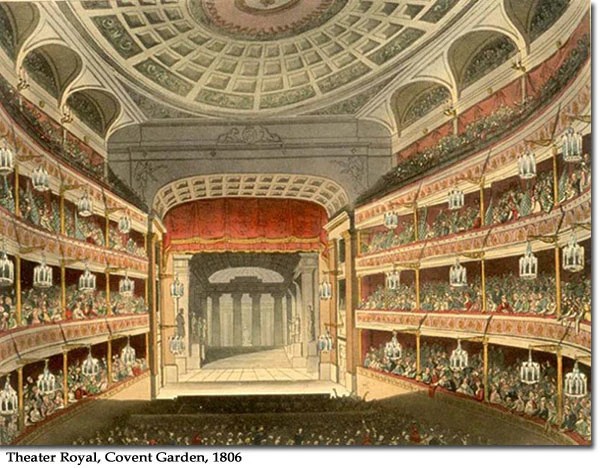
It is easy to think of Regency England’s upper class being full of starch–going to the opera and concerts for classical music and to the theater for Shakespeare and high-brow plays. However, the pantomime was big business and drew in an audience from all classes. The tradition of a Christmas ‘panto’ was already firmly entrenched by the Regency era. In many ways, the pantomime was the forerunner of the modern day stage musical due to Parliament’s Licensing Act 1737 which limited spoken drama to patent theaters–meaning the three Theater-Royals of Drury Land, Haymarket, and Covent Garden. The Theatrical Representation Act 1788 relaxed this to license occasional dramatic performances that lasted up to 60 days, for such theaters as the Lyceum, but most theatrical runs were of a few weeks, or as even as little as a week or two in the countryside.

Interior Theater with boxes on the sides and the pit with benches

Since pantomimes were all about comic songs and dance, colorful costumes, and spectacular effects (characters flying in or out, water scenes, falls and leaps, and all manner of action) and a good one drew in paying customers, this was the bred and butter of theaters such as Saddler Wells where Joseph Grimaldi often performed. The pantomime was a huge crowd pleaser, but audiences also expected great performances, and this is where Joseph Grimaldi becomes famous.

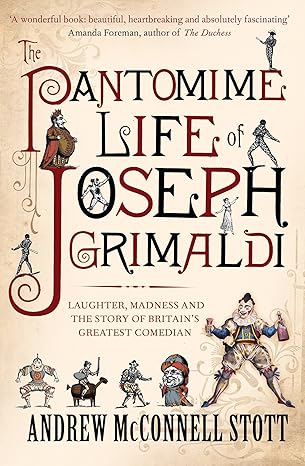
Pantomime book cover: Life of Goseph Grimaldi

As noted by the description of the book, The Pantomime Life of Joseph Grimaldi: Laughter, Madness and the Story of Britain’s Greatest Comedian Paperback by Andrew McConnell Stott, “…Joseph Grimaldi (1778-1837) was the most celebrated of English clowns. The first to use white-face make-up and wear outrageous coloured clothes, he completely transformed the role of the Clown in the pantomime with a look as iconic as Chaplin’s tramp or Tommy Cooper’s magician. One of the first celebrity comedians, his friends included Lord Byron and the actor Edmund Kean, and his memoirs were edited by the young Charles Dickens.” Stott’s book is excellent not just for his details about Grimaldi’s life, but for details of the theater, both the performances and what went on backstage.

Pantomime is still popular in England, and Mother Goose is again on the London stage (you can catch a look at a modern version on YouTube), but opened as ‘Harlequin and Mother Goose or The Golden Egg’ on Boxing Day in 1806 with Grimaldi playing the Clown to rave reviews. (A summary of that panto can be found here, but all pantomimes used familiar characters, usually those from folk or fairy tales, and often with Harlequin being the star, or he was until Grimaldi’s Clown made that role the main draw.) Even the larger patent theaters put on a pantomime to pull in audiences–the Mother Goose pantomime penned by Thomas Dibbin premiered at Covent Garden.

Stott’s book is excellent for anyone interested in theater or the Regency era–the details are marvelous. Other articles:

Theaters of Regency England – https://regencyfictionwriters.org/the-theaters-of-regency-london-by-regan-walker/

Joseph Grimaldi, Clown – https://spitalfieldslife.com/2012/02/05/joseph-grimaldi-clown/

Picking Your Protagonist

The protagonist—your central character—needs to be worthy of a story. The protagonist also needs enough going on to carry the story. One of the big problems I see in a lot of romances that aren’t working is that the writer is trying to make both the hero and heroine the protagonist, and that often leaves the story unfocused. Now, every character needs to have things going on—character arcs are important—but with genre fiction, one main character arc helps to give a story focus and also helps to keep the reader involved. Can you break this guideline? Sure, but think of your protagonist as the central tent post to a story—without that, everything sags or falls. (I use an image of my dog, Inky, because he definitely thought himself to be the protagonist of all stories.)

Inky

The protagonist needs some things set up so the story works better:

1-Conflict. Yes, it’s obvious, but there’s no such thing as enough of this. And this isn’t just external challenges to overcome. Protagonists are more interesting if they have internal issues. You want to set up issues, and personality clashes, and personal problems for the protagonist.

2-A specific past. This means a detailed, specific past. This where I see a lot of writers going for vague. How many characters out there have parents who died, or a rough childhood, or were bullied? You can count these by the thousands, because that description is too vague. If you want your protagonist to stand out and be worthy of a story, make them unique by making their past highly specific. The woman whose parents were run over by a rhino while they were on safari when she was ten and stuffed into a boarding school—that’s starting to shape a unique person. Or the boy who grew up traveling with his parents in a VW bus because they wanted to see the world—he’s got some interesting stories. Details make your characters come alive—never settle for less than highly specific.

3-Strengths and flaws. It’s too easy to focus on just one side of this. The hero who is not only handsome, but tall and talented, and just too good to be real. The heroine who is beautiful and brave and fearless. Or even the bad guy who is nothing but mustache-twirling evil. Characters that don’t have both flaws and strengths start to be boring. A protagonist who doesn’t screw up—or who does nothing but screw up—is going to lose readers. Do yourself a favor and make the main character’s main trait something that is both strength and a flaw—most traits come with a good side and bad.

4-Meaningful habits. We all have these. Twirling a lock of hair. A favorite phrase. A toothpick tucked into the corner of a mouth. Cracking knuckles, biting a thumbnail, tucking a quarter into a pocket. Your protagonist will be more interesting if you figure out not just habits, but specific habits that reveal something about that person. The person who has to organize any bookshelf she sees by topic is a different person from the one who never steps into a cab with a license plate that has the number thirteen on it. Make your protagonist worthy of a story by giving them meaningful habits.

5-Something they want. The best characters always have something they want—something they really want, something they really, really want, and something they really, really, really want. Go beyond that first want and dig deeper. First, second, and often even fourth ideas are usually clichés. These ideas jump at you because you’ve read them so many times. Always ask more of yourself and your protagonist—get down to what they really, really, really want. Do this not just for the story, but for every scene in the story, too.

6-A unique voice. Every character needs a unique voice, but a protagonist needs this more than any other character in your story. To be worthy of being at the center of the story, the protagonist needs to stand out—that means his or her dialogue needs to be sharp and needs to be something that would make any ‘star’ want to play this role. To help with this, image your favorite actor in this role—give this actor the best lines, such great lines that this actor would come up and hug you.

7-Likeability. A protagonist, to be worthy of his or her own story, needs to be likeable. The reader needs to identify with that person—the protagonist carries the reader into and through the story. Now, the protagonist can do things that makes the reader want to slap that character, or can make mistakes—in fact, that often leads to a more likeable person. But look closely at what actions your protagonist takes—does he treat others (who don’t deserve it) badly, does she kick the cat, does he make the same mistake repeatedly, does she do too much admiring of her own looks in the mirror? This is where it’s all about balance. A heroine can kick the cat if that cat is really a demon about to kill her—the action will seem justified. But if it’s a pitiful, cute kitten, that protagonist has just lost the reader’s sympathy. Make sure your readers understand the protagonist’s actions and motivations—we all tend to like people we admire and people whose actions we understand.

9-Friends and/or family. This can be one friend or several, it can be a big family or a small one, but friends and family serve to give your protagonist three dimensions. Allowing the reader to see the protagonist interacting with friends and family helps make the protagonist more interesting and more likeable by being more understandable. It also is a chance to layer in extra dimensions as the protagonist will interact with different people in different ways. If you have a really rough, hard-to-like protagonist (who must change in the story) give him or her a best friend who is easy to like—that person’s liking for the protagonist will convince the reader there are good qualities in the protagonist. This is also a great way to show contrasts—the tough hero can let his elderly mom boss him around, or the feisty no-nonsense heroine could be mush when it comes to helping her little sister play dress-up. Use the characters around the protagonist to make the protagonist more worthy of being at the center of the story.

10-Action. Let’s face it, a character that sits and thinks a lot is just not that interesting. Even Shakespeare sends Hamlet off to visit graves and spy on his uncle and set up plays and a duel—Shakespeare knew enough to put his protagonist into action. Actions show the reader the character’s personality better than anything else. If you have a protagonist who is a marksman, have him shooting a gun and making patterns on the target. If you have a protagonist who is a financial wiz, have her signing a deal that nets her an easy million. A character who is worthy of his or her on story is one who does things.

11-A Relationship to Theme. This is something that can be easily overlooked by writers just learning the craft. The protagonist is going to be the person who realizes theme, and who grows and changes as a character due to that theme. This is what will make a character arc—and the protagonist—resonate with readers.

12-An Antagonist. This can be another character, a sympathetic character or one that isn’t sympathetic, or it can be a situation or even a character trait with the protagonist that causes even more conflict. As the saying goes, the protagonist is only as strong as the antagonist—a really good antagonist can make the protagonist seem more likeable, more admirable, and can greatly improve the story. But this means the antagonist is that this must be a fully fleshed-out character, otherwise this can also make the protagonist seem one-dimensional.

Above all else, find out whatever it is that you need to know to make your protagonist real to you. If you don’t believe in your main character, it’s just about impossible to get a reader to believe, too.

The Fun of Something New

In every story I like to try something a little bit different, but I have learned a couple of things about this that I have to keep in mind.

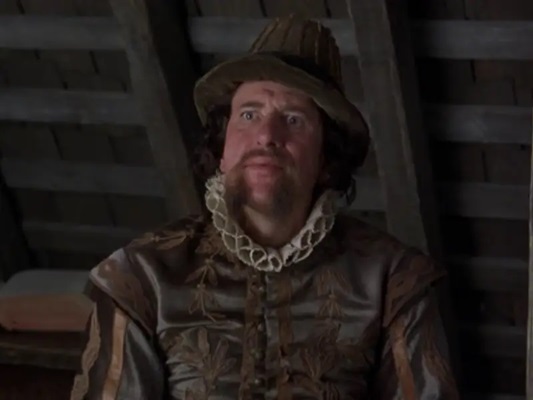
First off, the shiny something new is always more attractive than finishing up the something current–and I have to resist that urge. The something new seems better because it is in my imagination. Once it gets on paper the story in my head disappears and I have to deal with what is on paper. In other words, time to fix things and make it better, which is really the most difficult part of writing. I also hit with every story the point at which I can no longer tell if it is good or bad–it simply just is. That’s the time to trust in the process. There’s a quote from the movie Shakespeare in Love that seems to sum it up best. The wonderful Geoffrey Rush gets all the best lines, but as the play producer Philip Henslowe he notes that even when it is a disaster heading for ruin, somehow it all works out in the end. “It’s a mystery.” (He also says all you really need in a good play is love and a bit with a dog, and it’s hard to argue with that.)

Secondly, as for something new to try out I try to limit this. When I was first struggling with the craft of writing the technical challenges often overwhelmed me. There’s dialogue to get right–perhaps the most important skill since that brings characters to life–and description to make snap, and then there’s viewpoint to handle and scene structure and pacing and dealing with foreshadowing and making sure the characters and the plot makes sense, along with all the bits of punctuation to handle. I quickly learned that taking on one technical challenge at a time served me well. I could work on just that in a story and everything else could be handled in edits.

What if a couple interacted over the years, how would the relationship develop? What obstacles would keep them apart for long periods of time? How would they reconnect? Would they be friends who could just pick up right where they left off no matter how much time came between?

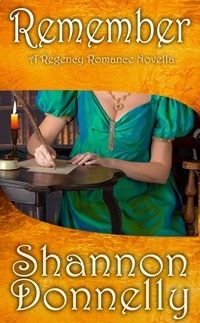
With my novella Remember the technical challenge I set was dealing with time…so many love stories seem to happen over days not weeks or months or years, but what if a love story did take place over years? That idea intrigued me, and I started to dive into the lovely game of “what if?”.

I’m not knocking the instant attraction of first glance, and there are people who know right on the spot ‘this person is for me’ while others don’t get that bolt from the blue. But the slow burn appealed to me as something I had not tried before. It was a something new technical challenge.

Chapter breaks helped a lot with that–new chapter, new year–but then I had to sort out the timeline and figure out what was going on in the world that could cause gaps in the relationship without breaking the relationship. I also had to decide what obstacles, such as age of the characters or status or background or goals, might be slowing down the immediate desire to become more than friends.

All of that ended up being a lot of fun–and some work in editing to make certain I wasn’t putting things out of order. So Remember ended up being a sweet story–I do like a story where not much happens other than lots of banter and getting there eventually. While it is fun to write some action and adventure, love and a bit with a dog goes a long way to pleasing audiences even to this day.

Plot vs. Pants vs. Why Pick?

There’s the old writer argument about which is better–plot out a story in advance or just write and see what develops. Personally, I’ve found a mix works best for me, and here are the merits, and drawbacks, I’ve found in each method.

Plotting–this is where you figure out the actions and motivations and put things together. To me–an old-time jigsaw puzzle fan–there is an attraction here. It is fun to work out pieces, and for action stories or mysteries this is important. The drawback here is that the plot can become a shiny object that pushes characters into the background–it is too easy to end up with undeveloped stereo-types who are forced into actions and situations just to make the plot work.

Pantsing–this is the approach were nothing is planned and the story is allowed an organic growth. The fun side of this is that the story–and the characters–have room to surprise the author, and since the story comes from character they have more freedom for development and growth. Characters get the focus. There is a downside here, too, however. Just allowing a story can flow can lead to a dead-end or to a tangle that makes no sense. The writer has to control tension and pacing with a more instinctive approach–and sometimes what that means is fixing a lot of things with revision.

Why Pick? The mix I’ve found works best for me is to write about 50 to 100 pages–that gives me enough information about the characters to know if I have an actual story and if the characters are likeable and strong enough to hold up in the story. Then I go back and start to sort out things like conflicts, backgrounds, and main story points or turning points that may work. These are not set in stone. I found out early on that if I knew too much about my characters they turned wooden, but if I knew too little the story stalled out. The trick became to sort out just enough–and also to occasionally to have to write some background scenes that I needed but which weren’t needed in the story.

Some pantsing, or winging it, is both freeing for the story and allows for really nice twists to come from the characters. Some plotting allows more control of the story tension and pacing with the action. With this mix, I still have revisions–new ideas pop in that will need to be foreshadowed, and sometimes I will abandon a plot I though would work because there’s planning and then there is making the characters come to life, and that’s always the harder task.

Writing styles evolve as well–after doing this for some time I have more technical skills I can lean on, I have useful habits, and I know the habits I have to watch out for since they are not the helpful ones. It also helps to keep the writing interesting by trying new things–by mixing it up. At one time night-owl writing worked best for me, but these days I’m up before dawn with my coffee and ideas and the fresh day. But I’m still open to changing that up–and trying something new.

This entry was posted on October 17, 2023, in Uncategorized. Leave a comment

My Fair Regency (or Short is Harder)

On October 12, 2023 I have a new novella coming out in an anthology, My Fair Regency. It was fun to write, and something a bit different, and writing short always has its challenges. In this case, I wanted to write a story that takes place over eight years. The first challenge in that was keeping track of the timeline, and what was happening in each year. The next was keeping track of the settings over those years and what the characters and secondary characters might be doing. These were technical issues, but they do matter in that you don’t really want the reader noticing this stuff.

The other thing is that I like stories that focus mostly on the characters, and this means the conflicts are often subtle and not earth-shattering–it’s the small things that can matter a lot. I also wanted it to be a somewhat light, fluffy story–in other words, a lot of talking and ‘piffle’ and yet it has to have enough substance to stand up (even a meringue needs that). This meant it needed the theme to weave into the scenes, and the characters needed things that mattered to them–and those wants had to both evolve slightly, yet had to remain over eight years. That was the core challenge–dealing with the growth and evolution of the characters, yet having them hold to some core guiding lights.

Now, I like a technical challenge–but I try to keep it to only one per book. I found out early on when I started writing that if I bit off too many challenges (and I often did), the characters and story tended to bog down in those issues. I ended up forcing characters into a plot due to the technical stuff. This includes trying to deal with viewpoint, scene arcs, dialogue, conflicts, theme, paragraph and sentence construction, descriptions, and even word choices. Technique needs to serve the story–meaning it has to serve the characters. If it takes over, it can take the life right out of a story–the story steps into being an intellectual exercise instead of an emotional experience. But how does one get technique out of the way?

I think it’s possible to deal with technique in a couple of ways. The first is to become skilled with it–meaning write a lot. If you write enough, you stop having to worry about certain things. They become automatic skills. How you handle transitions, viewpoint, scene arcs, dialogue all becomes automatic functions that you can allow your writer’s instinct to deal with–you get that internal nudge when something isn’t quite right. The other way is to handle it with edits. Get the important stuff for the characters–their emotions, desires, personality–onto the page. Edits will allow you to check for rough bits, for things that don’t quite work. With edits comes the need for copy edits and proof readers to help out and point to mistakes and what’s missing–but don’t neglect a potential read from a beta reader who may find emotional moments that may be missing.

The other factor with a novella is that short is harder than long–there’s less room to go off on interesting tangents and amusing secondary characters. Every word has to count, and pacing is vital.

How did all this apply to my novella?

Well, you’ll notice there’s actually more than one technical challenge here, so I split them up. I left sorting out the timeline to the edits–I could more easily fix that during revisions. This allowed me to focus just on the characters while I was writing, and since I like to treat setting as a character that was included. I split up the other technical issues as well, but that is my habit–I have found I can write dialogue or I can write description, but I can’t do both at the same time. It is easier for me to write the dialogue, sharpen it, and then come back and put in any action or description I need to weave in subtext or contrast or use setting to amplify emotion or motifs. Or I can do the descriptions to set up a scene or create a mood, and then I’ll figure out the dialogue when the scene starts. Polish for all of this comes in another edit–and that’s where I have to use care to keep the mood the same and not edit out emotion.

Finally, about the fun bits here–the anthology uses the Regency England setting of different holidays and fairs, so my holiday was Guy Fawkes Night, with its bonfires and crackers (fireworks to those of us in the US), and the other holidays used some of the lesser known events, such as Cheese Rolling, along with the better known May Day and Twelfth Night. For Guy Fawkes, I did do a bit of research–it’s still a rather rowdy event in England–but even more fun was weaving in events across the years from 1805 to 1813. With a bookish heroine, I was able to dive into scientific events, publications, and use apt quotes to mirror what was going on in her life. The hero is a more active person, out wanting to go places and do things, and join up with army during the Napoleonic Wars–a dangerous ambition. They were a nice pair, but when it comes to bringing them together, Guy Fawkes Night served nicely for that–it is a night when the unexpected can happen.

Hopefully, that is what this anthology is all about–the unexpected delights of new stories and new authors.

ABOUT THE ANTHOLOGY–MY FAIR REGENCY

Celebrate Regency romance all year long with this collection of short stories set during holidays and festivals throughout the four seasons! Fans of sweet romance will enjoy stories set from May Day all the way to Twelfth Night, featuring some of your favorite tropes—enemies-to-lovers, second-chance romance, forbidden love, friends-to-lovers, and more! The collection includes:

May Day Mayhem by Ann Chaney—Intrigue, death, and love come to Horsham-Upon-the-Thames as the small English village anticipates their May Day celebration. Home Office agents the Duke of Doncaster and governess Helen Stokes join forces to uncover a missing list of French agents before an enemy discovers it. Mired in May Day preparations while chasing hoodlums and gentry, Helen and Doncaster try to fight their mutual attraction in a romantic farce worthy of Covent Garden.

My Favorite Mistake by Courtney McCaskill—Sixteen years ago, lady’s maid Fanny Price was swept off her feet by a handsome horse trainer named Nick Cradduck. The very next day, he shattered her heart. But now, at the Cooper’s Hill Cheese Rolling and Wake, who should Fanny encounter but the man she crossed all of England to avoid… A second-chance love story featuring Fanny, the scene-stealing lady’s maid from How to Train Your Viscount!

His Damsel by Charlotte Russell—During her annual visit to Bartholomew Fair, Eliza Cranstoun is mistaken for a lady in distress when in fact she was attempting to avenge the honor of her cousin. Now, she insists Anthony Ripley, her savior, help her bring down a lordly scoundrel. Amidst the scheming however, the independent Eliza and the confirmed bachelor Anthony, discover that love finds even those who choose not to seek it.

When I Fall In Love by Cora Lee—The Harvest Festival is a chance for reunions and love, but perhaps not for childhood friends Sylvie Devereaux and Kit Mathison. When Kit returns to renovate the home he inherited, Sylvie’s financial burdens prompt Kit to propose a marriage of convenience. But Sylvie has always wanted to marry for love, and they don’t love each other…do they?

Remember by Shannon Donnelly—Over the years, Beatrice Foxton keeps meeting up with Andrew Cliffs on Guy Fawkes Night, but these two friends are separated by her family’s expectations for her to marry a well-born lord and his family’s background in trade. And, yet, they can’t stay away from each other…

The Aeronaut’s Heart by Regina Scott—Josephine Aventure was on her way to earning a place in England’s Aeronautical Corps until the dashing smuggler she’d once loved showed up. Etienne Delaguard risked much to help England win the war against France. Over a Twelfth Night masquerade, can a gentleman of the sea win the heart of a lady of the air

This entry was posted on September 26, 2023, in Uncategorized. Leave a comment

Tension in The Story

One of my favorite quotes about writing comes from Kurt Vonnegut (and if you haven’t read the classic Slaughterhouse Five, I recommend it highly). In Vonnegut’s 8 Rules for Writing, he notes, “Every character should want something, even if it is only a glass of water.” That is a brilliant observation, and this provides natural tension for any scene or the opening of a story.

The actual definition of tension is anything stretched tight. This gives any writer a lot of room. The reader’s curiosity about a character’s background can be stretched out until it becomes tight. A character’s quest for a goal can be stretched very tight with failure after failure. The reader’s interest in how a romance achieves a satisfying ending is yet another way to stretch tension.

All this means is that every character always needs to want something in every scene—this creates automatic tension since the question exists of will that character get it or not, and if so how will the character go about getting that desire.

The other brilliant part of Vonnegut’s rule here is that the want can be simple—it doesn’t have to be world peace or victory over evil, although those are certainly options. Small wants can lead to stories with lots of tension if that want means a lot to the character—or to the reader.

In any romance, the tension is never will they end up together. The tension comes from the HOW—how will this romance end in up a relationship that lasts. In a murder mystery, the tension is HOW will the murder be caught, and this can be wonderfully dark in a mystery where the murderer is also the protagonist. In a horror story the tension is about HOW will the evil be defeated—and it must be defeated, not just avoided, for the world to come back to normal.

All this leads me to the summary that tension needs to start with the first line of the story—that is where the first pull on the reader needs to happen. This means this is a great place for the protagonist to express a desire that is going to lead to the reader asking about how that character is going to get

The desire doesn’t have to be stated as the obvious—it can be implied. The opening line for Slaughterhouse Five is, “All this happened, more or less.” The reader knows there is a narrator who wants to tell a story—and the tension is started with a tug on reality. What is the more, what is the less? That question pulls on the reader, giving us some tension.

It can also be the first paragraph that gives the tug on the reader—that first start of tension in the story. In a novella I write, Border Bride, it starts: “She had been mad to agree to this. Stark, staring mad. So of course it must be love.” The inference is that the viewpoint character wants this madness to be love—she has a desire. The tension is set in the doubt underneath this that perhaps she is wrong, which is why she is doubting the action she is taking. That is the first tug that not all is right in this character’s world.

I think too often writers who are just learning their craft think they have to have big conflict, or big tensions, when it is often the tug, tug, tug of smaller events that better build the tension of the story, taking the reader along step by step into another world.

This is one reason why I love writers such as Elizabeth Daly, a mystery writer who set her books in the 1940s—when she was writing. Check out this wonderful opening line to Unexpected Night, “Pine trunks in a double row started out of the mist as the headlights caught them, opened to receive the car, passed like an endless screen, and vanished.” Wonderfully understated. The want is implicated—the viewpoint character wants to get somewhere. It doesn’t need the obvious stated. It’s also moody, sets the tone for a mystery, and the reader can settle down to enjoy a master story teller at work, caught in the subtle tension of where are we and who is heading into these mists?

Elizabeth George, another master of the craft, opens What Came Before He Shot Her—a why done it—with, “Joel Campbell, eleven years old at the time, began his descent towards murder with a bus ride.” We have tension galore in this line—and we wonder why this boy might want to kill someone. A want, and a tug on the reader. In the opening to The Vine Witch—a luscious novel that should be read and reread—by Luanne G. Smith, we have, “Her eyes rested above the waterline as a moth struggled inside her mouth. She blinked to force the wings past her tongue, and a curious revulsion followed. The strangeness of it filtered through her toad brain until she settled on the opinion that it was best to avoid the wispy yellow-winged ones in the future.” The tug is the, that bit of tension—a toad? Why is she a toad? What happened? She—the toad—might want a meal, but not out of this moth. What will happen next? The promise is here of a world that beckons us inside.

We also have Jane Austen who gives us the much quoted opening from Pride and Prejudice, “It is truth universally acknowledged that a single man in possession of a good fortune must be in want of a wife.” Again, we have a narrator’s voice—an assurance from the first line that we can settle back and trust we will be amused and entertained. But the tension is there. Why is this such a truth—is it really? Who is this man with a good fortune, and what wife does he want? The questions are implied, which is what makes this such a good draw. The reader gets the fun of reading the implications behind the statement.

So this is what the opening of the story should do—it should start to tug on the reader with a want, an implication, a promise of a good read ahead in this story. The tug can be a big one, or a small one, but it must be there. This is the start it says, this is the beginning of the ride—this is not all the stuff that came before, or the background. It offers the tension of want unfulfilled, a need unmet, a curious moment that beckons the reader to step into another world. The background is teased in with other tugs on us—we want to know more because of that tension introduced, and always made greater with more and more tugs. It can be a slender thread that keeps pulling on the reader, but pull we must by offering characters who want things, and questions we raise with a promise of answer coming later if you but keep reading.

Tips to Show More & Tell Better

I believe that both showing and telling (narrative) have their uses in any story. We often need to use both tools–for example, in the image at left, do you tell the reader about the waterfall or do you show the person feeling the spray of water? What serves the story best–that’s the real question.

Here are some tips to decided when to show more and what telling better can help with in a story.

SHOWING

  • Showing means convening the character in action and words.
  • Showing takes more words because the goal is to create a picture and feeling in the reader’s mind with only words.
  • Showing requires good visualization by the writer.
  • Showing is strongest when all five senses are used: smell, touch, taste, sight, hearing.
  • To better show a character, give your characters mannerisms (physical and verbal habits) that reveal their inner person.
  • Showing is the continual search for how to reveal what your character feels and how that character displays (or doesn’t display) those feelings.
  • Use of deep viewpoint allows the reader to ‘discover’ your characters through showing that inner person.
  • A character’s actions always speak louder to the reader than any thoughts or narrative about that character; actions reveal true character.

TELLING

  • -Telling means conveying exact meaning to the reader; it is, literally, telling the story.
  • -Telling compresses word count (useful in short stories and a synopsis).
  • -Telling, in a synopsis, is the ultimate compression of your story.
  • -Telling alerts the reader that the information, or the character, is relatively unimportant.
  • -Telling can smooth transition in time, distance, or viewpoint.
  • -Telling can establish a mood or setting when you do not wish to do this in any character’s viewpoint.
  • Telling is the continual search for fresh ways to give your reader information.
  • If dialogue is only about plot exposition, it is really telling a plot point to the reader.

.

To know if you’re telling vs. showing, look for “clue” words that tip off you may be telling more than showing, such as was, were, are, to be. As in, The sun was hot.

Showing and telling do not have to be absolutes; mix show, use more show than tell, or use more tell than show; part of the choice is your style, and part is the effect you want to have on the reader.

-In general, most people respond to any motivating stimulus (something happening) with FEELING, ACTION, SPEECH, so that’s how you want to structure scenes, so that a character feels something, acts on that feeling, then says something.

-Words and sentences and paragraphs that do not add anything actually detract from what is there–the end result is to weaken the good stuff.

-Multiple edits are your friend; it’s not necessary to get everything into one pass.  Make one edit about dialogue, the next edit about punching the narrative (telling), the next edit about adding more showing details.

7 Common Dialogue Mistakes

We all know great dialogue when we read it—and the best dialogue seems effortless. But good dialogue takes work, sometimes needing multiple edits and thinking it over and totally revising a scene. It also takes a few key ingredients. There are a few things that can help you punch your dialogue into shape—and that means editing out these problems.

1) Chit-chat. We get plenty of this in real life. The “Hi, how are you?” stuff is boring in fiction. You want dialogue that’s better than real life—that means bigger, too. You need to dramatize without going over the top to melodrama. You want the dialogue to be sharp—meaning you may need to really look at the words coming out of your characters’ mouths and take an edit just to punch the dialogue.

2) Poor Punctuation. Nothing will throw a reader out of a story faster than poor technique. Commas go inside quote marks and are used when the tag is part of the same sentence (action modifies the dialogue). He said, “I know how to use a comma.” And not: He said. “I know how to use a comma.” Put in a period when the action is its own sentence. He gave a sigh. “I wish more folks knew how to use commas.” And not: He gave a sigh, “I wish more folks knew how to use commas.” Cut the double punctuation, too!? It’s the mark of a writer who is still learning. And get a copy of Strunk & White’s Elements of Style so you know exactly how to write dialogue and internal dialogue so the reader gets into the story instead of being stopped by clumsy writing techniques.

3) Weird Paragraph Breaks. This is related to poor punctuation. Keep the action of a speaker with that person’s dialogue—use paragraph breaks when starting a new topic. In other words, you want your paragraphs to flow, as in:

        In a deliberate move, like slipping under a punch, Josh fixed his stare on Marion, wet his lips and asked, “Marion? As in librarian?”

            Marion’s mouth flattened and he lifted the Beretta higher. “Hey—gun here, Mr. Charming.”

            Josh didn’t look cowed by the threat, but that might have been due to the cool shades. “I thought you were interested in selling my skills, not shooting me.”

            “My line of work, it’s like a tightrope walker. You have to stay lean and flexible.”

            “That’s why you keep that name? You’re—?”

            “Nope. Not.”

            Marion didn’t look as if he’d say more, but Felix glanced at Josh. “He admires the late John Wayne, a man birthed with greatness and under such a name.”

4) Awkward Tags. Don’t trip a reader with awkward tags that clunk. Things like “he shouted miserably” and “she wailed” need cutting. This is a sure sign you’re trying to prop up weak dialogue with tags that hit the reader over the head. Make the dialogue stronger instead. Or give your characters stronger actions that contrast and highlight the dialogue. Show your characters expressing emotion through their words and their actions. Also, do remember that if you have three women in a conversation “she” is not going to be a clear pronoun, so use proper names. (Same goes for multiple of any gender.) If you only have two people speaking you need fewer tags, so you can use just action to better show what a character is feeling.

5) Obvious Clunkers. The worst offender here is dialogue that is there just for backstory or exposition. “Do you remember when we were ten and mom came after us with a butcher knife?” Why is this character saying this? Why bring up an obvious past? Is there a point to be made or are you (the author) looking to slip in backstory? Do you have the bad guy explaining her motivation in a monologue? Do you have the good guy explains the clever plot just to get it on the page (without any motivation for why he’s saying all this)? Are you forcing your characters to say things because the plot demands it? Instead of this, think about using dialogue to let your characters express emotion. Let your characters avoid answering questions, let them change topics, and let them meander. Let your characters be a little more real and not just be puppets pushed into saying things because the plot demands it.

6) Accents, Ye Olde English, and the Wrong Slang. While great dialogue has a flavor of an individual, too much of this can come across with as bad a taste as over-salted soup. One too many “mayhaps” can throw a reader right out of a story. Same goes for a cliché Scottish accent. When in doubt, go for telling the reader, “She had a lovely Scottish burr.” And leave it at that. Do your research for local dialect and slang but use it to just give a little flavor. A guy from Georgia will swear differently from a Jersey girl, and you want to nail this. You also want your slang to fit both the era and the person. A military man from 1940 will talk different than a lady from 1800. If you get that wrong, readers might not know what exactly is wrong, but they also might not believe your characters or your story. So look up words and phrases—etymology is your friend.

7) Overdone Internal Dialogue. Remember to give great lines to your characters to say and not just to think. Internal dialogue can be a wonderful thing. Writers like Mary Balogh are masters at it. But too much thinking can slow your story’s pace, particularly if a character thinks and thinks and thinks about the same thing. Know the type of story you’re writing and what works best for your characters and your story.