Compromises

Finally, my first published book is back in print–digital print.  A Compromising Situation came very much from a dream of the opening scene. But the theme of compromises–what’s too much or too little–is a reflection of my experiences then and now.

A Compromising SituationWhat is too much of a compromise?

I still have to ask that question. Back before I made my first sale, I tried a lot of things. That’s not a bad thing, but I could see compromises starting to slip in. Now a little of that is kind of needed if you’re writing for a market or a publishing house with guidelines: it’s not just yourself you have to please. Too much, however, and you end with both a hot mess on you hands and the loss of what makes your work unique. Voice is a tricky thing–no one can really define it, but we all know when it’s there. It’s part style, part personality, part experience, part technique, and part something extra. If the voice is gone, the work’s going to be ordinary.

And if you can see ordinary creeping into your work, time to freak out.

Which is why this book was written. This book’s all about when do you have to plant your feet down and say, “This is what I am, this is who I am.” It’s about taking a clear-eyed look at compromises, so you can know which ones you need to make to keep a relationship (or a career) alive, and which ones push too far and take too much away.

The book went on to win the Golden Heart.

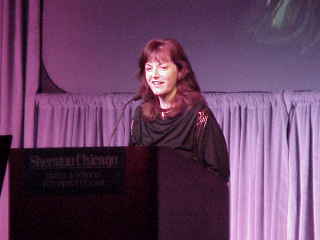
(Which I didn’t expect to win–I’d been a finalist before and hadn’t won–and my friend Kathi and I went out for a beer, instead of getting all dolled up for the awards, and I didn’t know beers in Chicago could come in yard glasses.  I arrived happily buzzed, in a borrowed dress, and somehow managed not to fall on my face getting up the stairs. I think I was reasonable coherent. I was more than delighted to receive the award from Jo Beverley one of my heroes.

At the RWA Awards Chicago

Better yet, the book went on to win me a publishing contract.

And I’m delighted it’s back in print.

Winning the RWA Golden Heart in Chicago

Setting up for Digital

Some things just seem simple–digital publication is one of those. Upload a file and presto, right? But there are a few things that you want to figure out first—it’s another case of a little planning going a long way.

ISBNS

The ISBN is an industry standard for identifying a book. If you want full control of your book listing, buy your own ISBNs, which you can do through Bowkers at myidentifiers.com

You can buy a single ISBN for $125, or a premium one for $185, or buy 10 at a time for $250. Assigning them is a bit of a pain.

The ISBN is not actually in use until it is applied to a book. To do this, you’ll need the book cover, your bio, your book description, a PDF of your book, and an Excel file saved in the CSV format with the Search Engine Optimization (SEO) terms you want to use.

After you buy your ISBN, login to myidentifiers.com and follow the tabs and fields to set up all the information. You can also replace an older print ISBN if that print edition has gone out-of-print.

Include pricing and sales areas (countries where you’re selling), and check back in a few days to confirm your ISBN has been activated for that digital publication. It usually takes only a day or two to get this set up.

Then you can do that “easy file upload” for digital publication on Amazon Kindle, B&N Nook, and Smashwords.

Smashwords

Smashwords.com is both easier in some respects, and more difficult in others. They do provide a lot of information readily available on their site. The first step is to sign up and set up an account. Set up payment methods and create a profile. Click on the PUBLISH button to start the publishing process.

Fill out all the forms. Set your price (and Smashwords offers a cool graph to show what you’ll be making on any book for each price point). Be honest about if your book contains adult material (explicit sex or graphic violence). Upload your correctly formatted book and your cover. And remember to include the wording that Smashwords requires at the front of your book.

IMPORANT: Always take a look at the preview to make sure your book appears as you want it formatted. If you need to, adjust the text in the file and upload that again to correct any formatting errors or typos.

With the ISBN manager at Smashwords, you can add your ISBN or let Smashwords give this to you. If you’re having Smashwords do your ISBN, but you’re doing your own Kindle and Pubit uploads, set up Smashwords first so you have the ISBN to add other places.

Before you do that final submit, read the legal stuff (the Terms). This is a contract you’re signing with your mouse click.

It can be minutes to hours to actually have the book upload. It will then show as pending approval (that’s okay).

In Smashwords, select DASHBOARD, and now set your distribution for this book with the Distribution Channel Manager.

You can let Smashwords distribute to all formats, including Kindle and Nook. However, you’ll make higher royalties if you do your own Amazon and BN distribution. For Smashwords, I opt out of Amazon and BN formats. I opt into Apple (which requires an explicit opt in selection).

NOTE: Your book will appear in Smashwords right away, but will not be listed there as “premium content” until it’s approved. Check back every few days to make sure it is approve, or if the format needs to be adjusted (and also to see how you’re sales are doing).

UPDATE TO SMASHWORDS: They now allow both short descriptions, and long descriptions of up to 4000 characters. If you have books on Smashwords, you may want to update your descriptions. I’m using the short descriptions for review promos, and then adding in more details about the story in the long descriptions.

B&N PUBIT

For uploading to the Nook via Pubit, this again starts with reading up on the process on their site, and creating an account, this time at pubit.com. B&N requires a credit card to create an account. This is in case a book is returned (for example, you’ve sold 20 books, but one person decides to send it back, but B&N has already paid you for 20 books; they use the credit card to account for that one return). Some folks don’t like this but I had no issues.

When your account is set up, head to Add a Title.

One nice thing about PubIt is that you can save your work as you go (very handy that). So you can add some info, go away, fuss with promotional copy, and come back and add that.

As with all other formats, once you upload your book, make sure you check out how it will look with the preview option (PubIt automatically brings this up for you to view, which is a nice feature). You can also mark if the book is part of a series.

You can add up to five reviews, including reviewer names and quotes. You can post excerpts from the reviews, but you should get clearance from the reviewers before you use their copywritten work.

NOTE: While BN’s PubIt doesn’t require you to have an ISBN, I’ve found it’s easier to add this up front, instead of trying to update the ISBN at a later time. Everything else is much easier to update (cover, copy, reviews, descriptions, even pricing).

Amazon Digital Text Platform- Kindle

UPDATE: Amazon has renamed this to the “Kindle Direct Publishing”. They’re also now putting out a newsletter with useful tips and advice. The old link below still works, but the new link is: https://kdp.amazon.com.

The options at Amazon can be confusing: they have Create Space, and Kindle, and their Associates Program. To actually sell a book on Kindle, you want to head to: https://dtp.amazon.com. If you don’t have an existing Amazon account, you can create it. Again, Amazon provides a lot of information about the process on their site (including a video). The details can be a little overwhelming, so you may want to tackle the basics first, and then improve your publishing and promoion.

NOTE: To help promote your book you’re also going to want an Author’s page at https://authorcentral.amazon.com.

As with PubIt and Smashwords, you’ll need to set up all your account information so you can get paid.

Again, you enter your book title, cover, and upload your book. Make sure you spell your name as the author correctly. Again, make sure you preview how the book looks on Kindle.

You can mark if this is a series (same as for PubIt). You can set your pricing and opt out of DRM. Add in your ISBN if you have one. When you save your information, the book will go into a pending mode. Once approved, the book will be listed for sale.

And there you have it – the easy (or almost) steps to digital publishing.

Twelve Steps to a Digital Format

There’s lots of information out there about eBook format. But in converting my print books, I’ve streamlined this to a simple twelve steps. You can get fancier if you know what you’re doing. My choice is go to for a clean format. So, here’s the twelve easy steps.

Twelve Steps to a Digital Format

STEP 1 – Put your book into a single file in Microsoft Word. I had my chapters split into multiple files, so the first step was a lot of cut and paste. I did have electronic versions of my work, but not the same ones as in print. This meant either scanning the books or manually inputting my edits. I went with the latter and made this part of my editing process.

Other ways you can do this might include a search the Internet to see if someone’s done the work for you and you can grab an electronic version (yes, those pirate sites have a use). You can invest in a scanner and OCR software that converts the scanned image into text—the cost will be about $300 – $400 for a full setup. Or you can pay for a print book to electronic conversion: about two to three dollars a page to get all the work done for you. If you’re still going it on your own….

STEP 2 – With your book file open, use the SELECT function. Select ALL and set the font to Ariel or Times Roman. Electronic readers like consistency and these are about the most Web-safe fonts around. I use Times Roman for the bulk of the book, but I put the title and front copy into Ariel.

STEP 3 – Set the font to 12 or 14 point, no smaller and no larger.  I like to set the title and chapter headings to 14 point and use 12 point for everything else.

STEP 4 – Remove all TAB marks. To do this, use the REPLACE function, select MORE and SPECIAL CHARACTERS. Put the tab mark in the field to “find” and nothing in the replace area and that will remove them all.

STEP 5 – Use the REPLACE function to search and replace all double spaces with single spaces (do this a couple of times to catch all of them).

STEP 6 – Set your paragraph indents with the PARAGRAPH function. Set INDENTATION to SPECIAL, FIRST LINE, with LEFT set to .2″ or .3″ (you can go up to .5″ but I think the smaller option looks better in the electronic readers).

STEP 7 – Use the PARAGRAPH function to set spacing to single space.

STEP 8 – Remove all headers and footers—deleted them.

SEPT 9 – Remove any page breaks between chapters.

STEP 10 – Center your chapter headings and number chapters as in “Chapter One” – that’ll help to automatically generate a table of contents. Put only a single blank line space between chapter headings and the text – that’s both before and after.

STEP 11 – For breaks within a chapter, use a simple mark such as the asterisk (*) which electronic readers can handle.  Center this and put a single blank line space before and after.

STEP 12 – Put dedications and reviews up front since this is free preview content.

Your format should look something like this (without the blue text which is just here to make the book text stand out)…

Opening Page:

A PROPER MISTRESS

Shannon Donnelly

For Marsha —
may you always find the courage to choose happiness

Bookseller’s Best Finalist, Golden Quill Finalist, Orange Rose Finalist

“With its excellent characterization, polished prose, and humor, Donnelly’s latest Regency is a supremely satisfying, deftly plotted delight.” – Booklist, American Library Association, John Charles

“…delightfully offbeat romp with an engaging set of young lovers and a good cast of supporting players…highly enjoyable” — Romantic Times Top Pick – 4½ Stars

“I highly recommend A PROPER MISTRESS, and can’t wait for Ms. Donnelly’s next book….” — Five Roses – Escape To Romance, Marlene Breakfield


CHAPTER ONE

“Beauty ain’t required, but she’s got to catch the eye,” Theodore Winslow said, striding across the small salon, one hand fisted behind his back and the other gesturing in the air. “I mean, I’m supposed to be smitten. But she can’t be at all acceptable—only she can’t be too coarse, either,


A chapter break will look similar to this:

“Why, you’re hardly more than a boy yourself! Why ever do you want to go hiring a woman from this house to act as your bride?”

CHAPTER TWO

At the sight of a short, curvaceous redhead being thrust into the room, Theo started to smile. But those tempting, full lips parted and her words cut into him like a butcher’s knife. Hardly more than a boy!

And a scene break will look something like this:

“Well, you want to make sure you ain’t a trout with your mouth gapping open to be hooked by this flash gent, or any other. Remember that, or you’ll be agreeing to more than you think you will now. And just you remember, too, every woman may have her price, but every man has his limits. Most of ’em start with his purse. Now, let’s see how those dresses look. You’re going to have to be dazzlin’, ’cause it’s going to take us longer than a quarter hour to turn you out in style.”

#

By the time Sallie finished, Molly no longer recognized herself. Nell and Harriet, seeing the door open to Jane’s forsaken room, had poked their heads in—eyes sleepy and hair tumbled and still in their night wrappers. Sallie’s house kept late hours and late mornings. Sallie bustled them out, saying to Molly afterwards, “Never does to stir up jealousy, and you don’t want them thinking you’re stealing their trade.”

———————-

If you know what you’re doing, you can get fancier about the formatting. Or if you pay someone to do this for you, they can do the fancy stuff.

While this may sound like a lot of work, I found it to be not all that difficult, it just takes some time. I’m averaging two to three weeks to get a book formatted and that’s working only weekends and evenings and doing all the edits. It’s going faster the more I do this (I’m getting a process down). Basically, this requires patience and persistence, something every writer needs in buckets.

Save your file as both a standard word .DOC or .DOCX.  Also save the file as a PDF version (this will allow you to give away free PDF copies to readers, and you’ll need this format, too, if you set up an ISBN).

NOTE: Smashwords also requires specific text at the front of your book about being published at Smashwords, so you want to set up a separate file with this info:

Published by Shannon Donnelly at Smashwords.com

Copyright 2010 Shannon Donnelly

Discover other works by Shannon Donnelly at Smashwords.com


That’s it. Twelve steps. The part that really takes the work is getting the writing done in the first place.

Keeping it Light – Writing Humor

Just finished the edits to get A Proper Mistress online, and it’s a delight to have a visit back with these characters. It’s a lighter romance, more what’s been called a Regency romp, though I don’t go for taking things too absurd. And that got me thinking about how touchy this sort of thing is to write, and my own guidelines for writing humor. My style is a blend of humor, a little drama, action, and I like to mix all of that up. I’ve tried to see how dark I can go, and I never can go all that dark–it almost always twists into black humor at some point. But, then, I like a little spice in almost everything. And, yes, you’re going to get a lot of cooking metaphors here–Molly Sweet, the heroine of A Proper Mistress is a delight and a cook and she always puts me into that frame of mind — which leads us to where we need to start, which is with characters.

A Proper Mistress

A Proper Mistress

Humor, in particular, needs characters who can carry the absurd. That’s harder than it sounds. I also think humor needs dialogue–great, snappy, fast dialogue. All the stuff that folks usually think needs to come out of their mouths and onto the page, and that’s going to keep the pace of any story moving and keep it fun. The other critical element is that I think the characters need to take their own situations seriously–its their lives. We may laugh, but if they do, it’s a bit like someone laughing at their own joke–kind of puts the pressure on that you should laugh, too, and that takes away the fun.

The other critical element is to know your character’s intelligence. I think writers often forget about this one, but it’s vital with humor. You need to know if a character is quick-witted, or a bit slow. You need to know how every character thinks. And you need to give them good reasons for why they are that way–there needs to be a reason why someone may be smart, but uneducated, or why someone else is smart in one fashion, but very stupid in other ways. This affects the story in major ways, and can be a great source of humor–with this, you don’t end up relying on ‘things’ being funny. Humor always works best when it comes from the characters, and the absurdity of life.

I also think you need to either build the absurd, or you need to start with it. Building the absurd is what the screwball comedies of the ’30’s do so well–they just keep stretching the absurd until its insanely silly. For a book, I like to go the other route and start with a situation that’s already heading off into crazy land.

For A Proper Mistress, I also wanted to start with twisting a cliché. This works great in any scene or story–take something that’s done to death and put a fresh spin on it.  The spin was that I’ve read way too many books in which the hero or heroine needs to get married in order to get an inheritance. This is such a worn old shoe that it squeaks. However, with the twist comes the need for motivation.

Good characters are method actors, always asking, “What’s my motivation?” Characters need reasons to do absurd things–these may be absurd reasons with faulty logic, but they should seem sensible to the characters. Which leads to the core question: what pushes a guy into trying to get disinherited?  Of course, the answer is what pushes us into most stupid things, and for me that’s a dysfunctional family.

The good part of being a writer is that all that junk in your own attic of live is useful. Creating a dysfunctional family isn’t hard for me since I had one, all my friends have one, and I actually have a hard time with normal. Everyone in A Proper Mistress is coping as well as they can, but they all have Issues–with that capital in there. The other thing about humor is that a little drama can help you ground it–it’s like having a string to a balloon.  Or to really mix the metaphors, a nice dense chocolate cake to go under the fluffy, sweet whip cream. Backstory for characters–the faulty motivations–is a great place for this grounding. And so is the character’s secret.

For me, characters start to come alive when they start keeping secrets–from others and from themselves. In A Proper Mistress, the hero both worships his older brother, but he’s also secretly a little resentful, and he doesn’t even realize it. The heroine has a secret wish to have a family (she’s an orphan). Theo’s dad has the biggest secret of all, one that’s impacted everyone’s lives, and all this is starting to sound a bit heavy. Which is where the last ingredient comes into play.

Balance in a story is as critical as the balance of spices and elements in a meal. And you want to push this balance off-center to get the emotion and effect you want. Go too far, however, and you end up with a hot mess. So with humor, you want to keep it light, fast-moving–the balance has to be more on what’s happening in the story, with only the lightest touches of heavy backstory. Molly was a godsend in A Proper Mistress. She could have ended a very tragic person–she’s had a tough life. But she’s resilient. She has no time to dwell, and is all about dealing with what’s happening now. She kept the story moving with her personality as much as anything else.

That brings us full circle and back to characters. Writing light, characters are everything. Their actions, their dialogue, their motivations, their flaws–which need to come out big time–provide all the elements for funny. Humor, for me, is about poking gently at all the flaws we carry with us–and pushing them a little bigger so those flaws stand out in the bright light of the absurd.  It’s about letting your characters go so they can surprise you and come up with their own twisted thinking. Give everyone a point of view and a plan, so that nothing ever goes right, or goes quite the way the characters think it will.

Above all else, humor needs two more things.  The first is a light hand–you need to edit, but you can also edit the funny right off the page. This means you have to treat the writing with a light touch–keep the prose clean and the plot even cleaner. If you get too fancy with technical stuff, it’s going to weigh the work down and dull the humor. The second is the courage to let your own quirks come out. Take your own flaws and put them on the page and into your characters. If you can laugh at yourself, it’ll be easier for readers to laugh at your characters and their absurd lives.

English Winter Fare

In the still largely agrarian world of the early 1800’s, autumn and winter became a time to relax after harvest. Gentry and yeoman alike could take advantage of old feasting customs that had long ago mingled with the Christian holidays.

In autumn, Parliament opened again and some of society returned to London. St. Michael’s and All Angel Day, or Michaelmas, at the end of September, marked the end of a quarter year. The Celtic calendar also wove itself into English holidays, with one of the main events on November 1 becoming All Saints Day or All Hallows and October 31 therefore set as All Hallows Eve. It should be noted that Saman (also Samana, Shamhain, and Samhain) a minor Celtic guardian of herds, and so important to a herding society, played a part in the celebrations, but modern lore has turned him into an ancient god of death and mixed up several Celtic customs along with imported Christian beliefs to give us Halloween.

October was a month when land owners ate pheasant, partridge, duck and grouse. Fish for meals included perch, halibut, carp, gudgeons, and shell fish. Poachers also looked to snared hares for their pot. Beans were still fresh, and the fruits of summer gave way to pears, apples, nuts and the last harvest of grapes.

On November 5 bonfires burned in mockery of Guy Fawkes and memory of the Gunpowder Plot to blow up Parliament. The Feast of St. Martin, or Martinmas, fell on November 11, and St. Andrew, the patron saint of Scotland, had his day on November 30. St. Andrew’s day also marked the beginning of Advent to celebrate the four weeks before Christmas. In November, the landed gentry still dined on wild foul as well as domestic poultry—which was now getting a bit old and aged (meaning tough and needing sauces to make the meat palatable). They also had beef, venison and pork with their meals. Fish could still be caught and served, and winter vegetables graced the dining room, including: carrots, turnips, parsnips, potatoes, leeks, cabbage, celery and lettuces. With November, walnuts and chestnuts came into season.

More celebrations lead to Christmas Eve when the Lord of Misrule danced and the Mummers traveled to perform their pantomimes. Then came Christmas Day, and Boxing Day on December 26, which was St. Stephen’s Day. Boxing Day did not get its name from gift boxes, for the exchange of gifts was a German custom still new to Regency England. Instead, Boxing Day got its name from the older tradition of it being a day in which pleadings could be placed in a box for a judge to privately review. In December, besides beef and mutton to eat, pork and venison were served. Goose was cooked for more than just the Christmas meal, and there would be turkey, pigeons, chicken, snipes, woodcock, larks, guinea-foul, widgeons and grouse to eat. Cod, turbot, soul, sturgeon and eels joined the list of fish in season. Forced asparagus added a delicacy to the usual winter vegetables. Stored apples, pears and preserved summer fruit appeared on the better, richer tables. Mince pies made from mincemeat, which has no meat in it, were another traditional fare, with the tradition being that everyone in the household should stir, for luck, the mix of dried fruit and spices before it was baked.

Households also celebrated not just according to the season, but also to the customs of the area. In the Regency, local customs in the countryside might well hold to the old ways.

Under the Kissing BoughFor one of my books, Under the Kissing Bough, I needed a Christmas wedding and customs that suited the countryside around London. In ancient days, a Christmas wedding would have been impossible for the English Church held a “closed season” on marriages from Advent in late November until St. Hilary’s Day in January. The Church of England gave up such a ban during Cromwell’s era, even though the Roman Catholic Church continued its enforcement. Oddly enough a custom I expected to be ancient—that of the bride having “something borrowed, something blue, and a sixpence in her shoe”—turned out to be a Victorian invention.

For Christmas customs, I relied on those that have carried down through the ages: the Yule log from Viking winter solstice celebrations (which gives us Yule Tide celebrations), the ancient Saxon decorations of holy and ivy, and the Celtic use of mistletoe on holy days, which transformed itself into a kissing bough. Carolers might well travel from house to house, offering song in exchange for a wassail bowl—a hot, spiced or mulled drink, another tradition left over from the Norse Vikings.

The holidays were a time of games as well, and the game of Snapdragon is a very old one. It’s played by placing raisins in a broad, shallow bowl, pouring brandy over them and setting the brandy on fire. Players then must show their courage by reaching through the spirit-flames to snatch up raisins. And the game even comes with its own song:

Here comes the flaming bowl,
Don’t he mean to take his toll,
Snip! Snap! Dragon!
Take care you don’t take too much,
Be not greedy in your clutch,
Snip! Snap! Dragon!

Celebrations continued to mix tradition and religion when the Twelfth Night feast arrived on January 5, which combine the Roman Saturnalia with the Feast of the Epiphany, when the three wise men were said to have paid tribute to the Baby Jesus. Deep in winter, there was still plenty of game to eat. Beside those wild and tame birds available in December, lobster came into season in January, as did crayfish, flounder, plaice, smelts, whiting, prawns, oysters and crab. Broccoli made a welcome change from the other winter vegetables, as did cress, herbs, cucumbers, beets and spinach. Preserved fruits would be running low in all but houses with large orchards, and stored apples and pears would have to serve guests until the expensive force strawberries of February appeared.

For the Celtic year, winter ended February 1 with the celebration of Imbolc or Oimelc. This is the time when ewes begin to lamb and lactate for their offspring, and life begins to return. For the ancient Celts, this was the celebration for Brigid (also Brigit, Brighid or Bride), the Light-Bringer, one of the main Celtic goddesses. She was strong enough to survive and be transformed by early Catholics into Saint Bridget, who was celebrated, along with the Virgin Mary, on February 2, Candlemas Day.

Another ancient tradition, this one of law, was to ignore leap year days—February 29 did not exist. This became the day when the world could be out-of-order. Tradition held that St. Bridget complained to St. Patrick about women having to wait so long for proposals, and Patrick answered that women could propose on Leap Day. In Scotland, their tradition added on that any man who declined a proposal in a leap year must pay a fine, which could be anything from a fine silk dress to a kiss given to the disappointed female.

St. David’s Day the Welsh patron saint came on March 1, and tradition held that all good Welshmen should wear a leak—a vegetable readily available from winter fare. March also brought Lent, and in Shropshire and Herefordshire, Simnel Cakes made with saffron were made for the season.

With March 21, the spring officially arrived, but for most of England, it would still be some time before warm weather and spring flowers arrived, and even longer until the return of the lush abundance of summer fruit and foods.

Edits and Revsions – When is Enough Enough?

Proper ConductWhen I set out to bring my books into e-format, I’d first thought I wouldn’t edit them. Then I did the first book, and I did edit. With Proper Conduct done and coming on sale now in electronic format, I’ve gone a step beyond that. I’ve revised the ending.

Now, there’s a story about JRR Tolkien, author of Lord of the Rings, that he was very late with delivering the manuscript for one of the books and someone finally showed up, boxed it up, took it from him, but as it was being carted off for publication, he called out the window that there was one more edit he needed to make. I don’t know if it’s a true story, but I suspect there’s truth in it in that we all want to correct our mistakes, and if you’ve grown up with that urge to perfectionism, you really want to go back and edit. The joy of electronic media is that we can now do so. It’s also the curse.

This doesn’t mean the book I’ve edited ends differently–the hero and heroine still get together, there still is a happy ending. However, when the book came out in print I had the restriction of paper, meaning a hard physical budget. My choices were a longer book and smaller type font, or keep it under 80,000 words, and I was already pushing that.  So I ended the book with the heroine and hero together, but I did read the reviews and I had to agree with a few of those who wanted a bit more.

Sometimes you just need that extra bit of afterglow, that emotional wrap-up that goes with the story to show that these two characters actually have done more than make that leap into love–they’re also going to be able to maintain the relationship. Sometimes you just need to show them getting along as they’re going to be getting along.

Now there are times I’m impatient with a book that drags on a bit much–none of us care for those guests who stay and stay and keep on until dawn. But there is such a thing as an end that comes too soon which leaves you wanting that extra bit more. I’m hoping I’ve erred on the side of enough without too much (or maybe it’s still not enough–it’s so hard to tell when you get that close to the work).  But there it is.  I’ve added edits, now, I’m revising myself.  And I’m already thinking about a couple of books where I wanted those extra scenes and just didn’t have the page count for it (or the time on the deadline).

But I do see the danger here, where one can revise and revise and never get to anything new. So I’m going to have to learn to balance this. For now, Proper Conduct is out on Smashwords with a fine new cover by Albert Slark, who also did the original cover, but I love the new cover.  It should also be showing up soon as well on Amazon.com for Kindle and BN.com for Nook.

I’m bringing out A Proper Mistress next, and while I don’t anticipate changes there, as I convert the book for electronic formatting, I wonder if I’ll find that I need a new scene, or an extra bit somewhere in the book.  It’s actually more fun to go back to these characters than I’d thought it would be, and now I can see why folks return to their old schools and go back to hang out at the old playground. The really interesting thing will be to find out if I have made the work better–or if I’ve just made it different.

It’s Not Just a Point of View

Let’s start with a disclaimer—I am not a POV purist. I’m probably going to sound like one, but really I’m fine with viewpoint shifts in a story, so long as they work. But I think most folks use the “I’m not a purist” line as an excuse not to master POV technique. And a lot of folks just don’t know why they need strong POV control in a story.

Back before my first book sold, I was lucky enough to get Jo Beverley as a judge in a contest (she writes historical romance and if you have not read her work, go and buy her books—she’s good). She stressed one comment—master your POV and you’ll sell. She was right. Back then, I had something I see a lot from journeyman writers—floating POV.

Floating POV is when the viewpoint is sort of third person and sort of omniscient. It’s sort of in one character, but sort of not. This can show up in first person, too, where it’s sort of first person, but sort of omniscient, so don’t think you’re immune there. However, it is less likely to show up in first person, which is one of the big advantages to using it. The big problem with floating POV is that it leaves the reader floating above and out of the story, too—the reader ends up emotionally detached. It’s weak writing.

Deep POV, the opposite of floating POV, is about reader immersion. And by deep, I mean viewpoint that is locked within a character. This means locked right behind that character’s eyes and within that character’s head and emotions. Deep POV can be locked in first person or third person, but it is locked tight. When you lock POV like this, it’s very tough to shift—both because you as the author start rolling along with the character, and each shift is a place to lose the reader. With deep POV you naturally tend to want to put viewpoint shifts at chapter breaks or major scene shifts instead of putting these viewpoint changes within a scene.

All transitions in a story are slippery places—chapter shifts, scene shifts and viewpoint shifts are the places where a reader can pause, slip out of the story and put the book down. Put enough of shifts into a scene, or too many fast shifting scenes before the reader is deep in a story, and you can see how POV purists end up having a good point—you’re better off being a purist than someone who changes POV so much that it pushes the reader out of the story.

Like any other writing technique, POV control is about mastering the technique. That’s an advantage a POV purist has because that person has nailed this part of the craft. And if you don’t practice a discipline, if you’re always loose with your POV, you won’t learn how to control your story (or the reader’s attention).

Coming from a background where I’ve dabbled in the other arts—music, painting, dance—I’m a believer in solid technique as a foundation. The stronger your technical skills, the more you can let them run on auto-pilot and focus on the fun stuff. When I played violin, every practice started with a half hour of scales. Only then could I dive into the music and have it come out sweet. Scales both limbered up my skills and improved my technique. A writer doesn’t really have the equivalent of musical scales, but we can still practice technique.

To improve my control of POV and my technical skills, I set myself the following disciplines.

First book I sold, I kept to one character’s viewpoint per chapter. This became the technical exercise in the book. If I needed to cover another character’s emotions in a scene, the following chapter could go back a bit in time to do that scene from that character. But I was a POV Nazi for myself and kept to one character’s POV in each chapter. This deepened my characterization and the emotion in the scenes. It gave me the control I needed—but I still have to go back to this practice at times (yes, those skills you don’t practice get rusty).

Next thing was to write more in first person. I still do this. While I like third person for the flexibility it gives of putting the viewpoints of a lot of characters into a story, I’ll still use first person to write a scene. After the scene is written, if the story is all in third person I’ll shift the first person scene into third person. First person helps me get into my characters and also works a lot like those musical scales to keep my technical skills sharp. It also gives me more emotional bang in my scene, and keeps me honest about my viewpoint control (it’s so easy to think you’re doing this well when you’re not—I always say there’s the story in your head, the story on the page, and the story in the reader’s head, and these don’t always match).

The last discipline is to always ask—do I need to shift viewpoint? (Hint: “Because I feel like it” is never a good enough answer.) Viewpoint shifts need to be treated like any other part of the story—they need a lot of good reasons to be in the story, or they need to be left out. That which does not improve a story will detract. If I have three good reasons to need a viewpoint shift—including the best one, which is that another person in the scene now has more emotionally at stake in the scene—only then will I look at crafting a shift.

Granted, sometimes the instinct to shift viewpoints is one you need to listen to. Writer instincts need to be developed and used. But sometimes this is also justification for a lazy habit that you need to pound out of your writing. This is where you have to be able to look at your writing and know that the scene works—it’s giving you the emotion you need, so don’t touch it. Or you have to apply the discipline to rewrite it and keep the reader within the viewpoint of the key character in that scene so the reader gets every ounce of emotion from that scene.

When you have to make a viewpoint transition, you want to use some technique to smooth this (it’s like a baton hand-off in a relay race, and if you fumble this, the reader can trip right out of your story). But that’s the subject for another day, and for the POV workshop that I teach (shameless plug there, but if you don’t take this workshop, at least pick up Orson Scott Card’s book, Characters & Viewpoint to grab some good tips).

I won’t tell you, “Master POV and you’ll sell.” You may have other writing or story issues to address. But I will say that mastering immersive POV—the ability to put your reader into the story and keep the reader there, the ability to control viewpoint so well that it the craft is transparent to the reader—is key to becoming a great storyteller.

At least, that’s my point of view.


(First published as a guest blog at the FFnP RWA Blogspot.)

Backlist Back for the Holidays

There is nothing quite as exciting as an adventure–also, nothing quite as uncomfortable, fraught with peril and generally the sort of thing that makes you both nervous and thrilled. Adventures also make for good story telling after the fact.  I’m still in the early stages of this new path, but seems like a good time to start sharing on what it’s like to bring out books in electronic format. And why not bring back my out-of-print books–I have the rights back and I’ve had folks asking when they could get these for electronic readers, so…let’s go.

Now, I’m not trail blazing here–lots of folks are going electronic, and there are definite advantages. But we’re not talking freeway fast path, either. We’re more like Oregon Trail–there is a trail, many folks have passed this way, and you can see the skeletons of some of them.  And we’re still in covered wagons–this is not a trip for those who aren’t stubborn as hell.

My particular trip started with getting enough info from the Novelists Inc. conference that I decided it was time to do some experiments, at the very least. My day job is web work, so you’d think my adoption factor would be high, but my books ran into the cobbler’s children syndrome–not an electronic stitch to have them shod. Time to change all that.

Under the Kissing Bough

First step–the cover.  The books are all done, so I don’t have to worry about finishing them, or edits (well, mostly not, but more on this later). I had the contact info for Albert Slark who did a couple of my covers. He gave me a great rate, and now I’ve fantastic covers coming, including one for Under the Kissing Bough (RITA nominee for Best Regency).

Second step–file conversion. My final edits were on paper, so I pulled out the books and the files to put in final edits. My initial thought was that I’d keep the books the same–they represent my writing at a certain stage of my life, and I thought that should stay the same. Then I started finding things I just did not want to allow in any new edition. There are no major edits, but I found things I wanted to be cleaner, stronger–my skills have improved as a writer, and I found I wanted the electronic edition to be as strong as I could make it.  Now I’m going to have to do that with all eight books, so this is going to take more time than I wanted.

Third  step–more file conversion. Formatting is a pain in the ass. There’s no way around that. There’s fussing with formats, and fonts, and making sure it’s going to display right on the reader. This is where that stubbornness can really help. You have to get everything ready for upload, and then you have to fuss more with the upload. This is where, on the Oregon Trail, you’re crossing the Continental Divide.  You just have to get  out and push sometimes.

Fourth step–this one is optional.  I bought ISBNs for the books–if you go this route, you need an ISBN for each version, print, electronic, etc.  This also gets the books listed in Books in Print, but it is more fussing. (I already have copyright on the books, but if you want to button everything up, you can also get a copyright on the book for not much money).

Now comes the next steps–promotion, promotion, promotion. Getting the word out in an already noisy world is always tough.  But I feel as if I’ve got my stake in the ground for some of the new promised land–I’ve cross the great divide and now must learn how to make this adventure work on a long-term basis.

I have to thank a few people who provided great info and insight, including Bob Mayer, Joe Konrath, Della Jacobs — these are all writers, so please go buy their books, too, all in convenient electronic format.

And you can now buy my RITA Nominee for Best Regency, Under the Kissing Bough, for: Amazon Kindle, Barnes & Noble Nook or for Sony readers or other formats at Smashwords…and next month, I’ll let you know how the adventure progresses. I’m pretty sure that, to paraphrase the words of Betty Davis when she played Margo Channing in All About Eve, what we all need to plan on is to, “Fasten your seatbelts. It’s gonna be a bumpy ride.”

Writing Resources

I’ve been doing a workshop on research, which led to my digging out some old notes on useful writing books.  This is the short list of the books that have taught me so very much about writing–these are the books I still have on my shelf, the ones I go back to for a refresher course. These books may speak to you, or may not, but if you find one good piece of advice and some entertainment, these will have served you well, too.

Bird by Bird, Anne Lamott — some instructions on writing and life, the perfect inspiration book

The Artist’s Way, Julia Cameron — a workshop on how to unblock any blocks

The Courage to Write, Ralph Keys — one of the best books ever written on writing

A Manual Of Writer’s Tricks, David L. Carroll — a great idea generator

Characters & Viewpoint, Orson Scott Card — How to invent, construct and animate vivid, credible characters and choose the best eyes through which to view the events of your short story or novel

Creating Characters, Dwight Swain — great advice for beginners and for experienced writers

Techniques of the Selling Writer, Dwight Swain — teaches the bones of story structure

Story, Rober McKee — get the CD, or take his workshop, the book is so dense it’s very heavy going, but there’s a tone of great story structure basics here

Write Away: One Novelist’s Approach to Fiction and the Writing Life, Elizabeth George — Fabulous book, but will be more useful for an experienced writer to take her writing to the next step

On Writing, Stephen King — simple clear advice on keeping writing simple, clear and powerful

Self-Editing for Fiction Writers, Renni Browne & Dave King–a book I still keep right beside by desk and these days every writer needs to learn how to edit her work.

How to Write Romances, Phyllis Taylor Pianka — the basics of the genre

The Art of Fiction, John Gardener — wonderful writing about writing

Just Beachy

Guest blogging over at http://www.ninc.com/blog/index.php/archives/just-beachy

The sand is as dazzling white as promised, the ocean as blue, and while there is much discussion of futures and publishing and brave new digital worlds, the refrain I hear echoed time and again is, “Write a good book.”  That is the one unchanging mantra from both traditional publishers and ‘digital first’ (a new buzz word and way more sexy than e-published, which is a mouthful, but does that imply ‘print last’?). 

Write a good book.  Easy words.  Hard task.

Which, of course, is why all of us are sitting here, trying to figure out how good is good?  And what do you do next these days?  The paths are many to get a good book out there and into a reader’s hands.

Print’s still around, of course, and going to be here for a bit, and it still has more allure, despite the cool new moniker of ‘digital first’ (and I do like the name ‘the Big Six’ for the NY publishing house, but the concensus is that that number’s going to be all over the map very soon).  Anyway, print is still a way to go if you don’t want to fuss with your own covers and you do have an idea that could kick into high gear with the right marketing machine.  And it’s got that lottery ticket allure that maybe you’ll hit the best seller list.

Then we have the ‘digital first’ publishers, our modern small publishers, who still have good things to offer, and Kindle is kicking these folks into high gear and Nook looks to do more, and this will be the Christmas for e-readers.

Beyond that is the world of self-publishing, which has good points (as in pocketing the money direct), but it also has its hard work — editing and covers and cover copy are all now in the author’s hands, a double-edged sword if ever, since it’s all your fault, too, if done badly.  But there are possibilities, and the stigma, while still there, is probably going to go away as more really good books actually come out of this area.

Which brings us back to the mantra–“Write a good book.”

Self-pub, digital first, print–they all demand the same thing.  A strong story, compelling characters, writing with a certain flow and flair.  You need a story worth telling, a tale that captures the imagination, something, as Kurt Vonnegut once put it, that doesn’t waste the reader’s time.  Oh, and a fair price point doesn’t hurt, either.

It’s comforting that some things never change–like the desire to have a good story.  And it reminds me what’s really important–which is to get the words on the page, and to keep working on improving my skills at doing so.  Conferences are always fun, but not as much fun as getting the words right on the page.