Getting the Good Stuff In First

There’s one think about all young writers (and I mean young by number of books written not age)–they all want to hold back on stuff. This crops up either in a synopsis (but I want to make the agent/editor want to read the book so I don’t want to tell the secret or big surprise), or in the manuscript (but I want the reader to get to the last part of the book before I reveal this big twist).

Darling writer–you’re not going to get that agent/editor to read the book nor are you going to get the reader to the last part of the book if you hold back on all the good stuff.

Get the good stuff in first. Or look at it this way–does a flower say, “Oh, I’m only going to blossom half way because I want to hold back.” No–it goes all out to give you its best as soon as it can.

Lead with your best. It is not wise or kind to hold back on this because basically you’re risking boring the reader (or worse, confusing the reader). Lead with your best because that’s the best way to hook a reader.

Ah, but now I hear you ask, “What about mystery? What about suspense? What about my great surprise?” Mystery and suspense comes from keeping information from your CHARACTERS (not from your readers). Play fair with the readers. Give them all the stuff they need to know. Then put in suspense by having your characters in the dark–make the characters struggle with understanding everything. Also, keep in mind that most readers don’t really want huge shocks or surprises–they can be very uncomfortable and if not handled well will throw the reader right out of the story.

So get the good stuff in first–it will give you happy readers who can’t wait to turn the page to see what the characters are going to do next. Getting all the good stuff up front, right where it’s going to temp readers into reading more.

Now I hear you say, “But if I use up all the good stuff up front then what goes into the rest of the book.” This is where you have to put in even better stuff. This is where your job as a writer comes into play–you think up even better stuff and get that to the reader as soon as you can.

Shutting the World Off

SunriseEvery now and then it all becomes too much–too much information, entertainment, and way too many to-dos. That’s the time to shut off the brain. My mum used to call it ‘brain in a wheelchair day’–you can still do stuff, but the idea is to stop thinking so much. In other words, turn off the news, set aside the bills and all the analytical stuff, go for a walk, weed the garden, but do stuff that doesn’t require the brain.

Washing dishes will work. Showers are great, or long soaks in a bath tub. You can also put on a movie you’ve seen before (nothing too demanding)–but make sure it’s nothing new. Keep the media to a minimum.

Darn socks, mend rips in table clothes, or just putter around dusting (again, it can’t be too demanding a project).

Go out and watch the sky, or stay in and watch rain drops, or play with a string and a kitten. Do mindless things.

For twenty-four hours, don’t read, don’t write, don’t pick up the phone to text someone. In fact, turn off the ringer if you can. If you have to go to work, just smile, nod and agree with everything–put all the thinking off for twenty-four hours.

It’s amazingly refreshing to have one of these ‘brain-dead’ days where you just let yourself (and the world coast). Trust me, if anything major happens, you’ll hear about it. If someone really needs to get hold of you, it’ll happen. But it’s amazing just how much can be put aside for a day.

LOVE YOUR VILLAINS

NY MetNothing marks a writer as a beginner as clearly as the cliché bad guy. This is the bad guy who is ugly inside and out with no redeeming qualities—this is the “boo-hiss” melodrama mustache twirling villain. And this is an easy fix in any story.

What’s that easy fix? Lots of things can help, but here are five quick fixes:

1. What does this character’s mother love about him or her?

Give ever character a mother. In the animated movie Despicable Me, it was funny that the main character (a villain) was largely motivated to please his mother. His opponent—another bad guy—was motivated to please his father. This gave both characters additional dimension and something we all can relate to since we all have parents.

Now the character’s mother may not be someone who bakes apple pie—maybe she’s a bank robber, or she murdered her husband, or she’s otherwise no dang good. But figure out what does she love—and how does she hope her son or daughter turns out better? Maybe she’s proud her daughter is a hit-man? Maybe she thinks her son is just misunderstood? Maybe she thinks tough love will give him a better backbone? Maybe she thinks if she just harps enough at her daughter the girl will marry well? Parents matter—even to a villain.

2. What does this character love?

We all have our favorites—even if it’s just a kind of ice cream. Alan Ladd in This Gun for Hire earned his way into fame portraying a cold blooded killer—but the killer had a soft spot. He loved cats. He’d look after stray kittens, was kind to them—and he was a sociopath. Because of that one soft spot—that love—he was more than just another guy with a gun. That’s what you want for your bad guys—find out what they love and show it in the story. Make it important.

3. Why does this character do bad things?

Motivations matter—they really matter for your villains. It’s not enough that the bad guy wants the heroine for his wife (no matter that she hates him). Why does he want this? Does he really want her money? Is he obsessed with earning her love for another reason? What are the deep, deep roots for what the villain wants?

A villain who just wants to take over the world is dull—it’s been overdone. So give him better reasons. Look at real people—Alexander the Great wanted to take over the world. And his basic reason was to show up his father who’d been good at conquering, too. (See how you get back to parents so easily.) No one is born bad, so what twisted your villain into someone who does bad things?

4. What would make this character a hero?

Turn the story around and look at it from the villain’s point of view. What actions would make this character a hero? We’re all heroes in our own story—we do things that may be wrong but at the time we think we have good reasons and they are right actions. Even Hitler thought he was saving Germany and building an empire that would last a thousand years—in his mind, he was restoring his people to greatness (the problem being it was his ideas of “his” people).

Maybe your villain has great reasons for doing what he or she must do—maybe she or he even regrets the need for bad actions. Or maybe your villain has no regrets—what must be done for the good of all must be done. Righteous villains can be really scary people.

5. Give your villain a trait you’d love to have.

Make your villains easy for you to love (makes ‘em easier to write, too). Give them, a trait or traits, you’d love to have. Maybe your villain is a decisive person, able to make up her mind at once. Maybe your villain is like Cruella de Ville and is a style-monster. Maybe your villain sings opera and keeps songbirds.

Make this trait also matter to the story—Cruella’s obsession with black and white fashion drives the story in 101 Dalmatians.

It’s that kind of love/hate that keeps readers intrigued with any bad guy—and you’ll have a lot more fun writing a villain you’d also love to be.

Originally posted at Writers in the Storm blog.

The Fear Factor

“I’m convinced that fear is at the root of most bad writing. . . . Good writing is often about letting go of fear and affectation.” – Stephen King

Up in a balloonFear shows up in a number of ways, and hits each of use differently. It shows up a lot in the only workshops I teach.

It shows up in excuses (I’m too old, I’m too busy, I won’t try this because I don’t understand).

It shows up in procrastination (I’ll catch up later, I’ll try the exercises after the class on my own).

It shows up in perfectionism (I’m awful because I didn’t do this right, I failed, I suck, I’m stupid).

It shows up in a refusal to try new things (I’ll post this old story bit instead of writing anything new).

And I can see it every single time. Then we have the brave souls who face their fears dive in and fall on their faces. I applaud that. Because they’re learning. Which is the point of a workshop. It’s supposed to be a safe place to try things, to experiment. Instead, I see so many writers who are afraid to spread their wings—as if one mistake is going to be a disaster.

Folks—we learn from our mistakes. Go out and make more of them.

I am amazed how many people resist this idea. They want to be praised. That’s not good. That’s not going to help you learn. What does help is the rewrite and the revision and the experiment. Try something new. Write a scene. Then rewrite it from a different viewpoint. Just because. Throw stuff out there. Try something in first person if you’ve never done first person. Or in present tense. Just try it out. Tell yourself that:

a) it doesn’t have to be perfect

b) it doesn’t have to be good

c) it can actually be really awful

Just let it be what it’s going to be. Then read (aloud so you catch what you’ve really done) what you’ve written and look at what you can learn from what you did. Look at what works. Look at what doesn’t work. Keep the good stuff.

This happens when I cook, too. I’ve made some awful things—I once put too much baking soda into my gingersnaps. They came out Alka-seltzer hockey pucks—hard and fizzy if you chewed on one. Great for your digestion (if you needed it), and not something anyone would eat (not even the horses would go for them, despite the sugar on the outside). Learned a great lesson on baking soda from that one.

Same applies to my writing. I’ve written awful scenes (and I expect I’ll keep doing that). Sometimes the dialogue clunks like a flat tire. I’ve tried first person, third, second, even. Present tense, past tense—it’s all about stretching those writing muscles and trying new things. You don’t know what really works until you’ve tried it.

I’ve written books that are not for everyone (go read the reviews)—sometimes folks hate my character (hey, it’s better than indifference). And I worry about all of it. I still get the nerves going and I still wonder if I’m any good at any this—no amount of praise ever takes that worry away.

The point of this is you’re never going to get over your fear.

Live with it. Know it’s there. Let it flow into you and out of you again and go write anyway. Use the fear—let it keep you sharp. Let go, too, of the affectations that King talks about—which means get out of the way of your characters. Let them tell you their story and stop pushing them into plots that don’t work. Stop being so damn writerly and just get clean words onto the page.

And if you need more good words from Stephen King buy his book On Writing: Memoirs of a Writing Career. Or read more at: http://grammar.about.com/od/advicefromthepros/a/StephenKingWriting.htm

(First published at https://writersinthestorm.wordpress.com.)

Best Advice from RWA National: The Promise To Your Readers

It was an upbeat conference this year. Editors didn’t look so hunted. Those writers not yet published didn’t look so desperate—probably because the decision to be published is now in their own hands. And the self publishing panels weren’t just about how to format an ebook, but actually had a lot of great info.

My favorite workshop was held by Barbara Freethy, Bella Andre, and Tina Folsom—three ladies who’ve done very well for themselves and who have shown that self published does not mean bad books or terrible sales. The best advice I heard came from Bella Andre who talked about the contract a writer has with a reader—a contract to deliver not just a good read but a certain level of sensuality in the books. She’s established as a secondary identity for a different type of book (and no, I’m not going to tell you the name—you’ll have to hunt it up yourself). But she did the new name because the books offer a different level of sex in the books—it’s a different “type” of book.

Now, I’d been looking at genre for “different”—and thinking that of course that’s why you needed a pen name. But this hit home—of course it’s not genre. It’s more about the feel of the book—what type of book is it. And that got me looking at my own bookshelves again.

I read sexy books—love the good ones. But it’s not my primary read. And that got me thinking.

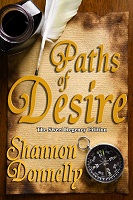
Paths of Desire is a book I did to break out to a larger book and a more sweeping historical. I amped up the sex in the book—probably too much so. It’s a good book—or I think so. But I got to thinking about my readers. I’d had one reader post a one star review—and I think she’s right. It’s not the book for her, but she’s my reader. And it’s a brave new world.

This lead me to do an edit and I’m bringing out Paths of Desire: The Sweet Regency Edition. It’s more like my other Regencies—not exactly the door shutting on the sex (it’s a romance, and these folks become lovers, and that’s a vital part of the plot), but making it more about the emotion and less about the body parts. A new cover and a new ISBN denotes the new version of the book. And now readers can choose which version they like better.

I’m also going to be looking closer at my urban fantasy books, too—maybe I’ll bring out the hot version and the plot version and let readers pick which they prefer. Or maybe I’ll just bring them into the “Shannon Donnelly” version so that no pen name is needed—it’ll be a change of genre, but not a change of tone.

Either way should be interesting.

So what do you think—hot or not? Or is it best to have a choice that you the reader can make in which edition you like best?

Writing Workshops

I’m just starting up the Writing the Regency Workshop online for Outreach International Romance Writers, which works well since I just gave a talk on this at RWA National Conference, too. This had me thinking about what is it that folks need to get right, and I also asked the RWA Beau Monde Chapter about what they thought. Here’s the short form answer:

1 – Basic History. Even if you’re doing alternate history, you need to know some of the basics because this informs the characters–people live within the context of their world, and it helps to know what events formed their parents and grandparents and their family.

2 – —Titles & Class System.  Gossford Park is great to help us Yanks get an idea of a nuanced class system–Americans are used to rich/poor and something in between and that’s about it. Getting this right can be tricky since titles evolved over more than a thousand years, but it’s important–nothing can throw a reader out of a story faster than a title that makes no sense.
—3 – British Sensibilities.  BBC America is a big help here, so is being an anglophile.  This one is another tricky spot since you can end up with characters who don’t seem as if they’ve ever been near England.
—4. Legal Stuff.  If your story premise has anything to do with inheritance or marriage laws, it’s time to break out the research books and make sure the basic premise works. If that doesn’t work the whole story can fall apart on you.
5. —Society’s Attitudes. The 1800’s are similar to our world, but it’s also a different era–and while your characters may rebel against this, they should know what they’re up against. Folks back then knew about a woman’s place, and a man’s place, and that there were no teenagers, just adults and children. All of this can affect your characters.

6. Social/Personal Constraints. Honor mattered, so did duty–and while some folks might shrug those off, others did not and it said a lot about a character who did not take these to heart. This is also the stuff that makes for great conflict so it’s wonderful meat for a writer.

Now, of course, there’s lots more to know–but those are the big ones. We’ll get into the rest in the workshop.

Tensed Verbs

Lately I’ve been seeing  a new trend that I don’t get—are folks not being taught verb tenses anymore?

This issue shows up in manuscripts that I see and not just a couple of them. Now, I can understand coma troubles—there’s a stylistic issue in play, so you can go for the less or more styles. Commas can be tricky and badly used can lead to awkward sentences. However, verbs tell the reader when something is happening. Get the verbs tense wrong and you’ve got a confused reader who has to stop reading the story to figure out what’s going on.

The worst of this shows up with past perfect tense.

If you’re writing in past tense and you need to talk about something in the more distant past, you need to use the past perfect tense to avoid confusion.

An example of this is you have two characters talking. Let’s say Sue and Larry are having dinner in a restaurant. Sue  thinks back to how she bought a gallon of milk yesterday. Maybe you write:

She bought a gallon of milk.

This sounds as if Sue is currently buying the gallon of milk in the middle of a conversation in the restaurant. And the reader goes, “Hun?” The reader now has to stop, reread, and has been thrown out of the story. Do this enough and the reader puts down the book.

The past perfect tense helps the reader figure out the time sequence. She bought a gallon of milk. becomes:

Yesterday, she’d bought a gallon of milk.

Or if you want to avoid “had”:

She remembered buying a gallon of milk yesterday.

Had is not a bad word. Neither is “that” but there also seems to be a trend toward removing both words, and this can make for awkward sentences.

Reading aloud will help you catch these things. So will a copy of Strunk & White’s Elements of Style, a handy small book that every writer needs close at hand.

Character Arcs, Plot Lines, and the Synopsis, oh my

My synopsis workshop finished up this past April for RWA’s Outreach International Chapter, and I’ve also been judging in some contests–boy do folks need to figure out their story arc and plot lines (and character arcs, too). This is one place where a synopsis can help you because it highlights every flaw in your story–all the weaknesses come out. Which is why I think editors really ask for these things.

So what are the THREE big flaws that I’m seeing (on a regular basis)?

1) The big one is that there is no plot line or story arc. In other words, the story rambles along and stuff happens.

This usually can be traced back to the main character (your protagonist) not having a strong, clear goal that’s well motivated and which kicks off the main plot line, or the main character’s arc in a more character-driven story. This goal can be as simple as survive a night in a haunted house in order to win a million dollars (motivated by the need for that money to save mom, who is about to lose the family farm), or it can be to win a contest to win her own self respect, or it can be as big as saving the universe. But there’s a couple of important things about this:

A) The main character’s goal must matter to that character–there has to be something personal at stake.

B) There have to be consequences for failure–ones that would shatter than character.

Once these are in place, the character has been set on a path. Now you’ve started a story arc. The stuff that happens now tries to push the character off that path (this is your plot). Worse and worse stuff happens until the character gets faced with a crisis–and this crisis had better be one that pits the character against wants and needs, so that the character has to make very tough choices. This is where the character gets stripped down to their core–to what makes that person tick. (And if you don’t know this, you need to get to know your characters better.)

Now stuff does happen still but it’s all related to the character’s struggles to get what that person wants. And you make it worse for the character by layering  in what a character needs. As in if you’ve stuffed your character into a haunted house for a night, what your character may need is sanity and a sane world, and that haunted house may strip both away from her. Now your character has internal conflict–stay for the money (external want) or leave to be safe (internal need). And now you can add in an antagonist with a conflicting goal.

This is going to complicate the pl0t–and give you more conflict.

Now your antagonist needs to be thought out–as in what does she want and need?

For example, what’s your ghost’s goal in driving everyone out? This is where you do not want to cop out and go for the cliche. In other words, don’t just go for “She’s insane” or “She’s angry because she was jilted.” Those are weak motivations.

Orson Scott Card in his book on Characters & Viewpoint notes that when you’re digging for your character’s motivations, the first three or four things that pop into mind will always be cliches. (If you don’t have this book, go buy it now, then come back to read the rest of this.) These great ideas are cliche because they are cliche–they’ve been used to death. Keep digging for better motivations. This is vital for any antagonist–write this person as if this character is the hero (we’re all heroes in our own stories).

Could be the ghost is trying to protect others from the damnation that caught her–except she’s driving them mad in the process. Or maybe the ghost has a secret she’s trying to hide. Or maybe the ghost is trying to find a body she can inhabit so she can live again. (And see how those cliches creep in as you’re batting ideas around–that’s why you keep writing down ideas.)

Find out what your bad guy wants as a goal. Find out what your bad guy needs, too. We all need love, right? Well, we all need our own internal rationalization systems, too. Even someone who is mad will have their own reasons for doing what they do.

2) The other biggie I see is that in what’s supposed to be a romance, but the romance is put in like an afterthought. The action overshadows the romance, so the story doesn’t seem as if it’s really about two people struggling to build a relationship. This one is tough.

In a romance, the romance is the main plot line. It’s the main story arc. So you have to have thought about both your hero and your heroine. What does each person want from a relationship? What does each one need? This can be different from the action plot line. It could be your heroine needs to save the world from a plague of vampires–that’s the action sub-plot in a paranormal romance. The plot needs to put her in conflict with a hero (and possible love interest). It makes sense that in this case the hero is the head of the vampires–that’ll give you great conflict in both the romantic plot and the action plot. But now you have to figure out what does each person need and want on a personal level–and how are these going to conflict?

Does the heroine need a steady guy? (And what’s her reason for that–did she grow up in an unstable home?) If she needs stable, you want to either pair her up with Mr. Seems-Like-A-Bad-Risk, or with Mr. Stable-But-Boring. And then you add in what she wants. Could be your vampire fighting heroine needs a partner to watch her back–and she gets Mr. Unstable. Or could be she needs a vampire to come over to her side–so she’s got to seduce one into helping her. The trick here is to keep looking for what adds more conflict and more complexity. Pair up the compulsive clean freak with the slob (The Odd Couple is really a great romance disguised by the fact that it has two guys). Layer in reasons for your romantic pair to be attracted to each other–and layer in plenty of personality issues to drive them apart. Make the relationship the focus of the plot.

Then go back to your action sub-plot. Just remember if the main plot line or story arc is all about action, then you’ve got something other than a romance on your hands. In a romance, the relationship is at the center of the story.

3) The third big thing is that every character’s motivations needs to be clear–that means this info must make it onto the page. This is one where I often feel, as I’m reading, as if the writer knows this stuff, but it hasn’t gotten to the page.

There is the story in your head. There is the story on the page. There is the story in the reader’s head. Ideally, all these match. If one is off, the story flops. This is where you want to ask–“Did I put in WHY my character acts this way or feels this way?” In a synopsis, you simply tell the reader–“He hates cats because he was once locked in a closet with ten of them.” You want to make sure the reader understands WHY your character acts as she does.

The other part of this is make sure your reader understands the setup for the story–how the plot line or story arc kicks off. Get a friend you trust to tell the truth to read this, too, and make sure you are not fudging things. It’s too easy to think, “This is good enough.” You need outside eyes here and someone who’ll say, “This doesn’t make sense” or “I don’t believe this.” That is something to fix with stronger motivations. (You can have a character act out of character or do amazing things only if this is sufficiently motivated–if you have cake-making mom suddenly pull out a sword and behead someone there’s got to be something in her background that would explain why she can do this, or she’s doing this because her child is threatened and she’s got adrenaline making her into super-mom.)

Too often I’m reading something and all I think is “why”. Why did that happen? Why does she feel that way. The worst is when a synopsis just says: And they fall in love. Well…why? What’s different about this relationship and love story? What’s motivating the emotion. Again, this is where a friend who will write “why” all over your synopsis can help. Answer every why–or leave the reason for the question coming up out of the synopsis.

There’s other stuff you can do, but if you cover the big three, you’ll have a much stronger book (and a stronger synopsis).

Throwing the Reader into the Deep…

SeaThere’s a recent trend in the contest I’ve been judging, and not a good one. And I think the confusion comes from the idea that you want to open fast and with action. This can be a good thing…or very, very bad.

First, let’s look at some wrong ways to open a book with a fast pace.

Action that’s just action for the sake of the characters doing something does not help your readers. The opening needs to set reader expectations about the tone of the book—so just action ends up giving the reader a mistaken idea about the book. Much better to open with your main character in a scene where something key about the character is show—and even better to have the action relate to the main plot.

Characters piled into the first few pages is another way to confuse readers and make it hard to get into the story. This is like walking into a party where you don’t know anyone—you tend to want to walk out again. Start with main characters and ease the reader into introductions.

Setting skipped past is yet another way to leave readers wondering about the story. This one is easy to if you’re busy with just a fast-paced happenings—but the reader has to known where and when the scene (and the book) starts. What’s the time of day, is the weather cold or hot, and the world like? The reader needs a little time to settle into the scene and the book. Every book needs this, but this is vital with historical, paranormal romances, or any book with an other-world setting.

Danger is often put into the first page and that can work, but only if the reader cares about what’s going on. A better way to think of this is that conflict and tension do not have to be instantly dialed up to ten—an opening scene with something as simple as a child’s lost shoe can involve the reader in the story if you first take the time to establish characters the reader can care about.

Dialogue can lead to a good or bad opening—this one can be tricky. You might have a great line—but if it feels stuffed into the opening, it’s not going to work. I’ve seen scenes that were obviously twisted to try and fit some clever dialogue into the opening. Instead, the scene came out stiff and as if it didn’t belong with the rest of the book.

Backstory, if laid in too heavy, is also going to kill your opening. The thing to remember here is that if you’re going back in time to put in stuff that happened in the past, you are not moving the present story forward. This is where you have to find the balance between weaving in enough information to keep everything clear and understandable, but not so much that you give the reader huge chunks of the past. Keep it to a sentence here and there. Not paragraphs. (Unless, of course, they are utterly brilliant paragraphs—and do not lie to yourself and tell yourself they are brilliant when they are not.)

Those are the main ways to do it wrong. How do you put in an opening that grabs the reader?

We all know these openings when we read them. Go out and read them. Take them apart and see how others do this. Dick Francis, the mystery writer, is a master of the fast opening that sets up the world and gives you an immediate likeable, sympathetic character. Nora Roberts is another writer who always starts her stories at the right place. When you find writers who give you great openings, don’t just read the rest of the book. Stop, take the writing apart. Look at the descriptions, the balance of narrative to scene (telling to showing), look at the viewpoint control, the words used, the sentence structures, the metaphors. Then look at your own work. Are you applying the same techniques? (Techniques, not same word—your writing will come across as stale if you try and put in sentences and phrases already used by others.)

Most of all, keep in mind the question—are you leading your reader by the hand into a nice swimming hole. Or are you pushing them into the deep end without so much as a lifeline? No one likes to be shoved into something, least of all a reader. Introduce your characters to your readers. Set the stage. Make the world come to life with just enough of the right descriptions (the ones that matter most to the story and the characters). Readers everywhere will thank you.

Stop. Look. Listen

Summer comes early to where we live in New Mexico—and when the warm weather shows up you want to get out into it (meaning the time at the computer writing can suffer). But my goal is to get my pages done early—except when I can’t. Life happens, of course. And sometimes the story stalls out. But that’s not writer’s block. It means something’s wrong.

The phrase I was taught as a kid was that at road crossings: stop, look, listen. Well, when the story stops, I’ve found it’s wise to apply the look and listen. While I don’t believe in writer’s block, I do believe the subconscious is always at work—and sometimes it hits you upside the head to get your attention. The reasons for the stop?

1 – Wrong viewpoint. If you’re in the wrong character’s viewpoint you’re not getting the most emotional bang from a scene, that’s a great reason for the subconscious to rebel and stop the action. A viewpoint switch is the first fix I apply and most of the time that’s the fix needed to get the flow going again.

2 – No conflict (or I don’t really understand the conflict). These are scenes that ramble along until you want to put a bullet in them. The fix here is to ask if you really understand what each character wants in that scene—and what’s stopping each character from getting that want. (This one also impacts dialogue—as in you do not want characters speaking too much to the point, but if you don’t know what the point is, the dialogue is going to wander along with the scene.)

3 – Breaking at the wrong point. I try to stop every writing session in the middle of a scene and the middle of a sentence, right where I know what the next words are going to be. This means I’ve primed the start of the next writing session. Every time I break at the end of a sentence—or worse, the end of a chapter break—it’s hard to get back into the scene. Because I’m into a new scene. I’ve learned to use tricks to get my head back into the story and stopping when the writing is still hot is a good one.

4 – Introduction of a new character—and you’re not sure of the personality or voice. Some characters are gems—they show up knowing their lines, and walk onto the page ready to steal the story. Some characters are shy and it takes chapters before you hit on their voice and their core issues. I’ve learned that whenever a new character comes into a story, it’s a trip time for the writing. Knowing this means I’m ready to deal with it—tensing up and fighting the stop is a great way to keep it around for a long time.

When you hit one of these stop points, look at the pages. Are you in the wrong character’s head, do you know the conflict. And listen to your characters—are they telling you you’ve got the conflict wrong, do you have that character’s voice showing up in dialogue. Reade your work aloud and listen to it–that may show you what’s wrong.

If you stopped writing at a chapter end (or a sentence end), go back and edit a couple of pages to help you pick up the scene.

Listen, too, to what your writer instincts are telling you—the stop may be because a setup you have three chapters earlier isn’t going to work. Or maybe you forgot a key line and motivation in the opening of the story and if it’s not there, the scene you’re working on is dead.

A stop is not a stop if you turn it to your advantage. And take advantage of the summer days, too—sometimes a long walk is just what you need to get your subconscious to tell you why it stop the show.

This entry was posted on June 18, 2012, in Uncategorized. Leave a comment