Archives

Rules of the Written Road

Kurt Vonnegut came up with eight rules for writing fiction, nicely referenced in an interview with Andrew O’Hagan, and noted there by O’Hagan as: “His rules for good writing are entirely bogus – he knew it, too – but they are not un-useful. Rules are just a bunch of things someone adorned into precepts while they were on the way to getting it wrong, but Vonnegut got it right now and then so we’d do well to listen.”

Vonnegut’s work, like his work, is more than “not un-useful” and it got me to thinking if I have rules. But then my love/hate relationship with rules kicks in–there is much to be said for wandering off any well-troden path. Something Vonnegut agreed as well with when he said, “The greatest American short story writer of my generation was Flannery O’Connor….She broke practically every one of my rules but the first. Great writers tend to do that.”

Now I do hold that extraordinary talent can get away with almost anything–and everything.  However, I’m pretty damn sure most folks over-estimate their talent by a huge factor.  Talent also, like a charming relative, can wear out its welcome way too fast if that’s all there is–auditions for any reality show prove this over and over again.

So…rules, or no rules? Or do you try a compromise and call them guidelines? But then I’m always suspicious of compromise in art–it tends to lead to a mush that no one can love.  Or, to put it another way, mix all your colors and you get bland gray mud. So how about  we say that it’s not bad to know the rules, use them, and ignoring either at your peril or only because they don’t work. But this brings us back to folks abusing the rules, ignoring them, and not necessarily coming up with a good story.

Also, writers being writers, the temptation to be clever crops up, as when Vonnegut’s advises to “Start as close to the end as possible.”   That’s about as much use as telling someone, “Start in the right place.”  Well, duh.  If one knew that, a whole host of other writing problems would be solved in an instant.  But the rest of his rules are good ones to lean on.

It’s also useful to have things boiled down by a pro like Vonnegut to what’s really important.

Personally, I find the last one the most useful:  Give your readers as much information as possible as soon as possible.

Seems to me that most folks mistake ‘tension or suspense’ as coming from a reader not knowing something. In truth, suspense comes from the reader knowing a lot and a character missing out on some key info, or just a plain old fashioned ticking clock going.  But there’s a caution here, too–too much information is as dangerous as too little.  You can overload a reader.  So the trick is:

Give your readers as much IMPORTANT information as possible as soon as possible–and make sure it’s interesting.

This automatically helps with not wasting anyone’s time.  Also, it cuts down on repetition. Saying something once is interesting. More than that and your now wearing on the nerves.

Two, three and four are all solid.  But ‘how ‘ to do all this becomes the question, so we have to expand this one…

Give the reader at least one character he or she can root for–as in you need to show that character early on doing things that earns a reader’s sympathy. We all admire talent, grace, good deeds. You can have a character get away with a lot if you set up a few traits the reader will fall for right off the bat.  Sympathy (by understanding someone) is an awesome hook.

Good to remember, too, that what you tell a reader often doesn’t stick. What you show, stays forever.  (i.e.–only bad guys kick the dog.)

Every character should want something, even if it is only a glass of water. This goes for every character and every scene. And again, is best shown by showing the character doing stuff to get what he or she wants.  The other shoe that needs to fall here is that something or someone should stand between the character and his or her goal. Conflict is what keeps any story popping.  Doesn’t have to be world-ending stuff, but does need to be there, or you’re back to wasting someone’s time. So could add here…

Every character should want something, even if it is only a glass of water–and something or someone should come between the character getting that want satisfied.

This also actually then ties into the advice that, Every sentence must do one of two things: reveal character or advance the action. If you’ve written a character who wants something, then what you’re writing is more likely to reveal something about that character (the want does that) and advance the action. Keep in mind that this does not mean ‘no description.’  Used right, descriptions can reveal everything.

And all of this then fits into, Be a sadist. Give a character a ‘want’–then you find ways to keep the candy from reach. Or give the character the candy, and have it blow up. Take joy in your work–in making life more complicated, making goals harder to reach, and raising stakes for failure to unbearable.  It’s not so much sadism as tough love–put your characters though the worst things possible so they can come out the other side knowing themselves better.

Now for the tricky bit–Write to please just one person.  There is a danger in getting too many opinions, particularly if the input comes too early.  It’s like opening the oven to see if the souffle is done–the thing usually falls flat on you.  Alternately, you’re going to have to show your work at some point unless it is just for you.  So, really, this to me is…

Write to please just one person–but learn to edit and take advice once the writing is done.

If one other person sees a mistake, maybe they’re wrong. Two people, same flaw–time to look at the pages. Closely. Three folks…ignore that at the peril of either appearing stupid in print or not even getting to that point. In this world, keeping the writing close is not a bad thing. But if your goal is to publish and be accessible, then eventually you not only have to open the window, but you have to throw your work there.

So those are my rules, I guess. My guidelines. I reserve the right to throw them out, but only if the story really, really, really needs something different.

Cat’s Cradle – Behind the Story

Cat's Cradle There’s a story behind every story–this one is about Cat’s Cradle, which is now available at Amazon for Kindle, BN.com for Nook, and at Smashwords. And I have to start this off by saying I’m partial to this story–ridiculously so, for a couple of reasons.

The first reason is this is the first Regency novella that I wrote. That’s not to say this is the first short fiction I’d written. I’d actually cut my writing teeth on shorter works before I went after novels–in fact, I wasn’t sure I could write anything longer than fifty pages or so until I’d written a longer work. But I’m a believer that structure is structure. Meaning if you can structure a story, you can structure a story. The nice thing about starting off working in shorter form is that there’s no room for wandering. In a novel, you can put in side bits, you can mess around a bit, you can basically add fluff. You can get lost. In a novella or short story, every word counts, so they all have to be right. You have to keep your focus. And I love working within the restrictions that applied.

The second reason this story holds a special place in my heart is that when I was asked if I’d like to do a kitten story, I knew I wanted the cats/kittens to be integral to the plot–they could not be stuck in there for window dressing (I hate that kind of story). With that in mind, I applied my theory of idea hunting–I went mining my past.

Now, I’ve heard it said that some writer write about their own lives and some steal other people’s lives for their source. I’m not sure which group I fit into–I’ve done both. But I do find that mining my own past tends to make for stronger stories. And I’d had this cat.

Stripey showed up one summer day when my brother and I were eating lunch on the back patio. She was–as she was named–a grey-striped cat with white patches. She was also hungry. And I was not about to eat the baloney in my sandwich. (I have never liked baloney and still do not eat the stuff.) Stripey was happy to help out with the sandwich, and since she hung around for more handouts, she became my cat. (I seem to recall there was also shameless begging on my part, but the end result is that Stripey stayed long enough to give us three litters of kittens.)

Most of time Stripey was the most timid of cats. She was the cat other cats chased–the weakling into whose face all felines kicked metaphorical sand. Until she had kittens. Then she became Stripey the Tiger, capital GRR. No one messed with her kittens–or her when she had kittens to look after. She also had one other habit. Her idea of the proper place to raise the kittens was in the garage.

We had an old dresser in the garage and my dad stored his tools and bits and pieces there. Stripey also insisted on having her kittens in the bottom drawer, which wouldn’t close. No matter what kind of beautiful kitten basket we made her, the kittens came into the world in that dresser. We’d try putting the kittens into the basket for her. Soon, she’d be trotting back to the garage, one kitten at a time dangling from the hold she had on the scruff of their necks. Eventually, we gave way to her demand that the kittens spend their first few weeks in the garage–as I said, she was more than decisive with kittens in her charge.

Stripey’s story became the story of “Bea” who insists on having her kittens in one place, even if that place proves inconvenient for her owner. And that became the catalyst (sorry about the pun) for the romance in the story.

Of course, a cat alone a romance does not make. Meaning I needed a hero and heroine to go with the cat. Obviously, such a protective mother as Stripey needed an owner with the same inclination–like cat, like owner. And so the hero would have to pose a threat to my heroine’s offspring (but the husband would have to be out of the scene). Thankfully, my muse presented me with two very good candidates–Ash and Evelyn. This also gave me a chance to do a fresh take on the “proper spinster” (the heroine’s not actually a spinster), and the bad boy (Ash isn’t that bad, either, but he does have a past that’s not all that savory).

One thing I’ve found with short stories or novellas–you have to limit the characters. Too many characters and you either cannot do justice to everyone or the story expands into a novel (that’s a tale for another day about Under the Kissing Bough and how that came to be written). But Evelyn needed boys–two youngsters, because it raised the stakes for her to have kids to look after. And Ash needed someone, too, because it’s no fun having the hero talk to himself or spend all his time brooding and thinking–besides, long-time servants are as good as family and families always cause the best additions of conflicts for characters. So that rounded out the cast to about six (including Bea, the cat–the kittens are a little too young to be more than “spear carrying” kittens). And there’s a couple of walk-ons, but a novella could handle that.

And so Cat’s Cradle was written. It’s one of those blessing stories–it flowed from start to finish, and I loved writing every bit of it. I got to have fun, and to put in those little bits I love in a story. I don’t know that it’s one of my best works, but it’ll always be a special story for me. I’m more than delighted that it’s available again, now as an e-book.

Is Your Scene Working Hard Enough?

Every now and then, a scene won’t work and my guiding principle here is that if a scene is boring to write, it’s going to be deadly dull to read. Which means time to rethink and revise. Over the years I’ve found–and have learned from others–that scenes need to have more than one thing going on in order to have that spark that keeps a reader’s attention. So here’s my checklist for all the heavy lifting that needs to happen in a scene:

1-Increase conflict.

If there’s no conflict in a scene, you might as well be writing down a recipe. Conflict can be as simple as she wants a glass of wine and he thinks she should have a beer. Or it can be deep and major. But it all boils down to making sure that every character wants something, and not everyone’s going to get what they want out of that scene.

2-Heighten tension.

This one is a little different than “conflict” — tension comes from the reader not quite being sure what will happen next. The reader may have an idea, but if it’s obvious how things will work out, there’s no tension. Sometimes you have to leave room for the characters to surprise you, meaning they’ll also surprise the reader and set up that tension. But you also have to stay away from cliches–there is nothing more predictable than a cliche. And this means do not push your characters into acting a set way to make a plot go a set way (as in the heroine who sees the hero with another woman and immediately assumes he’s cheating on her, which allows her to storm off and do something stupid, allowing the bad guy to kidnap her, so the hero can save her — just don’t do it).

3-Add complications.

Things have to get worse. Particularly, the relationship issues between a hero and heroine in a romance. And more obstacles have to crop up for the main character who is trying to reach  a goal.

This can also be called “plot twists” or “turning points” or there are a lot of other terms, but the guidelines I like to follow is that you cannot resolve one conflict or issue for the main character without introducing two new ones. So this is where its time to look at the scene and ask: How is this making it harder for the main character to get to his main goal? This can be with little things that add up, or a big old nasty complication, but it’s got to get worse.

4-Develop characters.

This can be posed as a question: What new side of the main character does this scene show to the reader? In other words, a song doesn’t play the same note over and over. You want your main character to stay fresh and keep developing. New conflicts means your character needs to be faced with having to make new choices. And new people in the story means you’re able to reveal new sides to your character since we all act differently with different folks. So each scene needs to show fresh angles on your main characters.

5-Show the world.

Scenes always need to take place somewhere. Ideally, the setting is as much a character as anyone walking or talking. The setting provides mood, it can be a contrast, can help heighten tension, can add in more conflict, it can enrich the reader’s feeling of being in another world. Too often I see setting skipped over, when it should be made into a vital part of the scene.

One big note here–I can write dialogue or I can write description. Meaning I can focus on the characters or the setting. Doing both at once–not an option with my brain. So I’ll do a draft that is only dialogue, and then go back and layer in the setting. Or I’ll get the setting right and then go back and lay in the scene. I have to do both, but they have to be done in different drafts.

6. Layer Subtext.

This one takes some work, but it’s one of my favorite things to do in a scene. I always want a scene to be about more than what’s obvious–there’s the surface text, and under that is the sub-text. This is where what characters want in the scene becomes very important–so does how a character goes about getting that desire. This is where you have characters talking at cross-purpose–one person talking about topic A while the other person thinks they are talking about topic B. This is where, as the writer, you can have a lot of fun, both with the characters and readers.

7. Raise the stakes.

This one seems a lot like conflict or tension, but it’s really about how a character comes out of a scene. This relates more to consequences. Every goal needs to come with consequences–what happens if you succeed and what happens if you fail? If the character’s life does not change, there are no consequences. Obviously, the worse the consequences, the greater the tension and conflict. But it’s even better if scenes can keep raising the stakes. It’s like a poker game–you want to keep making the pot bigger. Meaning, the main character has more to win–and more to lose. So how can the scene raise those stakes by offering the main character more, or by leaving the main character with a need to “ante up” to stay in the game?

8. Hit emotions.

This comes last on the list, but it’s perhaps the most important element. Readers need to feel something in a scene–if I’m crying when I write, that’s a good thing. If I’m starting to laugh, that’s great. If I don’t feel anything, that scene needs to be taken apart, scrapped, or totally rewritten. I’d rather come out of a draft with rough scene that has emotion, than perfect writing that’s flat. And if the emotion is there, I’m very, very careful with the editing — you can revise the emotion right out of a scene.

There’s also an obvious note is that scenes have to have something to do with the plot or subplots–don’t laugh, I’ve written great scenes and realized afterwards they didn’t have a damn thing to do with this book. (However, save these–they’ve found their way sometimes into other stories.)

And the final note is that scenes should be about forcing the main character to make a choice–and these should become tougher and tougher choices. The choices that someone makes reveal that person’s character. So scenes need to set up bad and worse choices–tough and tougher choices.

Now all of this is hard to get right in every single scene, so my goal is to get as many of these things right as possible. It’s my checklist. If a scene is only doing one or two of these things, that’s a scene that could be cut and the book won’t suffer for it. Or that scene needs to be revised and rewritten so that it’s doing more work.

If a scene is doing five or six of these things, cutting that scene is going to damage the story–that scene HAS to stay (and now I have good arguments if any editor even thinks of cutting it). It’s all about making sure every scene is working hard to help create a strong story.

A Sexy Synopsis

The synopsis–we all hate writing them, and yet, it’s one of the most valuable tools a writer has. And it’s not just about condensing the story–for me, it’s really more about if I have an idea for where the story is going and  a clear handle on the conflict. It’s a place where flaws shine big and bright, which means I need to fix them in the book, too. But, oh, have I written some very, very bad synopses.

What set me on the course to learn how to do a better job of this was my first synopsis. Like many writers, I just wrote. And then I heard about RWA’s Golden Heart contest. Ah, ha–a way to get to an editor faster than through a slush pile. But I needed a synopsis to enter. So I wrote one–twenty pages of details about the book. Thank heavens, this was a time when you still got feedback from this contest, and some kind soul pointed out I really needed to condense my synopsis and do a better job of just telling the story.

With that in mind–and now as a member of RWA–I set about to learn how to do a better job.

One of the best tools came to me through Dwight Swain’s book Techniques of the Selling Writer.

I still reference his book when it comes to writing a new synopsis. His advice is to boil your story down to some immediate, big picture information.

  • Who is the main character, and what is the situation this character is coming out of?
  • What does this person want?
  • What’s keeping this person from his or her goal?
  • What are the consequences–the bad outcome–from this character not getting his or her goal?

This was great. This allowed me to write an opening paragraph for each of my characters in the romance. The next year I went on to final in the Golden Heart–but I still wasn’t satisfied. Yes, it was progress, but it wasn’t a win and it wasn’t a sale (my ultimate goal). So I kept at it. And I kept learning. I’d go listen to anyone talk about writing a synopsis, and gradually I learned I not only needed a good synopsis, but I could use that to show me if I had weaknesses in my book (if the middle of a synopsis is vague, the real problem is probably not enough conflict to keep the story going).

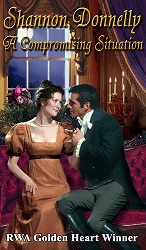
I was happy with the book, and the synopsis I wrote for A Compromising Situation–and the book won the Golden Heart and sold. That was a huge win.

A Compromising Situation

The synopsis then turned into a sales tool for me. From it, I was able to pick out possible cover scenes–because I knew by then that you needed a couple of key scenes in the synopsis to show the relationship developing. I was able to help focus cover copy, and also to write promotional copy that I could use on my website.

Now I realized just how powerful–although still painful–a synopsis could be.

Here’s the opening for that synopsis for A Compromising Situation.

After breaking her heart once years ago, MAEVE MIDDEN now only longs to find a position as a governess in a house full of young girls, where she might have a permanent position and a place to belong.  But can she settled for that after she falls in love with COLONEL ANDREW RICHARD DERHURST, now LORD ROTHE, a man far above her in station, a man who is supposed to be her employer, a man who may not be able to return her love?

And here’s how it fits into Dwight Swain’s advice:

Who is the main character, and what is the situation this character is coming out of:

  • After breaking her heart once years ago, MAEVE MIDDEN

What are the consequences–the bad outcome–from this character not getting his or her goal?

  • …now only longs to find a position as a governess in a house full of young girls, where she might have a permanent position and a place to belong.

What’s keeping this person from his or her goal?

  • …far above her in station, a man who is supposed to be her employer

What are the consequences–the bad outcome–from this character not getting his or her goal?

  • …who may not be able to return her love?

Notice the consequences are not world-ending. This was (and is) a story about people and so the consequences are deeply personal–and, for Maeve, a woman who has experienced rejection before, this type of rejection is deeply wounding. This would be a loss that would scar her.

By this point I’d learned how to stick to the main plot points in the synopsis, to focus on the conflict and the relationship since this was a romance, and I’d learned how to be very picky about each word used in the synopsis so that it was crafted to convey a tone and feel for the story (there’s no sense writing an action-packed synopsis if your story is a character study).

And I’m still learning.

Which is also why I’m still giving the synopsis workshop. Except these days a synopsis has to be even shorter, and even more able to catch someone’s interest. Which is why I call this a “sexy synopsis“. It’s got to be like a little black dress. It’s got to be something you can wear anywhere, and that’s useful as well as sexy–but it has to cover all the vital parts.

Just like the perfect little black dress,  a synopsis can take a lot of work to find all the right parts–the parts that flatter as well as fit. So if you, too struggle with your synopsis, head on over to the workshop at ORIW to pick up more tips and help for learning to get a synopsis that’s more than just something you need for writing contests and queries.

Reading Like a Writer

Another writer posted a question the other day to a loop I follow about chapter lengths.  It got me to thinking about how I’d learned where to break chapters from Elizabeth Daly, a fabulous mystery writer, who wrote back in the 40’s (you really have to love stories where everyone stops for civilized cocktails at five).  And that started me thinking about other writers I’ve learned from.

From Georgette Heyer and Catherine Coulter, they taught me about writing dialogue that has the same sharp sparkle as champagne (we’re talking the good stuff, not Cold Duck).

Jayne Ann Krentz and Nora Roberts taught me the importance of likeable main characters. Nora also taught me how to handle viewpoint transitions, and a dozen other things.

Dick Frances gave me great lessons in fast openings with strong hooks that pull you into empathy with the main character and a story that never lets up.

Dan Brown taught me about pacing–and that you really can make all that research into facinating stuff.

Loretta Chase taught me how great narrative can be, that if you work at your writing, you can hold the reader’s attention for anything.

From Susan Elizabeth Phillips I have great lessons on making even unlikeable characters into sympathetic characters–a very hard trick to pull off. And Jane Austen taught me that character flaws can make the entire story.

Connie Brockway taught me that funny is good, a lesson I keep forgetting until I go back to re-read her books.

From CJ Barry I learned about how good SF and Romance are when you mix them with a skilled hand and keep the tension going in both.

There’s lessons from Tate Hallaway and Libby Bray and Melissa Marr and Mary Stewart in how to mix magic and story and make it wonderful and not too complicated (or so crazy it makes no sense). And Jessica Davis Stein taught me in Coyote Dream how all the work to make a good book great is worth it (she wrote and rewrote that book six times from scratch and it shows in all the beautiful craft).

Fantasy writers Ray Bradbury taught me about lyrical prose, and Edgar Rice Burroughs taught how to keep a reader turning the page no matter what–and that writers improve as they write. While western writer Ernest Haycox taught me about strong characters and even stronger, clean, lean prose.

The list goes on and on and on–so does the bookshelves. I’ve learned from the books I don’t like as well–taking them apart has taught me to edit my own work, and it’s shown me mistakes I want to avoid.

Which all goes to show you need to be a reader to be a writer. And it all goes into the pot to influence your work.

All this means, too, that once you start writing, you start reading differently. You stop at great prose and take it apart. You find a passage and you ask, “How did she do that?” and so you study it and figure it out so you can use that trick, too. You become a critical reader, but the very best still make you stop reading and become part of the story so that you have to go back later and figure it out.

So who are you reading today who is giving you new lessons and ideas?

Writer’s Reference Shelf

If you do a search on Amazon.com for “writing,” over 50,000 books show up.  That’s a lot and doesn’t even include the other great reference a writer might use, such as books slang, foreign phrases, and grammar.  So I thought I’d share what’s on my writer’s reference shelf, the books I’ve found the most useful and helpful with craft and the inevitable questions that crop up for the odd bits and pieces sometimes necessary to create characters.

Techniques of a Selling Writer, Dwight Swain

This is a book I recommend in almost every workshop.  My paperback copy has Post-it notes stuck onto pages, and a cracked spine, and pages falling out, and it stays right by my computer.  The blub on the back says: “This book provides solid instruction for persons who want to write and sell fiction, not just to talk and study about it.”  Swain is brilliant.  His prose is clear, and he breaks down basic structure–beginnings, middles, ends–in such a way that you can’t help but become a better writer.  For me, this book had so many, ‘ah ha!’ moments.  If you struggle with “plot” and structure this is a great book.  If you struggle with how to break your story down and put it into a synopsis, this is a great book.  However, I know some writers who find that Swain doesn’t speak to them as well as Jack Bickman.  Bickman was a student’s of Swain and so he teaches the same concepts, but with a slightly different approach.  You might try Bickman’s works, but first go out, buy and read Techniques of a Selling Writer.  Trust me, it’s money well spent.

The Elements of Style, Strunk & White

While you can read this slim book–my copy is 92 pages, including the index–front to back in a short time, it is designed for reference.  Have a question about what words need a hyphen?  There’s an answer on pages 34-35.  Unsure about when to use ‘which’ or ‘that?’  Page 59.  This is a book to help you add the gleam of polish to your writing.  The index makes and table of contents makes it easy to look up topics that may be rattling your brain.  And, let’s face it, we all have bad stylistic habits as writers that we pick up and sometimes really need to clear out.  I use this book a lot during the editing phase just to make sure that every unnecessary work or unclear phrase is cleaned up and out.

What’s What, A Visual Glossary of the Physical World, Fisher Bragonier Jr.

Most libraries will have a copy of What’s What.  My local library was where I first discovered this book, but I soon had to have my own copy.  The book is just what it says; drawings and photos of all sorts of things and places with information of the names of everything.  This is fabulous for a) you know the name of something and can’t quite remember it or b) you need your character to know the name of things because of that character’s profession and you haven’t a clue.  Need to know all the parts of a sailboat?  Or maybe a hot air balloon?  Or what all those medieval arms are called and the parts of a knight’s armor?  This is the kind of book I occasionally get lost in, it’s got so much wonderful trivia.

Characters & Viewpoint, Orson Scott Card

Orson Scott Card is one of the top names in Science Fiction, and you can see where he gets his reputation for good writing in this book. Card says of it (on the back cover), “This book is a set of tools: literary crowbars, chisels, mallets, pliers, tongs, sieves, and drills.  Use them to pry, chip, beat, yank, shift, or punch good characters out of the place where they already live: your memory, your imagination, your soul.”  I say buy the book and a highlighting pen.  You’ll learn things you didn’t know, you’ll get ideas, and best of all it’ll makes you want to get back to the computer to apply the knowledge.

Write Away, Elizabeth George

This is subtitled “One Novelists Approach to Fiction and the Writing Life.”  Elizabeth George is a New York Times Best Selling mystery author, and this book is based on the writing courses she’s taught.  This is not your basic how to plot or writing book.  This is about a writer getting inside her own fiction in a detailed, methodical fashion and telling you how she makes it work.  It’s a fabulous book–but it can also be deep going.  I found myself having to read, stop and process, and then go back and reread passages.  But the purest gold often comes from the deepest mines where you have to sweat to get it out.

Goal, Motivation & Conflict, Debra Dixon

Published by Gryphon Books, the book is a companion to the workshop that Debra Dixon teaches. She also teaches novel writing and has written several romances.  The book is one I end up recommending more than any other because it’s packed with sound, good advice about how to punch up a scene or a story with stronger characters and that means stronger conflict.  Buy it.

What’s My Motivation?

No wonder most folks think they suck at plotting—they do. Lately, I’ve read implausible plots, overly melodramatic plots only missing the villain twirling a mustache, plots so tangled there’s no way you can get the synopsis to five pages and have it make sense, and complex plots where the romance (and the character) are lost in the action. How do you fix this? It all goes back to character.

To quote Robert Mckee “character is story and story is character.” A good story comes from good characters—folks with clear goals and motivations that make sense. The plot then is actually pretty easy—you throw things (events) at those characters that will hit on their weak points (take them off track from their goals) and hit their buttons for their internal issues. The plot tests the characters you’ve created.

If you haven’t done the homework of creating strong characters to start—that means well developed characters—those story people are going to be feel pushed through a contrived plot. This will give you implausible, melodramatic, tangled, and/or too complex plots. This is because you’ll be using action to make up for weak conflict due to weak characterization.

I’m going to be doing my Plotting from Character workshop again soon, and from what I’ve seen in contests lately, a lot of folks could use this. If you start with character, plotting gets a lot easier. And characters need a few things to work well in fiction:

Goals – everybody wants something. Even the character who wants for nothing will still have something that he or she wants and needs – a story is about a character whose life is pushed out of balance. And the goal for that character is to fix this imbalance—to get back to a happy place. Goals work best when they are a specific thing that represents achieving that goal—which is how you end up with things like the Maltese Falcon (it’s something tangible folks can be after—having it in your hands means goal achieved).

Negative goals (to avoid some event), aren’t so great unless you also have a clock running—as in stopping the bomb from blowing up becomes a positive due to that ticker. But something like avoiding marriage is a little harder—since it’s a negative, the reader doesn’t knows when the character has achieved this goal (Is he married now? Married now? How about now?) See—that’s not going to give you a tangible “he made it” goal.

Motivations – to go along with the goals, fictional character needs good reasons for their actions, for their goals. Fictional folks have to make a lot more sense than real people.  And motivations work best if deeply rooted in the characters psyche—the deeper, the better. As in, a motivation that comes from a key, formative event the character’s childhood is much stronger than a motivation that comes from a recent event. For example, a character that needs to find a new job because she’s been fired—that’s motivation, yes. It matters, but it hasn’t been made personal. A deeper motivation comes from that character having been raised poor. So what if she saw her mother crying over a broken down car when she was ten and vowed never to be that person. Now, she’s got strong motivation to get that new job. The motivation has been made personal. And notice how you also want to tie this motivation to a key moment in that character’s life so it will resonate—and you can use that scene then in the story.

Internal Needs – this relates to motivations, and also to goals. Stories work best with lots of conflict, so you want to develop characters with strong internal needs. And hopefully these are going to be in conflict with their goals. So the character who is out of work and needs that job—and has motivations from being poor in childhood—if she’s got the internal need for respect, and she’s offered a menial job with no respect, now her external goals and internal needs are in conflict. She wants the job (external), but she needs respect (and won’t get it from the job). So what does she give up? She’s in conflict, which is always good stuff for fiction. How the character then resolves this conflict becomes part of your plot—and reveals this character’s true colors.

Motivations – just as with goals, internal needs have to be motivated. (Remember, fictional folks have to make sense—much more so than real people.) So this character needs an event in his or her formative years that leaves him or her with deep reasons to have these internal needs. And, again, you want to tie this motivation to deep, core issues—could be the character is compensating for a handicap, and respect isn’t just about being respected.

Characters should have such strong goals and needs that the character (and the reader) should feel as if that character’s “self” will be destroyed by giving up either the goal or need.

And then you throw in the romance (if you’re writing a romance).

Once you create your main character, now you design the love interest, and all the other characters. The love interest is someone with a conflicting goal, conflicting internal needs, and motivations that are just as deep and strong. In other words, this is both the ideal person, and the totally wrong person. This is a soul mate (and I use the definition that soul mates are those people who push all your buttons—they make you grow).

You develop goals and motivations for all characters—in other words, you never have a bad guy who is bad just because he is bad. And you look to develop goals and motivations that go beyond clichés. (Trust me, your first few ideas for goals and motivations will be cliché—that’s why they pop up so readily. As Orson Scott Card advises in Characters & Viewpoint, dig deeper.)

And, very important, you want the story’s antagonist—the person up against the protagonist—to have conflicting goals. Only the protagonist or the antagonist should be able to win the day (and for more on this, study up on Bob Mayer’s talk on Conflict Lock – he’s bestselling author and he knows what he’s talking about).

Theme – this is what helps you with all this goals and motivations stuff, and with all the secondary characters you need. If your theme is about how love heals, you’re going to need hurt characters, and folks who’ve never been hurt by love. You’ll need folks who haven’t been heeled by love—and those who have. You need all sides of the theme. And the main character is going to be at the center of that theme.

Now, with characters and theme shaping up, you can plot. Meaning you look at your main character and you keep asking—What is the worst thing that could happen to this person? You ask this many, many times and jot down the answers. What could prevent this person from getting his or her goal? What would force this person to give up his or her goal? What would push this person to the extreme to get his or her goal or meet his or her needs? Keep pushing, keep making it worse. (Action movies are great to take apart for this sort of stuff—look at Indiana Jones, and how his life just gets harder and harder and harder.)

These ideas for obstacles that the main character must overcome can then be shaped into the main turning point actions—the plot that will test your character. It will also test the main character’s relationship—the romance. You put just as much strain there as you do for any action.

As you do this, you’re coming up with events to throw at your character, but this is not the time to decide yet how your character will act—that come from knowing your character and putting your character into these bad, bad situations. In other words, you set up the obstacle course—your characters decide how to run that course. The story comes out of the characters dealing with worst case scenarios.

Two things about this—first, you need to structure the action so that tension and conflict rises. In a good story, things go from bad to worse—not the other way around. Second, you’ll develop subplots around the main plot, but it’s the main action line—the main character’s driving goal, motivations for this, and obstacles (or turning points)—that should be the main focus. The main story arc must have the main character at its heart—the main character must resolve the story (or fail at this, which makes it a tragedy). And this should be the last set of story points to be resolved. (Subplots can start sooner than the main story, but should be all wrapped up before the main story is in order to create the most satisfying story.)

Notice how all this plotting now comes out of the characters that you set up. Your characters give you your theme, they start to suggest events you’ll need in the story to block them from their goals. For example, you know the woman who need a new job is going to start off applying for new positions—and maybe that’s not so exciting, so you start her where she’s just been turned down for the 100th time. But she starts off trying to do this the easy way—that’s so your story can build and get worse. You know you’re going to make things worse for her—she’s going to be face with choices. Maybe even asked to commit murder in order to make a million dollars. But she’s not going to be asked that right away—that’s going to come after she’s been tested, and tested, and tested more. That’s going to come when she’s more than desperate. That’s going to come when she has so few other choices this extreme one seems a viable option.

Once you get the ideas and characters down in writing, you’re going to check in with a writer friend. You’re going to look at this from all angles to see if it makes sense. If it’s plausible. If every character is well motivated with strong goals. You do this because it’s too easy to think you’ve got it all buttoned up when you don’t. And you’ll find you have stuff worked out in your head that doesn’t make it onto the page—you want to always make sure to get the story on the page as close to what’s in your head.

What this means it that you won’t be coming up with cliché conflict (the heroine is kidnapped and the hero saves her)—conflict will be very specific to the characters you’ve created because it will be deeply rooted in individual pasts. You won’t be stuck with how to escalate conflict and tension, because you’ve got goals and you’re going to take away all the easy ways for that character to reach his or her goals. You won’t be caught with a romance that relies on misunderstandings or mistaken assumptions to create problems in the relationship—problems will be built into your characters.

Just keep in mind—it’s all about the characters.

Managing POV

Years ago, I was lucky enough to have Jo Beverley judge one of my manuscripts in a contest. Her one comment stuck with me–learn to control viewpoint and you’ll sell. She was right. Now, I’d already tightened up a lot of other craft technique, but viewpoint was a place where I went a bit fuzzy. I wasn’t even aware how much it slipped, but it made me take a really hard look at viewpoint—and to start practicing the habit of only changing viewpoint when I absolutely needed to be in someone else’s POV. This let me cut a lot of the deadwood out of my stories, making them tighter and stronger.

Since then, I’ve since seen a lot of the same old habit I had in contests entries. It’s like something most writers have to go through. And I’ve noticed that viewpoint control actually impacts a whole bunch of other things.

Tighter viewpoint control picks up the pacing. It forces you to show more and tell less (you can’t keep slipping in and out of omniscient POV). Tight control improves characterization, brings in more emotion, and you get a much better story. The reader also tends to be less confused, and becomes more engaged by the character—spending time with anyone (even a character) is a good way to get to know and like that person.

Yet, this is a place where a lot of folks seem to want to be a little loosey-goosey. Folks will say, “But I like to switch POV.” And, yes, switching is fine, but if you’re not doing it for a reason, you may be killing the best parts of your scene. This is where a little more discipline and a little less seat of the pants can help.

And first person viewpoint can help a writer lean a lot. I’ve written a lot of stories in first person, and I still use this technique for scenes that are giving me trouble. Don’t get me wrong, I love third person, but first person is a great way to learn more control. It’s also sometimes the best way to tell a story. But watch using several first persons in a story, that can be tiresome and confusing to a reader unless there are large chunks of time with each character.

With the contest entries I read, I also sometimes get the feeling that some writers may not be aware of what are the viewpoint options. And how do they tighten their control of these.  Managing POV is an important technique to learn, and master.

Viewpoint control is like any other writing technique.  It’s one you have to think about, study, and practice. Once you get really good at it, you can put it in your hip pocket and forget about it—until it comes time to edit and fix problems. And then you need to get back to basics.

I’m doing a workshop on Managing Viewpoint with Savvy Authors this month. Hopefully, this will help folks pick up a few more tips and techniques to bring out the best in their scenes, stories, and characters.  There are techniques that can help you smooth viewpoint transitions. And there are exercises that will strengthen your control of viewpoint.

Even with first person POV, there are ways to improve your control—you can still slip into omniscient from first person if you’re not careful.

And I’m hoping the workshop will remind me, too, of the basics that I always have to keep in mind to tell a good story.

Titles — What’s in a Name?

For some reason known only to the muse of impulses, I stuck up my hand to chair the Orange Rose contest for the Orange County Chapter of RWA when they were looking for such unwise fools as me. Well, it’s turned out to be quite interesting, and a ton of work. As a friend of mine used to say, an experience not to be missed or repeated.

Anyway, I’ve had a lot of titles to view and it’s occurred to me more than once that folks need some help here. A title sets the reader’s expectation. It’s like the first light of dawn–it sets the tone for the rest of the day. It needs to be easy to remember–marketing counts. And it needs to be something to spur the reader to either click on a link/cover or pick up the book off a shelf. (Yes, the cover will help, but the title is part of that cover.)

So it makes sense that you want a catchy title that also intrigues. It’s really nice, too, if the title fits into the theme of a book.

Now, you may say, oh, pish-tosh, the publisher will change the title anyway. Possibly. But a good title is still going to be a good hook into a book (I’ve gotten so I can just about tell from the title alone if a manuscript is going to be good and almost ready for publication, or is going to be one of those manuscript that needs a ton of work ). And if you’ve got a great title, you won’t need to change it.

So, what should be in a title? Here’s my receipe:

It has to evoke the genre. This is critical. For my Regency romances I kept almost all my original titles, such as: A Compromising Situation, and A Proper Mistress. I wanted titles that let the reader know at a glance what kind of book this was.

It has to carry some hint of the theme. Think of titles like Silence of the Lambs. Not only a good hook, but also works into the book when it’s talked about the silence of the lambs before they’re slaughtered.

It has to easy to remember. Mission critical, this one. I recently read a contest entry and I can’t even remember the entry name, except to say it was one I looked at and thought, “How do you even write this one down to remember it?” This is where you can get just too clever.

It needs to fit on a book cover. Yes, the hard fact is that there’s only so much space — in print, or even if you’re going to make a legible image for online. The shorter the title, the bigger a font you can use–hence, the numerous one-word titles around. (Such as Twilight.)

I also like it if I’m not overusing a title that’s been used. Let’s face it, if your book is one of a hundred titled, Passion, how will anyone know to buy your book? (Meaning, when looking for titles, go check Amazon and Google the titles you have in mind.)

Finally, I like a title that doesn’t get too clever with the spelling or the words–this, to me, is just shooting yourself in the foot. A lot of folks do find books on Amazon, or Barnes and Noble, or Google, or other websites. And if the reader can remember the title but the spelling or the words are too weird, a search may turn up nothing.

Which brings us to, does the title look good? Yes, there are attractive words, and words that just make you stumble. You want to look at your title in print and see if it’s balanced or not. If I were to change any titles I’ve done it would be A Much Compromised Lady. It’s a clunky title and never did look that good in print, but I was stuck on the idea of a series with compromise in the title, and I should have listened to wiser council there.

Finally, I just like a title that makes me want to settle down with just that type of book.  If I have a book titled, Space Monkeys from Planet Ten, I expect that book to be fun and silly, and not to be a tragic romance. Likewise, with a book titled, The Moorish Prince, I’m looking for some adventure in there. Because the title gives me that first taste of the story.

So give thought to your titles. Spent time with them. Ask your friends what they think–what kind of book would this set their teeth for? And keep in mind that even if you’re not yet published, you’re marketing your book. Editors and agents get their expectations set by titles, too.

Easy Stuff to Fix – Past Perfect and Dialogue Punctuation

It’s contest judging season again — seems to come along every year with baseball and summer and picnics. And I’m seeing some of the same mistakes I always see. Now some stuff is tough to fix — as in you have a plot that’s not plausible, or wooden characters, or an idea that’s just too tired and cliche. That’s throw out the baby and the bathwater time. But some of this is easy to fix, and folks, you do need to fix the basics. What I’m seeing….

Tense issues. As in past tense, present tense, and past perfect tense (there are others, but these are the three you really need to nail).

Past tense works for most fiction. This is where you write: “He went to the store.” (Went being the past tense verb.)

Present tense is needed for a synopsis (it’s more dynamic), and you can also use it in a story. This is action happening now, as in: “He goes to the store.” (The verb become goes, or is going for present tense.)

Past perfect is where folks seem to really trip up. If you’re in the past tense and you want to write about the past (further in the past that is), you have to switch to past perfect.  As in: “He went to the store, and since he had been given a shopping list by his mother, he knew what to buy.”  Notice the switch to “had been” instead of “was” — that’s past perfect.

(And if you’re still confused, go and buy a copy of Strunk & White’s Element’s of Style. It’s a thin book, easily read in an hour and even easier to keep by your keyboard to sort out this stuff.)

The other thing that crops up a lot is weird uses of commas — commas put in where they are not needed or left out in other spots. That’s not too bad, but you do have to get this right around dialogue.

You use a comma to separate words spoken by a character from any action when (and only when) that action influences what is being said.

So these are all correct:

“You’re wrong,” she said.

“I can’t win,” he told her.

She cleared her throat, and said, “I love you.”

The action here is called an “action tag” by some and notice how these all form one sentence, and therefore use a comma.

The period is used when the action is NOT influencing what is said–when that is a separate thought and therefore should be a separate sentence. As in:

“You’re wrong.” She slammed her hand down on the table.

“I can’t win.” He let out a breath and shook his head.

She cleared her throat.  “I love you.”

Notice a couple of things. First, if you have action, you generally don’t need to attribute the dialogue (as in he said, she said). The reader knows who is speaking because there is action around the dialogue. Second, he said and she said are valid ways to attribute dialogue. It’s the mark of a beginning writer to go crazy with the adverbs and have folks chuckle, laugh, cry out and otherwise try to talk while they are doing something else.

In other words, rewrite when you put down stuff like:

“You’re wrong,” she yelled at him loudly. (If she’s yelling, then loudly is redundant, and the yelled is not letting the dialogue be strong.)

“I can’t win,” he chuckled sadly. (Try chuckling a word and see if you can do it — I dare you.)

She cleared her throat and breathed sexily, “I love you.”   (When in doubt read something aloud — if you cringe or someone laughs, you know you’ve hit melodrama. )

If you feel as if you need to add an adverb to any dialogue before you do this try rewriting the dialogue — dialogue that needs a crutch needs to be stronger so that it stands on its own.

And that’s my rant for the week. Or at least until the next contest I judge.