Archives

POV — What Readers Don’t Notice (Unless it’s Wrong)

Point of View is a phrase that writers use to death. It’s one of those things that a reader doesn’t notice until it’s done badly. But it’s also one of the most critical skills because it affects everything else in the story.

You don’t really think about until you have to figure out whose point of view gives you the best story.

Now, the “duh” moment here seems to be that well, of course any story uses the point of view of the main character. But sometimes that doesn’t work so well. Dr. Watson is the point of view character in Sherlock Holmes stories so Sherlock can seem smarter. (Watson’s no slouch, but by making him the POV character, the writer can hide clues that Sherlock will eventually use to make amazing deduction.)

My rule of thumb is to use the character with the most at risk in a scene–this gives the scene better conflict and drama. That risk also works better, too, if it’s emotional risk–a character who doesn’t care that a gun is pointed at him is not going to give you great drama if that character doesn’t care about dying. But this is a guideline, not a rule. Also, this doesn’t help with the whole story.

Should you write in third person, first person, multiple viewpoints, single?

This goes back to being a reader first.

What do you read? What do you like to read the most?

I’ll read just about anything, cereal boxes included. But while I like first person stories–when they’re good, they’re brilliant–I tend to read more third person. I’ve written first person stories, but I lean towards third person. But I’ve also learned over the years to control this so it’s a limited third person–I’m not dragging the reader into everybody’s heads.

There are also a few tricks to smooth viewpoint transition.

1 – Use proper names, not pronouns. He/she (or even worse, he/he) tends to put the reader deeper into his/her point of view. By moving out to a proper name, you’re moving the viewpoint out (like a camera would move out), which helps smooth the transition.

2 – Use action to hand off the POV switch. As in: Helen dropped the book. John caught it and handed it back. Notice how the action again moves the reader out of thought and into “seeing” a scene, so the action allows a change of POV by also helping move the POV out a little, into the room before dipping back into someone’s thoughts.

3 – Use clean sentence and paragraph structure to keep the transition cleaning. You can do anything, even change the point of view in the middle of a sentence. But why risk losing your reader by doing this? Instead, make your transitions clean and clear.

If you use POV right, no one will ever notice it. But oh, if you do it wrong, everyone knows.

The Pitch, The Blurb, The Writer’s Headache

It’s not enough to write a book–you have to figure out the pitch…the blurb…the exciting sentence that’ll make someone want to read a book. So you have to switch from a writing mind to a marketing mind, which is not always easy. But at the Desert Dreams conference this past weekend, I had a “duh” moment–this blurb is the external conflict for the main character.

This is a “duh” moment since it seems obvious, but I’d be struggling with fitting external/internal/more than I need into a short, catchy sentence. I know some folks like high concept–I’m more about interesting conflict.

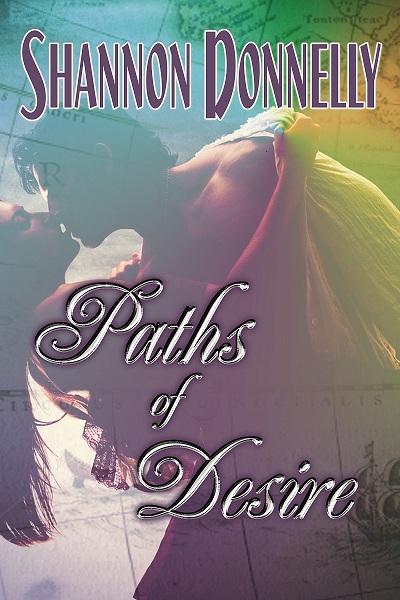
Paths of DesireSo I’ve been applying this insight to the books, and came up with this for Paths of Desire:

NO MAN’S MISTRESS…

She wants a rich lord for a husband—she won’t end like her mother, abandoned and broken.

NO WOMAN’S FOOL…

He wants to prove to his friend she’s the wrong woman—he knows too well the pain of a bad marriage.

WHEN AN ACTRESS CROSSES PATHS WITH AN ADVENTURER IN 1813 LONDON…

The last thing either wants is to fall in love, but when desire leads to a passion that won’t be denied, how can the heart do anything but follow?

This is way shorter than what I had and I actually think (hope) it’s far more catchier. Can you match these others to my books? (Click on the phrase to see the book.)

Reformed rakes make the best husbands–or do they?

Will it take a Gypsy thief to steal the heart of a rake?

A girl who can tame any wild creature….

A Gypsy lord out to redeem his name…

Some of the lines came out as questions, some as core situations.  The situation ones obviously needed a bit more, but they are at the heart of the book.

So…better maybe? We’ll see in the sales.

Clichés: Easy as Pie

1: a trite phrase or expression; also : the idea expressed by it
2: a hackneyed theme, characterization, or situation
3: something (as a menu item) that has become overly familiar or commonplace
Easy as Pie ClichesThat’s how Merriam-Webster’s defines a cliché — unfortunately, there are still far too many of them around. As writers, we owe it to our work, our characters, and our readers to change these hack phrases and situations around for something fresh. They are, to use a cliché phrase, easy as pie to come up with. And that’s the problem.
The first step, as with an addictive problem, is to recognize that it is a problem. And, yes, clichés are addictive. They pop out easy as easy as that pie from a greased tin, and they slide on by–which it’s why it’s a good idea to read your work aloud. You’ll catch these more easily when you read your own work.
They’ll show up in phrases–those are the easier ones to grab and shake out. The “stalking like a panther” phrases. Or easy as pie, or you’ll find many more over at Laura Hayden’s handout on Suspense.net. These just need a fresh phrase–an image that has not become used up in its overuse.
The harder ones to catch are the clichés situations that come from getting a little too lazy with the plotting. The ones I keep seeing crop up (in unpublished manuscripts) are:
1-Kidnapped heroine. Heroine stupidly ends up on her own and bad guy kidnaps her. Bad guy never seems to have a particularly good reason for this, menaces heroine without doing anything to her really, and ties up heroine for convenient rescue by hero. This is so old it creaks. Come on folks–if you need a confrontation with heroine and bad guy, come up with a better situation. How about bad guy throws a party and heroine is invited? Or what about kidnapping is really a plot to get to bad guy? Or how about a smarter bad guy who is just going to shoot the woman on sight and get her out of his way. This is easily solved with characters who are better motivated and who make sense.
2-Hero and heroine argue after making love. He pulls away, she pulls away, and all for no particular reason. How about letting your characters talk, hash it out, and make everything worse by blurting out the wrong thing at the wrong time? If you find yourself having to contrive the conflict, go back and give your characters deep, good reasons for not being in a relationship. If your characters are not acting in unique fresh ways, time to look at how do you motivate them to be unique, fresh folks.
3-Bad guy is infatuated with heroine. In such cases, heroine is usually hateful, mean, and bad mouths the guy, but somehow he still “wants” her. Another moldy oldy. This often comes along with bad guy wants heroine’s money–and while money is a good reason for a lot of things, it’s also been done way too many times. This is where you need to find better, deeper reasons for actions. Orson Scott Card gives wonderful advice in his book, Characters & Viewpoint, that the first four or so ideas you come up with for character motivation are almost always clichés–that’s why they pop up so fast.
4-Bad guy is just insane, which becomes explanation for everything. This shows up in almost every weak romantic suspense out there–and in more than a few Westerns, too. Bad guys need to make sense–they need motives and in some ways the word “sociopath” has led too many writers to think this is a bucket into which the bad guy can be dumped without any more effort applied. Go watch Dexter to see how a complex character can be created instead of just another crazy killer on the loose.
5-Hero/Heroine experience unexplainable attraction–beauty blinds sense and leads to lasting love, they are just “meant to be” soul mates. This often comes along after characters have been rude and horrible to each other for about 100 pages, but the truth dawns and true love (and sex) wins out. This situation is older than Cinderella, and is overdue for retirement. Give all your characters good reasons for their actions, and look for fresh reasons. Maybe your hero is a sucker for a great pair of legs, and that’s the initial draw–but it’s the fact she has a Cub’s t-shirt in her closet and wears it on game day, and eats hot dogs just the way he likes them (dripping with mustard, relish and sliced red onion), and won’t go outside without smearing every nose in sight with SPF 50 that does him in. Maybe her eye is caught by the broad shoulders, but he is a guy who cooks, loves pasta as much as she does, and he has a southern drawl that does her in, and he’ll do a deal to watch chick flicks with her (in exchange for a movie with stuff that blows up in between).  Its the details that make your characters–don’t get lazy here.
6-Hero’s ex wants him back, and so causes trouble. Usually this means ex lies (and heroine believes her–and, really, you would believe whatever you guy’s ex said over what he says?). This also usually has the ex being so nasty that you wonder how the hero ever hooked up with her in the first place–it really does put him in a very bad light. There’s an easy fix for this one–just remember we are all the hero of our own story. Even the ex has a story that makes her sympathetic and a good guy–make sure you know this story about her (and that you like you as much as you like all your other characters). And keep telling yourself–characters who are one-sided are cliche.
7-The big “MISUNDERSTANDING”. Hero/heroine assume the worst about each other after glimpsing something. This is usually heroine sees ex leaving hero’s bedroom (and or an intimate moment) and heroine assumes he’s back with her (and why she doesn’t go pounding on doors for answers is a mystery), or this is heroine is seen with someone from her past and hero assumes the worst–oh, my god, she hasn’t changed. This is a case where you wonder what are these two doing together. Then you wonder why doesn’t anyone talk. Make it easy on yourselves, folks–when in doubt, put your characters together and get them talking. The talking should make things worse, not clear up misunderstandings. And always remember conflict based on misunderstanding is a cliché.
8-Bad guy has to explain all his reasons for his actions. The Incredibles gave us this present tense verb of monologuing. If you have to stop the story to explain a bunch of stuff, consider the possibility that either the plot is too complicated or that you need smarter characters who can figure out things without having to have stuff explained. The other way around this is to make the information so interesting that folks will sit though this cliché without complaint. But that’s a risky bet.
9-The hero/heroine suddenly has a skill that’s unexplained and doesn’t fit their past. This happens with careless writing (the writer forgot to foreshadow a skill), or when a writer has backed herself into a corner and needs to get out–that’s not usually done gracefully. Just remember to ask if you’ve set up a character who can pull off the skills needed to make the plot work. Also remember that readers are not very forgiving of “luck” factoring into a story unless it’s bad luck (or unless the character has had so much bad luck that the readers are rooting for the universe to give the characters a break).
10-The parents who want to force the heroine into a bad marriage. This one shows up mainly in historical romance, and sometimes in some contemporary romances. And, yes, while there are bad parents out there, this ignores the basic core of most folks, which is that we regard friends and family as attachments of ourselves–we want the best for them because they are a part of us. To go against anything that is core to most people, you have to use strong motivations–this is usually overlooked for the quick form of just having them be greedy folks. That’s a cliché because it’s going for a quick answer instead of really figuring out your characters.
Now you’re going to find all of these clichés in various best sellers. Which goes to show there are no rules. But you’ll find them carried off with either a twist that gives them a little fresh tread on an otherwise worn tire, or you’ll find them stuffed in with so much other good stuff that most folks will turn a bad eye. But how much better to be aware of the clichés and to be ready to make the effort to find characters who’ll take you through a story with a lot more interesting things going on, all because the characters themselves are fresh and new and worth spending your time in their company.

The Story Tellling Instinct

Don't Fence me InThere’s a school of thought that there are somethings about writing that cannot be taught. In other words, you can teach grammar and plot structure and the technical stuff, but there’s something about story telling that you have or you don’t have. I’m not sure I buy into this.

Yes, we all have different levels of talent, but if you start fencing some folks out, you’re also fencing yourself in, and that’s never good. To me, this is like saying, “Well some dogs don’t chase chickens.”  If you hit a dog for doing something, that will stop that dog’s instinct to do what it loves to do–but that doesn’t mean that dog was not born to chase and hunt. And folks just like to tell stories–we all love stories.

I’ve taught story telling before–I’m about to teach an online class for Lowcountry Romance Writers on this (because there are classes on so many things, but most folks don’t talk about how to put it all together). And I think if you have a strong desire to do something because you love that thing, you’ll find a way to improve. You don’t get the desire to do something without some level of talent to go with.

Now, American Idol auditions may point to this not always being the case. But I’m willing to bet a lot of those really awful singers are there not because they love music and singing, but because of a desire for fame. This means their desire and talent don’t match: a love of fame is not going to make you a singer. (Or a writer.) You have to love your art enough to sweat for it, and be willing to do it for pennies, for free sometimes, and just because you cannot not do it. You tell stories because you have a story telling instinct. This, like any other instinct, can be developed and improved–or it can be beaten into oblivion. It’s that small, still voice inside that tells you when a story is on track, and it’s the thing that stops you from writing when the story is going wrong. It’s something you have to come to believe in and the more you use it, the better it will get.

And here’s ten ways to know if you have this instinct.

1-You cannot tell anyone about what happened today without embellishing, just to add some interest.

2-If someone’s giving you gossip about others, you always end up asking: “And then what happened?” And it’s really irritating if that person doesn’t know.

3-When you walk a city at twilight, you not only look into the open windows, but start inventing things about the people who live there.

4-If folks start telling you real life stories you want them to put a good ending on it even if there wasn’t one.

5-For any news story you don’t just wonder why someone acted as they did, you can come up with all sorts of plausible reasons.

6-When something bad happens to you, yes you cry–but there’s always some small part of you taking notes.

7-When a friend starts telling you about terrible things that have happened to them, you think about how this would be great in a story.

8-It’s almost impossible for you to walk out of a movie or put down a book–even the really terrible ones–because you always have a hope the story will get better, and you have to see how it ends (even if its obvious, because its cliche, how its going to end).

9-Your pets always have back stories–and you’ll tell them to anyone who will sit still.

10-You’re willing to do stupid things at times just because you’ve never done them and you have a character (or might someday have a story with a character) who is going to do them.

If you start nodding at five or more of these, you’ve got the story telling instinct, but it needs work. If you’re only nodding at a couple, your story telling instincts have been beaten out of you by past teachers who have also killed their own instincts–time for lots of meditation and getting back in touch with your subconscious. If you nod at eight or more of these, congrats–you’re instincts are going to serve you well.

Writers Come out of the Closet

Hi, my Name is Shannon, and I’m a Writer

It’s taken a long time for me to get comfortable with saying, “I a writer.” Part of this is due to the fact that I’ve always written—it’s just something you do…well, something I do. Part of this is due to the looks you get when you say this. Eager anticipation mixes—yes, they really do want to say they’ve met a real author—with half-hidden skepticism, and then you get The Question.

The Question comes phrased one of two ways. It’s either, “Oh, what do you write?” This comes with an implication that maybe you write technical manuals, or non-fiction, or something that means of course you don’t write anything meaningful—as if somehow none of that other stuff counts. (Is this because we’re taught in school that only “literary fiction” is of real value?) Or you get, “What have you written lately?”

Now, no one asks an accountant, “What taxes have you filed lately.” Or asks any other profession to somehow provide credentials to prove your claim. Lawyers do not have to whip out briefs; doctors do not need to show their latest prescription and case file. But a writer…you have to name your books, your stories, and I’ve thought sometimes that I should just carry a resume to show folks who ask. And here’s the thing—you tell them you write romances (or whatever genre, if you’re so lucky as to have a single genre), and you mention your story titles, and you get a blank look back. You’ve kicked their puppy, burst their balloon, salted their punch. Somehow you’ve disappointed. You’re not quite “a name” (or at least not the name they were looking for), yet you’re a writer. You’re not writing what they read, or what they want to tell people they read. The person doing the pop quiz has nothing to take home—no bragging rights for having met “a real author” (of real books, the definition of which changes depending on who is doing the reading).

It’s worse before you publish. It doesn’t get much better after you publish. So you start holding back. You duck the question. You keep it under wraps or wave it off, and you only answer if your significant other brags about you thus forcing you into The Question.

And when it comes time to file taxes, you hover over the words and put either a slash (as in I’m a web producer/writer), or you just put down the day job. Never mind that you’re working at a job that pays way less than minimum wage and doing it for love—those folks used to be admired, and now if you’re not a “professional” somehow you’re not legitimate. And never mind that you’re incurring all the cost of a business (equipment, supplies, training, sales letters, proposals to solicit work). Nope—somehow none of that really counts.

It’s worse before you publish. It doesn’t get much better after you publish. There’s still that edge of guilt—oh, yeah, well a real writer would have _______. Fill in the blank. A real writer would have won awards, been on best seller lists, sold fifty books…it’s like being an alcoholic in reverse. Instead of saying, “Well, I’m not an alcoholic because I don’t drink in bars.” (Or whatever excuse works.) It’s, “Well, I’m not a writer because I don’t write serious fiction.” (Or whatever excuse works.)  The excuse is all about excusing yourself from being a real writer. Meaning you can play around with the craft. Make it a hobby. You don’t have to think of yourself as a craftsman and artist and act that way—you don’t have to own the job.

I did this for a long time—longer than I should have. I had a day job. It paid well. I had a social life. I had family. I had lots of stuff going on. But I wrote at night and sent off manuscripts and took vacations from the writing when it wasn’t going so well. I quit a dozen times and started back at it even more times when the stories wouldn’t leave me alone (and when I got so grumpy from not writing that I couldn’t stand myself). And then I figured out I had to take it—and myself—seriously. If I wanted to be a writer, I needed to write.

I got comfortable with thinking of myself as a writer—still hated to say anything. I hung around with “real writers” who’d sold books. I kept at it. And I sold some books. I won awards. And I still didn’t feel comfortable with the title of “writer.” Author wasn’t so bad—I could do that at book signings because I had the dammed books in front of me so if someone asked The Question (and, yes, they did, even with the books sitting there), I could just gesture like Vanna. Here’s the goods—go ahead and give me that look, I dare you! But the rest of the time…

Well, still struggling. After all a real writer makes her living from books. Well, that’s what I do now, and guess what…I’m almost comfortable with the word. And I’m thinking it’s about time I do more than get comfortable with it. I need to own it. Looks from folks be dammed, it’s what I do.

Nowadays, I can talk about what I write a bit better. The looks still come, particularly when I cannot whip out a book to show someone—eBooks are great for a lot of things, but not so much for ego validation. The comfort zone is widening. I still aspire to more…to best seller lists, and to that ever elusive deal that someone will bring the validation I’ve wanted.

But I’ve figured out there’s never going to be enough of that from the outside. No deal will bring reassurance—I’ll always wonder afterwards if I can live up to it, or if they just got the wrong person by accident. No award will be enough, and no lists will make me into what I want to be. If it’s coming from the outside that means it goes away, too—the outside stuff always does.

It’s got to be an inside job, this idea that you’re a writer. That I’m a writer. It’s got to be grabbed and believed and fought for and defended. It’s got to take root so deep that it’s part of saying your name. It’s what you do—it’s who you are. You’re a writer because you write. Good stuff. Stuff to be excited about and want to tell folks about and grin like a loon when you talk—and make it into more than just a hobby, because it’s part of your soul, your heart, your being.

So…time to jump out of the closet and off the cliff. I’m Shannon, and I’m a writer. Now, what do you call yourself?
Joan Vincent Guest Blogger – Honour’s Debt

Welcome guest blogger, Joan Vincent…

Joan VincentHi, I’m Joan Vincent. I live in Kansas which is a long way from Enlgand and the Regency period. And I have a minor in American History. Who knew I would read over 200 regency romances in a month one summer long ago and decide I would like to take my hand at writing one? Certainly surprised me, delightfully so.

Honour’s Debt is the first book in my Honour series. It started out far different than it is today. It began it as a sweet rather simple regency like all my previous books and then, in chapter five my villian was killed. That rather stunned me. I needed at least 50,000 more words and what’s a story without a villian?  My sister said “find a worse villian.” After ruminating on it a few days I sat down and just starting typing. (I do plot but I’ve found if I don’t let my characters do what they want the story just doesn’t go anywhere. I once thought I created the characters and I’m in charge but something else is at work too) To my amazement a very dastardly villian–a master French spy appeared. Along with him came a young emigré pursing him. When I told my sister I didn’t know who this young man was she suggested i use for a character from an earlier book. The story reshaped itself; it became an entirely different more complex story. And it flowed onto the pages. In a week I had sketches for six more books but that it for another time.

Honor's DebtI didn’t fall in love with my hero but I like and respect him very much. Truth be told I did fall in love with the young emigré. He was six when he first appeared in the first regency I ever wrote –not the first one published. It was very spooky when I learned one of the men who tried to kidnap him in that book was the French master spy in Debt. These two men are in every book in the series.

The hardest part of writing the book was a multitude of research. After years of researching for and writing regencies I am grounded in a lot of regency history. But I had never had a hero who was in the military–much less the cavalry–the 15th Light Dragoons. I chose the 15th after research revealed they were in Spain in 1808. Then the real work began. There was the question of Light Dragoons or Hussars–you can read reams of information and still wonder about that. Also what color was their uniform, and in particular the facings they wore–each regiment’s is different. Once I got the details I needed I knew the hero’s motivation was grounded in what happened in Spain. More research was necessary to find the location where the action would take place in England. The setting had to have smuggling which led me to a study of Martello towers. More investigation followed on cottages. I always sketch out my character’s homes and this story involved several.

I like to be as accurate as possible. Accuracy in detail grounds the story, but plot drives it. Major Quentin Bellaport, Viscount Broyal sets out to redeem a debt of honour but falling in love was not part of the plan. Intent on saving Maddie Vincoer from the maelstrom of a funeral, a wedding, and kidnappings, he can only pray she’ll forgive his deceit. Will she believe she is not a pawn to his Honour’s Debt?

What’s the Book About?

I’m doing my “Sexy Synopsis” workshop for Outreach RWA Chapter this March — link here — and the workshop always has me thinking about how most writers dread the synopsis, but it really is a great tool. The two big dreads seem to be:

1 – If I write a synopsis, I won’t want to write the book, and

2 – How can I possibly condense my great, big wonderful book into a couple of pages?

(Yes, folks, a synopsis really should be only about 2 – 3 pages — anything more and you’re talking a detailed outline, which is a different animal.)

I started calling this workshop the “sexy synopsis” since a synopsis really should be short, stylish and cover the basics — you want to sell the book. And it’s not just about selling the book to editors and agents.

You’ve got to sell your book to readers, too.

In other words, the synopsis is really just slightly longer back cover copy. It answers the basic question–what’s the book about? (And you cannot flippantly say, oh, about 200 pages.)

But how do you answer those two basic dreads?  Well, you can take the workshop, but here’s some quick easy tips.

1 – Start with the big stuff — like theme and the core conflict. Bob Mayer does a great workshop on core conflict, and he’s teaching this soon, so I recommend it highly. This will get your idea down to just a single line, meaning you’ve got a lot of the work on your synopsis done right there.

2 – Focus on only the main character and main plot.

3 – Know what’s your selling point, and make sure that’s there — as in, if the book is funny, make sure the synopsis has a light tone, too.

4 – Be sure to include the ending — this is where a synopsis is different than back cover copy. The synopsis must have the resolution so that it shows the book has a satisfactory ending.

5 – Cut extra words.

6 – Read your synopsis aloud. Preferably to a friend whose never heard this story or ideas — that will tell you if you’re telling a story that makes sense.

7 – Think of your synopsis as the “bedtime story” version of your story — hit only the ‘good parts’, but make sure you do have good parts scenes mentioned.

8 – Shorter is harder — know this is going to be work going in and you won’t be so frustrated when it takes ten drafts to get even close to anything approaching ten pages that make sense.

9 – If all else fails, tape record yourself telling the story to a friend, and make sure you set a time limit of getting the telling done in less than five minutes.

10 – Don’t take it too seriously. The book still matters more than the synopsis. But, here’s the thing, if the synopsis comes out bad or flawed or with big holes in it, time to look at your book structure. The synopsis can be an early warning that you really have not fully thought out your story — make sure you pay attention to what the synopsis tells you. It can save you lots of headaches in revisions.

Most of all, remember that a synopsis is a guide–not a bible. Leave yourself room to diverge, and leave your characters room to grow. Let the story surprise you. And if the story wants to go in a new direction, let it. You can always change the synopsis later.

Also keep in mind that if you get stuck or lost, go back to your synopsis. Sometimes those few pages can be key to guiding you out of the woods and into finishing your story.

Paths of Desire – A Regency Historical Romance

Paths of DesirePATHS OF DESIRE

On Amazon Kindle

ISBN: 978-0-9831423-9-3

With too many secrets in her past, and too little future as an actress, Theodosia Newell wants one thing more than all else—security. She’s seen her mother abandoned, her younger brother die, and she’s vowed never to be poor. But then her path crosses that of a man who tempts her to abandon caution and all thought for the future for a passionate affair. Can she find the courage to break from her deepest fears? And will her love prove enough to save them both?

Born with a soul for adventure, David Llewellyn cannot resist a challenge—and his enthusiasm for life is as magnetic as his personality. But two women share his life, and only one can be his. Will his stubborn refusal to make a choice between them lead him to lose everything? Or will he find, in the journey to the lost city he dreams of discovering, a path to a deeper love than he thought possible?

For ten years, the affair between David and Thea goes from passion to love. Lives are changed.  Secrets come out. Marriages end. And new ones begin. Through it all, the desire of two strong-willed people lead them to clash, and to eventually find their own path–to each other and to facing the need and love they share.  From London to Italy to Syria, the Paths of Desire lead them on a journey they must make together.

—————————————-

My first step into a self-published novel — I’ll be posting updates each month to let you know how it’s going.

New Cover, New Book – Paths of Desire

Paths of DesirePaths of Desire comes out as an eBook this week—my first venture both into self-publishing and my first Regency Historical romance. I’ve been bringing out my backlist of Regency romances, and that’s encouraged me to take this next step.

There are several reasons to take “Paths” on this path, the main one being I really want the book out in print and in reader’s hands. It’s a book about courage and stepping out onto risky paths, so it seems to be one that really fits into new ventures.

It’s a book I wrote a few years back—my step into writing a longer Regency Historical. But it ended up being smack in the middle between being a Historical romance and a Historical novel—there are elements of both, and therefore it’s a hard book to market to publishers. Traditional publishers don’t know what to do with it. It covers ten years, a long time for a romance, and the hero is a married man—unhappily so. That’s a really hard sell to any romance publisher. But that’s something I wanted to deal with in this story. Fiction is a place to look at life, and romances can tackle issues of infidelity and what does it mean to love someone when you have ties to others. Yes, I could have pulled that out, changed the character to better fit the market, but this one stuck with me—this story needed to be told.

It’s a story about paths crossing—about how sometimes the timing for a relationship isn’t right, and then it is. The heroine struggles with her own issues—her need for security after having grown up on the streets of London and seen her younger brother die due to not having the money for a doctor. And also her realization that her acting talents are never going to get her to the top of her craft—limitations are a hard thing for anyone to come to terms with. The hero has both a loveless marriage with a wife who doesn’t really like sex, and a wanderlust that keeps taking him from home—he’s an adventurer, and the wrong man to love if you’re looking for that illusion of security. As with all my books, I wanted to give all the characters a “star moment” in the book—that was fun. It was great fun to research London theaters of the early 1800’s and to also be able to use Lady Hester Stanhope in a story—she’s the larger than life type of character that you could never hope to create and have believable because she defies all the conventions of the time.

So “Paths” is about to take its own path—and it’s actually been hard to let it go (compulsive editing and checking and I know I’ve still left typos in there or formatting stuff where Word is not playing nice with eBook formatting). But it’s been an adventure to get this ready to go out in the world—it’ll be another one to see if readers like something that’s a little different. But that’s the point of the book—we all have to find our own paths, and the courage to follow them if we’re to be worthy of our desires.

Look for Paths of Desire as Amazon Kindle eBook, exclusive to Amazon until April 2012.

The Desert Island Test

It’s contest judging season, and I have to say most of the manuscripts I’ve seen lately have been failing my “desert island” test. It’s a test I put my own plot ideas through—and it sorts out if all you have going is external conflict.

The question to ask is: If I dropped the hero and heroine in my romance onto a desert island, would there still be any conflict? If the answer is no, you know you’ve put all the conflict into external circumstances. There’s a problem with this.

Stories need conflict—the more the better. When you short-change your characters by having them only focus on external issues, you’re short-changing the romance and the reader. We all have issues. And the hero and heroine in a romance need to have personal issues that relate to the external ones you create to the plot—but these should be core issues. Issues so deep that dropping these two people onto a desert island would result in more than a few arguments—it might even result in separate living quarters on opposite sides of the island.

A good demonstration of this actually showed up in the second Pirates of the Caribbean movie. Captain Jack and Elizabeth are stuck on a desert island. Now these two are not the hero and heroine of a romance—the movie’s action/adventure—but you get instant conflict. She has ideas about how he should be acting, and he has ideas about getting drunk on rum, and since she’s here maybe he’ll have sex with her. The rum goes into an alert fire, thanks to Elizabeth. And now he’s ready to feed her to the sharks. She’s proper—he’s not. She’s focused on being active, facing their situation, taking charge—he’s focused on trying to avoid most everything, particularly the situation. You have personality conflicts showing up in action. That’s what makes a good romance into a great one.

Here’s the trick with this—it’s no good just giving a character arbitrary personal issues. These issues have to rub against the other person’s issues—if she likes cats, he has to be  dog guy, and vice versa. They have to be motivated in the character’s past—that makes the character more believable as a real person. And they work best if they have something to do with the external issues as well. As in, if these are cat and dog people, animals should probably come into the external problems (which is why you see stories about shape shifters and he’s a wolfman and she’s a cat-person quite literally—that’s amplified personal conflict since cat and dogs don’t even speak the same language).

For example, if you have a heroine who has been brought up a tom-boy, she’s going to have a pretty blunt way of taking action. She’s going to be insecure about having much skill with feminine grace, and she may end up pushy and take-charge. This is going to rub against a guy who is also take-charge and who has a pretty blunt way of taking actions. This is where being too much alike creates as much friction as does two opposites. I used this in Barely Proper for part of the conflict between here and heroine. I also did something similar in Under the Kissing Bough—the hero and heroine are two people with deep insecurities. They have different ways of hiding that they don’t feel adequate, but their insecurities keep cropping up and coming between them. For A Proper Mistress I went for the opposites. The heroine is level-headed and practical—she’s had to be due to her past. The hero is a bit of a wild cannon. They both learn from each other—she learns to enjoy spontaneity, and he learns a bit about responsibilities. So their issues become strengths to the other person—that makes for a very satisfying relationship, and a satisfying read.

So take a look at your characters—what would happen if you dropped them onto a desert island? Would they get along fine? Would one take charge and the other would allow it and all is good? Or would they fight and argue best plans for rescue? Would one be all about accepting the situation while the other is fighting it? Would one be exploring the island while the other hugs the beach, refusing to go into the dark jungle? How would their personalities clash—and how would their personalities complement each other?