Archives

New Cover, New Book – Paths of Desire

Paths of DesirePaths of Desire comes out as an eBook this week—my first venture both into self-publishing and my first Regency Historical romance. I’ve been bringing out my backlist of Regency romances, and that’s encouraged me to take this next step.

There are several reasons to take “Paths” on this path, the main one being I really want the book out in print and in reader’s hands. It’s a book about courage and stepping out onto risky paths, so it seems to be one that really fits into new ventures.

It’s a book I wrote a few years back—my step into writing a longer Regency Historical. But it ended up being smack in the middle between being a Historical romance and a Historical novel—there are elements of both, and therefore it’s a hard book to market to publishers. Traditional publishers don’t know what to do with it. It covers ten years, a long time for a romance, and the hero is a married man—unhappily so. That’s a really hard sell to any romance publisher. But that’s something I wanted to deal with in this story. Fiction is a place to look at life, and romances can tackle issues of infidelity and what does it mean to love someone when you have ties to others. Yes, I could have pulled that out, changed the character to better fit the market, but this one stuck with me—this story needed to be told.

It’s a story about paths crossing—about how sometimes the timing for a relationship isn’t right, and then it is. The heroine struggles with her own issues—her need for security after having grown up on the streets of London and seen her younger brother die due to not having the money for a doctor. And also her realization that her acting talents are never going to get her to the top of her craft—limitations are a hard thing for anyone to come to terms with. The hero has both a loveless marriage with a wife who doesn’t really like sex, and a wanderlust that keeps taking him from home—he’s an adventurer, and the wrong man to love if you’re looking for that illusion of security. As with all my books, I wanted to give all the characters a “star moment” in the book—that was fun. It was great fun to research London theaters of the early 1800’s and to also be able to use Lady Hester Stanhope in a story—she’s the larger than life type of character that you could never hope to create and have believable because she defies all the conventions of the time.

So “Paths” is about to take its own path—and it’s actually been hard to let it go (compulsive editing and checking and I know I’ve still left typos in there or formatting stuff where Word is not playing nice with eBook formatting). But it’s been an adventure to get this ready to go out in the world—it’ll be another one to see if readers like something that’s a little different. But that’s the point of the book—we all have to find our own paths, and the courage to follow them if we’re to be worthy of our desires.

Look for Paths of Desire as Amazon Kindle eBook, exclusive to Amazon until April 2012.

Free Books at Amazon — What’s All the Fuss?

Amazon’s launched their “Select” program — meaning that Amazon Prime members can read enrolled books for free. These books have to be exclusive to Amazon for now. Authors decided if they want to opt in or not, and are compensated from a pool of funds that all participating authors share in based on total number of books read through the program. And you would think from all the fuss that the sky is falling yet again. (It used to be falling about every couple of years, but technology has accelerated this so that it’s falling at least once a month now.)

Personally, I think it’s an author’s decision what to do with his or her own writing. Give it away, sell it to the highest bidder, sign a contract with a publisher (a good one, or a even one that’s going to make your life hell)…it’s a personal choice and we all get to make ’em.

For Amazon’s program, I did sign up. I’ve two books enrolled, and I’m about to bring out a new book and put it in the program. It’s an experiment, but isn’t everything right now in this ever shifting market. However, what really got me excited about the program is that fact that it works like a digital library.

As a kid, I got my reading start in the local library. I still remember the pleasure of getting my very own first library card so I could check out my own books (instead of checking them out under my mum’s card). Free books at the library made me into a life-long reader. So free books online–a way for folks to access books and read more. That’s fantastic.

I don’t expect to get rich or famous from the program — I’m one of many authors. I do hope I’ll get additional exposure and perhaps sales of other books will go up — I know if I like a book, I don’t just want a copy from a library, I want a copy at hand. I don’t really think of this as “losing sales” — a sale isn’t a sale until money has exchanged hands, so I think folks looking for free books are folks looking for free books.

As to what anyone thinks of the program, I recommend taking a deep breath and going and reading the actual terms. There’s a lot of not quite true facts being batted around, and a whole lot more about how this is going to put other folks out of business, and given the number of books that are out there I think this is more than unlikely. There are tons of books out there, and exclusive distributions have been around for a long time in a lot of different outlets.The sky is not falling, publishing is not dead, books are still going to be around, and that means we’ll have booksellers, too.

It’s up to each author to decide for yourself if it’s right for you or not. Make the call that you can live with. If you don’t like the terms, don’t opt in. If you do, try it out. It’s that simple. No one is an idiot or a fool for making a choice here. And that’s the real joy of being an author right now–there are choices. Lots of them. And if you just want to post your books for free on your site, go for it. We all write for different reasons, and it’s about time we started to celebrate that diversity of choice.

Christmas Stories

It’s Dicken’s fault–he started the trend. Now, maybe there were Christmas stories around before A Christmas Carol (favorite film version being the one with Alistair Sim), but Dicken’s became the one trotted out every year with the trees and holly and mistletoe. And why fight success. But I actually never set out to write a Christmas story.

Under the Kissing BoughUnder the Kissing Bough started life as a short story. It was supposed to be about 100 pages, and I actually didn’t start out with a time of year, but I did want to see if I could do a novella. I’d been writing a lot of novels and hadn’t done any shorter fiction in a long time, and I actually really, really like the shorter format. It’s a challenge to work in, but can be rewarding. I forgot one thing–you cannot do a short story with lots of characters. Not and do all the characters any kind of justice.

You see, I love to give every character a ‘star turn.’ I think of them all as actors, and every actor–even ones with bit parts–loves to have that great screen moment with wonderful dialogue that moves the story (and the audience). All this mean that with large families (heroine has two sisters, and her parents; hero has father, two brothers, and a former love interest who is now married), I knew that by page seventy, no way was this story ever going to fit into 100 pages. So I put it aside.

And then my then editor at Kensington asked if I’d like to do a holiday book–a Christmas story. “Sure” is always the immediate answer I provide in such situations. And then I had to figure out what I could do for Christmas. Because I can’t just stick on some holy and call it holiday. To me, if an element is not important in the story–and to the characters–it’s got no business being stuck in.

This mean research–as in I needed to dig into English Christmas customs (not difficult since I had a grandmother from Yorkshire and a lot of handed-down family traditions). And I dug out my short story to take another look.

The December setting suited my characters very well–I’d already set up a ‘marriage of convenience’ story (always a wonderful plot to use for historical fiction). Now I could weave in the holiday customs, make them part of the plot and the story (because, in England, you really, really need a very good reason to get married in the cold of winter). There were a few things I couldn’t quite fit into the story due to the limitations of page counts (from the days when that mattered so very much in print)–as in it would have been fun to do more with Twelfth Night celebrations. But I did get other things in there that I loved adding.

And I ended up with a Christmas story.

I’m toying this year with rereading it. I don’t often reread my own work. When you’ve spent a long time writing and revising, another read seems more of a burden than a treat. But it would be fun to do another holiday story. Mmmm…maybe Guy Fawkes day.

Cat’s Cradle – Behind the Story

Cat's Cradle There’s a story behind every story–this one is about Cat’s Cradle, which is now available at Amazon for Kindle, BN.com for Nook, and at Smashwords. And I have to start this off by saying I’m partial to this story–ridiculously so, for a couple of reasons.

The first reason is this is the first Regency novella that I wrote. That’s not to say this is the first short fiction I’d written. I’d actually cut my writing teeth on shorter works before I went after novels–in fact, I wasn’t sure I could write anything longer than fifty pages or so until I’d written a longer work. But I’m a believer that structure is structure. Meaning if you can structure a story, you can structure a story. The nice thing about starting off working in shorter form is that there’s no room for wandering. In a novel, you can put in side bits, you can mess around a bit, you can basically add fluff. You can get lost. In a novella or short story, every word counts, so they all have to be right. You have to keep your focus. And I love working within the restrictions that applied.

The second reason this story holds a special place in my heart is that when I was asked if I’d like to do a kitten story, I knew I wanted the cats/kittens to be integral to the plot–they could not be stuck in there for window dressing (I hate that kind of story). With that in mind, I applied my theory of idea hunting–I went mining my past.

Now, I’ve heard it said that some writer write about their own lives and some steal other people’s lives for their source. I’m not sure which group I fit into–I’ve done both. But I do find that mining my own past tends to make for stronger stories. And I’d had this cat.

Stripey showed up one summer day when my brother and I were eating lunch on the back patio. She was–as she was named–a grey-striped cat with white patches. She was also hungry. And I was not about to eat the baloney in my sandwich. (I have never liked baloney and still do not eat the stuff.) Stripey was happy to help out with the sandwich, and since she hung around for more handouts, she became my cat. (I seem to recall there was also shameless begging on my part, but the end result is that Stripey stayed long enough to give us three litters of kittens.)

Most of time Stripey was the most timid of cats. She was the cat other cats chased–the weakling into whose face all felines kicked metaphorical sand. Until she had kittens. Then she became Stripey the Tiger, capital GRR. No one messed with her kittens–or her when she had kittens to look after. She also had one other habit. Her idea of the proper place to raise the kittens was in the garage.

We had an old dresser in the garage and my dad stored his tools and bits and pieces there. Stripey also insisted on having her kittens in the bottom drawer, which wouldn’t close. No matter what kind of beautiful kitten basket we made her, the kittens came into the world in that dresser. We’d try putting the kittens into the basket for her. Soon, she’d be trotting back to the garage, one kitten at a time dangling from the hold she had on the scruff of their necks. Eventually, we gave way to her demand that the kittens spend their first few weeks in the garage–as I said, she was more than decisive with kittens in her charge.

Stripey’s story became the story of “Bea” who insists on having her kittens in one place, even if that place proves inconvenient for her owner. And that became the catalyst (sorry about the pun) for the romance in the story.

Of course, a cat alone a romance does not make. Meaning I needed a hero and heroine to go with the cat. Obviously, such a protective mother as Stripey needed an owner with the same inclination–like cat, like owner. And so the hero would have to pose a threat to my heroine’s offspring (but the husband would have to be out of the scene). Thankfully, my muse presented me with two very good candidates–Ash and Evelyn. This also gave me a chance to do a fresh take on the “proper spinster” (the heroine’s not actually a spinster), and the bad boy (Ash isn’t that bad, either, but he does have a past that’s not all that savory).

One thing I’ve found with short stories or novellas–you have to limit the characters. Too many characters and you either cannot do justice to everyone or the story expands into a novel (that’s a tale for another day about Under the Kissing Bough and how that came to be written). But Evelyn needed boys–two youngsters, because it raised the stakes for her to have kids to look after. And Ash needed someone, too, because it’s no fun having the hero talk to himself or spend all his time brooding and thinking–besides, long-time servants are as good as family and families always cause the best additions of conflicts for characters. So that rounded out the cast to about six (including Bea, the cat–the kittens are a little too young to be more than “spear carrying” kittens). And there’s a couple of walk-ons, but a novella could handle that.

And so Cat’s Cradle was written. It’s one of those blessing stories–it flowed from start to finish, and I loved writing every bit of it. I got to have fun, and to put in those little bits I love in a story. I don’t know that it’s one of my best works, but it’ll always be a special story for me. I’m more than delighted that it’s available again, now as an e-book.

Book View Cafe

Book View Cafe

Today I’m bringing some of my older Regency romances over to Book View Cafe. It’s a great place to be, plenty of other authors, and it’ll provide me a platform to bring out some new fiction, too.  And I’m hoping to do some more anthologies–I love novellas. There’s no room for mistakes, so the story has to be solid.

Wednesday will be a regular blog day for me at the Book View Cafe blog–I’ve a post live today.

So keep an eye out for more news — as with any new venture, there’s great possibilities, and lots of learning opportunities (that means changes for stuff to go wrong).


Compromises

Finally, my first published book is back in print–digital print.  A Compromising Situation came very much from a dream of the opening scene. But the theme of compromises–what’s too much or too little–is a reflection of my experiences then and now.

A Compromising SituationWhat is too much of a compromise?

I still have to ask that question. Back before I made my first sale, I tried a lot of things. That’s not a bad thing, but I could see compromises starting to slip in. Now a little of that is kind of needed if you’re writing for a market or a publishing house with guidelines: it’s not just yourself you have to please. Too much, however, and you end with both a hot mess on you hands and the loss of what makes your work unique. Voice is a tricky thing–no one can really define it, but we all know when it’s there. It’s part style, part personality, part experience, part technique, and part something extra. If the voice is gone, the work’s going to be ordinary.

And if you can see ordinary creeping into your work, time to freak out.

Which is why this book was written. This book’s all about when do you have to plant your feet down and say, “This is what I am, this is who I am.” It’s about taking a clear-eyed look at compromises, so you can know which ones you need to make to keep a relationship (or a career) alive, and which ones push too far and take too much away.

The book went on to win the Golden Heart.

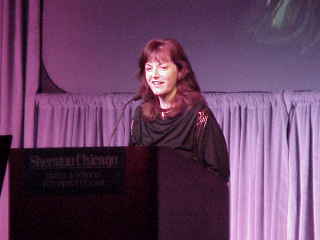
(Which I didn’t expect to win–I’d been a finalist before and hadn’t won–and my friend Kathi and I went out for a beer, instead of getting all dolled up for the awards, and I didn’t know beers in Chicago could come in yard glasses.  I arrived happily buzzed, in a borrowed dress, and somehow managed not to fall on my face getting up the stairs. I think I was reasonable coherent. I was more than delighted to receive the award from Jo Beverley one of my heroes.

At the RWA Awards Chicago

Better yet, the book went on to win me a publishing contract.

And I’m delighted it’s back in print.

Winning the RWA Golden Heart in Chicago

Keeping it Light – Writing Humor

Just finished the edits to get A Proper Mistress online, and it’s a delight to have a visit back with these characters. It’s a lighter romance, more what’s been called a Regency romp, though I don’t go for taking things too absurd. And that got me thinking about how touchy this sort of thing is to write, and my own guidelines for writing humor. My style is a blend of humor, a little drama, action, and I like to mix all of that up. I’ve tried to see how dark I can go, and I never can go all that dark–it almost always twists into black humor at some point. But, then, I like a little spice in almost everything. And, yes, you’re going to get a lot of cooking metaphors here–Molly Sweet, the heroine of A Proper Mistress is a delight and a cook and she always puts me into that frame of mind — which leads us to where we need to start, which is with characters.

A Proper Mistress

A Proper Mistress

Humor, in particular, needs characters who can carry the absurd. That’s harder than it sounds. I also think humor needs dialogue–great, snappy, fast dialogue. All the stuff that folks usually think needs to come out of their mouths and onto the page, and that’s going to keep the pace of any story moving and keep it fun. The other critical element is that I think the characters need to take their own situations seriously–its their lives. We may laugh, but if they do, it’s a bit like someone laughing at their own joke–kind of puts the pressure on that you should laugh, too, and that takes away the fun.

The other critical element is to know your character’s intelligence. I think writers often forget about this one, but it’s vital with humor. You need to know if a character is quick-witted, or a bit slow. You need to know how every character thinks. And you need to give them good reasons for why they are that way–there needs to be a reason why someone may be smart, but uneducated, or why someone else is smart in one fashion, but very stupid in other ways. This affects the story in major ways, and can be a great source of humor–with this, you don’t end up relying on ‘things’ being funny. Humor always works best when it comes from the characters, and the absurdity of life.

I also think you need to either build the absurd, or you need to start with it. Building the absurd is what the screwball comedies of the ’30’s do so well–they just keep stretching the absurd until its insanely silly. For a book, I like to go the other route and start with a situation that’s already heading off into crazy land.

For A Proper Mistress, I also wanted to start with twisting a cliché. This works great in any scene or story–take something that’s done to death and put a fresh spin on it.  The spin was that I’ve read way too many books in which the hero or heroine needs to get married in order to get an inheritance. This is such a worn old shoe that it squeaks. However, with the twist comes the need for motivation.

Good characters are method actors, always asking, “What’s my motivation?” Characters need reasons to do absurd things–these may be absurd reasons with faulty logic, but they should seem sensible to the characters. Which leads to the core question: what pushes a guy into trying to get disinherited?  Of course, the answer is what pushes us into most stupid things, and for me that’s a dysfunctional family.

The good part of being a writer is that all that junk in your own attic of live is useful. Creating a dysfunctional family isn’t hard for me since I had one, all my friends have one, and I actually have a hard time with normal. Everyone in A Proper Mistress is coping as well as they can, but they all have Issues–with that capital in there. The other thing about humor is that a little drama can help you ground it–it’s like having a string to a balloon.  Or to really mix the metaphors, a nice dense chocolate cake to go under the fluffy, sweet whip cream. Backstory for characters–the faulty motivations–is a great place for this grounding. And so is the character’s secret.

For me, characters start to come alive when they start keeping secrets–from others and from themselves. In A Proper Mistress, the hero both worships his older brother, but he’s also secretly a little resentful, and he doesn’t even realize it. The heroine has a secret wish to have a family (she’s an orphan). Theo’s dad has the biggest secret of all, one that’s impacted everyone’s lives, and all this is starting to sound a bit heavy. Which is where the last ingredient comes into play.

Balance in a story is as critical as the balance of spices and elements in a meal. And you want to push this balance off-center to get the emotion and effect you want. Go too far, however, and you end up with a hot mess. So with humor, you want to keep it light, fast-moving–the balance has to be more on what’s happening in the story, with only the lightest touches of heavy backstory. Molly was a godsend in A Proper Mistress. She could have ended a very tragic person–she’s had a tough life. But she’s resilient. She has no time to dwell, and is all about dealing with what’s happening now. She kept the story moving with her personality as much as anything else.

That brings us full circle and back to characters. Writing light, characters are everything. Their actions, their dialogue, their motivations, their flaws–which need to come out big time–provide all the elements for funny. Humor, for me, is about poking gently at all the flaws we carry with us–and pushing them a little bigger so those flaws stand out in the bright light of the absurd.  It’s about letting your characters go so they can surprise you and come up with their own twisted thinking. Give everyone a point of view and a plan, so that nothing ever goes right, or goes quite the way the characters think it will.

Above all else, humor needs two more things.  The first is a light hand–you need to edit, but you can also edit the funny right off the page. This means you have to treat the writing with a light touch–keep the prose clean and the plot even cleaner. If you get too fancy with technical stuff, it’s going to weigh the work down and dull the humor. The second is the courage to let your own quirks come out. Take your own flaws and put them on the page and into your characters. If you can laugh at yourself, it’ll be easier for readers to laugh at your characters and their absurd lives.

Edits and Revsions – When is Enough Enough?

Proper ConductWhen I set out to bring my books into e-format, I’d first thought I wouldn’t edit them. Then I did the first book, and I did edit. With Proper Conduct done and coming on sale now in electronic format, I’ve gone a step beyond that. I’ve revised the ending.

Now, there’s a story about JRR Tolkien, author of Lord of the Rings, that he was very late with delivering the manuscript for one of the books and someone finally showed up, boxed it up, took it from him, but as it was being carted off for publication, he called out the window that there was one more edit he needed to make. I don’t know if it’s a true story, but I suspect there’s truth in it in that we all want to correct our mistakes, and if you’ve grown up with that urge to perfectionism, you really want to go back and edit. The joy of electronic media is that we can now do so. It’s also the curse.

This doesn’t mean the book I’ve edited ends differently–the hero and heroine still get together, there still is a happy ending. However, when the book came out in print I had the restriction of paper, meaning a hard physical budget. My choices were a longer book and smaller type font, or keep it under 80,000 words, and I was already pushing that.  So I ended the book with the heroine and hero together, but I did read the reviews and I had to agree with a few of those who wanted a bit more.

Sometimes you just need that extra bit of afterglow, that emotional wrap-up that goes with the story to show that these two characters actually have done more than make that leap into love–they’re also going to be able to maintain the relationship. Sometimes you just need to show them getting along as they’re going to be getting along.

Now there are times I’m impatient with a book that drags on a bit much–none of us care for those guests who stay and stay and keep on until dawn. But there is such a thing as an end that comes too soon which leaves you wanting that extra bit more. I’m hoping I’ve erred on the side of enough without too much (or maybe it’s still not enough–it’s so hard to tell when you get that close to the work).  But there it is.  I’ve added edits, now, I’m revising myself.  And I’m already thinking about a couple of books where I wanted those extra scenes and just didn’t have the page count for it (or the time on the deadline).

But I do see the danger here, where one can revise and revise and never get to anything new. So I’m going to have to learn to balance this. For now, Proper Conduct is out on Smashwords with a fine new cover by Albert Slark, who also did the original cover, but I love the new cover.  It should also be showing up soon as well on Amazon.com for Kindle and BN.com for Nook.

I’m bringing out A Proper Mistress next, and while I don’t anticipate changes there, as I convert the book for electronic formatting, I wonder if I’ll find that I need a new scene, or an extra bit somewhere in the book.  It’s actually more fun to go back to these characters than I’d thought it would be, and now I can see why folks return to their old schools and go back to hang out at the old playground. The really interesting thing will be to find out if I have made the work better–or if I’ve just made it different.

Backlist Back for the Holidays

There is nothing quite as exciting as an adventure–also, nothing quite as uncomfortable, fraught with peril and generally the sort of thing that makes you both nervous and thrilled. Adventures also make for good story telling after the fact.  I’m still in the early stages of this new path, but seems like a good time to start sharing on what it’s like to bring out books in electronic format. And why not bring back my out-of-print books–I have the rights back and I’ve had folks asking when they could get these for electronic readers, so…let’s go.

Now, I’m not trail blazing here–lots of folks are going electronic, and there are definite advantages. But we’re not talking freeway fast path, either. We’re more like Oregon Trail–there is a trail, many folks have passed this way, and you can see the skeletons of some of them.  And we’re still in covered wagons–this is not a trip for those who aren’t stubborn as hell.

My particular trip started with getting enough info from the Novelists Inc. conference that I decided it was time to do some experiments, at the very least. My day job is web work, so you’d think my adoption factor would be high, but my books ran into the cobbler’s children syndrome–not an electronic stitch to have them shod. Time to change all that.

Under the Kissing Bough

First step–the cover.  The books are all done, so I don’t have to worry about finishing them, or edits (well, mostly not, but more on this later). I had the contact info for Albert Slark who did a couple of my covers. He gave me a great rate, and now I’ve fantastic covers coming, including one for Under the Kissing Bough (RITA nominee for Best Regency).

Second step–file conversion. My final edits were on paper, so I pulled out the books and the files to put in final edits. My initial thought was that I’d keep the books the same–they represent my writing at a certain stage of my life, and I thought that should stay the same. Then I started finding things I just did not want to allow in any new edition. There are no major edits, but I found things I wanted to be cleaner, stronger–my skills have improved as a writer, and I found I wanted the electronic edition to be as strong as I could make it.  Now I’m going to have to do that with all eight books, so this is going to take more time than I wanted.

Third  step–more file conversion. Formatting is a pain in the ass. There’s no way around that. There’s fussing with formats, and fonts, and making sure it’s going to display right on the reader. This is where that stubbornness can really help. You have to get everything ready for upload, and then you have to fuss more with the upload. This is where, on the Oregon Trail, you’re crossing the Continental Divide.  You just have to get  out and push sometimes.

Fourth step–this one is optional.  I bought ISBNs for the books–if you go this route, you need an ISBN for each version, print, electronic, etc.  This also gets the books listed in Books in Print, but it is more fussing. (I already have copyright on the books, but if you want to button everything up, you can also get a copyright on the book for not much money).

Now comes the next steps–promotion, promotion, promotion. Getting the word out in an already noisy world is always tough.  But I feel as if I’ve got my stake in the ground for some of the new promised land–I’ve cross the great divide and now must learn how to make this adventure work on a long-term basis.

I have to thank a few people who provided great info and insight, including Bob Mayer, Joe Konrath, Della Jacobs — these are all writers, so please go buy their books, too, all in convenient electronic format.

And you can now buy my RITA Nominee for Best Regency, Under the Kissing Bough, for: Amazon Kindle, Barnes & Noble Nook or for Sony readers or other formats at Smashwords…and next month, I’ll let you know how the adventure progresses. I’m pretty sure that, to paraphrase the words of Betty Davis when she played Margo Channing in All About Eve, what we all need to plan on is to, “Fasten your seatbelts. It’s gonna be a bumpy ride.”

Writing Resources

I’ve been doing a workshop on research, which led to my digging out some old notes on useful writing books.  This is the short list of the books that have taught me so very much about writing–these are the books I still have on my shelf, the ones I go back to for a refresher course. These books may speak to you, or may not, but if you find one good piece of advice and some entertainment, these will have served you well, too.

Bird by Bird, Anne Lamott — some instructions on writing and life, the perfect inspiration book

The Artist’s Way, Julia Cameron — a workshop on how to unblock any blocks

The Courage to Write, Ralph Keys — one of the best books ever written on writing

A Manual Of Writer’s Tricks, David L. Carroll — a great idea generator

Characters & Viewpoint, Orson Scott Card — How to invent, construct and animate vivid, credible characters and choose the best eyes through which to view the events of your short story or novel

Creating Characters, Dwight Swain — great advice for beginners and for experienced writers

Techniques of the Selling Writer, Dwight Swain — teaches the bones of story structure

Story, Rober McKee — get the CD, or take his workshop, the book is so dense it’s very heavy going, but there’s a tone of great story structure basics here

Write Away: One Novelist’s Approach to Fiction and the Writing Life, Elizabeth George — Fabulous book, but will be more useful for an experienced writer to take her writing to the next step

On Writing, Stephen King — simple clear advice on keeping writing simple, clear and powerful

Self-Editing for Fiction Writers, Renni Browne & Dave King–a book I still keep right beside by desk and these days every writer needs to learn how to edit her work.

How to Write Romances, Phyllis Taylor Pianka — the basics of the genre

The Art of Fiction, John Gardener — wonderful writing about writing