Archives

Things We No Longer Ask For

I love old cookbooks–they are a glimpse into a past era. They also often have great recipes. Reading Dorothy Hartley’s wonderful Food in England got me thinking about how there are certain foods and drinks we no longer ask for when dining out, such as:

Meat and fish hanging, bread, cooked eggs, glassware, parsnips, lemon, platters on a side table all in  a larder or kitchen

A joint of beef — we have all sorts of fancy cuts these days.

Johnnycakes — these are actually delicious…they are basically a cornmeal fried bread, meaning like a pancake but with more crunch. Easy to make, too.

Mutton — it is still possible to find lamb in some supermarkets, but mutton has gone completely out of fashion (no old sheep for a low cost meal).

Pig cheeks — still available in some parts of the world, and by all accounts, the best part of the pig. Also called pork cheeks, and this goes along with calf cheeks or beef cheeks, a specialty of the Café Procope, one of the oldest cafes in Paris.

cucumber or parmesan ice cream — it is difficult enough these days to find real parmesan cheese.

watercress and egg sandwiches — these can be found in some tea shops still (thankfully), but watercress can be difficult to come by in many modern supermarkets (at least in the US).

gruel — this is an unlovely name and the food has a bad rep from the Victorian era, but some recipes call for butter, brandy, and enough spices to make this a very tasty mean (it’s basically think oatmeal).

A pot of ale — while ale is still around, it usually comes in cans, bottles, or a pint or half pint. The pint pot has long ago been replaced with glass.

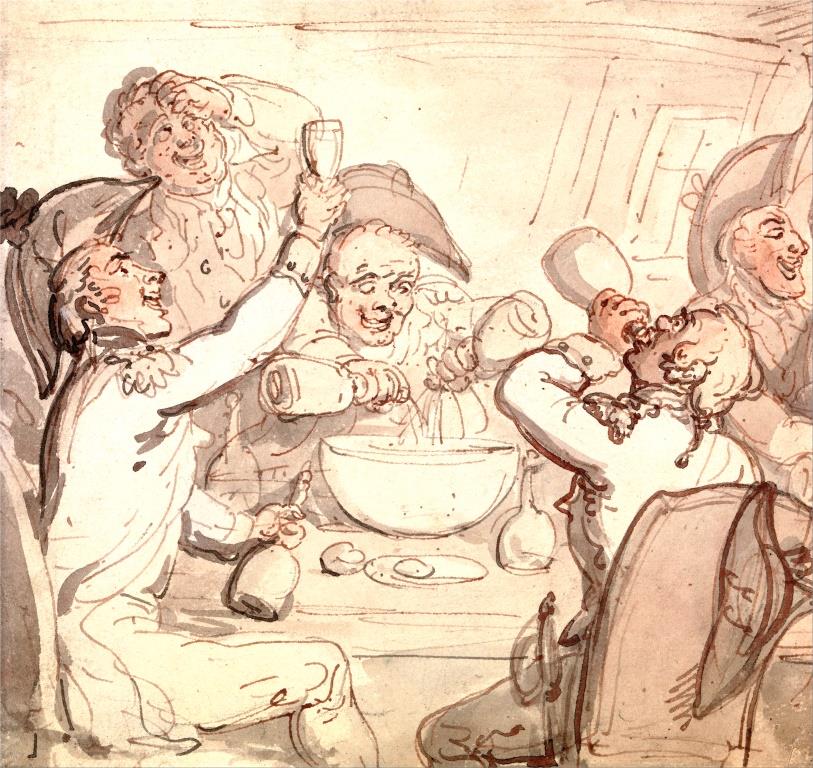
A bowl of punch — this used to be a highly alcoholic drink, but these days folks are more likely to think of punch being a fruity drink without brandy, champagne, rum, and other spirts all mixed together. The bowl is no longer with us either for dipping into with a mug or cup.

A posset — this was a hot drink made from curdled milk and sack or a sweet sherry.

A flip — another drink (more alcohol) usually made with beer, rum, eggs, and heated with a poker (not the one used to stir the fire, but a special poker used just to heat drinks).

A purl — another hot drink made with beer, gin, nutmeg, and sugar.

That is just a few things we generally must make ourselves if we want to sample something from the past (unless we find a place that also likes to keep going with what were once old favorites).

Thomas Rowlandson Naval Officers and a bowl of Punch

Lady Catherine’s Salon for Tea

There’s a quote from Shakespeare in Love (wonderful movie, with a terrific script from Marc Norman and Tom Stoppard, and Geoffrey Rush stealing scenes as usual, and as Philip Henslowe, Rush has the lines: “…, allow me to explain about the theatre business. The natural condition is one of insurmountable obstacles on the road to imminent disaster.” That, too is the writing business overall, and as Henslowe goes on to say, “Strangely enough, it all turns out well.” How? Well, that is the mystery.

And that brings me to heading over to Lady Catherine’s Salon next week.

Tea cup and cookie

I’ll be there to answer questions, and post in general about the mystery of writing–and the less mysterious bits–and talk about the research that goes into a Regency, along with talking about some of my favorite books, just doing what one does with tea–talking.

There is good reason that “scandalbroth” was a name for tea–it is the time to swap gossip and brew scandal along with the beverage. I’ll be drinking my favorite right now (Lady Gray, a variation of Earl Gray, but with less bergamot, however, I am very fond of an excellent Gunpowder if it can be hand, or a smoky Lapsang souchong).

So please feel free to join me at the salon…asking those questions you might like to ask. We’ll see what we can do about all that mystery (maybe even create a little more, for every story ought to have a little mystery).

Coffee – As Important as Tea

I’ve just finished up the Regency Food and Seasons workshop for Regency Fiction Writers, and there’s always some ephemera that doesn’t quite make it into the workshop. This one is a poster from 1840 showing coffee being grown, what the leaf and bean looked like, roasting, grinding, and serving it up.

We tend to associate tea drinking with England–thanks to the high tea that came along in the late 1800s. But coffee was just as important a beverage–perhaps even more so–in the late 1700s and early 1800s. Coffee houses became all the rage in the 1600s, and continued to be so into the Regency era in England.

Not everyone was a fan of the coffee house (they also would serve drinking chocolate, tea, and punch, and provided newspapers to read). As reported on The Gazette UK website, “On 29 December 1675, a proclamation by the king was published that forbade coffee houses to operate after 10 January 1676 (Gazette issue 1055), because ‘the Idle and Disaffected persons’ who frequent these establishment have led to ‘very evil and dangerous Effects’ and ‘malicious and scandalous reports to the defamation of His Majesties Government’.” Meaning, of course that folks were talking politics. The notice gave warning that, “after the 10th day of January ensuing, to keep any publick Coffeehouse, or to utter or sell .… any Coffee, Chocolet, Sherbett or Tea, or they will answer the contrary at their utmost Perils’. Licences were to be made void, and if continued to trade, given a forfeiture of £5 per month and then ‘the severest Punishments that may by Law be inflicted’.” Naturally, the whole thing went bust, along with a “Women’s Petition Against Coffee” which reported it made men talk too much–it was, of course, yet another political maneuver that lacked popular support.

Folks kept drinking coffee, grocers added the beans to their stock (along with tea leaves), and porcelain manufacture created lovely tea and coffee sets, some as large as 40 pieces including cups, saucers, pots and everything else needed. Silversmiths also did a good trade, such as for this coffee pot, tea pot, creamer and sugar holder from 1800 made by John Emes, with gilt interiors.

Jane Austen wrote in a letter, commenting on her brother’s habits, that, “It is rather impertinent to suggest any household care to a housekeeper, but I just venture to say that the coffee-mill will be wanted every day while Edward is at Steventon, as he always drinks coffee for breakfast.” Coffee would also be brought into the drawing room with tea after dinner, so that guests could have a choice of beverage.

All these thoughts about coffee come–not just due to my being a coffee drinker, for I also love my morning and afternoon tea–but due to a headline that, ‘Your coffee habit could be linked to healthier aging, study finds‘. Good news for those of us who love that morning coffee…and who are getting up in years.

So drink up and enjoy your coffee…and you can still fit in that afternoon tea as well–green tea, after all, is so good for you as well.

Speaking About Writing…

tbm4

I’m delighted to announce that The Beau Monde, the Regency chapter of the Romance Writers of America has asked me to be their keynote speaker at this year’s conference in July. This is not just a lovely honor–it feels to me like a continuity of writers. It’s been 25 years since The Beau Monde was started–that’s a generation. And my how the world has changed, particularly for writers. I think that’s actually one of the attractions to Regency England–it’s a world that is safely in the past, with all the changes done and over with, and a much easier world to navigate in many ways. (Of course, you still have wars, and you have a lack of penicillin, other bad medical care, and not much in the way of rights for women or anyone else other than a rich, white male, oh, and let’s not forget the desperately poor along with some other problems–but let’s not dwell on the negative.)

One of the advantages of writing about the good stuff in the Regency is that it is possible to provide an escape back to a world that’s a little less complicated, a whole lot slower, and a lot of style. But I’m jumping  ahead of myself–it’s off to New York (not my favorite place it the world, but I am looking forward to a cross-country drive to see a bit more of the US) for The Beau Monde conference.

In the meantime, I have a Regency romance novella to finish up!

Giving Critiques

sleepyrideIt’s sometimes as hard to give another writer the truth about the work as it is to take it. Let’s face it, we all love our own babies. Even if they are ugly squalling brats, we want to see the good side. The trouble is, if you don’t go looking for the faults you can’t fix ’em. Or to mix up the metaphor–if someone’s on a mule but asks you what do you think of their horse, it’s time to tell them that’s a fine mule but he’s never going to grow up into a horse. The truth has to come out then.

But I still struggle with it.

On one hand, I want to encourage other writers–it’s great to just be getting the words on the paper and who knows what kind of cool story could result. You may love taht mule you have! On the other, I can’t really encourage someone to head on down a rocky path without at least a warning–if someone really, really wants a horse, they should find out the differences between the two animals.

The warnings I give usually goes along the lines of you can do whatever you want, however…

It’s that ‘however’ that’s the kicker. The most common issue is that the story is going to disappoint readers or leave them utterly cold. I write for readers–I want folks to have fun with my stories. Yes, I’m the first reader I need to please, but I also figure if someone’s giving my work a few hours from their life, I owe them a good story. That means likeable characters, an entertaining tale well told, and a satisfying ending. I also figure other writers feel the same, but maybe they don’t. I do not think story telling is about me being really clever–it’s about me being true to my characters. I figure that’s enough to juggle without taking on major technical challenges, or trying to tackle epic themes with major point of view changes and a vast array of characters. I’ll leave that to the more ambitious and the more talented. But don’t all try to bite off too much at some point?

I’ve got several manuscripts locked away and a few more started and abandoned–stuff that I followed down that path to heartache because I was starting out and struggling and no one warned me. I thought I was riding horses every time, but turned out some of them were even donkeys. But I have to ask–would I have kept at it if someone had shot those ideas down? I think I would have–particularly if someone pointed out an easier or better way to get to a good story. Or had taught me how to look for the flaws. But I know we all have different levels of tolerance. What one person views as a challenge, another takes as a slapdown. We all have different skin thicknesses. But, ultimately, we also all have to find our own paths–a teacher can only point out different paths.

Which leaves me having to trust that truth is truth. Yes, it may be my truth–but you really have to be honest about the work. If I’m seeing a mule, and someone asks, I have to point out that’s a mule. If something is great, it’s time to give a thumbs up. But if that baby–or that mule–is going to give someone a world of misery, you have to point out the problems and hope to heck the writer has a thick enough hide to take the input and make something even more amazing.

After all, if you start telling lies to others, soon you may start telling them to yourself, too. And no writer can afford to do that.

Shutting the World Off

SunriseEvery now and then it all becomes too much–too much information, entertainment, and way too many to-dos. That’s the time to shut off the brain. My mum used to call it ‘brain in a wheelchair day’–you can still do stuff, but the idea is to stop thinking so much. In other words, turn off the news, set aside the bills and all the analytical stuff, go for a walk, weed the garden, but do stuff that doesn’t require the brain.

Washing dishes will work. Showers are great, or long soaks in a bath tub. You can also put on a movie you’ve seen before (nothing too demanding)–but make sure it’s nothing new. Keep the media to a minimum.

Darn socks, mend rips in table clothes, or just putter around dusting (again, it can’t be too demanding a project).

Go out and watch the sky, or stay in and watch rain drops, or play with a string and a kitten. Do mindless things.

For twenty-four hours, don’t read, don’t write, don’t pick up the phone to text someone. In fact, turn off the ringer if you can. If you have to go to work, just smile, nod and agree with everything–put all the thinking off for twenty-four hours.

It’s amazingly refreshing to have one of these ‘brain-dead’ days where you just let yourself (and the world coast). Trust me, if anything major happens, you’ll hear about it. If someone really needs to get hold of you, it’ll happen. But it’s amazing just how much can be put aside for a day.

Egg-Cerpt Exchange – Tina Gayle’s Book

The Executive Wives’ Club SeriesFour women…One fatal car wreck…Everyone’s lifes changes…

Blurb for “The Unwilling Widow”:Jennifer Larson, having lost her husband, friends and the perfect life she’d had plan, now faces the biggest challenge of her life, moving into an unplanned future. While the rest of the Executive Wife Club is still wallowing in the past, Jen is tempted into the future by a sexy chiropractor, Hagan Chaney.But does he really love her or is he only after her money like everyone else?Excerpt:Friday night sitting at a booth in a nice, romantic restaurant, Jen silently wished she could enjoy the subdued atmosphere, and order a rib eye steak. Instead, her hands shook and her stomach churned with doubt. The survival skills, she’d learned after becoming a real estate agent demanded a calm composed front, but she couldn’t pull it off.

Hell, who was she fooling?

After ten years without a date, what made her believe she could do this again? She stared at the menu. Could she even swallow a bite of beef? And if not, what should she order?

She lifted her gaze to the drop-dead gorgeous man on the other side of the table. Hagan Cheney, a Greek god incarnated, had strawberry blonde hair glowing like gold around his head. Wide shoulders and strong arms encased in a hunter-green cashmere sweater. Apollo, himself, wouldn’t look any better.

Why in heavens name did he ask her on a date?

And why did she care?

She had no plans other than a casual dinner for two.

He glanced up and a pretty-boy grin crossed his lips. The twinkle in his hazel eyes softened the square line of his jaw. “So have you decided what you want?”

Heat simmered low in her belly. Oh, yeah, answering that question the wrong way could get her into a world of trouble.
Find out more on

Tina’s Book Page
Visit Tina at
www.tinagayle.net

www.tinagayle.blogspot.com

The Balancing Act

Adobe Walls Going UpWe’re building a house–it’s a passive solar adobe straw bale hybrid, meaning we’re inventing some things as we go and learning a lot. And we’re working damn hard. As in laying actual adobe bricks. Which also means my life’s out of balance. Again. This happens with obsessive-compulsive types, but I can’t moan too much about being that type since it also helps with the writing. But…a little more balance is needed. As in I need to carve out my writing time again.

I was doing great with this. Up an hour or so early. Get my coffee, sit down and write. Even a few pages is great, and I could often do five or ten before the day got cooking. Then it got cold. And dark. A warm bed is now too much of an invitation to lounge. It’s not going to get warm again for more than a few months–meaning I need to adjust my schedule, or I’m going to have to bite the bullet and get out of bed. Since the latter is not too likely, I’m going to try other things. Such as making sure I have my priorities sorted out. And pulling out the pages to mess with them every day, even if it’s only for a few minutes here and there.

It’s all part of the balancing act–one I have to go through every few months (or sometimes every few weeks). Get enough sleep, enough food, enough solitude–too much company and my brain gets too busy.  A little bit of “bored” time is a good thing. So is a little bit of daydreaming time. But there always seems to be other things making demands on my time. Which is when I have to remember what’s important. And, yes, house done before winter would be a very, very good thing — warm place to write…mmmmmm. But I’ve got a book that’s begging to be finished. For a writer, you’ve got to write.

Twelve Steps to a Digital Format

There’s lots of information out there about eBook format. But in converting my print books, I’ve streamlined this to a simple twelve steps. You can get fancier if you know what you’re doing. My choice is go to for a clean format. So, here’s the twelve easy steps.

Twelve Steps to a Digital Format

STEP 1 – Put your book into a single file in Microsoft Word. I had my chapters split into multiple files, so the first step was a lot of cut and paste. I did have electronic versions of my work, but not the same ones as in print. This meant either scanning the books or manually inputting my edits. I went with the latter and made this part of my editing process.

Other ways you can do this might include a search the Internet to see if someone’s done the work for you and you can grab an electronic version (yes, those pirate sites have a use). You can invest in a scanner and OCR software that converts the scanned image into text—the cost will be about $300 – $400 for a full setup. Or you can pay for a print book to electronic conversion: about two to three dollars a page to get all the work done for you. If you’re still going it on your own….

STEP 2 – With your book file open, use the SELECT function. Select ALL and set the font to Ariel or Times Roman. Electronic readers like consistency and these are about the most Web-safe fonts around. I use Times Roman for the bulk of the book, but I put the title and front copy into Ariel.

STEP 3 – Set the font to 12 or 14 point, no smaller and no larger.  I like to set the title and chapter headings to 14 point and use 12 point for everything else.

STEP 4 – Remove all TAB marks. To do this, use the REPLACE function, select MORE and SPECIAL CHARACTERS. Put the tab mark in the field to “find” and nothing in the replace area and that will remove them all.

STEP 5 – Use the REPLACE function to search and replace all double spaces with single spaces (do this a couple of times to catch all of them).

STEP 6 – Set your paragraph indents with the PARAGRAPH function. Set INDENTATION to SPECIAL, FIRST LINE, with LEFT set to .2″ or .3″ (you can go up to .5″ but I think the smaller option looks better in the electronic readers).

STEP 7 – Use the PARAGRAPH function to set spacing to single space.

STEP 8 – Remove all headers and footers—deleted them.

SEPT 9 – Remove any page breaks between chapters.

STEP 10 – Center your chapter headings and number chapters as in “Chapter One” – that’ll help to automatically generate a table of contents. Put only a single blank line space between chapter headings and the text – that’s both before and after.

STEP 11 – For breaks within a chapter, use a simple mark such as the asterisk (*) which electronic readers can handle.  Center this and put a single blank line space before and after.

STEP 12 – Put dedications and reviews up front since this is free preview content.

Your format should look something like this (without the blue text which is just here to make the book text stand out)…

Opening Page:

A PROPER MISTRESS

Shannon Donnelly

For Marsha —
may you always find the courage to choose happiness

Bookseller’s Best Finalist, Golden Quill Finalist, Orange Rose Finalist

“With its excellent characterization, polished prose, and humor, Donnelly’s latest Regency is a supremely satisfying, deftly plotted delight.” – Booklist, American Library Association, John Charles

“…delightfully offbeat romp with an engaging set of young lovers and a good cast of supporting players…highly enjoyable” — Romantic Times Top Pick – 4½ Stars

“I highly recommend A PROPER MISTRESS, and can’t wait for Ms. Donnelly’s next book….” — Five Roses – Escape To Romance, Marlene Breakfield


CHAPTER ONE

“Beauty ain’t required, but she’s got to catch the eye,” Theodore Winslow said, striding across the small salon, one hand fisted behind his back and the other gesturing in the air. “I mean, I’m supposed to be smitten. But she can’t be at all acceptable—only she can’t be too coarse, either,


A chapter break will look similar to this:

“Why, you’re hardly more than a boy yourself! Why ever do you want to go hiring a woman from this house to act as your bride?”

CHAPTER TWO

At the sight of a short, curvaceous redhead being thrust into the room, Theo started to smile. But those tempting, full lips parted and her words cut into him like a butcher’s knife. Hardly more than a boy!

And a scene break will look something like this:

“Well, you want to make sure you ain’t a trout with your mouth gapping open to be hooked by this flash gent, or any other. Remember that, or you’ll be agreeing to more than you think you will now. And just you remember, too, every woman may have her price, but every man has his limits. Most of ’em start with his purse. Now, let’s see how those dresses look. You’re going to have to be dazzlin’, ’cause it’s going to take us longer than a quarter hour to turn you out in style.”

#

By the time Sallie finished, Molly no longer recognized herself. Nell and Harriet, seeing the door open to Jane’s forsaken room, had poked their heads in—eyes sleepy and hair tumbled and still in their night wrappers. Sallie’s house kept late hours and late mornings. Sallie bustled them out, saying to Molly afterwards, “Never does to stir up jealousy, and you don’t want them thinking you’re stealing their trade.”

———————-

If you know what you’re doing, you can get fancier about the formatting. Or if you pay someone to do this for you, they can do the fancy stuff.

While this may sound like a lot of work, I found it to be not all that difficult, it just takes some time. I’m averaging two to three weeks to get a book formatted and that’s working only weekends and evenings and doing all the edits. It’s going faster the more I do this (I’m getting a process down). Basically, this requires patience and persistence, something every writer needs in buckets.

Save your file as both a standard word .DOC or .DOCX.  Also save the file as a PDF version (this will allow you to give away free PDF copies to readers, and you’ll need this format, too, if you set up an ISBN).

NOTE: Smashwords also requires specific text at the front of your book about being published at Smashwords, so you want to set up a separate file with this info:

Published by Shannon Donnelly at Smashwords.com

Copyright 2010 Shannon Donnelly

Discover other works by Shannon Donnelly at Smashwords.com


That’s it. Twelve steps. The part that really takes the work is getting the writing done in the first place.

Just Beachy

Guest blogging over at http://www.ninc.com/blog/index.php/archives/just-beachy

The sand is as dazzling white as promised, the ocean as blue, and while there is much discussion of futures and publishing and brave new digital worlds, the refrain I hear echoed time and again is, “Write a good book.”  That is the one unchanging mantra from both traditional publishers and ‘digital first’ (a new buzz word and way more sexy than e-published, which is a mouthful, but does that imply ‘print last’?). 

Write a good book.  Easy words.  Hard task.

Which, of course, is why all of us are sitting here, trying to figure out how good is good?  And what do you do next these days?  The paths are many to get a good book out there and into a reader’s hands.

Print’s still around, of course, and going to be here for a bit, and it still has more allure, despite the cool new moniker of ‘digital first’ (and I do like the name ‘the Big Six’ for the NY publishing house, but the concensus is that that number’s going to be all over the map very soon).  Anyway, print is still a way to go if you don’t want to fuss with your own covers and you do have an idea that could kick into high gear with the right marketing machine.  And it’s got that lottery ticket allure that maybe you’ll hit the best seller list.

Then we have the ‘digital first’ publishers, our modern small publishers, who still have good things to offer, and Kindle is kicking these folks into high gear and Nook looks to do more, and this will be the Christmas for e-readers.

Beyond that is the world of self-publishing, which has good points (as in pocketing the money direct), but it also has its hard work — editing and covers and cover copy are all now in the author’s hands, a double-edged sword if ever, since it’s all your fault, too, if done badly.  But there are possibilities, and the stigma, while still there, is probably going to go away as more really good books actually come out of this area.

Which brings us back to the mantra–“Write a good book.”

Self-pub, digital first, print–they all demand the same thing.  A strong story, compelling characters, writing with a certain flow and flair.  You need a story worth telling, a tale that captures the imagination, something, as Kurt Vonnegut once put it, that doesn’t waste the reader’s time.  Oh, and a fair price point doesn’t hurt, either.

It’s comforting that some things never change–like the desire to have a good story.  And it reminds me what’s really important–which is to get the words on the page, and to keep working on improving my skills at doing so.  Conferences are always fun, but not as much fun as getting the words right on the page.