Narrative is one of those flexible words. The basic meaning is the same as a story, but narrative can be use as a noun or as an adjective. it is an account of events, experiences and details. But as an adjective, narrative describes the style of the story being told. A good narrative means in part a good style in the story and style matters.
I’m teaching my workshop on showing and telling in February for Outreach International Writers, and I’ve also been reading The Paper Magician, which is a wonderful book to illustrate great narrative, which relies on really excellent telling mixed with showing. That’s right–it’s not only show your characters to the reader.
Now, too much narrative can indeed slow the pace of any story–but it is also useful to set the pace. That includes the details that make up the style. Style is partly a matter of work choice, and also how do you structure your sentences, and how do the paragraphs connect and flow. What are the modifiers you use–are they fresh and specific? Do you vary sentence structure, using shorter sentences to speed action and longer to slow the reader? What words to you choose to set the mood for not just the scene but the entire story? All these details matter.
You may not be too concerned with style when you are just trying to get words on the page and get started, but it’s something to look at as you edit and revise. The style of the story is what pulls in a reader–this is your writer’s voice.
There is a danger here–too much style can become a burden to the reader. This is where the writing gets “writerly”–the writer is drunk on words and this can trip up readers, throwing the reader out of the story. Sometimes the right word is an unusual word–sometimes the unusual word is just the writer getting in the way of the story. This is where the phrase “kill your darlings” can be helpful. It’s a lot like choosing the style of your clothes. That extra watch or scarf or colorful hat may be the right touch–or it may just be one step too far over the edge. But we are back to style. There are writers who can take things far too far and still make it work.
Narrative is all about the details. Is the sky black or inky? Or purple edged? Or pale blue-white, dotted with fluffs of gray? Those are the details that put the reader into the world, and that’s all about telling the reader those exact details. Don’t forget to layer specific details that weave into the style–the sense of smell is one of the strongest to evoke an emotion. Sounds can also act to bring in mood and emotion onto the page. We all have good and bad connotations associated with sounds. Taste and touch are also often neglected as “telling” details that help put the reader into the world. Smells can connect to a taste, bringing in a a bitter taste or a anticipating taste of something delicious. Touch puts the reader in touch with the world–the air, the weather, the heat, the chill, and all the reactions to the setting.
Again, this goes back to style. Some writers have a sparse style–the focus is more on dialogue and action and more on showing. Others have a talent with description and can weave a spell that keeps the reader going. Part of this is about the genre of the work Stories set outside the normal world tend to need more details–and often a slower pace that appeals to the reader–to bring the reader into the world. While action-based stories usually put the action first. It’s all about knowing what is your writing style, and using what you’re good at.
That all starts with being able to know how to show the character to the reader, but also knowing how to use great telling to pull the reader into the fictional world. More on that in February.
An open iron gate leads to an enchanting secret garden surrounded by ivy covered trees.
Something what sets a good story apart from a great one is the use of setting as a character. A setting is not just description of a place—it gives the reader more emotion on the page. It uses mood and vivid details to put the reader into the story. Setting is also as much about theme and motifs as anything else.
Let’s take a look at one setting, but given two very different moods and themes. Let’s put the main character into a summer garden—or, actually, two different summer gardens:
She pushed open the gate. It groaned on rusted hinges, barely yielding to her shoves. Ivy dangled low from the wall, browned and gnarled, and a willow tree in the corner sagged against the bricks as if braced for her. A wind whispered, dry and cool, brushing through the leaves as if warning the garden against her presence. Sweat trickled down her back and gathered on her brow, and the bees swarmed to her right, the buzz an angry sting of noise to break the quiet.
That’s garden one—now, same time of year, but a very different mood for this garden:
She pushed open a gate that squeaked on rusted hinges, yielding to her shoves as if grateful for someone to come at last. Ivy curled down from the wall in splashes of green against the red bricks. The willow tree in the corner stirred, the long fronds of leaves beckoning with a luxurious shade away from the heat that pressed down on her. The breeze brushed her cheeks, dusting away her sweat, bringing a sweet tease of wild roses and lavender and honeysuckle. Bees hummed through the dazzling colors at her feet, their legs heavy-bright with pollen, wobbling like drunk sailors in a welcoming port.
This summer garden has gone from a touch ominous to a lush romantic spot through word choices—this lets the reader into the world through the character’s senses. Obviously, in the first garden description, the mood is one of danger and tension. We’re going to have a theme of danger and suspense. The second garden offers a lighter mood—this is going to be a fun story, possibly with some hints in the theme of magic or romance.
That’s what description can do for a story—that’s what setting can do. Setting can anchor the reader into the world. It draws the reader into a place and time and into sensations that make the world come to life. It becomes a vivid character if the writer takes the time to develop all the characters.
All this starts with asking a simple question—what is the mood here? You can follow this up with—what would my character notice? You can overwrite—that’s always possible. But by remember mood and what is important to the story, that will tell you what you need in your setting.
Theme will also help you in that it will tell you what motifs you want to use over and over to better weave theme into your story. Perhaps your theme is about the masks we all wear to protect our inner selves, and so masks and their collection or use, or things hidden with shadows and shading will be part of the settings to bring this theme to the reader without hitting the reader over the head. Or perhaps the theme is about rebirth of self, and you want setting to move from winter to spring several times over to bring that them into the story in subtle ways. All this means the writer must pay attention to the real world and the fictional world.
When thinking about setting, bring in something more than sight. We all lean too much on the physical description of things we see, but very often it’s the aroma floating in the air or the notes of music lingering that really capture our imaginations. A touch of jasmine incense could bring in the exotic, or the sour note from an out-of-tune piano clattering adds a jarring feeling to the reader’s mood. Maybe it’s the taste of something—a spice that goes from nose to tongue. Or maybe it’s the shiver of fog on the skin. Go for the very specific detail.
When you’re editing, look at the writing to remove clichés and look for fresh modifiers—and watch those weak verbs.
Notice that in the garden above, I never write: “The garden was overgrown.” That is flat telling and robs the description of the vivid touches the reader needs to be inside that garden. “Was” becomes a weak verb in such a case. Notice the fresh modifiers—a breeze that dusts away sweat, a sting of noise. You may not come up with these in the first draft, so as you edit, look for fresh ways to convey the mood you want the reader to get from that scene.
By vivid, I mean VERY specific. If you don’t have the specific in mind, go hunting in your experiences or in your imagination.
Never been to the Redwoods, but need them in the story? It’s time to get a really good travel guide, or watch a very detailed documentary. Do the same for any profession you might give a character, or for that character’s background. This is the truth in the phrase “write what you know.”
Whenever you can, pull from where you have been and use your own experiences to give you that perfect smell, that right feeling on your skin, the sounds you heard, and the taste in your mouth. A vivid imagination can help, but so can stepping outside—close your eyes and put your other senses to work. What birds do you hear? What about traffic, or the lack of it. If you’re near the ocean, that tang of salt in your mouth will be noticeable—and perhaps that sand itching under your swimsuit as it dries. Think about what details will best realize your setting as a character and a mood, and reveal something to the reader without “telling” the reader that information.
Maybe your protagonist is an artists and the world is vivid colors—teal, azure, verdant green. Or what if your antagonist has perfect pitch and the least dissonate voice is a screech to her? Be picky about word choices, particularly when editing. In a second or third draft, that is a great time to read your work aloud and write in the margin the emotion you want, and then decide if the words pile into the correct cadence and mood.
Look for overused words. Do you repeat the same phrase too often? Is there a “pet” word you fell in love with that starts to hammer on the reader?
Remember that each new scene needs to be “set” for the reader—the reader won’t be happy if left floating in a void. It doesn’t take much—look at the paragraphs above for the garden. Four or five sentence can do the job. If you have a character in that description and that character’s viewpoint to layer in tension, the reader is going to be caught up in the moment.
Above all, take the time—don’t feel that you have to worry about “oh, it’s a slow pace with too much description.” That description allows the reader to settle into the story and the scene. If your setting is a character, that character can bring forward so many more layers to your story that it can move from just okay to a book a reader can’t put down.
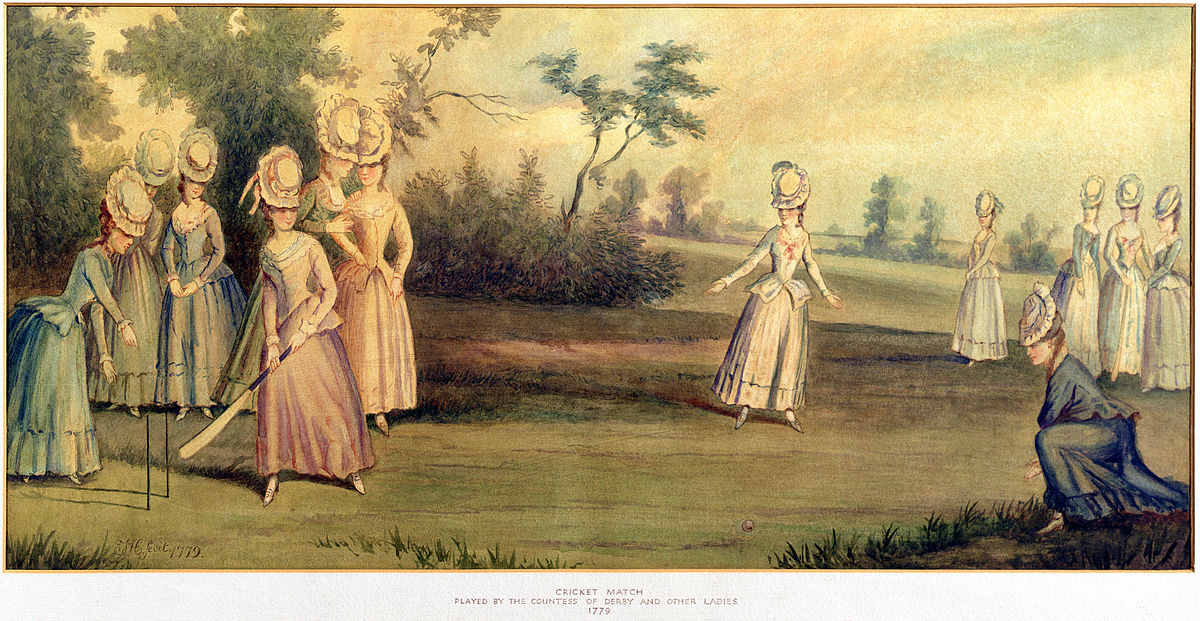
The phrase “it’s just not cricket” applies to anything that’s just not fair—such as excluding women from a good number of entertaining sports. However, cricket was one sport where ladies did play. The print of a match held in 1779 and organized by Elizabeth Smith-Stanley, eldest daughter of the 6th Duke of Hamilton, and wife of the Earl of Derby, got me started down this rabbit path.
As noted by Naomi Clifford on her website, “Women’s cricket was not unknown, the first recorded match being between Bramley and Hambleton in Surrey,” in 1775. Held at Moulsey Hurst, near West Molesey, Surrey, “there was a match between teams of six married and unmarried women, with the singletons winning. Betting was ‘great’.” (The betting note comes from The Recreative Review, or Eccentricities of Literature and Life (1822). Vol 3. London: J. Wallis. Quoting Dodsley, 1774.) She also mentions a women’s match that took place in 1811 at Ball’s Bond, near Newington Green between teams from Hampshire and Surrey
As noted in Pierce Egan’s Book of Sports, and Mirror of Life Embracing the Turf, And Mirror of Life (1836), Ann Baker was ‘the best runner and bowler’ on the Surrey side. However, Hampshire won, after which the players went to the Angel, Islington for a what was accounted to be “slap-up entertainment.”
Back to the Countess of Derby and her match. According to The Pebble in My Shoe: An Anthology of Women’s Cricket, by Roy Case, the other women in the painting include “two teams drawn entirely from upper-class society”. Miss Elizabeth Ann Burrell was said to have ‘got in more notches (meaning a run) in the first and second inning than any other Lady’ which seems to have earned her the admiration of the 8th Duke of Hamilton who married her “before the next cricket season began” according to Case.
In Women’s Sports: A History, Allen Guttman notes that women’s cricket matches were not always genteel—a match held in July, 1747 was interrupted by “crowd trouble”. Heavy betting might be involved—wasn’t it always for any game—and prizes for the winning team could range from pairs of lace gloves to money to barrels of ale.
“’On Wednesday October 3rd 1811 A Singular Cricket Match took place at Balls Pond Newington. The Players on both sides were 22 Women 11 Hampshire against 11 Surrey. The Match was made between Two Amateur Noblemen of the respective Counties for 500 Guineas a side. The Performers in the Contest were of all Ages and Sizes.’”
“The scene shows batswomen running hard, while one of the field leaps to attempt a high catch; the wicket-keeper crouches behind the wicket, hands on knees. The players have petticoats kilted above the knee, bare heads, necks, and arms; they wear flat slippers. All the fielders look or run towards the ball; one has fallen with great display of leg; another, running headlong, trips over a dog. Eleven are playing, including those batting.”
It does make sense that girls would grow up knowing how to play cricket. After all, if you need 11 players to make a full team, you’d want to draft every player around, regardless of age and sex (and yes, it is recorded that some women played into their 60s). Even for a less official team, the girls might well need to be drafted to play so there’d be enough for a batter and a bowler, and don’t forget the wicketkeeper, the slip, and all the fielding positions.
Back to the countess—she was a bit of a rebel for her era. By 1778, rumors were already going around of her affair with “the most notorious rake of the day” (to quote Alan Crosby’s book Stanley, Edward Smith, twelfth earl of Derby). That man was John Sackville, the Duke of Dorset, and the story went that he would disguise himself as a gardener at Knowsley Hall and climb into the window to visit the countess. That story is generally discounted, but what is true is that Elizabeth separated from her husband, and that was one scandal too many. She had to move abroad, and didn’t return until her husband kicked up a worse scandal by taking up with an actress.
Cricket remained cricket, however, and official women’s clubs would sprint up in later Victorian years.
Descriptions and narrative can be a wonderful tool for a writer. It is often overlooked by beginning writers—or those still learning their craft—in favor of going for scene after scene after scene. We’re all influenced by both the fast pace of modern life and the fast pace of movies and TV, but stories in print have advantages that the screen lacks. What can great description do for your stories?
Set the World—Vivid, specific descriptions put the reader into the world you build. While you may be able to assume much if you’re writing in the modern world, you may still have unique places you want to bring to life. Don’t assume the reader knows what your fictional seaside small town looks like, or what the big city feels like—you may have readers who have never been and want to be transported. In a historical or fantasy setting, you have to build the world for the reader, and you don’t just want the reader to “see” the world, but to experience the sounds, the smells, to feel the weather, to have the touch of the wind on their skin and all of this takes vivid details. You want to layer in sensations for the characters, so they become the stand-in for the reader in that world.
Reveal Your Characters—What a character notices tells the reader a lot about that character. Is your main character a baker, and smells really matter? Does your character have an artistic bent and colors stand out right away? Is your character someone who pays a lot of attention to sounds, or to the clothes of others, or to cars, or to the status of others? Figure that out and weave that in. Maybe your main character is a little bit of a snob and the frayed cuff of a coat sleeve stands out. Or maybe your main character notices the laugh lines around a woman’s face before she sees the diamond and sapphire necklace around that woman’s neck. Again, vivid specific details matter the most. You don’t want to overwhelm the reader, but you want the right description to pull the reader into your character’s thoughts.
Control Pacing—A story can move too fast. If the reader doesn’t care about the characters, the action just becomes action without any emotional stake in the outcome. The reader also can use a breather between too much action—you can wear a reader out if it’s just one thing after another with no relief. Descriptions can help you slow the pace as much as you need by bringing in a change of scene where descriptions matter to put the reader into a time and place. It can help you slow the pace between scenes to give the main character time to regroup and make new plans. It can also help you weave in backstory.
Set the Mood—A great story has a theme and it has a tone or mood. Descriptions are a huge part of this, ranging from the storm battered coast with a leaden sky and a crumbling castle outlined in a brief flash of lightning to the rolling, endless prairie grass dancing in a breeze scented by a cascade of wildflowers that dot the landscape, to the crowded streets of a city with gleaming skyscrapers and the rush of buses and taxies and the blare of sirens in the background. The details you weave in can set an ominous mood or a romantic one, or can increase tension or layer in the details that make the reader want to cozy up on the couch with a tea and dive into your world. We are back again to needing vivid specific detail. If you don’t know your world you must invent or you must research so that you can bring this world to life. You need to know not just the sights, but the sounds, the aromas, the feel of the place.
Is a Vital Part of Voice—A writer’s voice is one of the most powerful tools to hook a reader into wanting more of your stories. You have to discover your voice and develop it—writing is a craft to learn, and then can become an art to practice. Is your voice best suited to sly comedy or to tense drama? Look at your bookshelf for what attracts you most. Do you have a voice better suited to the modern world or to a historical era? Is your voice best for the old west or for a pirate’s adventure on the high seas? Every writer has to figure this out, and then use description as part of that voice. This is how you phrase things, how you view the world, how your characters view the world. Do not be afraid if your voice works better with omniscient viewpoint instead of third person, or go for first person if that’s the voice where you feel comfortable. Beware following trends—if a voice isn’t right for you that story’s not going to work.
Description takes all your skill as a writer to make the writing disappear for the reader, to bring the reader into your fictional world and show the reader this world through your characters’ eyes and through the vivid details that you weave into your story. You have to choose the right descriptions for the place and time—not just the era, but the month, the week, the day, the hour. Vivid, specific description—not just yellow, but vibrant lemon—make the world come to life for the reader, and that’s one step closer to making your characters come to life.
Shopping. Parties. Fashion. Frivolity and pleasurable pastimes. Much of Regency fiction presents ladies indulging in such a life. But a married woman also had responsibilities–and the greater the household under her care, the greater her duties.
Maria Rundell in her book Domestic Cookery (1814 edition) recommends that the most important aspect of a girl’s education is the addition and subtraction of numbers. Without these, she cannot possibly keep the household finances, account for purchases by the staff, and budget her expenses. She also holds that March’s Family Book-keeper “is a very useful work, and saves much trouble in the various articles of expense–being printed with a column for every day of the year so that at one view the amount of expenditure on each, and the total sum, may be known.”
If married to a lord with multiple properties, a lady might be expected to manage all his estate households. She would be assisted by housekeepers, but it would fall to her to review accounts and hire the household servants, for while her lord might be concerned with properties, society dictated that the house was a lady’s domain.
The English class system extended not just through the upper ranks, but well into lower orders, which had its own complications of hierarchy. In the country, an estate needed the following, in order of their own precedent:
A land steward to manage the estate, collect rents, and settle disputes between tenants. His salary would be variable, based on his experience and his tasks—the land steward to a great estate such as a dukedom would have a handsome salary, even up to five hundred pounds a year.
A house steward or housekeeper to supervise indoor staff for two hundred pounds a year, and some houses might have both a house steward and a housekeeper who served under him.
A valet for the master of the house, and a lady’s maid for the lady of the house, whose wages might be anything from twenty to two hundred pounds a year, depending on if they were in demand in London, or stuck in the countryside without opportunity.
A master of horse or stable clerk to supervise the stables, including livery servants who worked outdoors, coachmen, and stable lads, for around sixty pounds a year in salary.
A butler, a cook, a head gardener, who earned twenty to forty pounds a year each. The house might also include a wine-butler, and also a porter or major domino who supervised the comings and goings at the house, and a groom of chambers, who looked after the furniture in the house.
In the lower male ranks came other coachmen, footmen, running footmen, grooms, under-butlers, under-coachmen, park-keepers, game-keepers, yard boys, hall boys, and footboys.
In the lower female servant ranks came nannies, chambermaids, laundry maids, dairy maids, maids-of-all-work, and scullery maids.
In town lower ranking staff might earn as much as ten to twenty pounds a year each, with men being paid more. In the country, salaries were half that or could be even less.
Between servant and master existed those creatures who might be of upper or lower class, but who did not quite fit either: the governess, tutor, and dancing master. Which is one good reason why these positions were often uncomfortable–you couldn’t be one of the servants and you weren’t quite one of the quality. (Any time you had to take a job you pretty much fell out of the ranks of the upper class.)
With such a social structure, an estate acted very much like its own village, with squabbles between servants, gossip, flirtations, jealousies, and structure. A large estate might require as many as fifty indoor servants, and twice that or more in outside labor to deal with the estate’s lawns, animals, produce, beer-making, dairy and so on. However, the world was changing.
New factories, new roads, and lower costs of transportation were making even the servant class more mobile. And keeping a good staff began to be an issue.
To hire staff, the lady of the house–or the housekeeper or house steward–might advertise in The London Times or the Morning Post. The custom of ‘Mop Fairs’ where servants might parade and find new positions also existed through the 1700’s and into the 1800’s. “Females of the domestic kind are distinguished by their aprons, vs. cooks in coloured, nursery maids in white linen and chamber and waiting maids in lawn or cambric,” writes Samuel Curwen of such a fair at Waltham Abbey in 1782. Such a fair included strolling, stalls, and full public houses, with a good bit of drinking. It was, for many servants, a holiday.
Dress very much told of a person’s status, both as in the world upstairs and below. The upper servants dressed in livery and uniforms provided by the house, while lower servants were expected to wear plain and ordinary.
The cost to hire, feed, and dress an extensive staff could be considerable. Wages tended to be higher as well in a richer house. And servants could expect to be left tips–or vails–by visiting guests. A vail might be as much as a month’s wages left by a departing houseguest, the amount determined by the status of the guest and the rank of the servant.
Coupled with the expense of a staff came its management. While on many country estates, servants came from the local lower orders and might well be born on the estate and look to live and die there, in town, servants looked for opportunities to advance. Servants in town could register with agencies, but they would need to bring with them good references.
However, as noted by a Portuguese visitor to England in 1808, “servants are not to be corrected, or even spoken to, but they immediately threaten to leave their service.'”
As with any group, problems arose. Servants gossiped, stole from the pantry, and took items to sell from a careless master’s closet, and then there was the issue of upper class males taking too great an interest in lower class females.
“If you are in a great family, and my lady’s woman, my lord may probably like you, although you are not half so handsome as his own lady.” So wrote Jonathan Swift in his “Directions to Servants” in 1745. He went on to advise any lady’s maid to make certain she is paid for “the smallest liberty.”
Maria Rundell notes that, “Instances may be found of ladies in the higher walks of life, who condescend to examine the accounts of their house steward; and by overlooking and wisely directing the expenditure of that part of their husband’s income which falls under their own inspection, avoid the inconvenience of embarrassed circumstances.”
Of course, a lazy or ignorant woman might leave all management to her housekeeper, cook, and other servants, but she did so at the risk of being cheated by her staff or by merchants. For a woman dealing with great houses, all this jotting down of expenditures could be left to a house steward, a secretary, or a housekeeper. But there were numerous stories of servants who filled their pockets by padding the household account books, writing in more than was paid to the merchants and keeping the difference. A lack of knowledge in a very large household could easily lead the family into financial difficulties. The Duchess of Devonshire, with her fashionable excesses, her addiction to gambling, and her utter lack of any financial knowledge, constantly exceeded a generous allowance, borrowed heavily from everyone, and left behind debts of around twenty thousand pounds, which had to be settled from the family estate.
On the other end of the spectrum were ladies so thrifty that they watered the wine that they served at parties, underpaid their staff, and accounted for every half-penny spent.
A woman in ’embarrassed circumstances’ might need to know how to stretch her pence for food. In the city, she could buy meat scraps rather than full roasts, but there would be no funds for luxuries such as butter. The cheapest bread would be coarse, adulterated with alum, which cost less than flour. And she might be able to afford wool for knitting gloves and scarves and undergarments and fabric to make clothes, or she might have to make do with purchasing used clothing from a street fair. Shoes would need to be bought, and tinkers paid to mend pots and sharpen knives. With the added expense of rent, anything such as costly tea would be a luxury, as would any servants or services.
In the middle class, a woman could count on more luxuries. She would have staff to do the work, and could afford beeswax candles that did not drip (or smell of beef fat), and fine milled soap. There would also be funds to pay the washer woman, the school fees for her children, buy coal and wood to heat her house, pay servant’s wages, donate money for charity, and hand out coins as tips when she visited country houses.
For any lady of a great family, launching your children into the world could be rather like managing a small corporation. It’s no wonder parents expected such investments would pay off with alliances that brought influence and money back into the family. No wonder, too, at the appeal of living quietly in the country where such demands were not made upon the purse.



 Shannon Donnelly's Fresh Ink